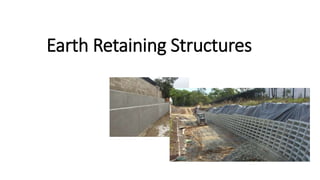
Earth Retaining Structures
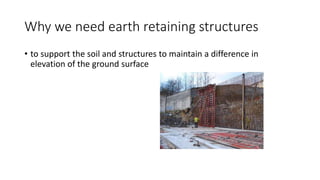
Why we need earth retaining structures
• to support the soil and structures to maintain a difference in
elevation of the ground surface
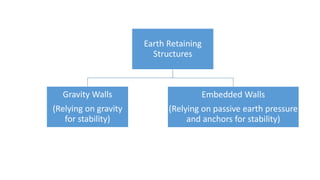
Earth Retaining
Structures
Gravity Walls
(Relying on gravity
for stability)
Embedded Walls
(Relying on passive earth pressure
and anchors for stability)
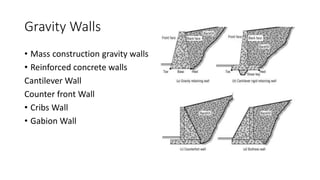
Gravity Walls
• Mass construction gravity walls
• Reinforced concrete walls
Cantilever Wall
Counter front Wall
• Cribs Wall
• Gabion Wall
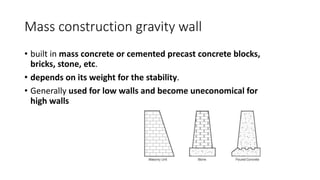
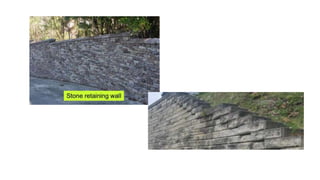
Mass construction gravity wall
• built in mass concrete or cemented precast concrete blocks,
bricks, stone, etc.
• depends on its weight for the stability.
• Generally used for low walls and become uneconomical for
high walls
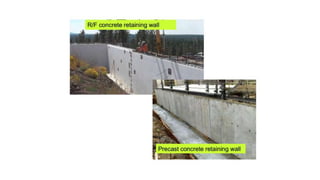
Reinforced Concrete walls
Cantilever Walls
• Has a vertical, or inclined, stem monolithic with a base
• Suitable for heights up to about 7 m
• Slenderness is possible as the
tensile stresses within its stem
and base are resisted by steel
reinforcement
• Most common type of walls due
to economy and ease of
construction
.
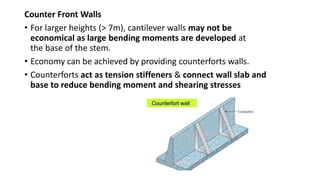
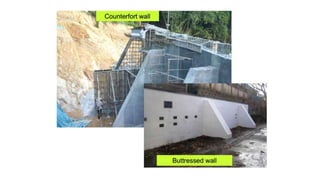
Counter Front Walls
• For larger heights (> 7m), cantilever walls may not be
economical as large bending moments are developed at
the base of the stem.
• Economy can be achieved by providing counterforts walls.
• Counterforts act as tension stiffeners & connect wall slab and
base to reduce bending moment and shearing stresses
• Can be used for heights greater than 6 m
• Counterforts space -0.6H but not less than 2.5 m due to the
construction considerations.
• The footer, counterfort and retaining wall should be tied to
one another with steel r/f
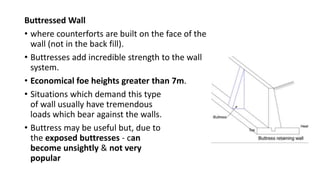
Buttressed Wall
• where counterforts are built on the face of the
wall (not in the back fill).
• Buttresses add incredible strength to the wall
system.
• Economical foe heights greater than 7m.
• Situations which demand this type
of wall usually have tremendous
loads which bear against the walls.
• Buttress may be useful but, due to
the exposed buttresses - can
become unsightly & not very
popular
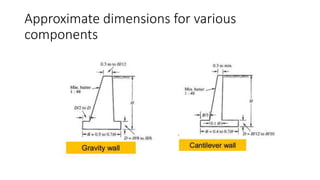
Approximate dimensions for various
components
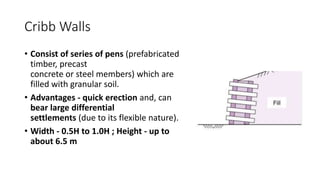
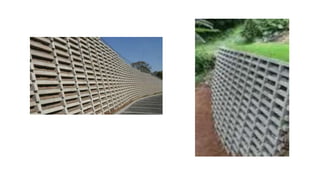
Cribb Walls
• Consist of series of pens (prefabricated
timber, precast
concrete or steel members) which are
filled with granular soil.
• Advantages - quick erection and, can
bear large differential
settlements (due to its flexible nature).
• Width - 0.5H to 1.0H ; Height - up to
about 6.5 m
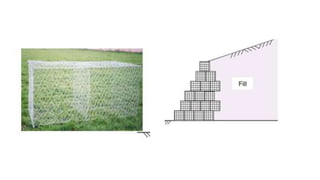
Gabion Walls
• It is a cuboid metal cages or baskets made up from a square
grid of steel fabric ( 5 mm in dia. & spacing - 75 mm)
• These baskets - 2 m long & 1 m2 in cross section
• A central diaphragm - divides it into two equal 1 m3 sections &
adds stability.
• Base - about 0.5H
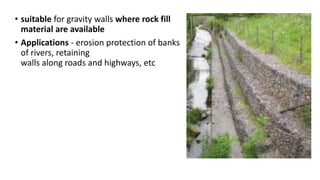
• suitable for gravity walls where rock fill
material are available
• Applications - erosion protection of banks
of rivers, retaining
walls along roads and highways, etc
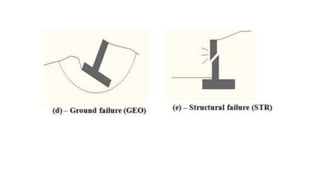
Failure modes for gravity retaining walls
1. Gravity Retaining walls
Embedded Walls
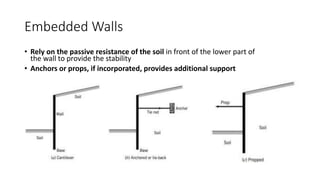
• Rely on the passive resistance of the soil in front of the lower part of
the wall to provide the stability
• Anchors or props, if incorporated, provides additional support
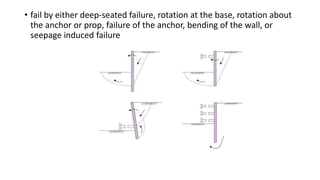
• fail by either deep-seated failure, rotation at the base, rotation about
the anchor or prop, failure of the anchor, bending of the wall, or
seepage induced failure
Sheet Pile Walls
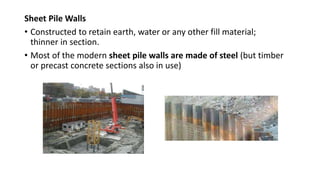
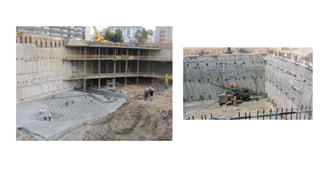
• Constructed to retain earth, water or any other fill material;
thinner in section.
• Most of the modern sheet pile walls are made of steel (but timber
or precast concrete sections also in use)
Diaphragm Walls
• Can be classed either as a reinforced concrete wall or as a sheet
pile wall .
• It consists of a vertical r/f concrete slab fixed in position in the
same manner as a sheet pile in that the lower section is held in
place by the active & passive earth pressure
Thank You !

Earth Retaining Structures.pptx

  • 1.
  • 2.
    Why we needearth retaining structures • to support the soil and structures to maintain a difference in elevation of the ground surface
  • 3.
    Earth Retaining Structures Gravity Walls (Relyingon gravity for stability) Embedded Walls (Relying on passive earth pressure and anchors for stability)
  • 4.
    Gravity Walls • Massconstruction gravity walls • Reinforced concrete walls Cantilever Wall Counter front Wall • Cribs Wall • Gabion Wall
  • 5.
    Mass construction gravitywall • built in mass concrete or cemented precast concrete blocks, bricks, stone, etc. • depends on its weight for the stability. • Generally used for low walls and become uneconomical for high walls
  • 7.
    Reinforced Concrete walls CantileverWalls • Has a vertical, or inclined, stem monolithic with a base • Suitable for heights up to about 7 m • Slenderness is possible as the tensile stresses within its stem and base are resisted by steel reinforcement • Most common type of walls due to economy and ease of construction .
  • 9.
    Counter Front Walls •For larger heights (> 7m), cantilever walls may not be economical as large bending moments are developed at the base of the stem. • Economy can be achieved by providing counterforts walls. • Counterforts act as tension stiffeners & connect wall slab and base to reduce bending moment and shearing stresses
  • 10.
    • Can beused for heights greater than 6 m • Counterforts space -0.6H but not less than 2.5 m due to the construction considerations. • The footer, counterfort and retaining wall should be tied to one another with steel r/f
  • 11.
    Buttressed Wall • wherecounterforts are built on the face of the wall (not in the back fill). • Buttresses add incredible strength to the wall system. • Economical foe heights greater than 7m. • Situations which demand this type of wall usually have tremendous loads which bear against the walls. • Buttress may be useful but, due to the exposed buttresses - can become unsightly & not very popular
  • 13.
    Approximate dimensions forvarious components
  • 15.
    Cribb Walls • Consistof series of pens (prefabricated timber, precast concrete or steel members) which are filled with granular soil. • Advantages - quick erection and, can bear large differential settlements (due to its flexible nature). • Width - 0.5H to 1.0H ; Height - up to about 6.5 m
  • 17.
    Gabion Walls • Itis a cuboid metal cages or baskets made up from a square grid of steel fabric ( 5 mm in dia. & spacing - 75 mm) • These baskets - 2 m long & 1 m2 in cross section • A central diaphragm - divides it into two equal 1 m3 sections & adds stability. • Base - about 0.5H
  • 19.
    • suitable forgravity walls where rock fill material are available • Applications - erosion protection of banks of rivers, retaining walls along roads and highways, etc
  • 20.
    Failure modes forgravity retaining walls 1. Gravity Retaining walls
  • 22.
    Embedded Walls • Relyon the passive resistance of the soil in front of the lower part of the wall to provide the stability • Anchors or props, if incorporated, provides additional support
  • 23.
    • fail byeither deep-seated failure, rotation at the base, rotation about the anchor or prop, failure of the anchor, bending of the wall, or seepage induced failure
  • 24.
    Sheet Pile Walls •Constructed to retain earth, water or any other fill material; thinner in section. • Most of the modern sheet pile walls are made of steel (but timber or precast concrete sections also in use)
  • 25.
    Diaphragm Walls • Canbe classed either as a reinforced concrete wall or as a sheet pile wall . • It consists of a vertical r/f concrete slab fixed in position in the same manner as a sheet pile in that the lower section is held in place by the active & passive earth pressure
  • 27.