Industrial Disputes Act, 1947
The objective of the Industrial Disputes Act 1947 is to secure
industrial peace and harmony by providing machinery and procedure
for the investigation and settlement of industrial disputes by
negotiations. This act deals with the retrenchment process of the
employees, procedure for layoff, procedure and rules for strikes and
lockouts of the company.
Appropriate Government [Sec. 2(a)]:
Appropriate Government means the Central Government in relation to
any industrial dispute concerning any industry carried on by or under the
authority of the Central Government, any industry carried on by a
Railway Company, any controlled industry specified by the Central
Government, The Unit Trust of India. Corporations under the Central
Statutes, Banking company, Insurance company. Mines. Oil field,
Cantonment board, Major ports, etc. In relation to any other industrial
dispute, the appropriate Government is the State Government.
Industry [Sec. 2(j)]:
Industry means any business, trade, undertaking, manufacture or calling
of employers and includes any calling, service, employment, handicraft
or industrial occupation or avocation of workmen.
Industrial Dispute [Sec. 2(k)]: means any dispute or difference
between employers and employers, or between employers and
workmen, or between workmen and workmen, which is connected with
the employment or non-employment or the terms of employment or
with the conditions of labour, of any person.
Settlement [Sec. 2(p)]: Settlement means a settlement arrived at in
the course of conciliation proceeding and includes a written
agreement between an employer and a workman arrived at otherwise
than in the course of conciliation proceeding where such agreement
has been signed by the parties thereto in such manner as may be
prescribed and a copy thereof has been sent to an officer authorised
by the Appropriate Government and the Conciliation Officer.
DISPUTE SETTLEMENT AUTHORITIES UNDER THE ACT
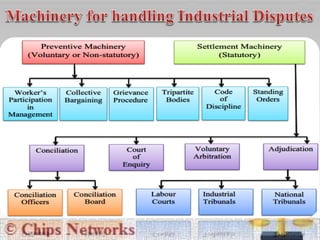
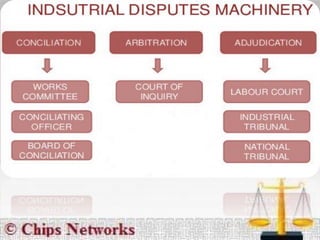
The I.D. Act provides elaborate and effective machinery for the
investigation and amicable settlement of industrial disputes by setting
up the various authorities. These are:
Works Committee;
Conciliation Officer;
Conciliation Board;
Court of Enquiry;
Labour Court;
Industrial Tribunal;
National Tribunal;
Arbitrators;
Grievances Settlement Authority.
WORKS COMMITTEE [Sec. 3]:
In the case of an industrial establishment in which 100 or more workmen
are employed, the appropriate Government may require the employer to
constitute a 'Work Committee'. It consists of equal number of
representatives of employers and workmen engaged in the establishment.
The representatives of the workmen shall be chosen from amongst the
workmen engaged in the establishment and in consultation with the
registered trade union, if any. Works committee deals with the workers
problem arising day to day in the industrial establishment.
CONCILIATION OFFICER [Sec. 4]: The appropriate Government is
empowered to appoint any number of persons, as it thinks fit, to be
conciliation officers.
The conciliation officer having duty of mediating and acts as the
mediators in between the parties to resolve the dispute.
In the case of public utility services matters like strikes and lockouts the
conciliation officer can initiate the conciliation proceeding and tries to
settle the dispute in between the parties.
CONCILIATION OFFICER [Sec. 4]:
If the conciliation officer fails to resolve the dispute between the parties,
he should report to the appropriate government.
If necessary the dispute shall be referred to the Board, Labour Court,
Tribunal or National Tribunal, by the appropriate government. [Sec 12
(5)]
Duties of conciliation officers. [Sec 12]
Hold conciliation proceedings relating to Strikes and lockouts
procedural matters of public utility services.
Investigate the matters of the disputes.
Conciliation officers shall induce the parties to come to a fair and
amicable settlement of the dispute.
Duty to send the report of settlement of dispute and memorandum of
the settlement signed by the parties to the dispute to the government
or his superior.
In case of failure of settlement of dispute in between parties, duty to
send them to the government or his superior, report of facts and
circumstances relating to the disputes and in his opinion,
a settlement could not be arrived at,
Duty to send the report to the government or his superior within 14
days from the commencement of the proceeding. or within such
shorter period as may be fixed by the appropriate Government .
CONCILIATION BOARD [Sec. 5]: as occasion arises appropriate
Government is also authorised to constitute a Board of conciliation for
promoting the settlement of an industrial dispute.
CONCILIATION BOARD
It consists of a chairman who shall be an independent person, and two or
four other members.
The members appointed shall be in equal numbers to represent the
parties to the dispute.
On the dispute being referred to the Board it is the duty of the Board to
do all things as it thinks fit for the purpose of inducing the parties to
come to fair and amicable settlement.
Duties of board. [Sec 13]
it shall be the duty of the Board to endeavor to bring about a
settlement of dispute.
Investigate the matters relating to the dispute between parties and
inducing the parties to come to a fair and amicable settlement of the
dispute.
In case of failure of settlement of dispute in between parties, duty to send
to the government the report of facts and circumstances relating to the
disputes and board opinion,
a settlement could not be arrived at,
The Board shall submit its report under this section within 2 months of
the date on which the dispute was referred to it or within such shorter
period as may be fixed by the appropriate Government.
COURT OF ENQUIRY [Sec. 6]:
s occasion arises, Government can initiate a Court of Inquiry.
This Court of Inquiry was to find out matters connected with
or relevant to an industrial dispute. Where a Court consists of
two or more members, one of them shall be appointed as the
chairman.
A Court of Inquiry looks into only matters which are referred
to it by Government and submits its report to the Government
ordinarily within certain period from the date of reference.
Industrial Tribunal [Sec. 7A]:
The appropriate Government may, by notification in the Official Gazette,
constitute one or more Industrial Tribunals for the adjudication of
industrial disputes relating to any matter, whether specified in the Second
Schedule or the Third Schedule and for performing such other functions
as may be assigned to them under this Act.
A Tribunal consists of one person only.
For appointment as the presiding officer of a Tribunal
he is, or has been, a Judge of a High Court; or
he has, for a period of not less than 3 years, been a District Judge or
an Additional District Judge;
he is or has been a Deputy Chief Labour Commissioner (Central) or
Joint Commissioner of the State Labour Department, having a degree
in law and at 7 seven years’ experience in the labour department after
having acquired degree in law including three years of experience as
Conciliation Officer:
National Tribunal [Sec. 7 (B)]: The Central Government may, by
notification in the Official Gazette, constitute one or more National
Industrial Tribunals. Its main function is the adjudication of industrial
disputes which involve questions of national importance or affecting the
interest of two or more States.
According to [Sec 10 (1-A)] dispute involves any question of national
importance or is of such a nature that industrial establishments situated in
more than one State, whether it relates to any matter specified in the
Second Schedule or the Third Schedule, the government will order in
writing refer to National Tribunal for adjudication.
ARBITRATION
Voluntary reference of disputes to arbitration. [sec. 10 (a)]
an arbitrator is appointed by the Government. Whether the dispute is
before Labour Court, or Industrial Tribunal or National Tribunal, the
parties can go to arbitration by written agreement. The arbitrators
conduct the investigation in to the dispute matters and give arbitration
award (final decision or settlement or decree) as for making reference of
an industrial dispute.
If an industrial dispute exists or is apprehended and the employer and the
workman agree to refer the dispute to an arbitration, they may refer the
dispute to an arbitration. But such reference shall be made before the
dispute has been referred under Sec. 19 to a Labour Court or Tribunal or
National Tribunal by a written agreement. The arbitrator may be
appointed singly or more than one in number. The arbitrator or arbitrators
shall investigate the dispute and submit to the appropriate Government
the arbitration award signed by the arbitrator or all the arbitrators, as the
case may be.
Industrial disputes  and settlements

Industrial disputes and settlements

  • 2.
    Industrial Disputes Act,1947 The objective of the Industrial Disputes Act 1947 is to secure industrial peace and harmony by providing machinery and procedure for the investigation and settlement of industrial disputes by negotiations. This act deals with the retrenchment process of the employees, procedure for layoff, procedure and rules for strikes and lockouts of the company.
  • 4.
    Appropriate Government [Sec.2(a)]: Appropriate Government means the Central Government in relation to any industrial dispute concerning any industry carried on by or under the authority of the Central Government, any industry carried on by a Railway Company, any controlled industry specified by the Central Government, The Unit Trust of India. Corporations under the Central Statutes, Banking company, Insurance company. Mines. Oil field, Cantonment board, Major ports, etc. In relation to any other industrial dispute, the appropriate Government is the State Government.
  • 5.
    Industry [Sec. 2(j)]: Industrymeans any business, trade, undertaking, manufacture or calling of employers and includes any calling, service, employment, handicraft or industrial occupation or avocation of workmen.
  • 6.
    Industrial Dispute [Sec.2(k)]: means any dispute or difference between employers and employers, or between employers and workmen, or between workmen and workmen, which is connected with the employment or non-employment or the terms of employment or with the conditions of labour, of any person.
  • 7.
    Settlement [Sec. 2(p)]:Settlement means a settlement arrived at in the course of conciliation proceeding and includes a written agreement between an employer and a workman arrived at otherwise than in the course of conciliation proceeding where such agreement has been signed by the parties thereto in such manner as may be prescribed and a copy thereof has been sent to an officer authorised by the Appropriate Government and the Conciliation Officer.
  • 8.
    DISPUTE SETTLEMENT AUTHORITIESUNDER THE ACT The I.D. Act provides elaborate and effective machinery for the investigation and amicable settlement of industrial disputes by setting up the various authorities. These are: Works Committee; Conciliation Officer; Conciliation Board; Court of Enquiry; Labour Court; Industrial Tribunal; National Tribunal; Arbitrators; Grievances Settlement Authority.
  • 9.
    WORKS COMMITTEE [Sec.3]: In the case of an industrial establishment in which 100 or more workmen are employed, the appropriate Government may require the employer to constitute a 'Work Committee'. It consists of equal number of representatives of employers and workmen engaged in the establishment. The representatives of the workmen shall be chosen from amongst the workmen engaged in the establishment and in consultation with the registered trade union, if any. Works committee deals with the workers problem arising day to day in the industrial establishment.
  • 10.
    CONCILIATION OFFICER [Sec.4]: The appropriate Government is empowered to appoint any number of persons, as it thinks fit, to be conciliation officers. The conciliation officer having duty of mediating and acts as the mediators in between the parties to resolve the dispute. In the case of public utility services matters like strikes and lockouts the conciliation officer can initiate the conciliation proceeding and tries to settle the dispute in between the parties.
  • 11.
    CONCILIATION OFFICER [Sec.4]: If the conciliation officer fails to resolve the dispute between the parties, he should report to the appropriate government. If necessary the dispute shall be referred to the Board, Labour Court, Tribunal or National Tribunal, by the appropriate government. [Sec 12 (5)]
  • 12.
    Duties of conciliationofficers. [Sec 12] Hold conciliation proceedings relating to Strikes and lockouts procedural matters of public utility services. Investigate the matters of the disputes. Conciliation officers shall induce the parties to come to a fair and amicable settlement of the dispute. Duty to send the report of settlement of dispute and memorandum of the settlement signed by the parties to the dispute to the government or his superior.
  • 13.
    In case offailure of settlement of dispute in between parties, duty to send them to the government or his superior, report of facts and circumstances relating to the disputes and in his opinion, a settlement could not be arrived at, Duty to send the report to the government or his superior within 14 days from the commencement of the proceeding. or within such shorter period as may be fixed by the appropriate Government .
  • 14.
    CONCILIATION BOARD [Sec.5]: as occasion arises appropriate Government is also authorised to constitute a Board of conciliation for promoting the settlement of an industrial dispute.
  • 15.
    CONCILIATION BOARD It consistsof a chairman who shall be an independent person, and two or four other members. The members appointed shall be in equal numbers to represent the parties to the dispute. On the dispute being referred to the Board it is the duty of the Board to do all things as it thinks fit for the purpose of inducing the parties to come to fair and amicable settlement.
  • 16.
    Duties of board.[Sec 13] it shall be the duty of the Board to endeavor to bring about a settlement of dispute. Investigate the matters relating to the dispute between parties and inducing the parties to come to a fair and amicable settlement of the dispute.
  • 17.
    In case offailure of settlement of dispute in between parties, duty to send to the government the report of facts and circumstances relating to the disputes and board opinion, a settlement could not be arrived at, The Board shall submit its report under this section within 2 months of the date on which the dispute was referred to it or within such shorter period as may be fixed by the appropriate Government.
  • 18.
    COURT OF ENQUIRY[Sec. 6]: s occasion arises, Government can initiate a Court of Inquiry. This Court of Inquiry was to find out matters connected with or relevant to an industrial dispute. Where a Court consists of two or more members, one of them shall be appointed as the chairman.
  • 19.
    A Court ofInquiry looks into only matters which are referred to it by Government and submits its report to the Government ordinarily within certain period from the date of reference.
  • 20.
    Industrial Tribunal [Sec.7A]: The appropriate Government may, by notification in the Official Gazette, constitute one or more Industrial Tribunals for the adjudication of industrial disputes relating to any matter, whether specified in the Second Schedule or the Third Schedule and for performing such other functions as may be assigned to them under this Act.
  • 21.
    A Tribunal consistsof one person only. For appointment as the presiding officer of a Tribunal he is, or has been, a Judge of a High Court; or he has, for a period of not less than 3 years, been a District Judge or an Additional District Judge; he is or has been a Deputy Chief Labour Commissioner (Central) or Joint Commissioner of the State Labour Department, having a degree in law and at 7 seven years’ experience in the labour department after having acquired degree in law including three years of experience as Conciliation Officer:
  • 22.
    National Tribunal [Sec.7 (B)]: The Central Government may, by notification in the Official Gazette, constitute one or more National Industrial Tribunals. Its main function is the adjudication of industrial disputes which involve questions of national importance or affecting the interest of two or more States. According to [Sec 10 (1-A)] dispute involves any question of national importance or is of such a nature that industrial establishments situated in more than one State, whether it relates to any matter specified in the Second Schedule or the Third Schedule, the government will order in writing refer to National Tribunal for adjudication.
  • 23.
    ARBITRATION Voluntary reference ofdisputes to arbitration. [sec. 10 (a)] an arbitrator is appointed by the Government. Whether the dispute is before Labour Court, or Industrial Tribunal or National Tribunal, the parties can go to arbitration by written agreement. The arbitrators conduct the investigation in to the dispute matters and give arbitration award (final decision or settlement or decree) as for making reference of an industrial dispute.
  • 24.
    If an industrialdispute exists or is apprehended and the employer and the workman agree to refer the dispute to an arbitration, they may refer the dispute to an arbitration. But such reference shall be made before the dispute has been referred under Sec. 19 to a Labour Court or Tribunal or National Tribunal by a written agreement. The arbitrator may be appointed singly or more than one in number. The arbitrator or arbitrators shall investigate the dispute and submit to the appropriate Government the arbitration award signed by the arbitrator or all the arbitrators, as the case may be.