
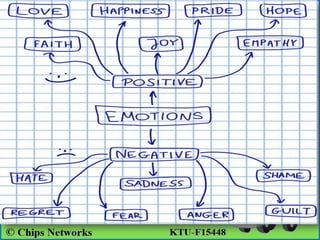


What is Emotion?
In psychology, emotion is often defined as a complex state of feeling
that results in physical and psychological changes that influence
thought and behavior.
Emotionality is associated with a range of psychological phenomena,
including temperament, personality, mood, and motivation.
Characteristics of Emotions:
Emotion is a stirred up state of the organism.
It is a specific condition of the mind.
Emotion is a feeling of pleasantness and unpleasantness.
An emotion is always aroused by a certain stimulus.
The same stimulus may arouse different emotions.
Maturation plays an important role in emotional development.
There are objective and subjective factors in the development of
emotions.
Emotion is more intense than feeling.
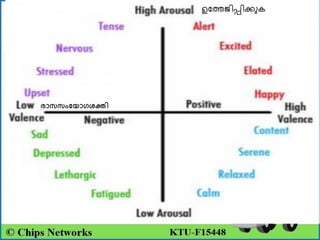
ഉത്തേജിപ്പിക്കുക
രാസസംയ ാഗശക്തി
The James-Lange Theory of Emotion
The James-Lange theory is one of the best-known examples of a
physiological theory of emotion.
Independently proposed by psychologist William James and
physiologist Carl Lange, the James-Lange theory of emotion suggests
that emotions occur as a result of physiological reactions to events
This theory suggests that when you see an external stimulus
that leads to a physiological reaction. Your emotional
reaction is dependent upon how you interpret those
physical reactions.
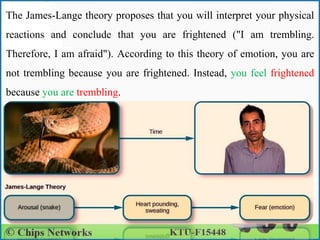
The James-Lange theory proposes that you will interpret your physical
reactions and conclude that you are frightened ("I am trembling.
Therefore, I am afraid"). According to this theory of emotion, you are
not trembling because you are frightened. Instead, you feel frightened
because you are trembling.
The Cannon-Bard Theory of Emotion
Walter Cannon disagreed with the James-Lange theory of emotion on
several different grounds.
First, he suggested, people can experience physiological reactions
linked to emotions without actually feeling those emotions.
For example, your heart beat might raise because you have been
exercising and not because you are afraid.
Cannon also suggested that emotional responses occur much
too quickly for them to be simply products of physical
states. When you encounter a danger in the environment,
you will often feel afraid before you start to experience the
physical symptoms associated with fear such as shaking
hands, rapid breathing, and a racing heart.
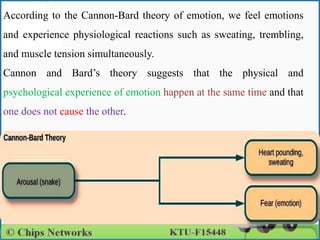
According to the Cannon-Bard theory of emotion, we feel emotions
and experience physiological reactions such as sweating, trembling,
and muscle tension simultaneously.
Cannon and Bard’s theory suggests that the physical and
psychological experience of emotion happen at the same time and that
one does not cause the other.
Schachter-Singer Theory ഷാച്ചർ-സിിംഗർ തിയറി
Also known as the two-factor theory of emotion, the Schachter-Singer
Theory is an example of a cognitive theory of emotion. This theory
suggests that the physiological arousal occurs first, and then the
individual must identify the reason for this arousal to experience and
label it as an emotion.
A stimulus leads to a physiological response that is then cognitively
interpreted and labeled which results in an emotion.
Schachter-Singer theory also suggests that similar physiological
responses can produce varying emotions.
For example, if you experience a racing heart and sweating palms during
an important mathematics exam, you will probably identify the emotion
as anxiety.
If you experience the same physical responses on a date with your
significant other, you might interpret those responses as love, affection,
or arousal.
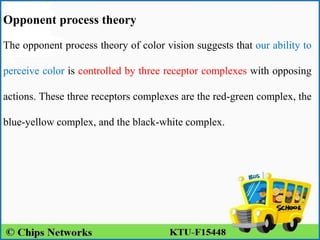
Opponent process theory
The opponent process theory of color vision suggests that our ability to
perceive color is controlled by three receptor complexes with opposing
actions. These three receptors complexes are the red-green complex, the
blue-yellow complex, and the black-white complex.
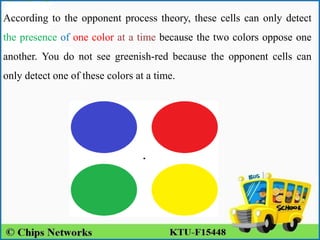
According to the opponent process theory, these cells can only detect
the presence of one color at a time because the two colors oppose one
another. You do not see greenish-red because the opponent cells can
only detect one of these colors at a time.
How the Opponent Process Works
For example, red creates a positive (or excitatory) response, while
green creates a negative (or inhibitory) response.
These responses are controlled by opponent neurons, which are
neurons that have an excitatory response to some wavelengths and an
inhibitory response to wavelengths in the opponent part of the
spectrum.
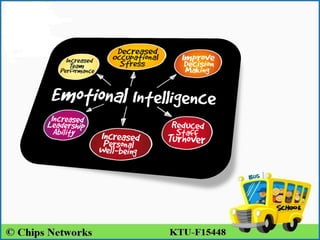
What is Emotional Intelligence?
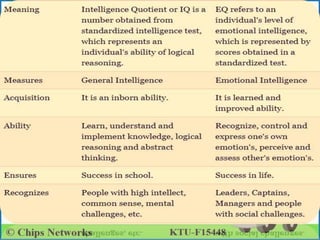
Emotional intelligence refers to the ability to identify and manage one’s
own emotions, as well as the emotions of others.
Emotional intelligence is generally said to include at least three skills:
emotional awareness, or the ability to identify and name one’s own
emotions;
the ability to harness those emotions and apply them to tasks like
thinking and problem solving; and
the ability to manage emotions, which includes both regulating one’s
own emotions when necessary and helping others to do the same.
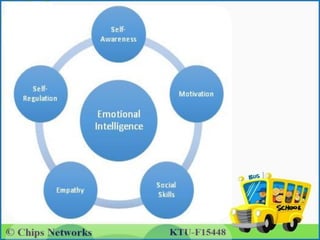
Five Components
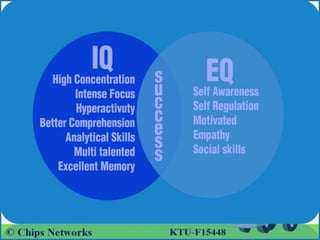
According to Daniel Goleman, there are five main elements of
emotional intelligence.
Self-Awareness
Self-Regulation
Motivation
Empathy
Social Skills
Self-Awareness
This is the ability to recognize and understand ones moods, motivations,
and abilities. Also understanding the effects they have on others.
Goleman says to achieve a state of complete self-awareness, an
individual must be able to monitor their emotional state and identify their
emotions.
Traits that prove an individual as emotionally mature include:
confidence, the ability to laugh at ones self and their mistakes, and the
awareness of how you are perceived by others.
Self-Awareness
Example: By reading the reaction of someone else, you know how you
are perceived by them. (Goleman)
Self-Regulation
This is the ability to control ones impulses, the ability to think before
you speak/react, and the ability to express yourself appropriately.
Goleman defines emotional maturity in this component as being able
to take responsibility for your actions, being able to adapt to change,
and the ability to respond appropriately to other peoples irrational
emotions or behavior.
Self-Regulation
Example: If someone is screaming at you, you know that they are not
always angry at you.
You have the ability to understand they may be angry at a particular
situation and feel they need to take it out on someone.
You do not take this personally or react angry back.
(Goleman)
Motivation
This is having an interest in learning and self-improvement. It is having
the strength to keep going when there are obstacles in life. It is setting
goals and following through with them.
Goleman would define an emotional mature individual in this category
to have traits such as having initiative and the commitment to complete
a task, and having perseverance in the face of adversity.
Motivation
Example: If a student fails a class, they see this as an opportunity to
learn and retake the class without self doubt.
They do not let failure get in the way of their goal.
(Goleman)
Empathy
This is the ability to understand other peoples emotions and reactions.
Empathy can only be achieved if self-awareness is achieved. Goleman
believes that one must be able to understand themselves before they can
understand others.
Emotional maturity in this category includes people having traits such as
perception of others, being interested in other peoples worries and
concerns, the ability to anticipate some ones emotional response to a
problem or situation, and the understanding of societies norms and why
people act the way they do.
Example: Being able to understand cope with some one else's hardships
or sadness.
When you fully understand yourself and why you feel the things you
feel, you can understand other peoples even if they are different than
you. (Goleman)
Social Skills
This is the ability to pick up on jokes, sarcasm, customer service,
maintaining friendships and relationships, and finding common ground
with others.
Goleman states that emotional maturity in this component defines
someone who has good communication skills, good time management,
the ability to be a leader or manage a group of people, and the ability to
resolve difficult situations or conflicts using negotiation or persuasion.
Example: Someone in a "boss" position usually has a good grasp on
handling all different types of personalities.
If two of their employees are having a conflict, they can find common
ground and resolve the issue in a civilized and fair manner.
(Goleman)
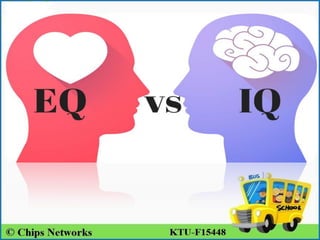
The Intelligence Quotient (IQ) acronym for Intelligence Quotient.
The IQ is a measurement of your intelligence and is expressed in a
number.
A person's IQ can be calculated by having the person take an
intelligence test. The average IQ is 100. If you achieve a score higher
than 100, you are smarter than the average person, and a lower score
means you are (somewhat) less smart.
Industrial psychology Unit 3

Industrial psychology Unit 3

  • 3.
    What is Emotion? Inpsychology, emotion is often defined as a complex state of feeling that results in physical and psychological changes that influence thought and behavior. Emotionality is associated with a range of psychological phenomena, including temperament, personality, mood, and motivation.
  • 5.
    Characteristics of Emotions: Emotionis a stirred up state of the organism. It is a specific condition of the mind. Emotion is a feeling of pleasantness and unpleasantness. An emotion is always aroused by a certain stimulus. The same stimulus may arouse different emotions. Maturation plays an important role in emotional development. There are objective and subjective factors in the development of emotions. Emotion is more intense than feeling.
  • 6.
  • 7.
    The James-Lange Theoryof Emotion The James-Lange theory is one of the best-known examples of a physiological theory of emotion. Independently proposed by psychologist William James and physiologist Carl Lange, the James-Lange theory of emotion suggests that emotions occur as a result of physiological reactions to events
  • 8.
    This theory suggeststhat when you see an external stimulus that leads to a physiological reaction. Your emotional reaction is dependent upon how you interpret those physical reactions.
  • 9.
    The James-Lange theoryproposes that you will interpret your physical reactions and conclude that you are frightened ("I am trembling. Therefore, I am afraid"). According to this theory of emotion, you are not trembling because you are frightened. Instead, you feel frightened because you are trembling.
  • 10.
    The Cannon-Bard Theoryof Emotion Walter Cannon disagreed with the James-Lange theory of emotion on several different grounds. First, he suggested, people can experience physiological reactions linked to emotions without actually feeling those emotions. For example, your heart beat might raise because you have been exercising and not because you are afraid.
  • 11.
    Cannon also suggestedthat emotional responses occur much too quickly for them to be simply products of physical states. When you encounter a danger in the environment, you will often feel afraid before you start to experience the physical symptoms associated with fear such as shaking hands, rapid breathing, and a racing heart.
  • 12.
    According to theCannon-Bard theory of emotion, we feel emotions and experience physiological reactions such as sweating, trembling, and muscle tension simultaneously. Cannon and Bard’s theory suggests that the physical and psychological experience of emotion happen at the same time and that one does not cause the other.
  • 13.
    Schachter-Singer Theory ഷാച്ചർ-സിിംഗർതിയറി Also known as the two-factor theory of emotion, the Schachter-Singer Theory is an example of a cognitive theory of emotion. This theory suggests that the physiological arousal occurs first, and then the individual must identify the reason for this arousal to experience and label it as an emotion. A stimulus leads to a physiological response that is then cognitively interpreted and labeled which results in an emotion.
  • 14.
    Schachter-Singer theory alsosuggests that similar physiological responses can produce varying emotions. For example, if you experience a racing heart and sweating palms during an important mathematics exam, you will probably identify the emotion as anxiety. If you experience the same physical responses on a date with your significant other, you might interpret those responses as love, affection, or arousal.
  • 15.
    Opponent process theory Theopponent process theory of color vision suggests that our ability to perceive color is controlled by three receptor complexes with opposing actions. These three receptors complexes are the red-green complex, the blue-yellow complex, and the black-white complex.
  • 16.
    According to theopponent process theory, these cells can only detect the presence of one color at a time because the two colors oppose one another. You do not see greenish-red because the opponent cells can only detect one of these colors at a time.
  • 17.
    How the OpponentProcess Works For example, red creates a positive (or excitatory) response, while green creates a negative (or inhibitory) response. These responses are controlled by opponent neurons, which are neurons that have an excitatory response to some wavelengths and an inhibitory response to wavelengths in the opponent part of the spectrum.
  • 19.
    What is EmotionalIntelligence? Emotional intelligence refers to the ability to identify and manage one’s own emotions, as well as the emotions of others. Emotional intelligence is generally said to include at least three skills: emotional awareness, or the ability to identify and name one’s own emotions; the ability to harness those emotions and apply them to tasks like thinking and problem solving; and the ability to manage emotions, which includes both regulating one’s own emotions when necessary and helping others to do the same.
  • 20.
    Five Components According toDaniel Goleman, there are five main elements of emotional intelligence. Self-Awareness Self-Regulation Motivation Empathy Social Skills
  • 22.
    Self-Awareness This is theability to recognize and understand ones moods, motivations, and abilities. Also understanding the effects they have on others. Goleman says to achieve a state of complete self-awareness, an individual must be able to monitor their emotional state and identify their emotions. Traits that prove an individual as emotionally mature include: confidence, the ability to laugh at ones self and their mistakes, and the awareness of how you are perceived by others.
  • 23.
    Self-Awareness Example: By readingthe reaction of someone else, you know how you are perceived by them. (Goleman)
  • 24.
    Self-Regulation This is theability to control ones impulses, the ability to think before you speak/react, and the ability to express yourself appropriately. Goleman defines emotional maturity in this component as being able to take responsibility for your actions, being able to adapt to change, and the ability to respond appropriately to other peoples irrational emotions or behavior.
  • 25.
    Self-Regulation Example: If someoneis screaming at you, you know that they are not always angry at you. You have the ability to understand they may be angry at a particular situation and feel they need to take it out on someone. You do not take this personally or react angry back. (Goleman)
  • 26.
    Motivation This is havingan interest in learning and self-improvement. It is having the strength to keep going when there are obstacles in life. It is setting goals and following through with them. Goleman would define an emotional mature individual in this category to have traits such as having initiative and the commitment to complete a task, and having perseverance in the face of adversity.
  • 27.
    Motivation Example: If astudent fails a class, they see this as an opportunity to learn and retake the class without self doubt. They do not let failure get in the way of their goal. (Goleman)
  • 28.
    Empathy This is theability to understand other peoples emotions and reactions. Empathy can only be achieved if self-awareness is achieved. Goleman believes that one must be able to understand themselves before they can understand others. Emotional maturity in this category includes people having traits such as perception of others, being interested in other peoples worries and concerns, the ability to anticipate some ones emotional response to a problem or situation, and the understanding of societies norms and why people act the way they do.
  • 29.
    Example: Being ableto understand cope with some one else's hardships or sadness. When you fully understand yourself and why you feel the things you feel, you can understand other peoples even if they are different than you. (Goleman)
  • 30.
    Social Skills This isthe ability to pick up on jokes, sarcasm, customer service, maintaining friendships and relationships, and finding common ground with others. Goleman states that emotional maturity in this component defines someone who has good communication skills, good time management, the ability to be a leader or manage a group of people, and the ability to resolve difficult situations or conflicts using negotiation or persuasion.
  • 31.
    Example: Someone ina "boss" position usually has a good grasp on handling all different types of personalities. If two of their employees are having a conflict, they can find common ground and resolve the issue in a civilized and fair manner. (Goleman)
  • 32.
    The Intelligence Quotient(IQ) acronym for Intelligence Quotient. The IQ is a measurement of your intelligence and is expressed in a number. A person's IQ can be calculated by having the person take an intelligence test. The average IQ is 100. If you achieve a score higher than 100, you are smarter than the average person, and a lower score means you are (somewhat) less smart.