Types of
Instructional Software
Dr. Alaa Sadik
Sultan Qaboos University, Oman
www.alaasadik.net
alaasadik@gmail.com
Instructional Software: A Taxonomy
1. Applications
2. Drill-and-Practice
3. Tutorials
4. Simulation
5. Instructional Games
6. Problem-Solving
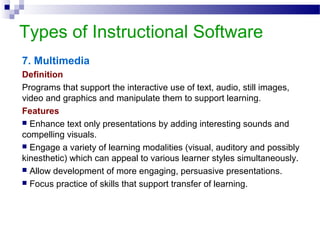
7. Multimedia
8. Teacher Utilities
Types of Instructional Software
1. Applications
Definition
A group of applications programs that is designed to automate
general-purpose and specific tasks such as word processing,
database management, spreadsheet, attendance, accounting, grade
reporting, scheduling and others.
Features
 acquire knowledge and insight about content and processes.
 enhance problem-solving and thinking skills.
 enhance students’ technical skills.
 enhance student’s personal productivity.
Types of Instructional Software
Example
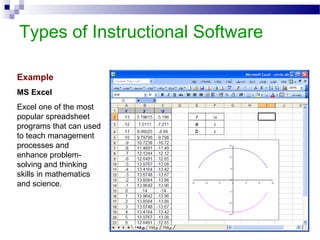
MS Excel
Excel one of the most
popular spreadsheet
programs that can used
to teach management
processes and
enhance problem-
solving and thinking
skills in mathematics
and science.
Types of Instructional Software
2. Drill and Practice
Definition
Drill and practice software provides exercises in which students work
example items one at a time and receive feedback on their
correctness.
Features
 Reinforce instruction by providing the repetition necessary to move
acquired skills and concepts into long-term memory.
 Capture and retain the attention of students.
 Save teachers’ time and efforts.
 Personalize instruction by meeting individual differences among
learners.
Types of Instructional Software
Example
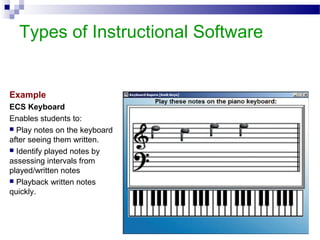
ECS Keyboard
Enables students to:
 Play notes on the keyboard
after seeing them written.
 Identify played notes by
assessing intervals from
played/written notes
 Playback written notes
quickly.
Types of Instructional Software
Example
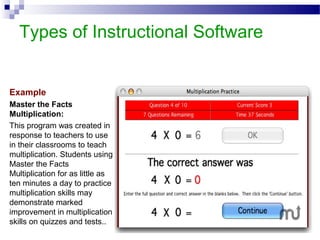
Master the Facts
Multiplication:
This program was created in
response to teachers to use
in their classrooms to teach
multiplication. Students using
Master the Facts
Multiplication for as little as
ten minutes a day to practice
multiplication skills may
demonstrate marked
improvement in multiplication
skills on quizzes and tests..
Types of Instructional Software
3. Tutorials
Definition
A tutorial exposes the learner to material that is believed not to have
been previously taught or learned. A tutorial often includes pre-test,
post test and drill and practice activities.
Features
 Follow linear programmed instruction or branching design.
 Encourage students to interact, control and response to the
program.
 Guide the learner throughout learning from the beginning
(objectives) to the end (evaluation).
 Have computer-management capabilities (e.g. data collection).
Types of Instructional Software
Example
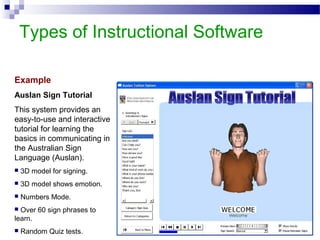
Auslan Sign Tutorial
This system provides an
easy-to-use and interactive
tutorial for learning the
basics in communicating in
the Australian Sign
Language (Auslan).
 3D model for signing.
 3D model shows emotion.
 Numbers Mode.
 Over 60 sign phrases to
learn.
 Random Quiz tests.
Types of Instructional Software
Example
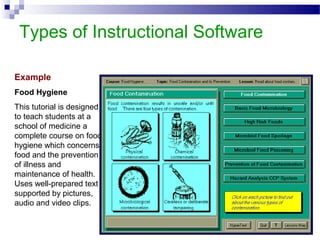
Food Hygiene
This tutorial is designed
to teach students at a
school of medicine a
complete course on food
hygiene which concerns
food and the prevention
of illness and
maintenance of health.
Uses well-prepared text
supported by pictures,
audio and video clips.
Types of Instructional Software
4. Simulations
Definition
A simulation is a computerized model of real or imagined system
designed to teach how a system works and allows learners to create
their own sequence for using simulation.
Features
 Involve students into learning process.
 Compress time or slow down processes.
 Save money and resources.
 Make experimentation safe.
 Make impossible situations possible and controllable.
 Let student repeat events as many times as they want.
Types of Instructional Software
Example
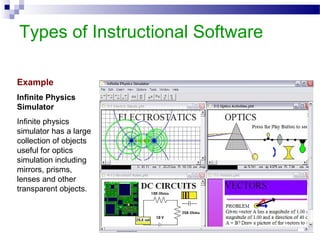
Infinite Physics
Simulator
Infinite physics
simulator has a large
collection of objects
useful for optics
simulation including
mirrors, prisms,
lenses and other
transparent objects.
Types of Instructional Software
Example
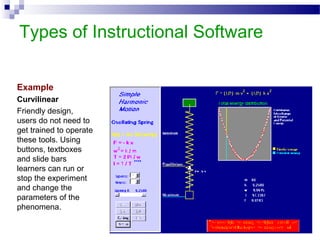
Curvilinear
Friendly design,
users do not need to
get trained to operate
these tools. Using
buttons, textboxes
and slide bars
learners can run or
stop the experiment
and change the
parameters of the
phenomena.
Types of Instructional Software
5. Instructional Games
Definition
Instructional games are courseware designed to motivate learning by
adding game rules to learning activities.
Features
 Make learning fun and motivating (Edutainment).
 Motivate learners via the challenge of competition.
 Engage the learner in a situation where the learner is competing for
a high score.
 Include elements of adventure and uncertainty.
 Provide different levels of complexity that match player’s ability.
Types of Instructional Software
Example
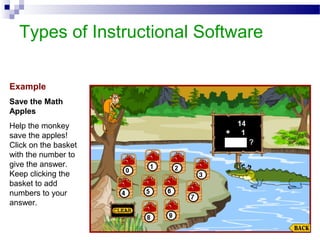
Save the Math
Apples
Help the monkey
save the apples!
Click on the basket
with the number to
give the answer.
Keep clicking the
basket to add
numbers to your
answer.
Types of Instructional Software
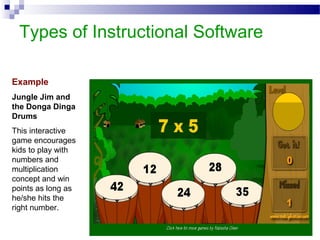
Example
Jungle Jim and
the Donga Dinga
Drums
This interactive
game encourages
kids to play with
numbers and
multiplication
concept and win
points as long as
he/she hits the
right number.
Types of Instructional Software
6. Problem-Solving
Definition
Problem-solving software is a type of content-free or content-based
programs that places emphasis on critical thinking, analysis, logic and
reasoning via the presentation of set of data or problematic event.
Features
 Stress thinking processes rather than correct answers.
 Expose students to a series of activities that would help teach the
desired skills.
 Help students work together in small teams.
 Give students opportunities to see how information applies to actual
problems.
 Vary the amount of direction and assistance depending on the each
student’s needs.
Types of Instructional Software
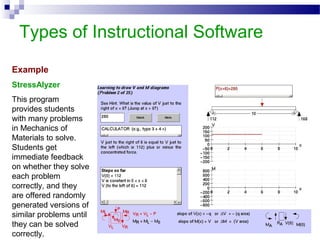
Example
StressAlyzer
This program
provides students
with many problems
in Mechanics of
Materials to solve.
Students get
immediate feedback
on whether they solve
each problem
correctly, and they
are offered randomly
generated versions of
similar problems until
they can be solved
correctly.
Types of Instructional Software
Example
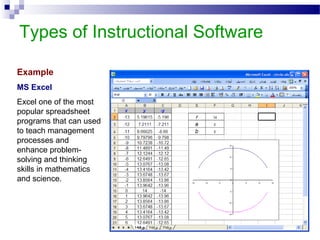
MS Excel
Excel one of the most
popular spreadsheet
programs that can used
to teach management
processes and
enhance problem-
solving and thinking
skills in mathematics
and science.
Types of Instructional Software
7. Multimedia
Definition
Programs that support the interactive use of text, audio, still images,
video and graphics and manipulate them to support learning.
Features
 Enhance text only presentations by adding interesting sounds and
compelling visuals.
 Engage a variety of learning modalities (visual, auditory and possibly
kinesthetic) which can appeal to various learner styles simultaneously.
 Allow development of more engaging, persuasive presentations.
 Focus practice of skills that support transfer of learning.
Types of Instructional Software
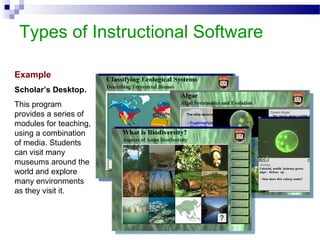
Example
Scholar’s Desktop.
This program
provides a series of
modules for teaching,
using a combination
of media. Students
can visit many
museums around the
world and explore
many environments
as they visit it.
Types of Instructional Software
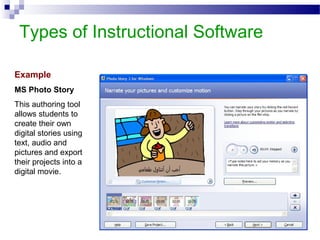
Example
MS Photo Story
This authoring tool
allows students to
create their own
digital stories using
text, audio and
pictures and export
their projects into a
digital movie.
Types of Instructional Software
8. Teacher Utilities
Definition
Non-instructional or administrative programs used to prepare
instructional materials or organize, store, evaluate and report
information on pupils’ achievement and progress.
Features
 Based on the principle of database management.
 Manipulate classroom and examination data.
 Permit the teacher to have untold amounts of information.
 Reduce the amount of repetitive paper work.
 Create and maintain lesson plans.
 Create and print a school calendar.
Example: HeadMaster 2007 [www.acstechnologies.com/headmaster]
Types of Instructional Software
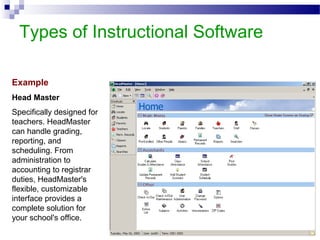
Example
Head Master
Specifically designed for
teachers. HeadMaster
can handle grading,
reporting, and
scheduling. From
administration to
accounting to registrar
duties, HeadMaster's
flexible, customizable
interface provides a
complete solution for
your school's office.

Types of Instructional Software

  • 1.
    Types of Instructional Software Dr.Alaa Sadik Sultan Qaboos University, Oman www.alaasadik.net alaasadik@gmail.com
  • 2.
    Instructional Software: ATaxonomy 1. Applications 2. Drill-and-Practice 3. Tutorials 4. Simulation 5. Instructional Games 6. Problem-Solving 7. Multimedia 8. Teacher Utilities
  • 3.
    Types of InstructionalSoftware 1. Applications Definition A group of applications programs that is designed to automate general-purpose and specific tasks such as word processing, database management, spreadsheet, attendance, accounting, grade reporting, scheduling and others. Features  acquire knowledge and insight about content and processes.  enhance problem-solving and thinking skills.  enhance students’ technical skills.  enhance student’s personal productivity.
  • 4.
    Types of InstructionalSoftware Example MS Excel Excel one of the most popular spreadsheet programs that can used to teach management processes and enhance problem- solving and thinking skills in mathematics and science.
  • 5.
    Types of InstructionalSoftware 2. Drill and Practice Definition Drill and practice software provides exercises in which students work example items one at a time and receive feedback on their correctness. Features  Reinforce instruction by providing the repetition necessary to move acquired skills and concepts into long-term memory.  Capture and retain the attention of students.  Save teachers’ time and efforts.  Personalize instruction by meeting individual differences among learners.
  • 6.
    Types of InstructionalSoftware Example ECS Keyboard Enables students to:  Play notes on the keyboard after seeing them written.  Identify played notes by assessing intervals from played/written notes  Playback written notes quickly.
  • 7.
    Types of InstructionalSoftware Example Master the Facts Multiplication: This program was created in response to teachers to use in their classrooms to teach multiplication. Students using Master the Facts Multiplication for as little as ten minutes a day to practice multiplication skills may demonstrate marked improvement in multiplication skills on quizzes and tests..
  • 8.
    Types of InstructionalSoftware 3. Tutorials Definition A tutorial exposes the learner to material that is believed not to have been previously taught or learned. A tutorial often includes pre-test, post test and drill and practice activities. Features  Follow linear programmed instruction or branching design.  Encourage students to interact, control and response to the program.  Guide the learner throughout learning from the beginning (objectives) to the end (evaluation).  Have computer-management capabilities (e.g. data collection).
  • 9.
    Types of InstructionalSoftware Example Auslan Sign Tutorial This system provides an easy-to-use and interactive tutorial for learning the basics in communicating in the Australian Sign Language (Auslan).  3D model for signing.  3D model shows emotion.  Numbers Mode.  Over 60 sign phrases to learn.  Random Quiz tests.
  • 10.
    Types of InstructionalSoftware Example Food Hygiene This tutorial is designed to teach students at a school of medicine a complete course on food hygiene which concerns food and the prevention of illness and maintenance of health. Uses well-prepared text supported by pictures, audio and video clips.
  • 11.
    Types of InstructionalSoftware 4. Simulations Definition A simulation is a computerized model of real or imagined system designed to teach how a system works and allows learners to create their own sequence for using simulation. Features  Involve students into learning process.  Compress time or slow down processes.  Save money and resources.  Make experimentation safe.  Make impossible situations possible and controllable.  Let student repeat events as many times as they want.
  • 12.
    Types of InstructionalSoftware Example Infinite Physics Simulator Infinite physics simulator has a large collection of objects useful for optics simulation including mirrors, prisms, lenses and other transparent objects.
  • 13.
    Types of InstructionalSoftware Example Curvilinear Friendly design, users do not need to get trained to operate these tools. Using buttons, textboxes and slide bars learners can run or stop the experiment and change the parameters of the phenomena.
  • 14.
    Types of InstructionalSoftware 5. Instructional Games Definition Instructional games are courseware designed to motivate learning by adding game rules to learning activities. Features  Make learning fun and motivating (Edutainment).  Motivate learners via the challenge of competition.  Engage the learner in a situation where the learner is competing for a high score.  Include elements of adventure and uncertainty.  Provide different levels of complexity that match player’s ability.
  • 15.
    Types of InstructionalSoftware Example Save the Math Apples Help the monkey save the apples! Click on the basket with the number to give the answer. Keep clicking the basket to add numbers to your answer.
  • 16.
    Types of InstructionalSoftware Example Jungle Jim and the Donga Dinga Drums This interactive game encourages kids to play with numbers and multiplication concept and win points as long as he/she hits the right number.
  • 17.
    Types of InstructionalSoftware 6. Problem-Solving Definition Problem-solving software is a type of content-free or content-based programs that places emphasis on critical thinking, analysis, logic and reasoning via the presentation of set of data or problematic event. Features  Stress thinking processes rather than correct answers.  Expose students to a series of activities that would help teach the desired skills.  Help students work together in small teams.  Give students opportunities to see how information applies to actual problems.  Vary the amount of direction and assistance depending on the each student’s needs.
  • 18.
    Types of InstructionalSoftware Example StressAlyzer This program provides students with many problems in Mechanics of Materials to solve. Students get immediate feedback on whether they solve each problem correctly, and they are offered randomly generated versions of similar problems until they can be solved correctly.
  • 19.
    Types of InstructionalSoftware Example MS Excel Excel one of the most popular spreadsheet programs that can used to teach management processes and enhance problem- solving and thinking skills in mathematics and science.
  • 20.
    Types of InstructionalSoftware 7. Multimedia Definition Programs that support the interactive use of text, audio, still images, video and graphics and manipulate them to support learning. Features  Enhance text only presentations by adding interesting sounds and compelling visuals.  Engage a variety of learning modalities (visual, auditory and possibly kinesthetic) which can appeal to various learner styles simultaneously.  Allow development of more engaging, persuasive presentations.  Focus practice of skills that support transfer of learning.
  • 21.
    Types of InstructionalSoftware Example Scholar’s Desktop. This program provides a series of modules for teaching, using a combination of media. Students can visit many museums around the world and explore many environments as they visit it.
  • 22.
    Types of InstructionalSoftware Example MS Photo Story This authoring tool allows students to create their own digital stories using text, audio and pictures and export their projects into a digital movie.
  • 23.
    Types of InstructionalSoftware 8. Teacher Utilities Definition Non-instructional or administrative programs used to prepare instructional materials or organize, store, evaluate and report information on pupils’ achievement and progress. Features  Based on the principle of database management.  Manipulate classroom and examination data.  Permit the teacher to have untold amounts of information.  Reduce the amount of repetitive paper work.  Create and maintain lesson plans.  Create and print a school calendar. Example: HeadMaster 2007 [www.acstechnologies.com/headmaster]
  • 24.
    Types of InstructionalSoftware Example Head Master Specifically designed for teachers. HeadMaster can handle grading, reporting, and scheduling. From administration to accounting to registrar duties, HeadMaster's flexible, customizable interface provides a complete solution for your school's office.