Current Trends in
Educational Technology
Veronica Diaz, PhD
vdiaz@educause.edu
@drvdiaz
Director, Online Programs
Associate Director, EDUCAUSE Learning Initiative
EDUCAUSE
What we’ll discuss…
• The student perspective
• Learning models and innovations
– Flipped learning model
– Hyflex model
– Microlearning
– Collaborative learning
• What’s next: innovation synthesis
What students
say about
technology…
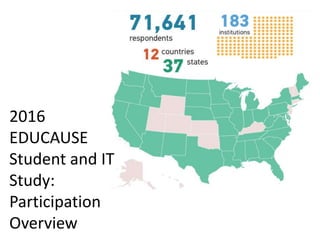
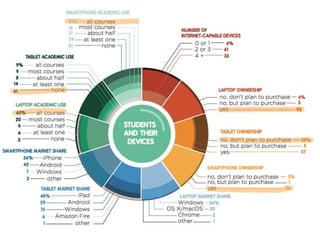
2016
EDUCAUSE
Student and IT
Study:
Participation
Overview
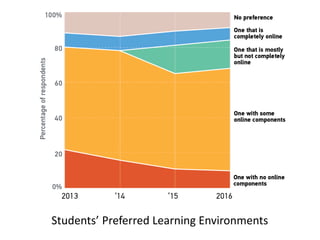
Students’ Preferred Learning Environments
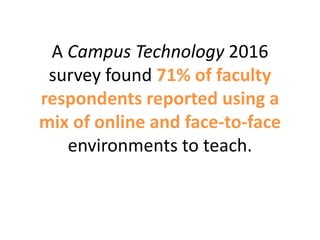
A Campus Technology 2016
survey found 71% of faculty
respondents reported using a
mix of online and face-to-face
environments to teach.
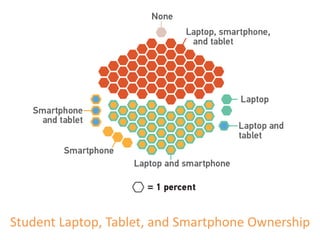
Student Laptop, Tablet, and Smartphone Ownership
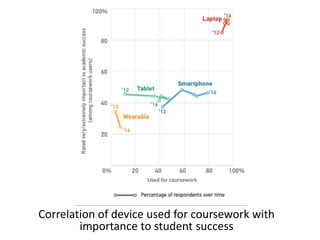
Correlation of device used for coursework with
importance to student success
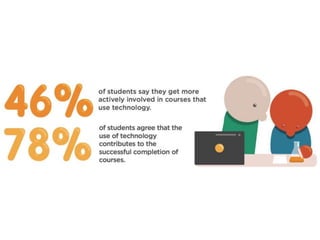
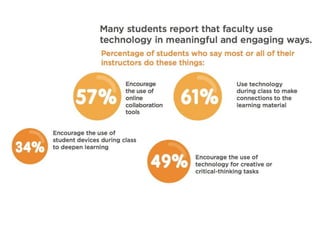
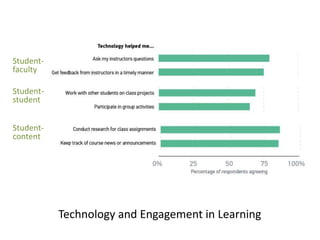
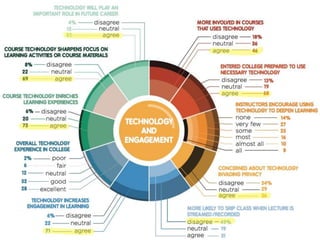
Technology and Engagement in Learning
Student-
faculty
Student-
student
Student-
content
Key
Findings
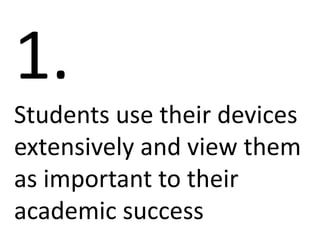
1.
Students use their devices
extensively and view them
as important to their
academic success
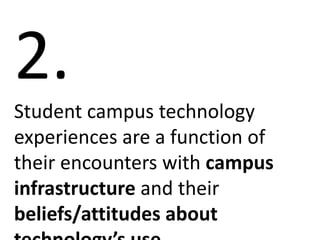
2.
Student campus technology
experiences are a function of
their encounters with campus
infrastructure and their
beliefs/attitudes about
3.
A majority of students prefer
learning environments that are
blended; those preferences are
shaped by the courses they have
taken
4.
Students, especially women and
first-generation students, think
technology increases their
learning engagement,
enrichment & efficacy
QUESTIONS/DISCUSSION?
Innovations in
Blended Learning
1.
The Flipped Classroom
Think, Pair, Share
1. Identify a strategy from 1 of the three videos
2. Share it with your neighbor
3. Share
Peer Instruction for Active Learning
Eric Mazur
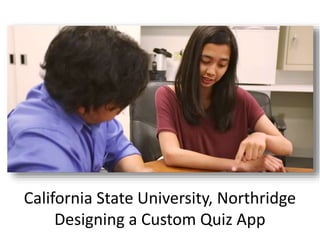
California State University, Northridge
Designing a Custom Quiz App
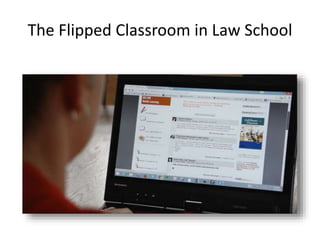
The Flipped Classroom in Law School
Think, Pair, Share
1. Identify a strategy from 1 of the three videos
2. Share it with your neighbor
3. Share
2.
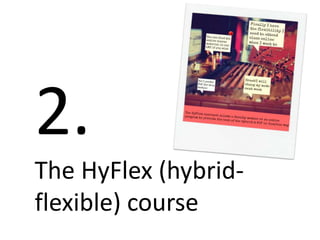
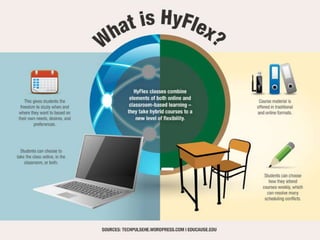
The HyFlex (hybrid-
flexible) course
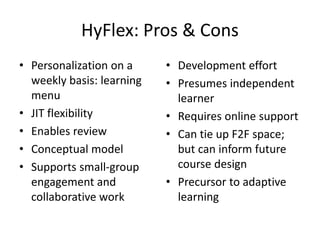
HyFlex: Pros & Cons
• Personalization on a
weekly basis: learning
menu
• JIT flexibility
• Enables review
• Conceptual model
• Supports small-group
engagement and
collaborative work
• Development effort
• Presumes independent
learner
• Requires online support
• Can tie up F2F space;
but can inform future
course design
• Precursor to adaptive
learning
3.
Microlearning
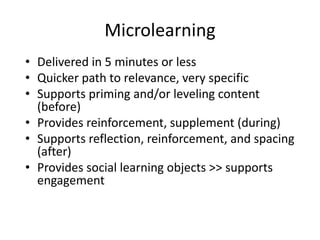
Microlearning
• Delivered in 5 minutes or less
• Quicker path to relevance, very specific
• Supports priming and/or leveling content
(before)
• Provides reinforcement, supplement (during)
• Supports reflection, reinforcement, and spacing
(after)
• Provides social learning objects >> supports
engagement
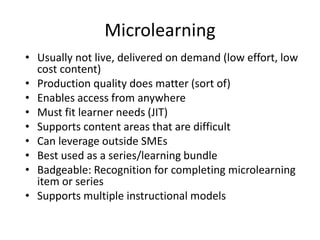
Microlearning
• Usually not live, delivered on demand (low effort, low
cost content)
• Production quality does matter (sort of)
• Enables access from anywhere
• Must fit learner needs (JIT)
• Supports content areas that are difficult
• Can leverage outside SMEs
• Best used as a series/learning bundle
• Badgeable: Recognition for completing microlearning
item or series
• Supports multiple instructional models
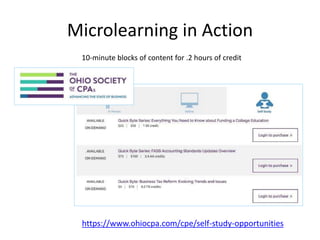
Microlearning in Action
10-minute blocks of content for .2 hours of credit
https://www.ohiocpa.com/cpe/self-study-opportunities
4.
Collaborative Learning
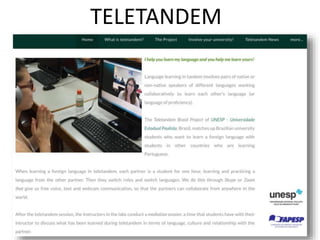
TELETANDEM
What is it and what does it do?
• An online collaborative with a partner aimed at learning a
foreign language
• A joint endeavor that consists of online regular meetings
extended over a specific time period
• Learners take responsibility for and engage in social
learning in reciprocal and autonomous ways
• Learners exercise autonomy and manage one’s own
learning process
• Learners develop relationships
• Analogous to the global workforce
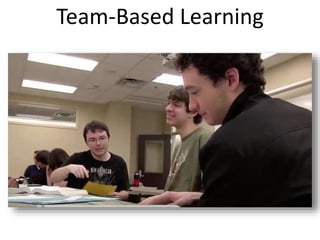
Team-Based Learning
Integrating Collaboration Tools
1. Will this application/tool enhance, improve instruction or
motivate learners?
2. Review the learning objectives to determine what activity
(with support of the tool ) will support learning.
3. Identify the content/concepts students need to learn –
review, augment and/or update content that students may
need to access during activity.
4. Will the tool encourage students to apply the content and
learn the material, construct knowledge and promote
critical thinking?
5. Create concise instructions of how-to use tool. Allow time
for learning of tool and learning of course content. AND,
explain to students.
Source: https://onlinelearninginsights.wordpress.com/2016/07/02/how-to-integrate-online-collaboration-tools-to-support-learning/
On the horizon:
innovations
coming together.
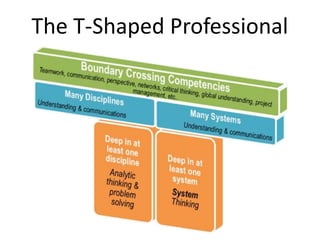
The T-Shaped Professional
Microcredentialing
Evolution of the transcript
Competency-based learning
Personalization
Differentiation
Skill development
“Grades are for meat and eggs. It’s simply
labeling the quality of the finished product.
As such, letter grades contribute to a system
of education that’s more about sorting
people than actually allowing them the
opportunities to learn and to master
something of value.”
It’s about personalization and
meeting students’ needs.
Source: Kyle Peck, co-director of the Center for Online Innovation in Learning at Penn State
“Transcripts are a relic from a paper and
pencil age. They don’t even use whole words
to describe the course. Could you tell me
what ‘Iss Ed Res’ means? I bet you wouldn’t
guess Issues in Educational Research. What
does that title really indicate to you?”
It’s about personalization and
meeting students’ needs.
Source: http://er.educause.edu/blogs/2017/2/kyle-peck-predicting-the-future-of-alternative-credentials
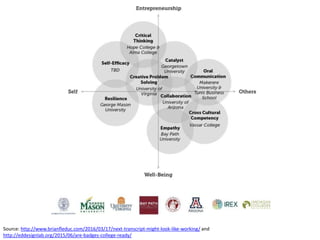
Source: http://www.brianfleduc.com/2016/03/17/next-transcript-might-look-like-working/ and
http://eddesignlab.org/2015/06/are-badges-college-ready/
PBS News Hour: https://www.youtube.com/watch?v=KGdHNtLlcrg
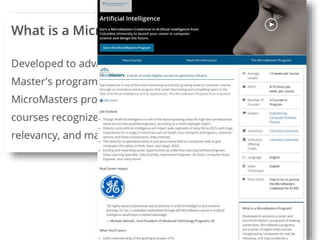
From Degree-Based Hiring to
Competency-Based Hiring
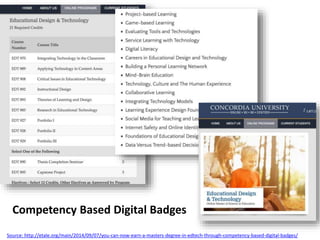
Source: http://etale.org/main/2014/09/07/you-can-now-earn-a-masters-degree-in-edtech-through-competency-based-digital-badges/
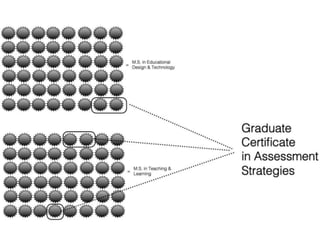
Competency Based Digital Badges
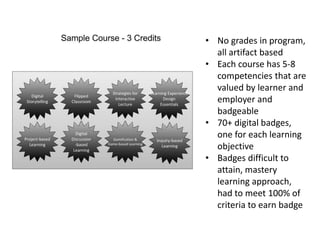
• No grades in program,
all artifact based
• Each course has 5-8
competencies that are
valued by learner and
employer and
badgeable
• 70+ digital badges,
one for each learning
objective
• Badges difficult to
attain, mastery
learning approach,
had to meet 100% of
criteria to earn badge
Veronica Diaz, PhD
Director, EDUCAUSE Online Programs
Associate Director, EDUCAUSE Learning Initiative
EDUCAUSE
@drvdiaz
vdiaz@educause.edu
http://www.educause.edu/eli
https://www.linkedin.com/in/veronica-diaz/

Current Trends in Educational Technology