University of Chakwal, Pakistan
DEPARTMENT OF ZOOLOGY
PRESENTED BY: ALISHBA BATOOL
REG NO: 20M-UOC/ZOL-21
BS-ZOOLOGY
SESSION 2020-2024
COURSE TITLE: ICHTHYOLOGY
SUBMITTED TO: DR. SYEDA NADIA AHMAD
TOPIC: RAJIDAE (SKATES FISH)
THE SKATE
FISH
ALISHBA BATOOL
CONTENTS
1 2 3 4 5
Taxonomy Distribution Importance Interesting
Facts
Unique Facts
6
Morphology
7
Behavior
Introduction
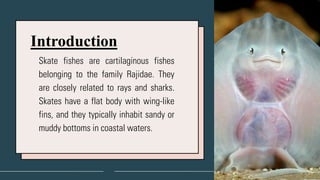
Skate fishes are cartilaginous fishes
belonging to the family Rajidae. They
are closely related to rays and sharks.
Skates have a flat body with wing-like
fins, and they typically inhabit sandy or
muddy bottoms in coastal waters.
Taxonomy of Skate
Fishes
• Kingdom: Animalia
• Phylum: Chordata
• Class: Chondrichthyes
• Subclass: Elasmobranchii
• Order: Rajiformes
• Family: Rajidae
Distribution of Skate Fishes
• Global Reach: Skates are cosmopolitan, meaning they're found in most
parts of the world's oceans.
• Salty Only: Skates are exclusively saltwater fish.
• Temperature: Skates tend to favor cooler waters. They are more diverse
in higher latitudes and deeper waters, with a preference for cool waters.
• Habitat: Skates are bottom-dwelling fish, meaning they live on the
seafloor. Different skate species can be found in a variety of habitats
including soft-sediment seafloors, rocky reefs, and kelp forests.
Importance of Skate Fishes
• Ecological Importance
• Scientific Importance
• Economic Importance
• Research and Significance
• Cultural Significance
• Nutrient Cycling
Interesting Facts
• They are electrical Communicators.
• They have more species than you think.
• They are Deep-sea dwellers.
• They are underwater detectives.
• They have fashionable foodies.
• They have layers on their eggs.
Unique Facts
• Lumbering Liver
• Mermaid's Purse
• Thorny Defense
• Masters of Disguise
• Elegant Gliders
Morphology of Skate Fishes
President Chief Executive Officer Chief Operations Officer VP Marketing
• Mouth
• Scales
• Fins
Scales
• Develop winning strategies to keep ahead of the competition
• Capitalize on low-hanging fruit to identify a ballpark value
Skates have placoid scales. These scales are homologous to teeth,
Each placoid scale has a flattened base embedded in the skin and a
pointed cusp that projects outwards. The cusps are angled backwards,
creating a rough texture that helps protect the skate from predators and
abrasions as it glides across the seafloor.
Mouth
The mouth of a skate is located on the ventral side of the body The mouth is
lined with small, sharp teeth that help skates crush and tear through their prey.
There are some additional interesting features of a skate's mouth
• Sensory Pits: Around the mouth, skates have clusters of small pits called
electroreceptors. These pits can detect weak electric fields emitted by buried
prey, aiding skates in locating food.
• Labial Cartilages: Projecting flaps of cartilage around the mouth help
channel food towards the mouth.
Fins
The fins on a skate are:
• First and Second Dorsal Fins: Located on the back of the skate
these fins help with stability and maneuvering.
• Caudal Fin: The tail fin, used for steering and propulsion.
• Pelvic Fins: Paired fins located on the underside of the body,
near the vent.
These fins aid in and stability.
Behavior of Skate Fishes
• Parental Behavior
• Migratory Behavior
Parental Behavior
Skates are oviparous, meaning they lay eggs. The eggs are fertilized internally and then
deposited on the sea floor in a leathery casing often called a mermaid's purse. The embryo
develops inside the purse for several months, up to 15 months in some species, before hatching.
Unlike many fish that simply scatter their eggs and leave them to fend for themselves, skate
eggs have a sticky filament that allows them to attach to seaweed or other objects on the
seabed. This helps to protect them from predators and ensures they stay in a suitable
environment for development. Once hatched, the young skates are miniature versions of the
adults and are independent from the moment they emerge from the egg case.
Migratory Behavior
• Unlike their close relatives the stingrays, skates are not highly migratory fish. They
tend to stay close to the seabed in the areas they inhabit. However, some species do
exhibit seasonal movements. For example, the barndoor skate (Dipturus laevis) is
known to migrate to deeper waters in the winter to reproduce.
• Skates use their wing-like pectoral fins to "fly" through the water, but they are not the
strongest swimmers. This is why they tend to stay close to the bottom where they can
rest and avoid predators.
18
Conclusion
Skate fishes are a diverse group known for their flattened bodies
and unique reproductive strategies. In conclusion, these fascinating
creatures play important roles in marine ecosystems, serving as
both predators and prey. However, many skate species face threats
from overfishing and habitat destruction, highlighting the need for
conservation efforts to ensure their survival and the health of
marine ecosystems.
References
• Ebert, D. A., & Sulikowski, J. A. (2019). Preface: Distribution of skates. Distribution
of Skates, 1- 4.
• Serra-Pereira, B., Erzini, K., Maia, C., & Figueiredo, I. (2020). Importance of essential
fish skates based on fishers’ knowledge. Environmental management, 53, 985-998.
• Ebert, D. A., & Compagno, L. J. (2021). Biodiversity and systematics of skates
(Chondrichthyes: Rajiformes: Rajoidei). Biology of skates, 5-18.
• Soares, K. D., Moreira, R. A., & Gomes, U. L. (2021). Phylogeny of the tribe Riorajini
with comments on the morphological character evolution within Rajiformes
(Chondrichthyes, Batoidea). Zoologica Scripta, 52(6), 606-628.
• Mulas, A., Bellodi, A., Cannas, R., Cau, A., Cuccu, D., Marongiu, M. F., ... & Follesa,
M. C. (2020). Diet and behaviour of longnosed skate fishes Journal of Fish Biology,
86(1), 121- 138.
Skate Fish Introduction, Morphology & it's Characteristics.

Skate Fish Introduction, Morphology & it's Characteristics.

  • 1.
  • 2.
    DEPARTMENT OF ZOOLOGY PRESENTEDBY: ALISHBA BATOOL REG NO: 20M-UOC/ZOL-21 BS-ZOOLOGY SESSION 2020-2024 COURSE TITLE: ICHTHYOLOGY SUBMITTED TO: DR. SYEDA NADIA AHMAD TOPIC: RAJIDAE (SKATES FISH)
  • 3.
  • 4.
    CONTENTS 1 2 34 5 Taxonomy Distribution Importance Interesting Facts Unique Facts 6 Morphology 7 Behavior
  • 5.
    Introduction Skate fishes arecartilaginous fishes belonging to the family Rajidae. They are closely related to rays and sharks. Skates have a flat body with wing-like fins, and they typically inhabit sandy or muddy bottoms in coastal waters.
  • 6.
    Taxonomy of Skate Fishes •Kingdom: Animalia • Phylum: Chordata • Class: Chondrichthyes • Subclass: Elasmobranchii • Order: Rajiformes • Family: Rajidae
  • 7.
    Distribution of SkateFishes • Global Reach: Skates are cosmopolitan, meaning they're found in most parts of the world's oceans. • Salty Only: Skates are exclusively saltwater fish. • Temperature: Skates tend to favor cooler waters. They are more diverse in higher latitudes and deeper waters, with a preference for cool waters. • Habitat: Skates are bottom-dwelling fish, meaning they live on the seafloor. Different skate species can be found in a variety of habitats including soft-sediment seafloors, rocky reefs, and kelp forests.
  • 8.
    Importance of SkateFishes • Ecological Importance • Scientific Importance • Economic Importance • Research and Significance • Cultural Significance • Nutrient Cycling
  • 9.
    Interesting Facts • Theyare electrical Communicators. • They have more species than you think. • They are Deep-sea dwellers. • They are underwater detectives. • They have fashionable foodies. • They have layers on their eggs.
  • 10.
    Unique Facts • LumberingLiver • Mermaid's Purse • Thorny Defense • Masters of Disguise • Elegant Gliders
  • 11.
    Morphology of SkateFishes President Chief Executive Officer Chief Operations Officer VP Marketing • Mouth • Scales • Fins
  • 12.
    Scales • Develop winningstrategies to keep ahead of the competition • Capitalize on low-hanging fruit to identify a ballpark value Skates have placoid scales. These scales are homologous to teeth, Each placoid scale has a flattened base embedded in the skin and a pointed cusp that projects outwards. The cusps are angled backwards, creating a rough texture that helps protect the skate from predators and abrasions as it glides across the seafloor.
  • 13.
    Mouth The mouth ofa skate is located on the ventral side of the body The mouth is lined with small, sharp teeth that help skates crush and tear through their prey. There are some additional interesting features of a skate's mouth • Sensory Pits: Around the mouth, skates have clusters of small pits called electroreceptors. These pits can detect weak electric fields emitted by buried prey, aiding skates in locating food. • Labial Cartilages: Projecting flaps of cartilage around the mouth help channel food towards the mouth.
  • 14.
    Fins The fins ona skate are: • First and Second Dorsal Fins: Located on the back of the skate these fins help with stability and maneuvering. • Caudal Fin: The tail fin, used for steering and propulsion. • Pelvic Fins: Paired fins located on the underside of the body, near the vent. These fins aid in and stability.
  • 15.
    Behavior of SkateFishes • Parental Behavior • Migratory Behavior
  • 16.
    Parental Behavior Skates areoviparous, meaning they lay eggs. The eggs are fertilized internally and then deposited on the sea floor in a leathery casing often called a mermaid's purse. The embryo develops inside the purse for several months, up to 15 months in some species, before hatching. Unlike many fish that simply scatter their eggs and leave them to fend for themselves, skate eggs have a sticky filament that allows them to attach to seaweed or other objects on the seabed. This helps to protect them from predators and ensures they stay in a suitable environment for development. Once hatched, the young skates are miniature versions of the adults and are independent from the moment they emerge from the egg case.
  • 17.
    Migratory Behavior • Unliketheir close relatives the stingrays, skates are not highly migratory fish. They tend to stay close to the seabed in the areas they inhabit. However, some species do exhibit seasonal movements. For example, the barndoor skate (Dipturus laevis) is known to migrate to deeper waters in the winter to reproduce. • Skates use their wing-like pectoral fins to "fly" through the water, but they are not the strongest swimmers. This is why they tend to stay close to the bottom where they can rest and avoid predators.
  • 18.
    18 Conclusion Skate fishes area diverse group known for their flattened bodies and unique reproductive strategies. In conclusion, these fascinating creatures play important roles in marine ecosystems, serving as both predators and prey. However, many skate species face threats from overfishing and habitat destruction, highlighting the need for conservation efforts to ensure their survival and the health of marine ecosystems.
  • 19.
    References • Ebert, D.A., & Sulikowski, J. A. (2019). Preface: Distribution of skates. Distribution of Skates, 1- 4. • Serra-Pereira, B., Erzini, K., Maia, C., & Figueiredo, I. (2020). Importance of essential fish skates based on fishers’ knowledge. Environmental management, 53, 985-998. • Ebert, D. A., & Compagno, L. J. (2021). Biodiversity and systematics of skates (Chondrichthyes: Rajiformes: Rajoidei). Biology of skates, 5-18. • Soares, K. D., Moreira, R. A., & Gomes, U. L. (2021). Phylogeny of the tribe Riorajini with comments on the morphological character evolution within Rajiformes (Chondrichthyes, Batoidea). Zoologica Scripta, 52(6), 606-628. • Mulas, A., Bellodi, A., Cannas, R., Cau, A., Cuccu, D., Marongiu, M. F., ... & Follesa, M. C. (2020). Diet and behaviour of longnosed skate fishes Journal of Fish Biology, 86(1), 121- 138.