Shri Shankaracharya Mahavidyalaya, Junwani , Bhilai
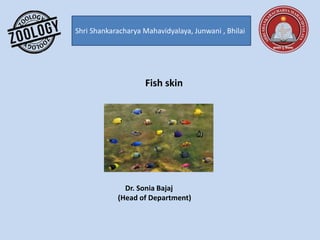
Fish skin
Dr. Sonia Bajaj
(Head of Department)
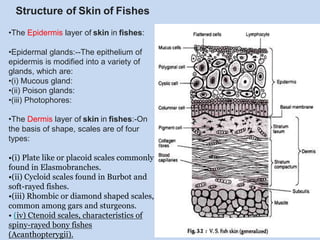
Structure of Skin of Fishes
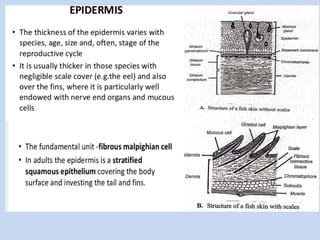
•The Epidermis layer of skin in fishes:
•Epidermal glands:--The epithelium of
epidermis is modified into a variety of
glands, which are:
•(i) Mucous gland:
•(ii) Poison glands:
•(iii) Photophores:
•The Dermis layer of skin in fishes:-On
the basis of shape, scales are of four
types:
•(i) Plate like or placoid scales commonly
found in Elasmobranches.
•(ii) Cycloid scales found in Burbot and
soft-rayed fishes.
•(iii) Rhombic or diamond shaped scales,
common among gars and sturgeons.
• (iv) Ctenoid scales, characteristics of
spiny-rayed bony fishes
(Acanthopterygii).
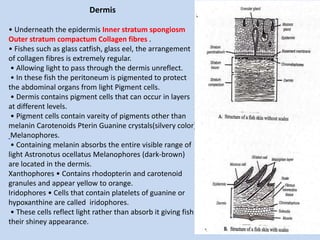
Dermis
• Underneath the epidermis Inner stratum spongiosm
Outer stratum compactum Collagen fibres .
• Fishes such as glass catfish, glass eel, the arrangement
of collagen fibres is extremely regular.
• Allowing light to pass through the dermis unreflect.
• In these fish the peritoneum is pigmented to protect
the abdominal organs from light Pigment cells.
• Dermis contains pigment cells that can occur in layers
at different levels.
• Pigment cells contain vareity of pigments other than
melanin Carotenoids Pterin Guanine crystals(silvery color)
Melanophores.
• Containing melanin absorbs the entire visible range of
light Astronotus ocellatus Melanophores (dark-brown)
are located in the dermis.
Xanthophores • Contains rhodopterin and carotenoid
granules and appear yellow to orange.
Iridophores • Cells that contain platelets of guanine or
hypoxanthine are called iridophores.
• These cells reflect light rather than absorb it giving fish
their shiney appearance.
References-
Modern text book -Kotpal
Jantu Vigyan- S.M. sexsena
Jantu Vigyan- Dr.H.N. Baijal

Fish skin

  • 1.
    Shri Shankaracharya Mahavidyalaya,Junwani , Bhilai Fish skin Dr. Sonia Bajaj (Head of Department)
  • 2.
    Structure of Skinof Fishes •The Epidermis layer of skin in fishes: •Epidermal glands:--The epithelium of epidermis is modified into a variety of glands, which are: •(i) Mucous gland: •(ii) Poison glands: •(iii) Photophores: •The Dermis layer of skin in fishes:-On the basis of shape, scales are of four types: •(i) Plate like or placoid scales commonly found in Elasmobranches. •(ii) Cycloid scales found in Burbot and soft-rayed fishes. •(iii) Rhombic or diamond shaped scales, common among gars and sturgeons. • (iv) Ctenoid scales, characteristics of spiny-rayed bony fishes (Acanthopterygii).
  • 4.
    Dermis • Underneath theepidermis Inner stratum spongiosm Outer stratum compactum Collagen fibres . • Fishes such as glass catfish, glass eel, the arrangement of collagen fibres is extremely regular. • Allowing light to pass through the dermis unreflect. • In these fish the peritoneum is pigmented to protect the abdominal organs from light Pigment cells. • Dermis contains pigment cells that can occur in layers at different levels. • Pigment cells contain vareity of pigments other than melanin Carotenoids Pterin Guanine crystals(silvery color) Melanophores. • Containing melanin absorbs the entire visible range of light Astronotus ocellatus Melanophores (dark-brown) are located in the dermis. Xanthophores • Contains rhodopterin and carotenoid granules and appear yellow to orange. Iridophores • Cells that contain platelets of guanine or hypoxanthine are called iridophores. • These cells reflect light rather than absorb it giving fish their shiney appearance.
  • 5.
    References- Modern text book-Kotpal Jantu Vigyan- S.M. sexsena Jantu Vigyan- Dr.H.N. Baijal