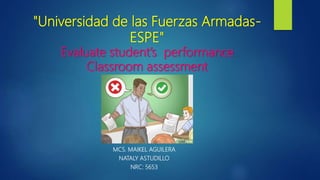
Evaluate student’s performance
Classroom assessment
MCS. MAIKEL AGUILERA
NATALY ASTUDILLO
NRC: 5653
"Universidad de las Fuerzas Armadas-
ESPE"
Classroom Assessment
 Evaluation is the process of data
collection in which the teacher
measures the progress of students'
skills, as well as serves as an aid for
effective decision making to improve
present and future learning.
 A meaningful evaluation implies that
students are interested in feedback
and not only in the quantitative
qualification, it also implies motivation,
for this reason it must comply with
clear, concise instructions based on the
needs or adaptations of the students.
Classroom Assessment Concepts
 Quantitative assessment: These are
numerical results, there are in formal
evaluations, where development is
measured numerically.
 Qualitatite assessment: They are results that
describe qualities, being informal
evaluations since they describe the
behavior of the students in the process of
skill development.
 Measurement: Procedure to obtain
numerical values in reference to knowledge
or skills
 Realiability: It is the consistency of the tool
in obtaining results.
 Validity: measurement effectiveness .
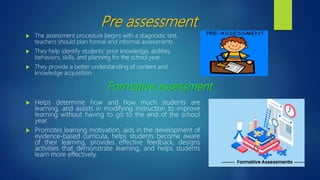
Pre assessment
 The assessment procedure begins with a diagnostic test,
teachers should plan formal and informal assessments.
 They help identify students' prior knowledge, abilities,
behaviors, skills, and planning for the school year.
 They provide a better understanding of content and
knowledge acquisition.
Formative assessment
 Helps determine how and how much students are
learning, and assists in modifying instruction to improve
learning without having to go to the end of the school
year.
 Promotes learning motivation, aids in the development of
evidence-based curricula, helps students become aware
of their learning, provides effective feedback, designs
activities that demonstrate learning, and helps students
learn more effectively.
Summative Assessment
 It is a paper and pencil assessment at the end of the school
year that is graded by teachers, they are usually multiple
choice, matching, true and false, etc., or alternative
assessments such as: portfolios, projects, etc.
 Their objective is the amount of evidence and complete
understanding of the learning content, they allow certifying or
promoting students, they are part of a larger process.
Norm-referenced evaluation
 Standardized tests that compare individual student
performance in reference to a population.
 Evaluates basic skills, identifies learning disabilities, all decision
making, determines student readiness.
 English teachers look for ways to enhance
students' competencies to improve their
performance, thus a set of questions are asked
and followed based on traditional methods, which
seek quantitative results that reflect the fulfillment
of skills and knowledge.
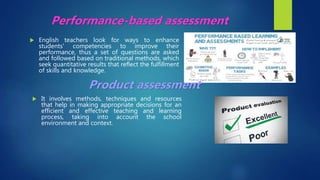
Performance-based assessment
Product assessment
 It involves methods, techniques and resources
that help in making appropriate decisions for an
efficient and effective teaching and learning
process, taking into account the school
environment and context.
 They are systematic investigations on a specific
content, they are in charge of achieving specific
predefined objectives based on a rubric.
Project o report rubric
Research paper
 It is part of an academic writing that
analyzes, interprets and argues on the
basis of independent research.
Log or journal
 Provides structure to students' activities, through
appropriate written language on a given content,
developed the ability to organize thoughts and
feelings and critical thinking.
Media product
 Promotes digital management skills and
linguistic literacy, as young people are
highly skilled, thus trying to include
technological devices in the teaching-
learning process.
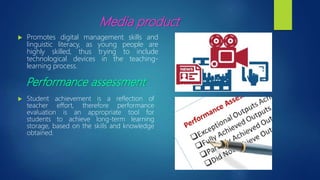
Performance assessment
 Student achievement is a reflection of
teacher effort, therefore performance
evaluation is an appropriate tool for
students to achieve long-term learning
storage, based on the skills and knowledge
obtained.
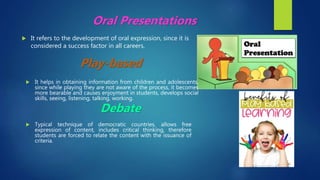
 It refers to the development of oral expression, since it is
considered a success factor in all careers.
Oral Presentations
Play-based
 Typical technique of democratic countries, allows free
expression of content, includes critical thinking, therefore
students are forced to relate the content with the issuance of
criteria.
Debate
 It helps in obtaining information from children and adolescents,
since while playing they are not aware of the process, it becomes
more bearable and causes enjoyment in students, develops social
skills, seeing, listening, talking, working.
A4.Astudillo.Nataly.Catedra.pptx

A4.Astudillo.Nataly.Catedra.pptx

  • 1.
    Evaluate student’s performance Classroomassessment MCS. MAIKEL AGUILERA NATALY ASTUDILLO NRC: 5653 "Universidad de las Fuerzas Armadas- ESPE"
  • 2.
    Classroom Assessment  Evaluationis the process of data collection in which the teacher measures the progress of students' skills, as well as serves as an aid for effective decision making to improve present and future learning.  A meaningful evaluation implies that students are interested in feedback and not only in the quantitative qualification, it also implies motivation, for this reason it must comply with clear, concise instructions based on the needs or adaptations of the students.
  • 3.
    Classroom Assessment Concepts Quantitative assessment: These are numerical results, there are in formal evaluations, where development is measured numerically.  Qualitatite assessment: They are results that describe qualities, being informal evaluations since they describe the behavior of the students in the process of skill development.  Measurement: Procedure to obtain numerical values in reference to knowledge or skills  Realiability: It is the consistency of the tool in obtaining results.  Validity: measurement effectiveness .
  • 4.
    Pre assessment  Theassessment procedure begins with a diagnostic test, teachers should plan formal and informal assessments.  They help identify students' prior knowledge, abilities, behaviors, skills, and planning for the school year.  They provide a better understanding of content and knowledge acquisition. Formative assessment  Helps determine how and how much students are learning, and assists in modifying instruction to improve learning without having to go to the end of the school year.  Promotes learning motivation, aids in the development of evidence-based curricula, helps students become aware of their learning, provides effective feedback, designs activities that demonstrate learning, and helps students learn more effectively.
  • 5.
    Summative Assessment  Itis a paper and pencil assessment at the end of the school year that is graded by teachers, they are usually multiple choice, matching, true and false, etc., or alternative assessments such as: portfolios, projects, etc.  Their objective is the amount of evidence and complete understanding of the learning content, they allow certifying or promoting students, they are part of a larger process. Norm-referenced evaluation  Standardized tests that compare individual student performance in reference to a population.  Evaluates basic skills, identifies learning disabilities, all decision making, determines student readiness.
  • 6.
     English teacherslook for ways to enhance students' competencies to improve their performance, thus a set of questions are asked and followed based on traditional methods, which seek quantitative results that reflect the fulfillment of skills and knowledge. Performance-based assessment Product assessment  It involves methods, techniques and resources that help in making appropriate decisions for an efficient and effective teaching and learning process, taking into account the school environment and context.
  • 7.
     They aresystematic investigations on a specific content, they are in charge of achieving specific predefined objectives based on a rubric. Project o report rubric Research paper  It is part of an academic writing that analyzes, interprets and argues on the basis of independent research. Log or journal  Provides structure to students' activities, through appropriate written language on a given content, developed the ability to organize thoughts and feelings and critical thinking.
  • 8.
    Media product  Promotesdigital management skills and linguistic literacy, as young people are highly skilled, thus trying to include technological devices in the teaching- learning process. Performance assessment  Student achievement is a reflection of teacher effort, therefore performance evaluation is an appropriate tool for students to achieve long-term learning storage, based on the skills and knowledge obtained.
  • 9.
     It refersto the development of oral expression, since it is considered a success factor in all careers. Oral Presentations Play-based  Typical technique of democratic countries, allows free expression of content, includes critical thinking, therefore students are forced to relate the content with the issuance of criteria. Debate  It helps in obtaining information from children and adolescents, since while playing they are not aware of the process, it becomes more bearable and causes enjoyment in students, develops social skills, seeing, listening, talking, working.