NGO
NON GOVERNMENTAL ORGANIZATIONS IN INDIA
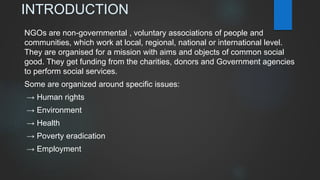
INTRODUCTION
NGOs are non-governmental , voluntary associations of people and
communities, which work at local, regional, national or international level.
They are organised for a mission with aims and objects of common social
good. They get funding from the charities, donors and Government agencies
to perform social services.
Some are organized around specific issues:
→ Human rights
→ Environment
→ Health
→ Poverty eradication
→ Employment
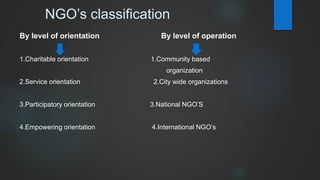
NGO’s classification
By level of orientation By level of operation
1.Charitable orientation 1.Community based
organization
2.Service orientation 2.City wide organizations
3.Participatory orientation 3.National NGO’S
4.Empowering orientation 4.International NGO’s
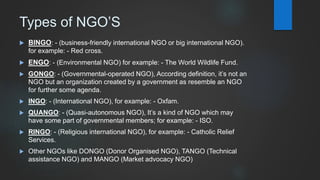
Types of NGO’S
 BINGO: - (business-friendly international NGO or big international NGO).
for example: - Red cross.
 ENGO: - (Environmental NGO) for example: - The World Wildlife Fund.
 GONGO: - (Governmental-operated NGO), According definition, it’s not an
NGO but an organization created by a government as resemble an NGO
for further some agenda.
 INGO: - (International NGO), for example: - Oxfam.
 QUANGO: - (Quasi-autonomous NGO), It’s a kind of NGO which may
have some part of governmental members; for example: - ISO.
 RINGO: - (Religious international NGO), for example: - Catholic Relief
Services.
 Other NGOs like DONGO (Donor Organised NGO), TANGO (Technical
assistance NGO) and MANGO (Market advocacy NGO)
Corporate structure of NGO’s
 Staffing
 Funding
 Overhead costs
 Monitoring and control
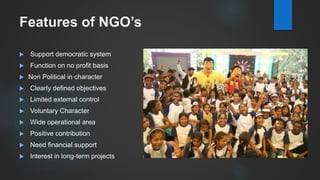
Features of NGO’s
 Support democratic system
 Function on no profit basis
 Non Political in character
 Clearly defined objectives
 Limited external control
 Voluntary Character
 Wide operational area
 Positive contribution
 Need financial support
 Interest in long-term projects
Activities of NGOs
 Create awareness
 Protection of human rights
 Public relations
 campaigning
 Gainful employment
Function’s of NGO’S with respect to
Entrepreneurial scenario
 Entrepreneurial Development Programme (EDP)
 Counseling
 Development of Infrastructure
 Construction of Housing Facility
 Supporting Innovation and Pilot Projects
 Providing Technical Assistance
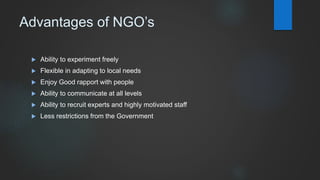
Advantages of NGO’s
 Ability to experiment freely
 Flexible in adapting to local needs
 Enjoy Good rapport with people
 Ability to communicate at all levels
 Ability to recruit experts and highly motivated staff
 Less restrictions from the Government
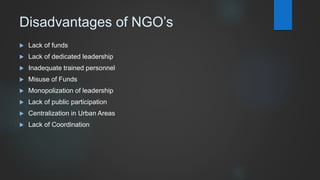
Disadvantages of NGO’s
 Lack of funds
 Lack of dedicated leadership
 Inadequate trained personnel
 Misuse of Funds
 Monopolization of leadership
 Lack of public participation
 Centralization in Urban Areas
 Lack of Coordination
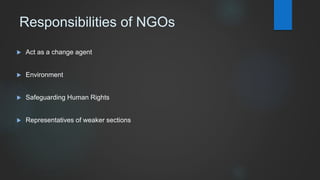
Responsibilities of NGOs
 Act as a change agent
 Environment
 Safeguarding Human Rights
 Representatives of weaker sections
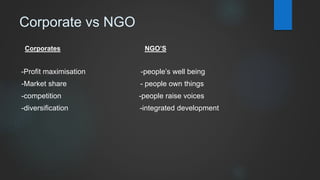
Corporate vs NGO
Corporates NGO’S
-Profit maximisation -people’s well being
-Market share - people own things
-competition -people raise voices
-diversification -integrated development
WASME
It stands for World Association for Small and Medium Enterprises (WASME)
Established in 1980
Headquartered in Noida, India
Objectives of WASME:
 Developing relationship between SMEs in developed and developing countries.
 Networking with related/similar organizations.
 Enlarging collaboration with UN agencies and international organizations.
 Capacity building of SMEs through managerial and skill development programmes.
 Disseminating information on and about international developments in SME sector.
 Carrying out research and studies on topical issues confronting SMEs
AWAKE
It stands for Association of Women Entrepreneurs of Karnataka
Type: Intermediate NGO
Headquartered in Bangalore, Karnataka, India
Strives to promote entrepreneurship among women as a means to achieve self reliance and
socio-economic independence.
AWAKE aims to:
 To promote entrepreneurship among women and thereby empower them to join the economic
mainstream.
 To enhance the status of women in the society, by creating a culture of entrepreneurship
amongst women in both rural and urban areas
 To develop successful models of entrepreneurship for emulation world-wide
CRY
It stands for Child Rights and You
Type: Grass root level NGO
Established in 1979
Non-profit organization in India that aims to restore children's rights in India.
It was started by Rippan Kapur
It focuses mainly on the 4 basic rights:
 Survival
 Development
 Protection
 Participation
THANK YOU!

Non Governmental Organisations (NGOs)

  • 1.
  • 2.
    INTRODUCTION NGOs are non-governmental, voluntary associations of people and communities, which work at local, regional, national or international level. They are organised for a mission with aims and objects of common social good. They get funding from the charities, donors and Government agencies to perform social services. Some are organized around specific issues: → Human rights → Environment → Health → Poverty eradication → Employment
  • 3.
    NGO’s classification By levelof orientation By level of operation 1.Charitable orientation 1.Community based organization 2.Service orientation 2.City wide organizations 3.Participatory orientation 3.National NGO’S 4.Empowering orientation 4.International NGO’s
  • 4.
    Types of NGO’S BINGO: - (business-friendly international NGO or big international NGO). for example: - Red cross.  ENGO: - (Environmental NGO) for example: - The World Wildlife Fund.  GONGO: - (Governmental-operated NGO), According definition, it’s not an NGO but an organization created by a government as resemble an NGO for further some agenda.  INGO: - (International NGO), for example: - Oxfam.  QUANGO: - (Quasi-autonomous NGO), It’s a kind of NGO which may have some part of governmental members; for example: - ISO.  RINGO: - (Religious international NGO), for example: - Catholic Relief Services.  Other NGOs like DONGO (Donor Organised NGO), TANGO (Technical assistance NGO) and MANGO (Market advocacy NGO)
  • 5.
    Corporate structure ofNGO’s  Staffing  Funding  Overhead costs  Monitoring and control
  • 6.
    Features of NGO’s Support democratic system  Function on no profit basis  Non Political in character  Clearly defined objectives  Limited external control  Voluntary Character  Wide operational area  Positive contribution  Need financial support  Interest in long-term projects
  • 7.
    Activities of NGOs Create awareness  Protection of human rights  Public relations  campaigning  Gainful employment
  • 8.
    Function’s of NGO’Swith respect to Entrepreneurial scenario  Entrepreneurial Development Programme (EDP)  Counseling  Development of Infrastructure  Construction of Housing Facility  Supporting Innovation and Pilot Projects  Providing Technical Assistance
  • 9.
    Advantages of NGO’s Ability to experiment freely  Flexible in adapting to local needs  Enjoy Good rapport with people  Ability to communicate at all levels  Ability to recruit experts and highly motivated staff  Less restrictions from the Government
  • 10.
    Disadvantages of NGO’s Lack of funds  Lack of dedicated leadership  Inadequate trained personnel  Misuse of Funds  Monopolization of leadership  Lack of public participation  Centralization in Urban Areas  Lack of Coordination
  • 11.
    Responsibilities of NGOs Act as a change agent  Environment  Safeguarding Human Rights  Representatives of weaker sections
  • 12.
    Corporate vs NGO CorporatesNGO’S -Profit maximisation -people’s well being -Market share - people own things -competition -people raise voices -diversification -integrated development
  • 13.
    WASME It stands forWorld Association for Small and Medium Enterprises (WASME) Established in 1980 Headquartered in Noida, India Objectives of WASME:  Developing relationship between SMEs in developed and developing countries.  Networking with related/similar organizations.  Enlarging collaboration with UN agencies and international organizations.  Capacity building of SMEs through managerial and skill development programmes.  Disseminating information on and about international developments in SME sector.  Carrying out research and studies on topical issues confronting SMEs
  • 14.
    AWAKE It stands forAssociation of Women Entrepreneurs of Karnataka Type: Intermediate NGO Headquartered in Bangalore, Karnataka, India Strives to promote entrepreneurship among women as a means to achieve self reliance and socio-economic independence. AWAKE aims to:  To promote entrepreneurship among women and thereby empower them to join the economic mainstream.  To enhance the status of women in the society, by creating a culture of entrepreneurship amongst women in both rural and urban areas  To develop successful models of entrepreneurship for emulation world-wide
  • 15.
    CRY It stands forChild Rights and You Type: Grass root level NGO Established in 1979 Non-profit organization in India that aims to restore children's rights in India. It was started by Rippan Kapur It focuses mainly on the 4 basic rights:  Survival  Development  Protection  Participation
  • 16.