Meaning of Corporate Social
Responsibility(CSR), 2013:
 CSR is a process by which an organizational thinks about and evolves its
relationships with stakeholders for the common good and demonstrate its
commitment in this regard by adoption of appropriate business processes and
strategies. Thus CSR is no charity or donations.
 CRS is a way of conducting business, by which corporate entities visibly
contribute to the social good. Socially responsible companies use CSR to integrate
economic, environmental and social objective with the company’s operations and
growth.
Applicability of CSR Rules:
 As per Section 135(1) of the act, all companies that have either of the following
in any financial year-
 Net worth of INR 500 Cr. or more
 Turn over of INR 1000 Cr. or more
 Net profit of INR 5 Cr. Or more
*All companies means every company including its holding or subsidiary or foreign
company having its branch office or project office on India.
Appointment of CSR Committee:
 Compromising as per Companies Act 2013:-
• Compromising of three or more directors with at least one independent Director.
• Composition should be disclose in the annual board of directors report.
 Company – wise composition rules:-
• Unlisted public or private company u/s 135(1), not required to appoint Independent
Director pursuant to SEC.149(4):- Composition committee without independent director
• Private company having 2 director only:- Compose committee with such 2 directors
• In case of foreign company:- Committee shall comprise of 2 persons of which
1. One person shall be specified u/s 380(1)(d) of this act
2. Another person shall be nominated by foreign company
Responsibilities of the Committee:
o Committee shall prepare, formula and recommend to the
board of the CSR policy of the company which shall
indicate activities to be undertaken.
o Recommend amount of expenditure to be incurred on the
above activities.
o Monitor CSR policy from time to time.
Responsibilities of Company’s Board:
o Approve and Disclose CSR policy in the Annual Director’s report
and company website.
o Ensure implementation of CSR activities as per the policy.
o Ensure that the company spends, in every financial year, at least 2%
of average net profit made during the three immediate preceding
financial years.
o Director’s report to specify reasons in case the specified amount is
not spent.
Annual spending on CSR by Companies:
 For every financial year, CSR spending would be computed as 2%
of the average net profit made by the company during every block
of three preceding financial years.
 Net profit for the SEC.135 and CSR rules shall mean, net profit
before tax as per books of accounts and shall not include profit
arising from branches outside India.
 For this purpose, the average net profit will be calculated in
accordance with SEC.198.
CSR Policy:
 CSR Policy of the company shall include:-
• Projects and programs that are to be undertaken.
• A list of CSR project/programs which a company plans to undertake, which may also
focus on integrating business models with social and environmental priorities and
processes in order to create shared value, specified modalities of execution in the
execution of areas or sectors chosen and implementation schedules.
 CSR of the company should provide the surplus arising out of the CSR activity will not be
part of business profits of a company.
 CSR policy would specify that the corpus would include the following:
I. 2% of the average net profits, there from, out of CSR activities.
II. Any income arising out of CSR activities.
III. Surplus arising out of the CSR activities.
Format of Reporting:
 Format for the annual report on CSR initiatives to be included in the board report
by qualifying companies.
 Provide a brief outline on company’s CSR policy including an overview of
activities proposed to be undertaken and indicate the web link to the CSR policy.
 The composition of the CSR committee.
 Average net profit of the company for last three financial years.
 Prescribed CSR expenditure.
 In case the company has failed to spend the 2% of the average net profit (INR) of
the last 3 financial years, please provide the reasons for not spending the amount.
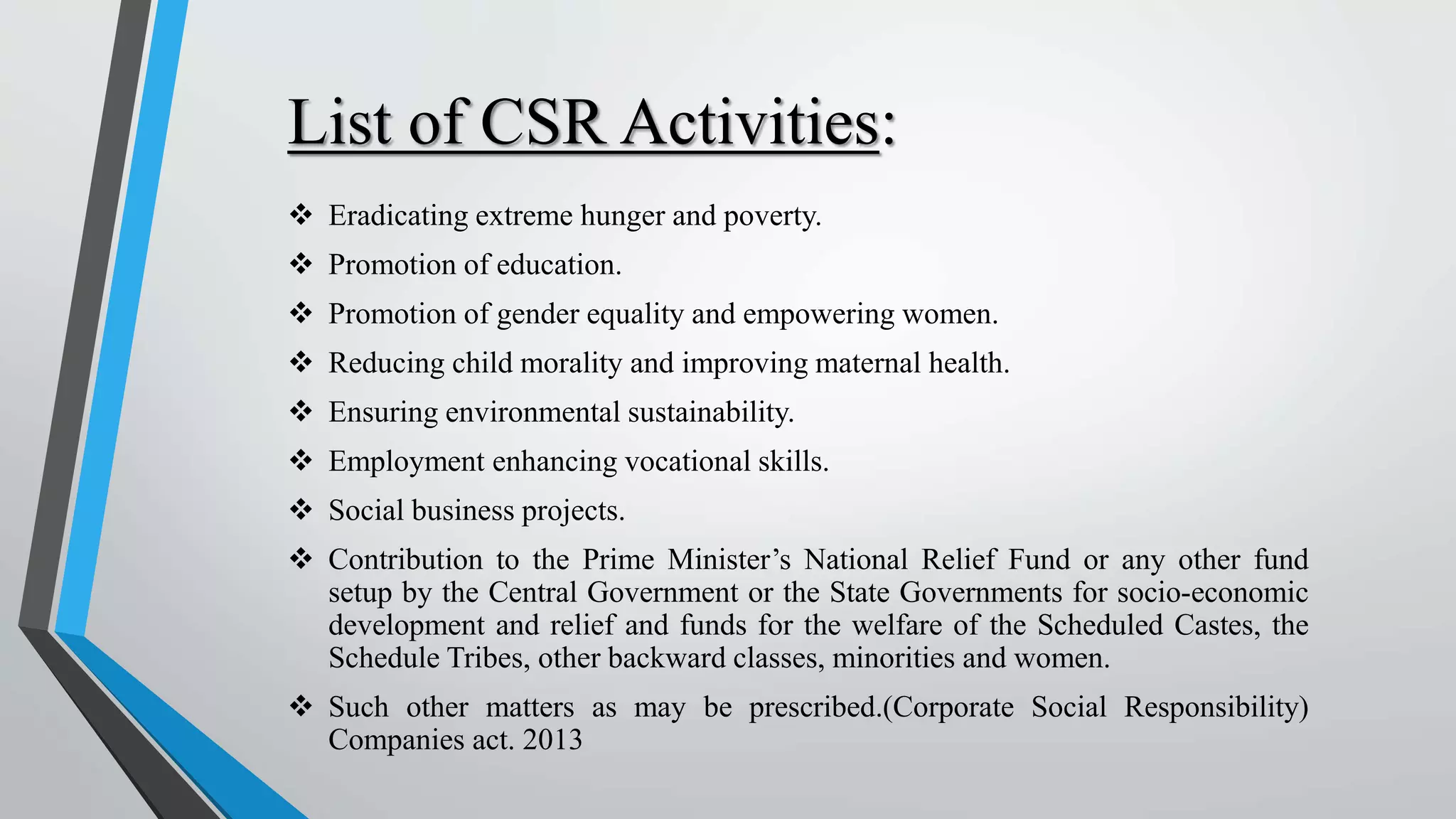
List of CSR Activities:
 Eradicating extreme hunger and poverty.
 Promotion of education.
 Promotion of gender equality and empowering women.
 Reducing child morality and improving maternal health.
 Ensuring environmental sustainability.
 Employment enhancing vocational skills.
 Social business projects.
 Contribution to the Prime Minister’s National Relief Fund or any other fund
setup by the Central Government or the State Governments for socio-economic
development and relief and funds for the welfare of the Scheduled Castes, the
Schedule Tribes, other backward classes, minorities and women.
 Such other matters as may be prescribed.(Corporate Social Responsibility)
Companies act. 2013
Thank You…

Corporate social responsibility

  • 2.
    Meaning of CorporateSocial Responsibility(CSR), 2013:  CSR is a process by which an organizational thinks about and evolves its relationships with stakeholders for the common good and demonstrate its commitment in this regard by adoption of appropriate business processes and strategies. Thus CSR is no charity or donations.  CRS is a way of conducting business, by which corporate entities visibly contribute to the social good. Socially responsible companies use CSR to integrate economic, environmental and social objective with the company’s operations and growth.
  • 3.
    Applicability of CSRRules:  As per Section 135(1) of the act, all companies that have either of the following in any financial year-  Net worth of INR 500 Cr. or more  Turn over of INR 1000 Cr. or more  Net profit of INR 5 Cr. Or more *All companies means every company including its holding or subsidiary or foreign company having its branch office or project office on India.
  • 4.
    Appointment of CSRCommittee:  Compromising as per Companies Act 2013:- • Compromising of three or more directors with at least one independent Director. • Composition should be disclose in the annual board of directors report.  Company – wise composition rules:- • Unlisted public or private company u/s 135(1), not required to appoint Independent Director pursuant to SEC.149(4):- Composition committee without independent director • Private company having 2 director only:- Compose committee with such 2 directors • In case of foreign company:- Committee shall comprise of 2 persons of which 1. One person shall be specified u/s 380(1)(d) of this act 2. Another person shall be nominated by foreign company
  • 5.
    Responsibilities of theCommittee: o Committee shall prepare, formula and recommend to the board of the CSR policy of the company which shall indicate activities to be undertaken. o Recommend amount of expenditure to be incurred on the above activities. o Monitor CSR policy from time to time.
  • 6.
    Responsibilities of Company’sBoard: o Approve and Disclose CSR policy in the Annual Director’s report and company website. o Ensure implementation of CSR activities as per the policy. o Ensure that the company spends, in every financial year, at least 2% of average net profit made during the three immediate preceding financial years. o Director’s report to specify reasons in case the specified amount is not spent.
  • 7.
    Annual spending onCSR by Companies:  For every financial year, CSR spending would be computed as 2% of the average net profit made by the company during every block of three preceding financial years.  Net profit for the SEC.135 and CSR rules shall mean, net profit before tax as per books of accounts and shall not include profit arising from branches outside India.  For this purpose, the average net profit will be calculated in accordance with SEC.198.
  • 8.
    CSR Policy:  CSRPolicy of the company shall include:- • Projects and programs that are to be undertaken. • A list of CSR project/programs which a company plans to undertake, which may also focus on integrating business models with social and environmental priorities and processes in order to create shared value, specified modalities of execution in the execution of areas or sectors chosen and implementation schedules.  CSR of the company should provide the surplus arising out of the CSR activity will not be part of business profits of a company.  CSR policy would specify that the corpus would include the following: I. 2% of the average net profits, there from, out of CSR activities. II. Any income arising out of CSR activities. III. Surplus arising out of the CSR activities.
  • 9.
    Format of Reporting: Format for the annual report on CSR initiatives to be included in the board report by qualifying companies.  Provide a brief outline on company’s CSR policy including an overview of activities proposed to be undertaken and indicate the web link to the CSR policy.  The composition of the CSR committee.  Average net profit of the company for last three financial years.  Prescribed CSR expenditure.  In case the company has failed to spend the 2% of the average net profit (INR) of the last 3 financial years, please provide the reasons for not spending the amount.
  • 10.
    List of CSRActivities:  Eradicating extreme hunger and poverty.  Promotion of education.  Promotion of gender equality and empowering women.  Reducing child morality and improving maternal health.  Ensuring environmental sustainability.  Employment enhancing vocational skills.  Social business projects.  Contribution to the Prime Minister’s National Relief Fund or any other fund setup by the Central Government or the State Governments for socio-economic development and relief and funds for the welfare of the Scheduled Castes, the Schedule Tribes, other backward classes, minorities and women.  Such other matters as may be prescribed.(Corporate Social Responsibility) Companies act. 2013
  • 11.