TYPES OF BEAM & TYPES OF
SUPPORTS
Subject: Engineering Mechanics
By: Engr.Mir zafarullah Jamali
Quaid-e-Awam University of Engineering, Science &
Technology Larkana
INTRODUCTION
 What is meant by a beam in Engineering?
 A beam is a structural element which is capable of
withstanding transverse loads. Simply a beam
transfers its applied loads to the supports
 What is meant by a support?
 A support is an element which bears the weight of a
beam and keeps it upright. Simply we can say that
it is a thing which keeps beam in Equilibrium.
 What is meant by a load?
 A load in this concept refers to the forces acting on
Structures. This is the reason these can be also
called as structural loads.
TYPES OF SUPPORTS
 Basing on the concept how they are supporting the
beam they are classified into 4 types
 1. Fixed Support
 2. Simple Support
 3. Roller Support
 4. Hinged Support
FIXED SUPPORT
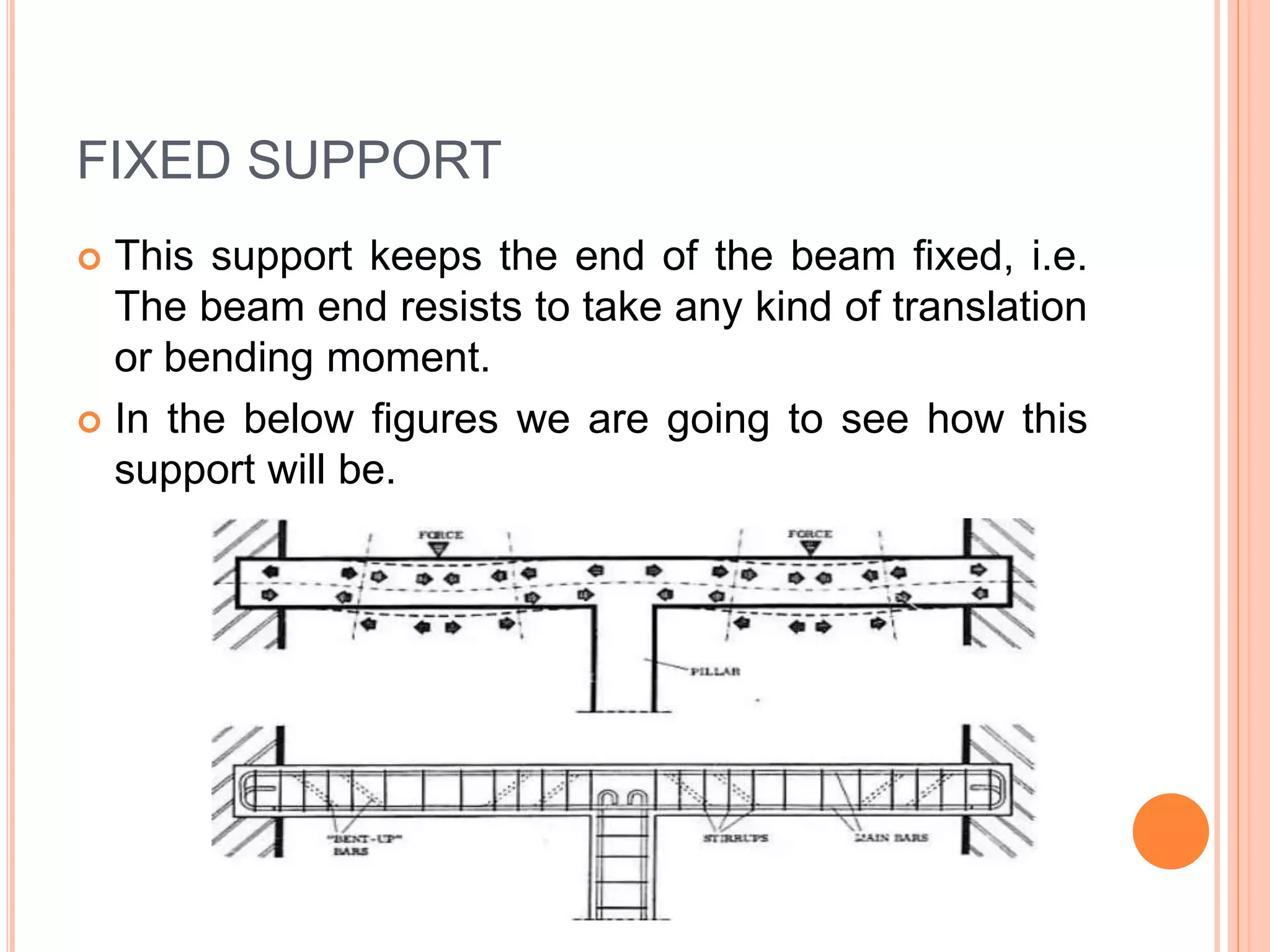
 This support keeps the end of the beam fixed, i.e.
The beam end resists to take any kind of translation
or bending moment.
 In the below figures we are going to see how this
support will be.
FIXED SUPPORT
ROLLER SUPPORT
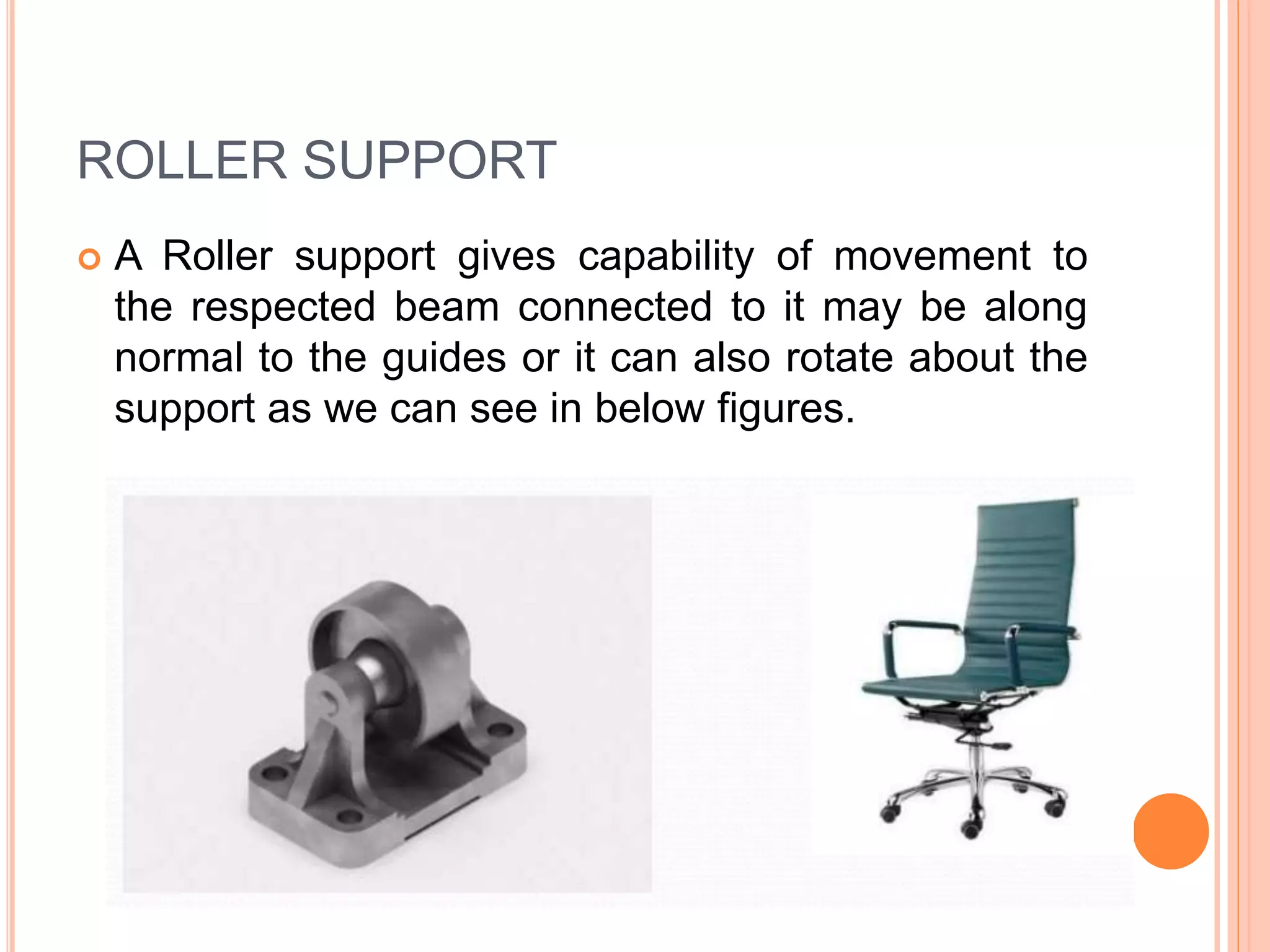
 A Roller support gives capability of movement to
the respected beam connected to it may be along
normal to the guides or it can also rotate about the
support as we can see in below figures.
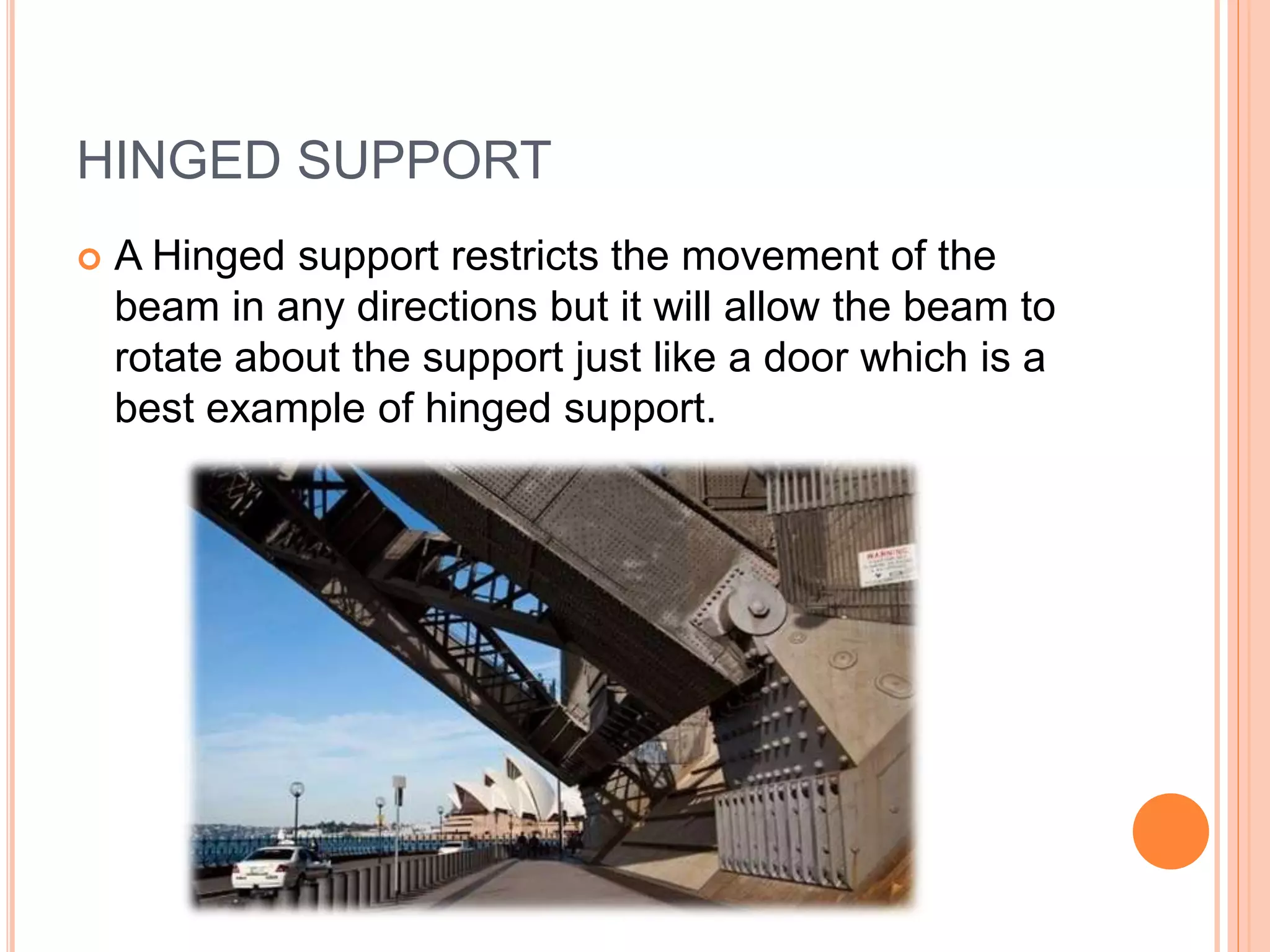
HINGED SUPPORT
 A Hinged support restricts the movement of the
beam in any directions but it will allow the beam to
rotate about the support just like a door which is a
best example of hinged support.
TYPES OF BEAMS
 Basing on the concept how they are supported they
are classified into floowing types
 1. Fixed Beam
 2. Cantilever Beams
 3. Simply Supported Beams
 5. Over Hanging Beams
 6. Continuous Beams
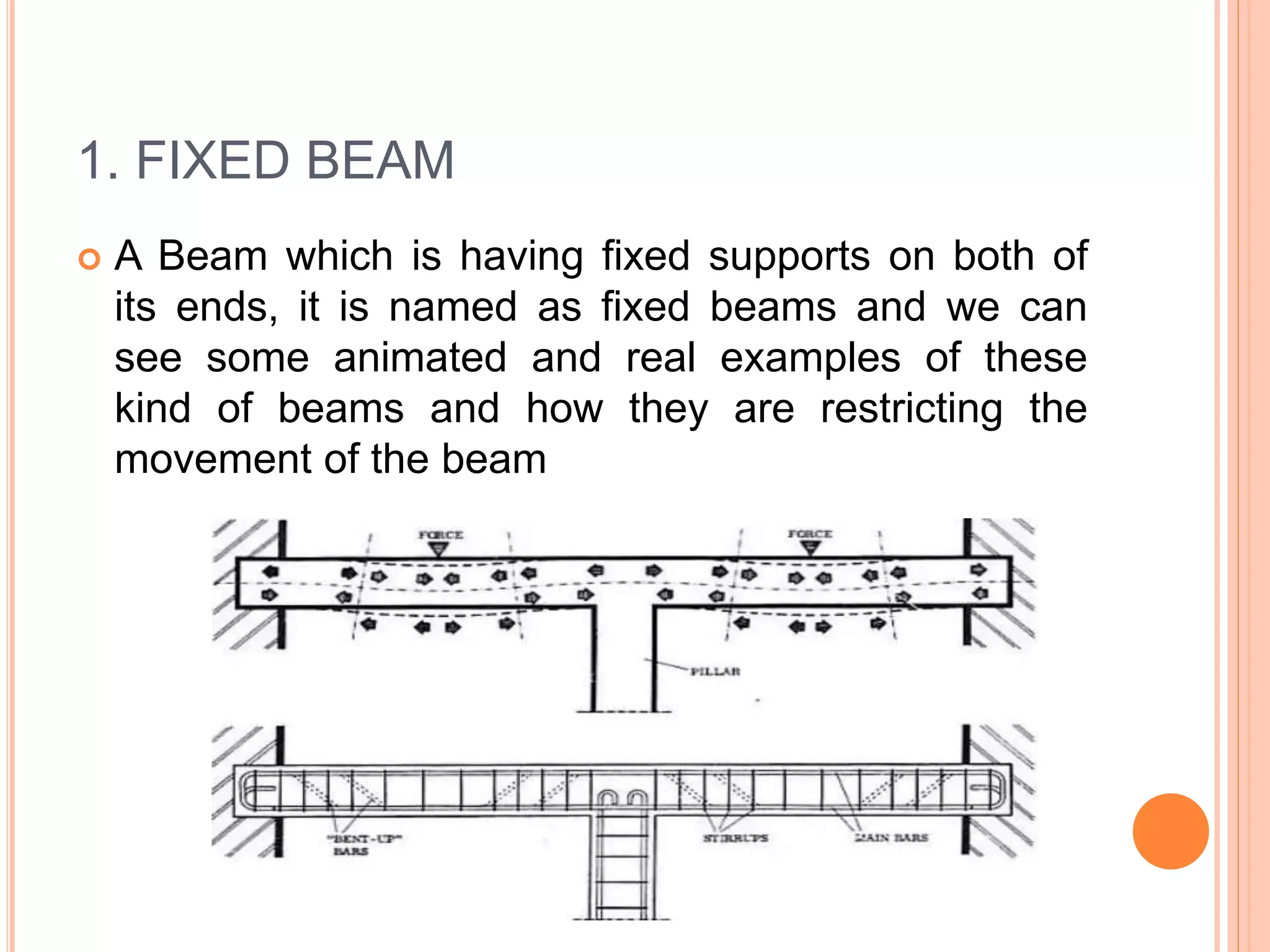
1. FIXED BEAM
 A Beam which is having fixed supports on both of
its ends, it is named as fixed beams and we can
see some animated and real examples of these
kind of beams and how they are restricting the
movement of the beam
1.FIXED BEAM
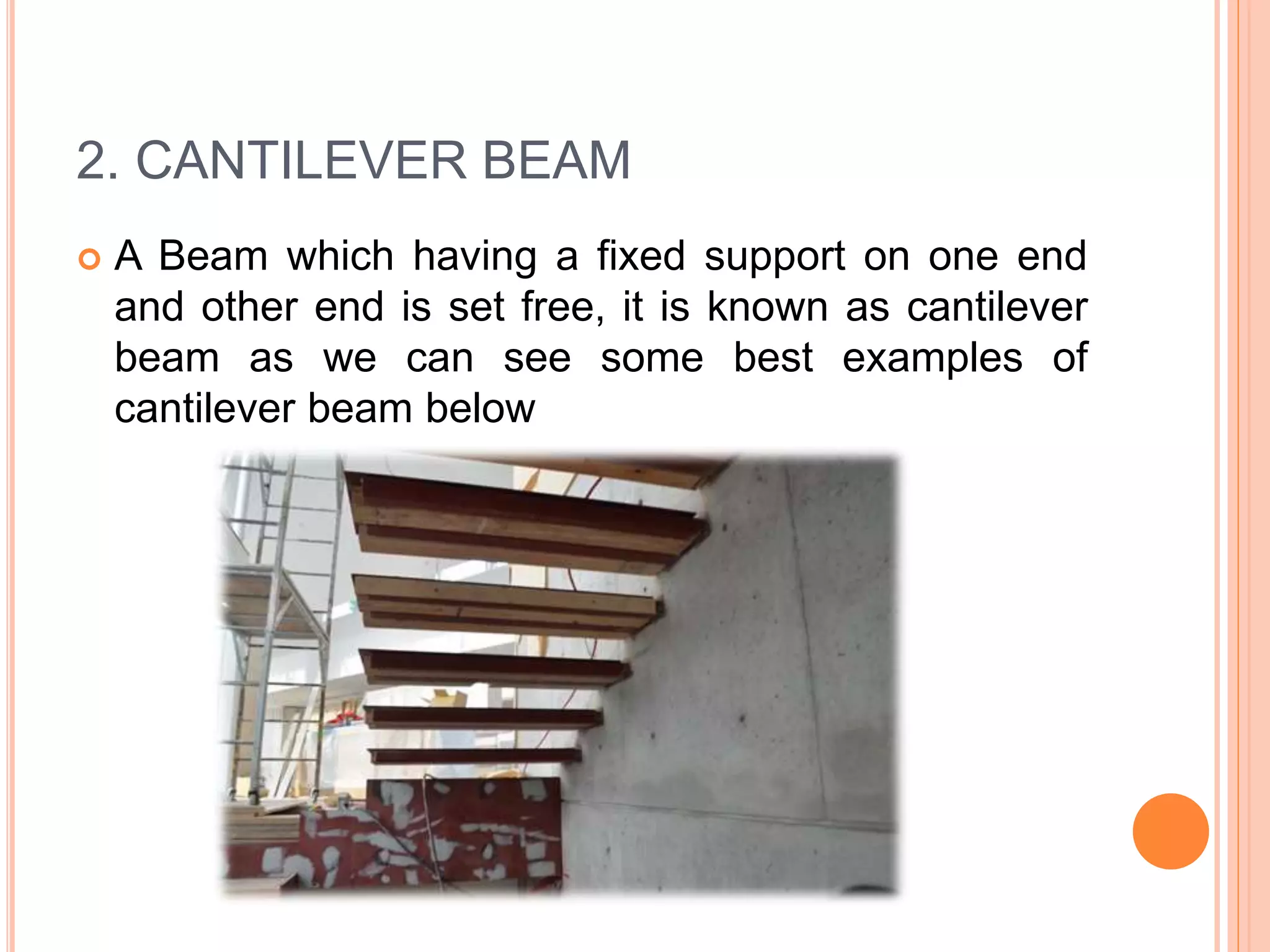
2. CANTILEVER BEAM
 A Beam which having a fixed support on one end
and other end is set free, it is known as cantilever
beam as we can see some best examples of
cantilever beam below
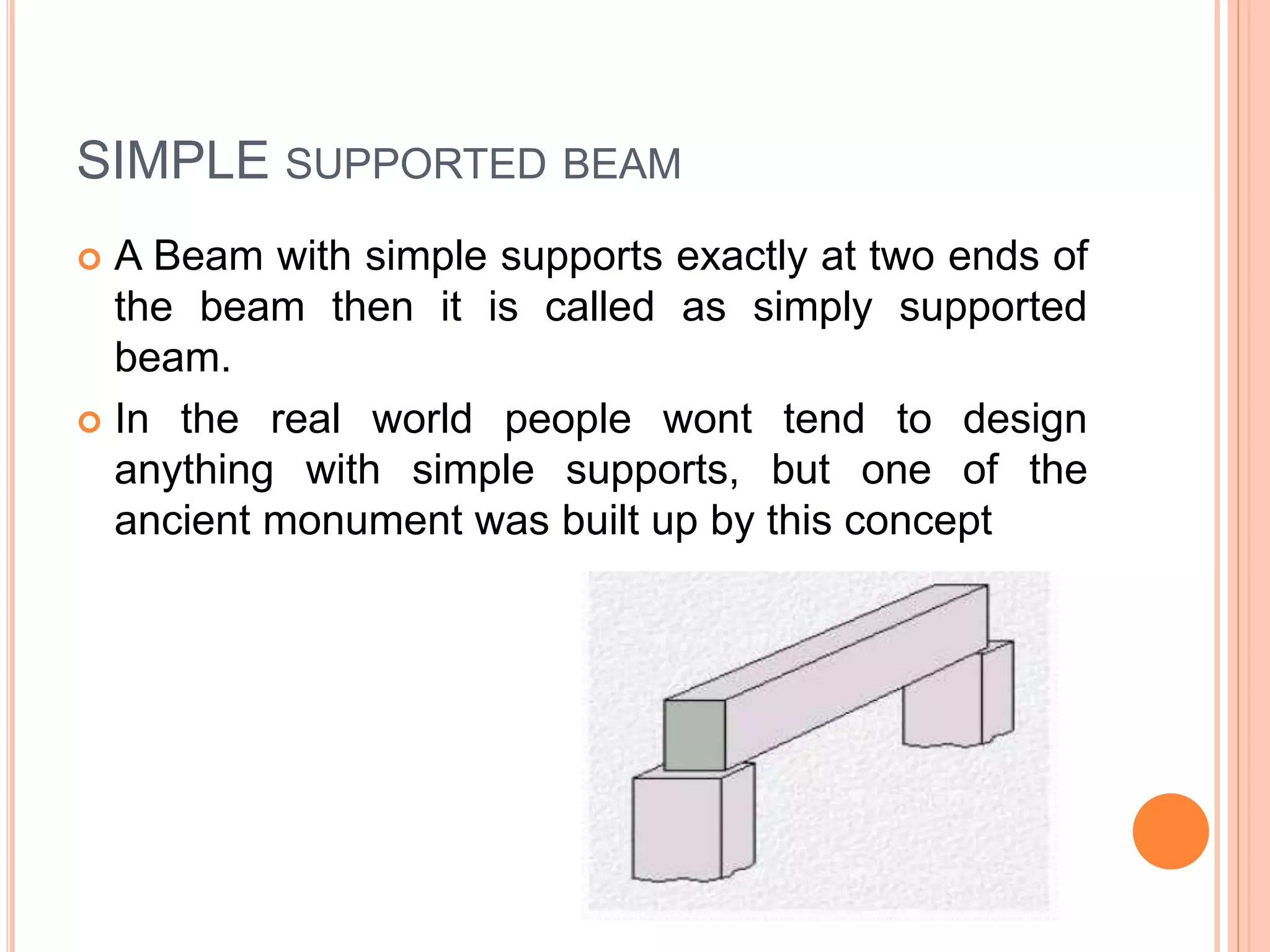
SIMPLE SUPPORTED BEAM
 A Beam with simple supports exactly at two ends of
the beam then it is called as simply supported
beam.
 In the real world people wont tend to design
anything with simple supports, but one of the
ancient monument was built up by this concept
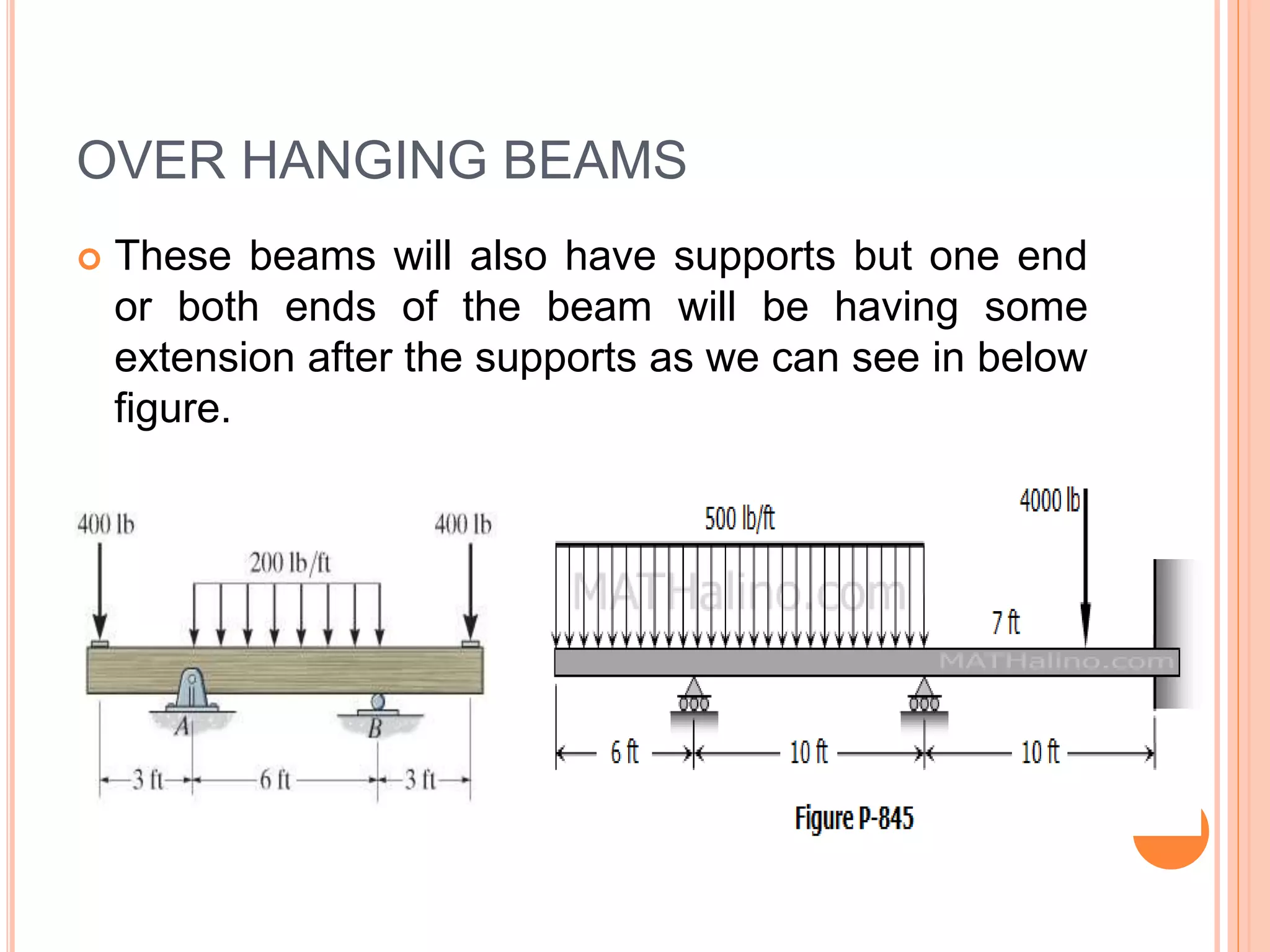
OVER HANGING BEAMS
 These beams will also have supports but one end
or both ends of the beam will be having some
extension after the supports as we can see in below
figure.
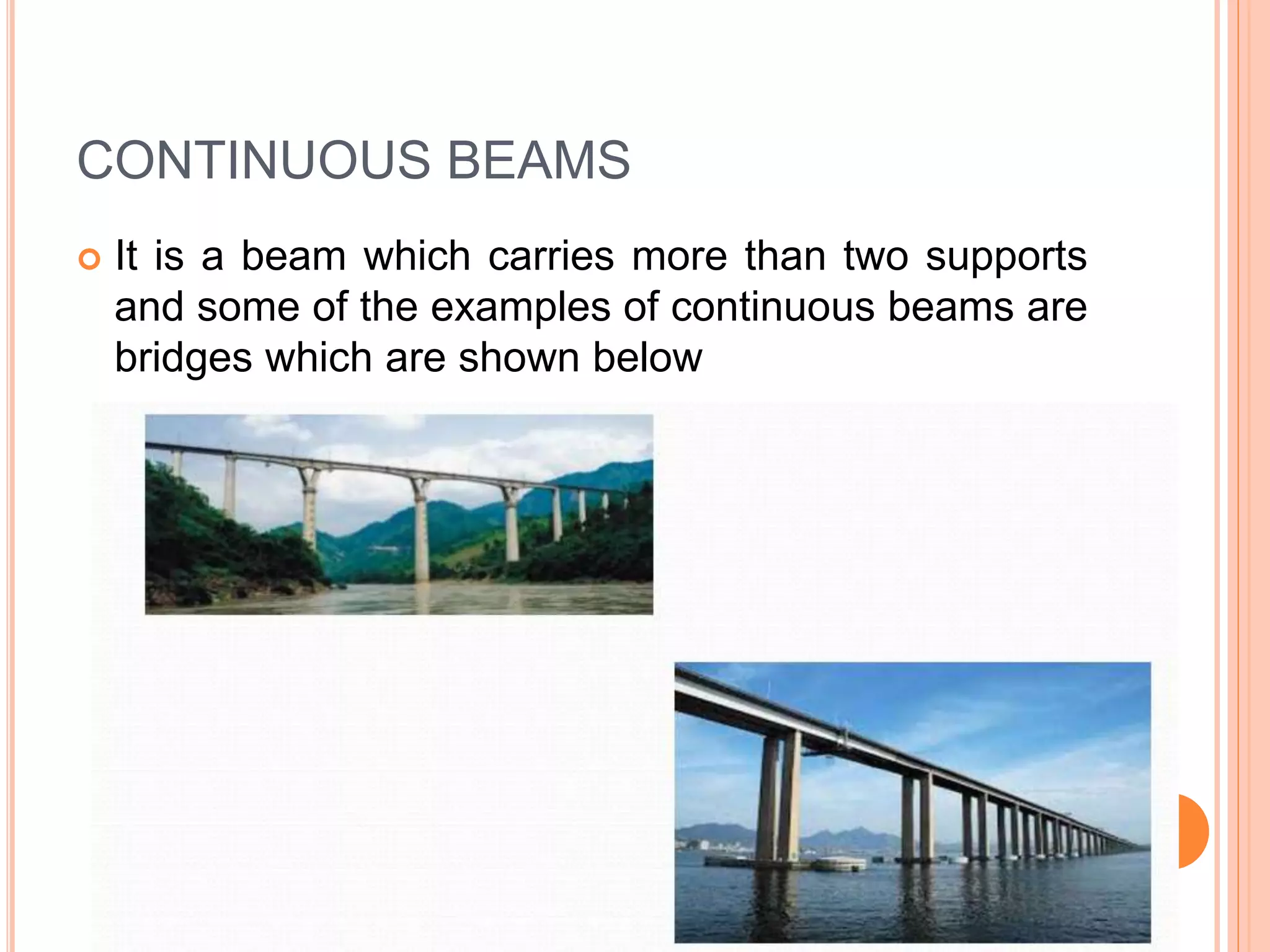
CONTINUOUS BEAMS
 It is a beam which carries more than two supports
and some of the examples of continuous beams are
bridges which are shown below
TYPES OF LOADS
 Basing on the action of the forces the loads are
classified into 3 types
 1. Point Load (or) Concentrated Load
 2. Uniformly Distributed Load
 3. Uniformly Varying Load
POINT LOAD (OR) CONCENTRATED
LOAD
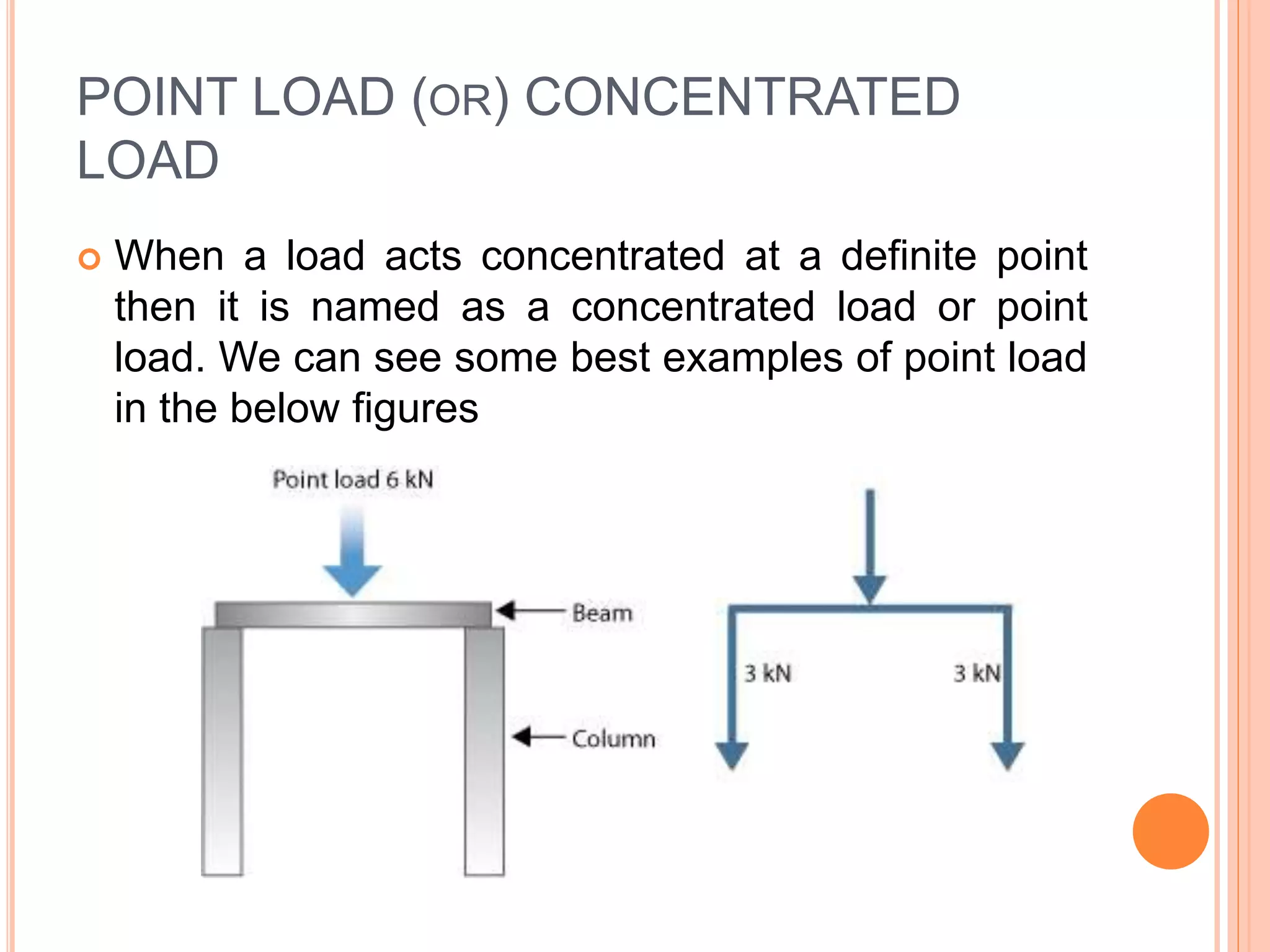
 When a load acts concentrated at a definite point
then it is named as a concentrated load or point
load. We can see some best examples of point load
in the below figures
UNIFORMLY DISTRIBUTED LOAD
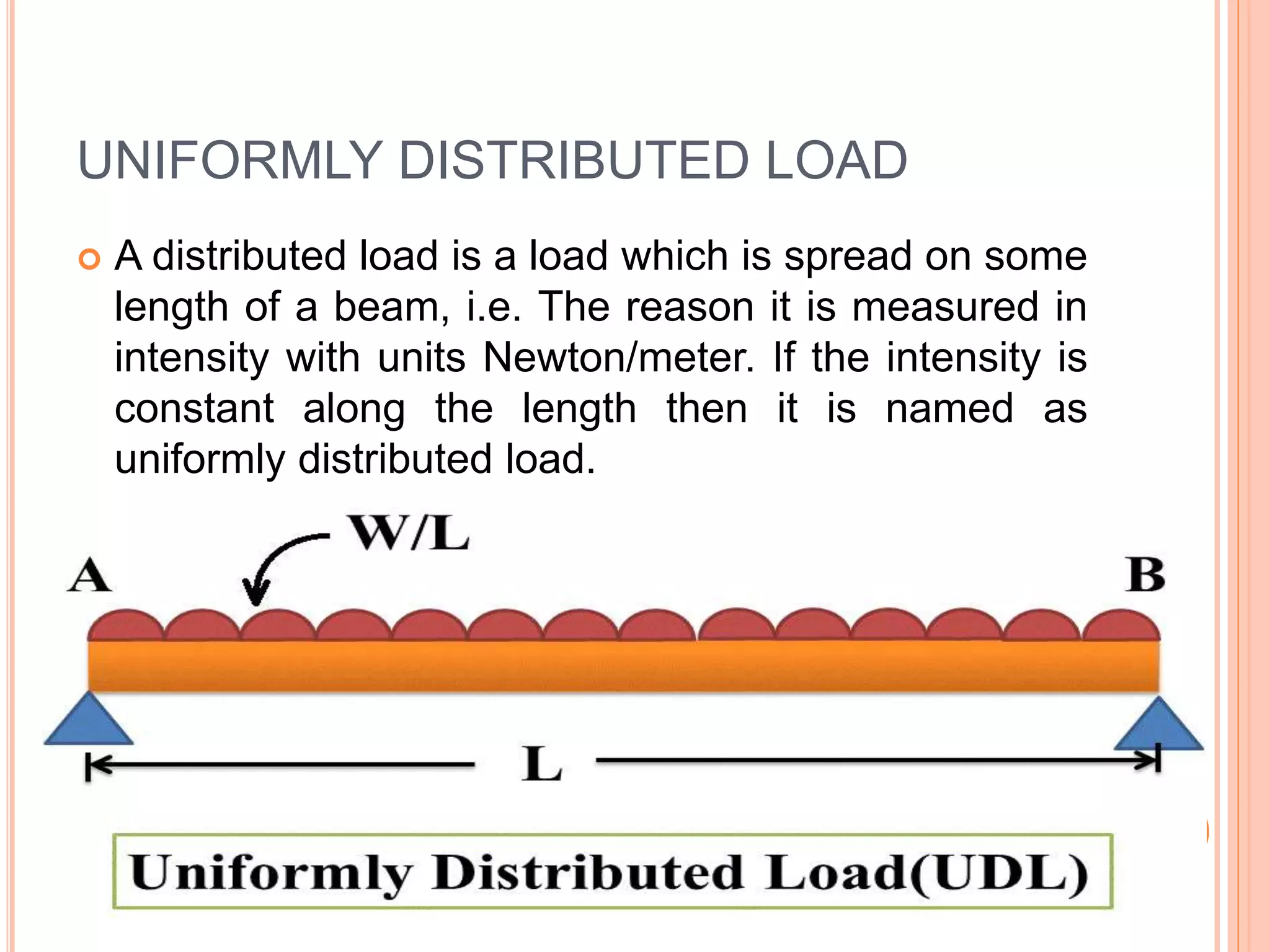
 A distributed load is a load which is spread on some
length of a beam, i.e. The reason it is measured in
intensity with units Newton/meter. If the intensity is
constant along the length then it is named as
uniformly distributed load.
UNIFORMLY VARYING LOAD
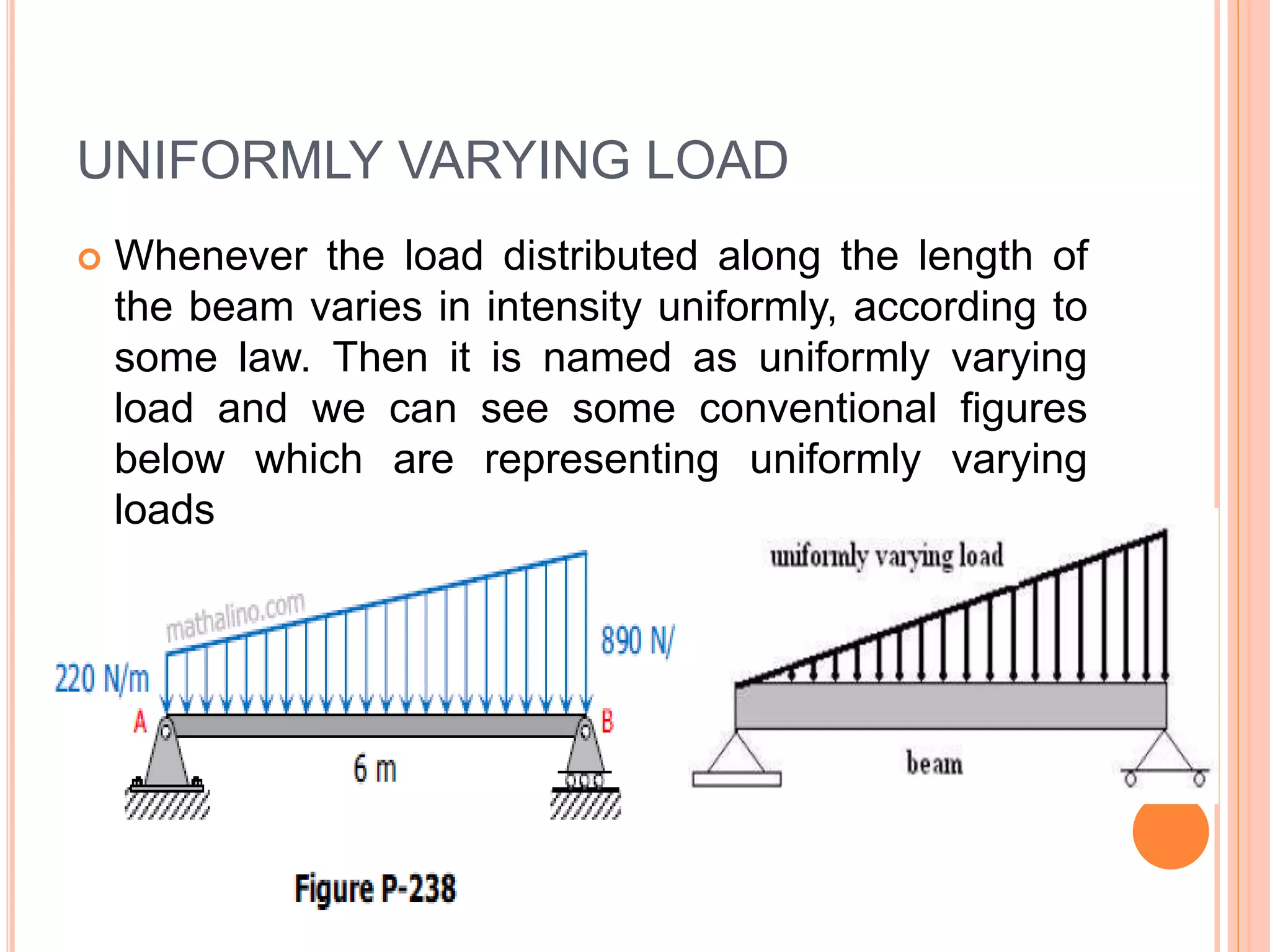
 Whenever the load distributed along the length of
the beam varies in intensity uniformly, according to
some law. Then it is named as uniformly varying
load and we can see some conventional figures
below which are representing uniformly varying
loads
STIFFNESS
STIFFNESS
 Stiffness is the extent to which a body resist
deformation in response to an applied force.
 The complementary concept is flexibility or
pliability: the more flexible an object is, the less stiff
it is
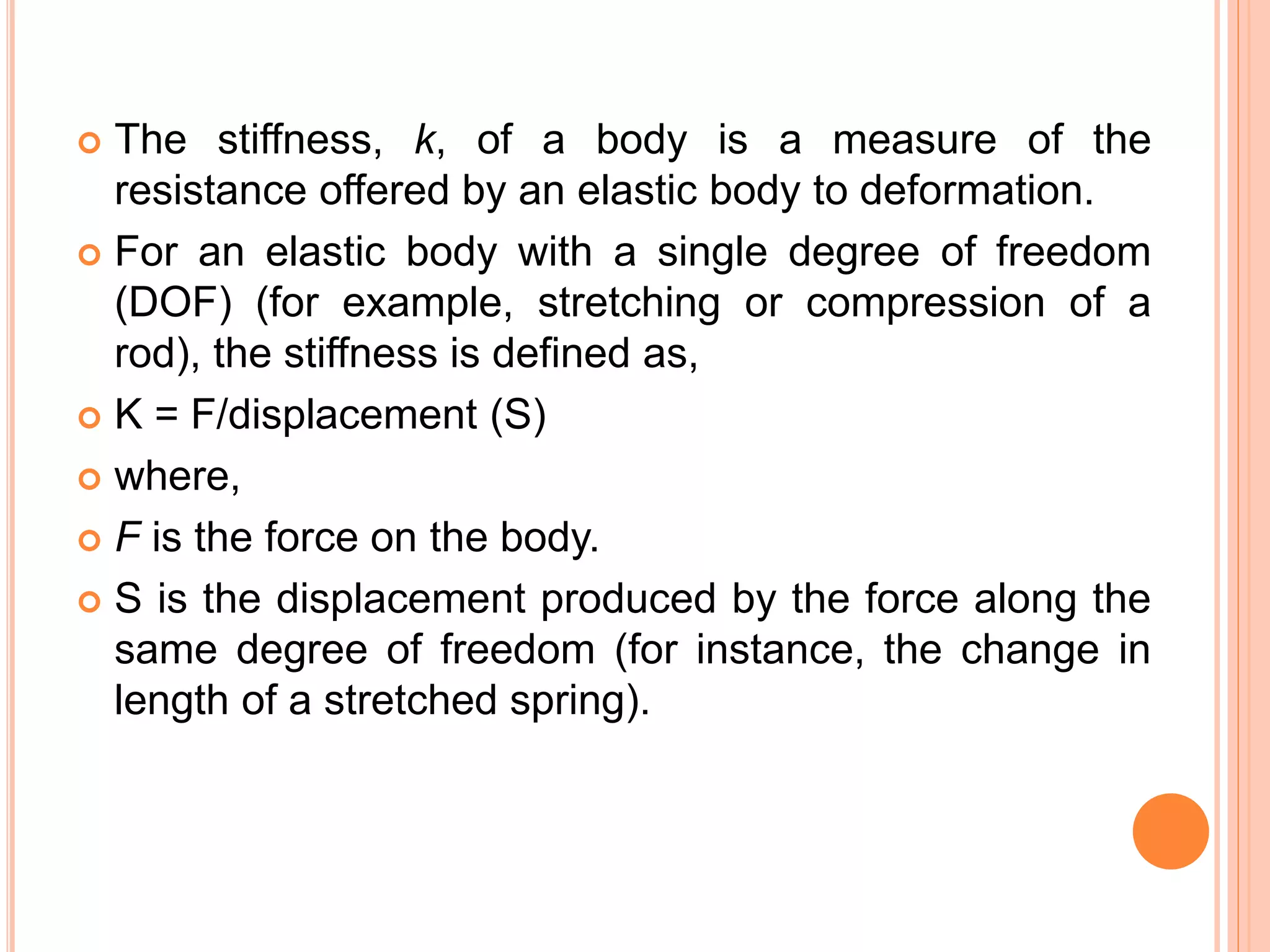
 The stiffness, k, of a body is a measure of the
resistance offered by an elastic body to deformation.
 For an elastic body with a single degree of freedom
(DOF) (for example, stretching or compression of a
rod), the stiffness is defined as,
 K = F/displacement (S)
 where,
 F is the force on the body.
 S is the displacement produced by the force along the
same degree of freedom (for instance, the change in
length of a stretched spring).
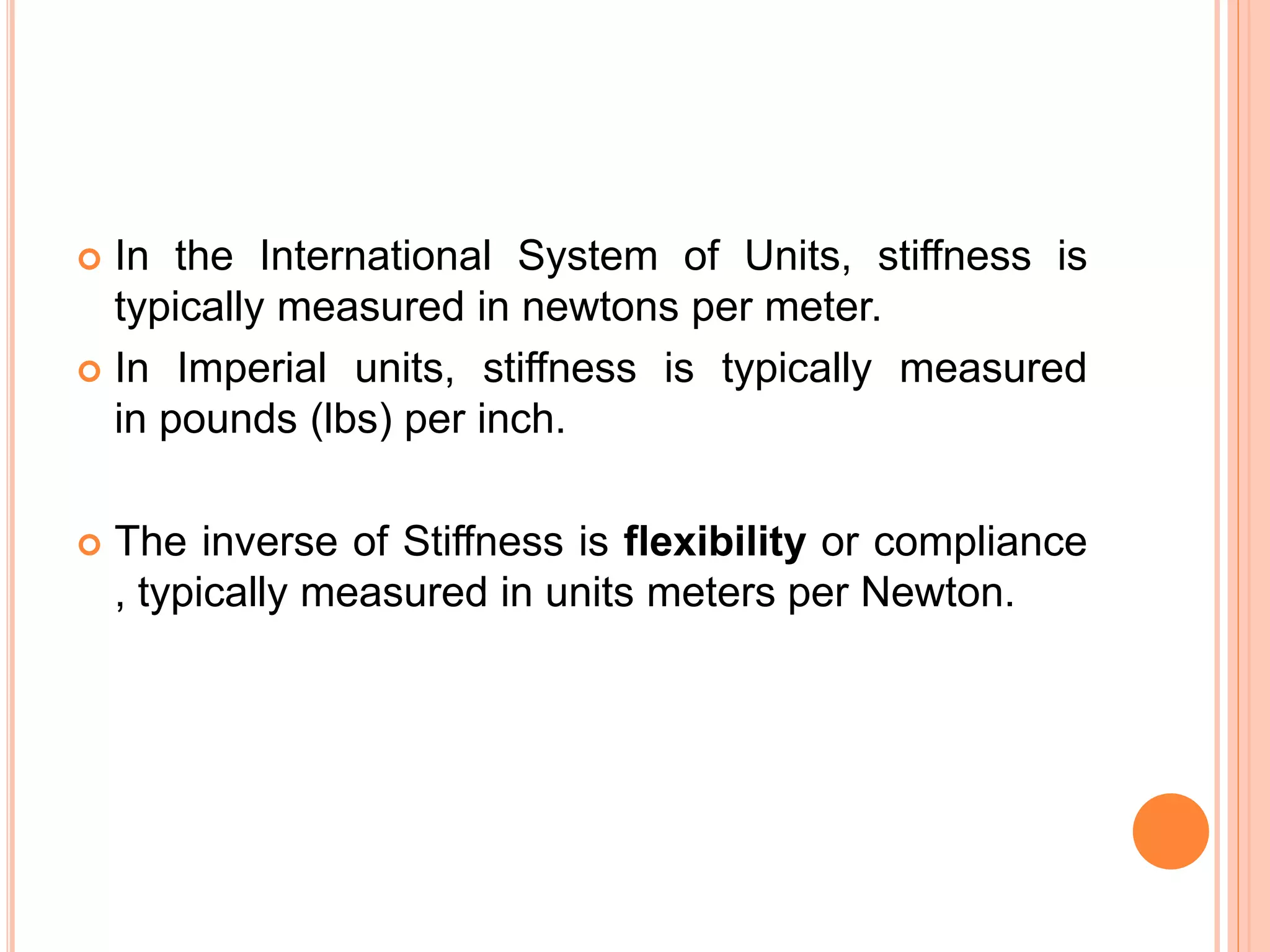
 In the International System of Units, stiffness is
typically measured in newtons per meter.
 In Imperial units, stiffness is typically measured
in pounds (lbs) per inch.
 The inverse of Stiffness is flexibility or compliance
, typically measured in units meters per Newton.

Types of beam & types of supports

  • 1.
    TYPES OF BEAM& TYPES OF SUPPORTS Subject: Engineering Mechanics By: Engr.Mir zafarullah Jamali Quaid-e-Awam University of Engineering, Science & Technology Larkana
  • 2.
    INTRODUCTION  What ismeant by a beam in Engineering?  A beam is a structural element which is capable of withstanding transverse loads. Simply a beam transfers its applied loads to the supports  What is meant by a support?  A support is an element which bears the weight of a beam and keeps it upright. Simply we can say that it is a thing which keeps beam in Equilibrium.  What is meant by a load?  A load in this concept refers to the forces acting on Structures. This is the reason these can be also called as structural loads.
  • 3.
    TYPES OF SUPPORTS Basing on the concept how they are supporting the beam they are classified into 4 types  1. Fixed Support  2. Simple Support  3. Roller Support  4. Hinged Support
  • 4.
    FIXED SUPPORT  Thissupport keeps the end of the beam fixed, i.e. The beam end resists to take any kind of translation or bending moment.  In the below figures we are going to see how this support will be.
  • 5.
  • 6.
    ROLLER SUPPORT  ARoller support gives capability of movement to the respected beam connected to it may be along normal to the guides or it can also rotate about the support as we can see in below figures.
  • 7.
    HINGED SUPPORT  AHinged support restricts the movement of the beam in any directions but it will allow the beam to rotate about the support just like a door which is a best example of hinged support.
  • 8.
    TYPES OF BEAMS Basing on the concept how they are supported they are classified into floowing types  1. Fixed Beam  2. Cantilever Beams  3. Simply Supported Beams  5. Over Hanging Beams  6. Continuous Beams
  • 9.
    1. FIXED BEAM A Beam which is having fixed supports on both of its ends, it is named as fixed beams and we can see some animated and real examples of these kind of beams and how they are restricting the movement of the beam
  • 10.
  • 11.
    2. CANTILEVER BEAM A Beam which having a fixed support on one end and other end is set free, it is known as cantilever beam as we can see some best examples of cantilever beam below
  • 12.
    SIMPLE SUPPORTED BEAM A Beam with simple supports exactly at two ends of the beam then it is called as simply supported beam.  In the real world people wont tend to design anything with simple supports, but one of the ancient monument was built up by this concept
  • 13.
    OVER HANGING BEAMS These beams will also have supports but one end or both ends of the beam will be having some extension after the supports as we can see in below figure.
  • 14.
    CONTINUOUS BEAMS  Itis a beam which carries more than two supports and some of the examples of continuous beams are bridges which are shown below
  • 15.
    TYPES OF LOADS Basing on the action of the forces the loads are classified into 3 types  1. Point Load (or) Concentrated Load  2. Uniformly Distributed Load  3. Uniformly Varying Load
  • 16.
    POINT LOAD (OR)CONCENTRATED LOAD  When a load acts concentrated at a definite point then it is named as a concentrated load or point load. We can see some best examples of point load in the below figures
  • 17.
    UNIFORMLY DISTRIBUTED LOAD A distributed load is a load which is spread on some length of a beam, i.e. The reason it is measured in intensity with units Newton/meter. If the intensity is constant along the length then it is named as uniformly distributed load.
  • 18.
    UNIFORMLY VARYING LOAD Whenever the load distributed along the length of the beam varies in intensity uniformly, according to some law. Then it is named as uniformly varying load and we can see some conventional figures below which are representing uniformly varying loads
  • 19.
  • 20.
    STIFFNESS  Stiffness isthe extent to which a body resist deformation in response to an applied force.  The complementary concept is flexibility or pliability: the more flexible an object is, the less stiff it is
  • 21.
     The stiffness,k, of a body is a measure of the resistance offered by an elastic body to deformation.  For an elastic body with a single degree of freedom (DOF) (for example, stretching or compression of a rod), the stiffness is defined as,  K = F/displacement (S)  where,  F is the force on the body.  S is the displacement produced by the force along the same degree of freedom (for instance, the change in length of a stretched spring).
  • 22.
     In theInternational System of Units, stiffness is typically measured in newtons per meter.  In Imperial units, stiffness is typically measured in pounds (lbs) per inch.  The inverse of Stiffness is flexibility or compliance , typically measured in units meters per Newton.