• POINT LOAD ( CONCENTRATED LOAD)
• UNIFORMLY DISTRIBUTED LOAD. ( UDL)
• UNIFORMLY VARYING LOAD (UVL)
• ROLLING LOAD
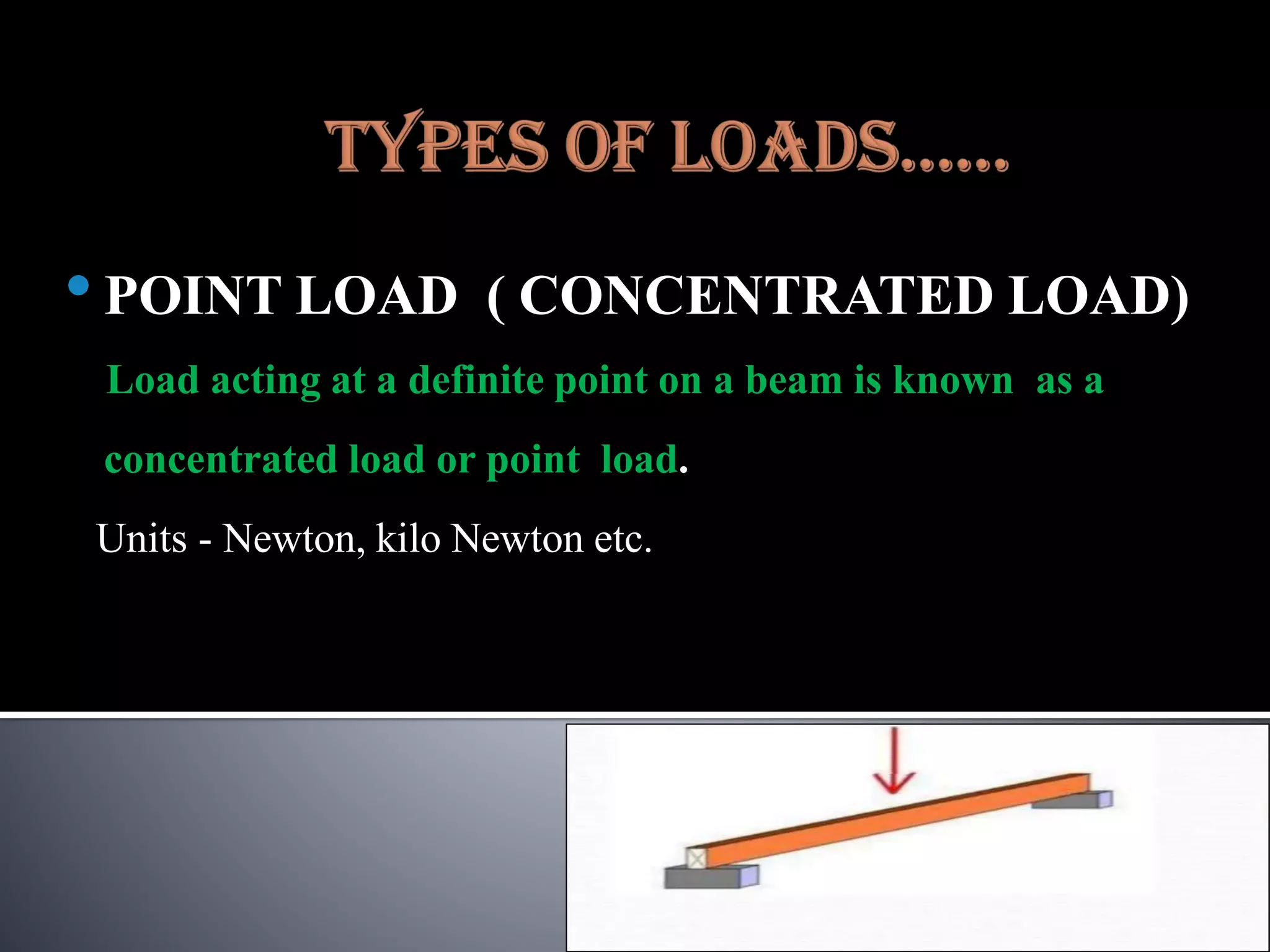
•POINT LOAD ( CONCENTRATED LOAD)
Load acting at a definite point on a beam is known as a
concentrated load or point load.
Units - Newton, kilo Newton etc.
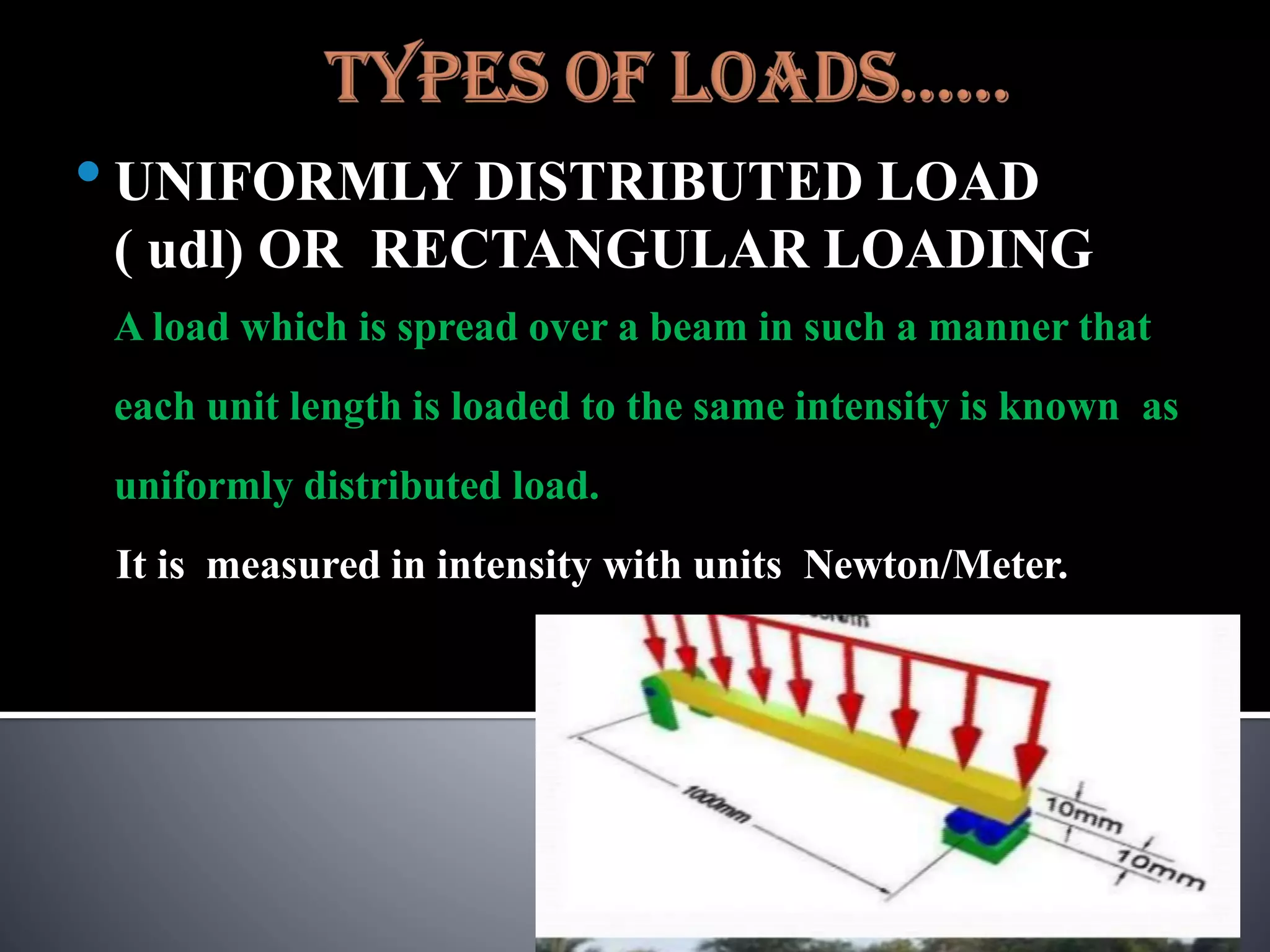
•UNIFORMLY DISTRIBUTED LOAD
( udl) OR RECTANGULAR LOADING
A load which is spread over a beam in such a manner that
each unit length is loaded to the same intensity is known as
uniformly distributed load.
It is measured in intensity with units Newton/Meter.
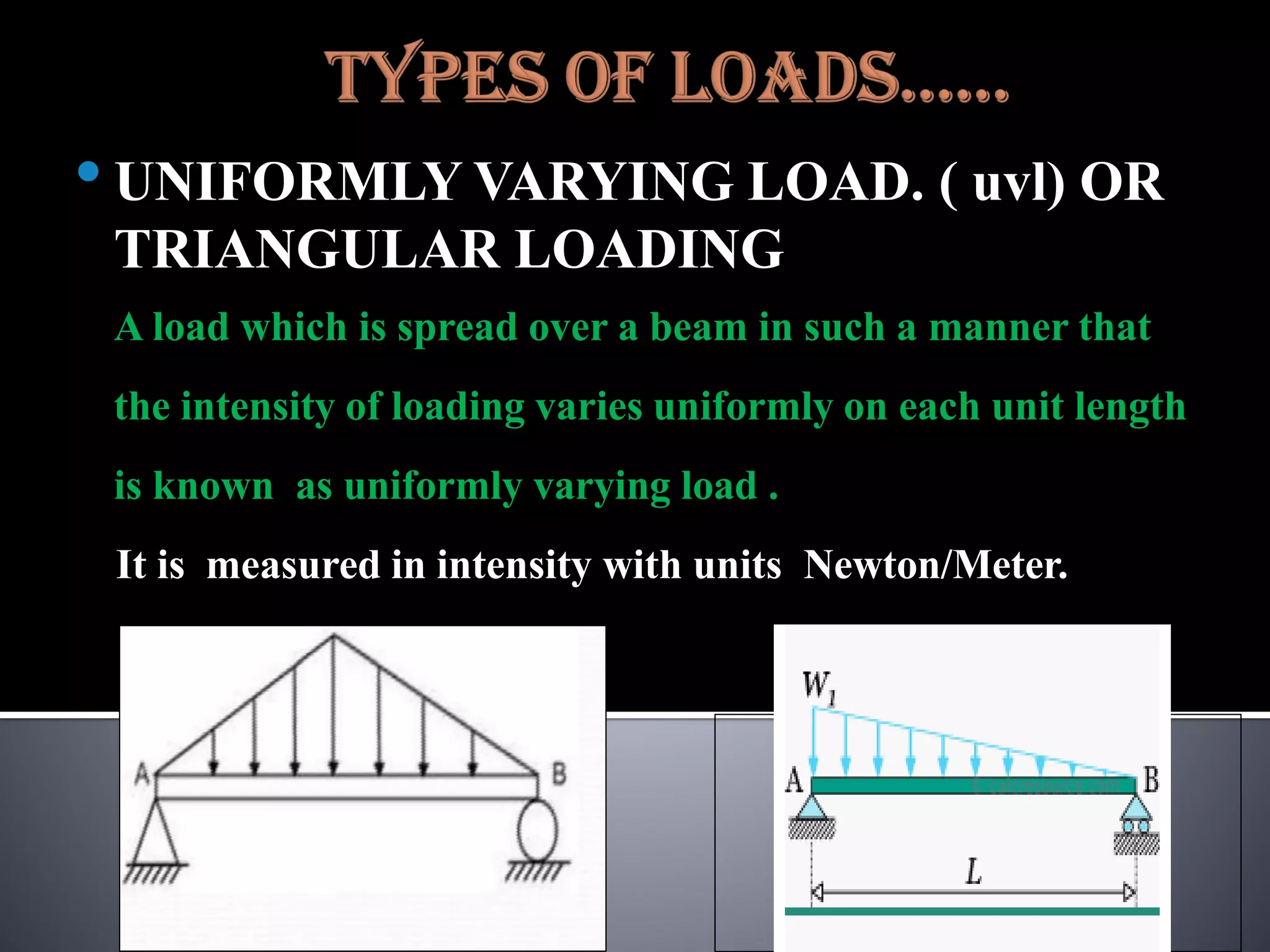
•UNIFORMLY VARYING LOAD. ( uvl) OR
TRIANGULAR LOADING
A load which is spread over a beam in such a manner that
the intensity of loading varies uniformly on each unit length
is known as uniformly varying load .
It is measured in intensity with units Newton/Meter.
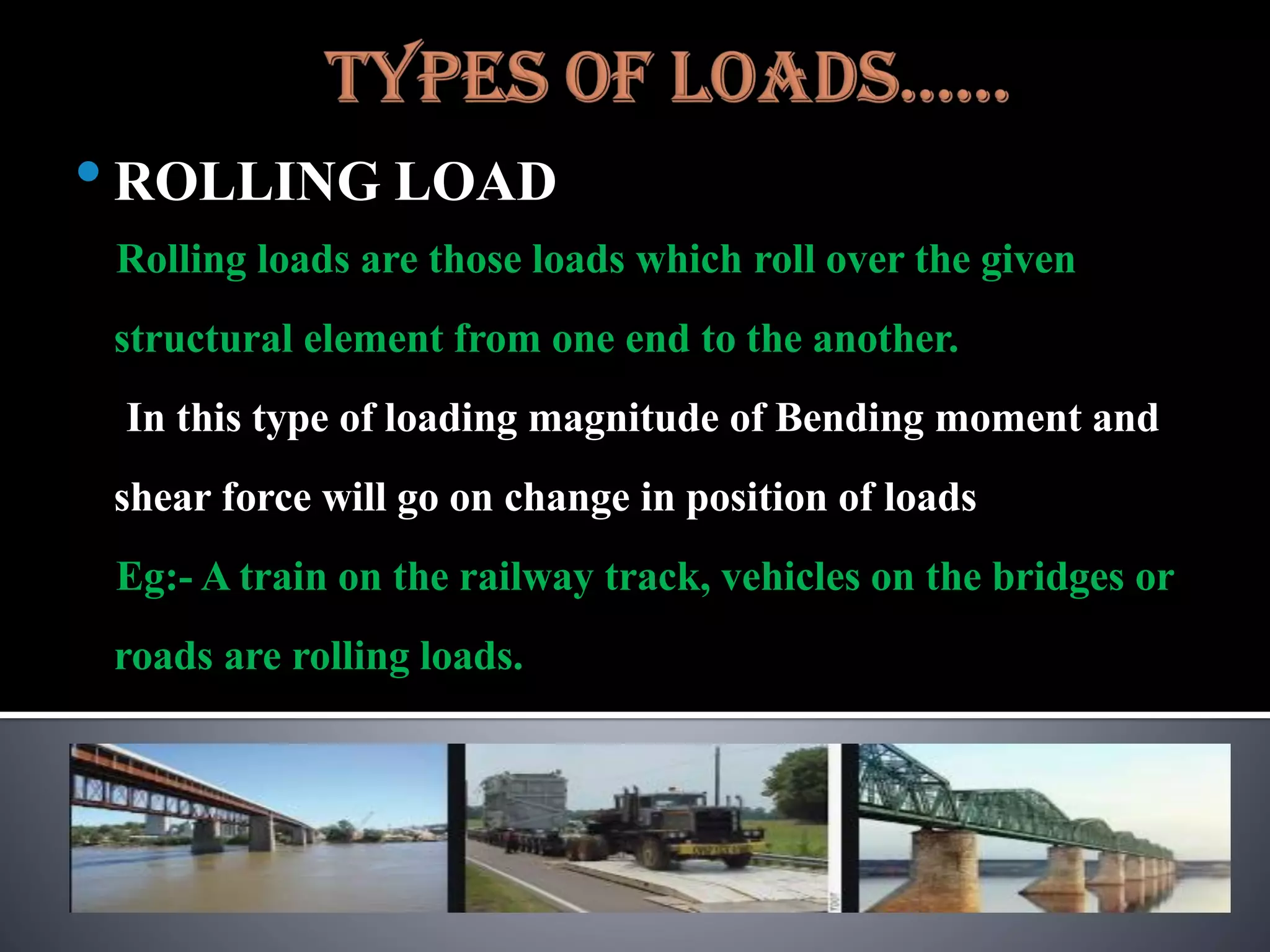
•ROLLING LOAD
Rolling loads are those loads which roll over the given
structural element from one end to the another.
In this type of loading magnitude of Bending moment and
shear force will go on change in position of loads
Eg:- A train on the railway track, vehicles on the bridges or
roads are rolling loads.
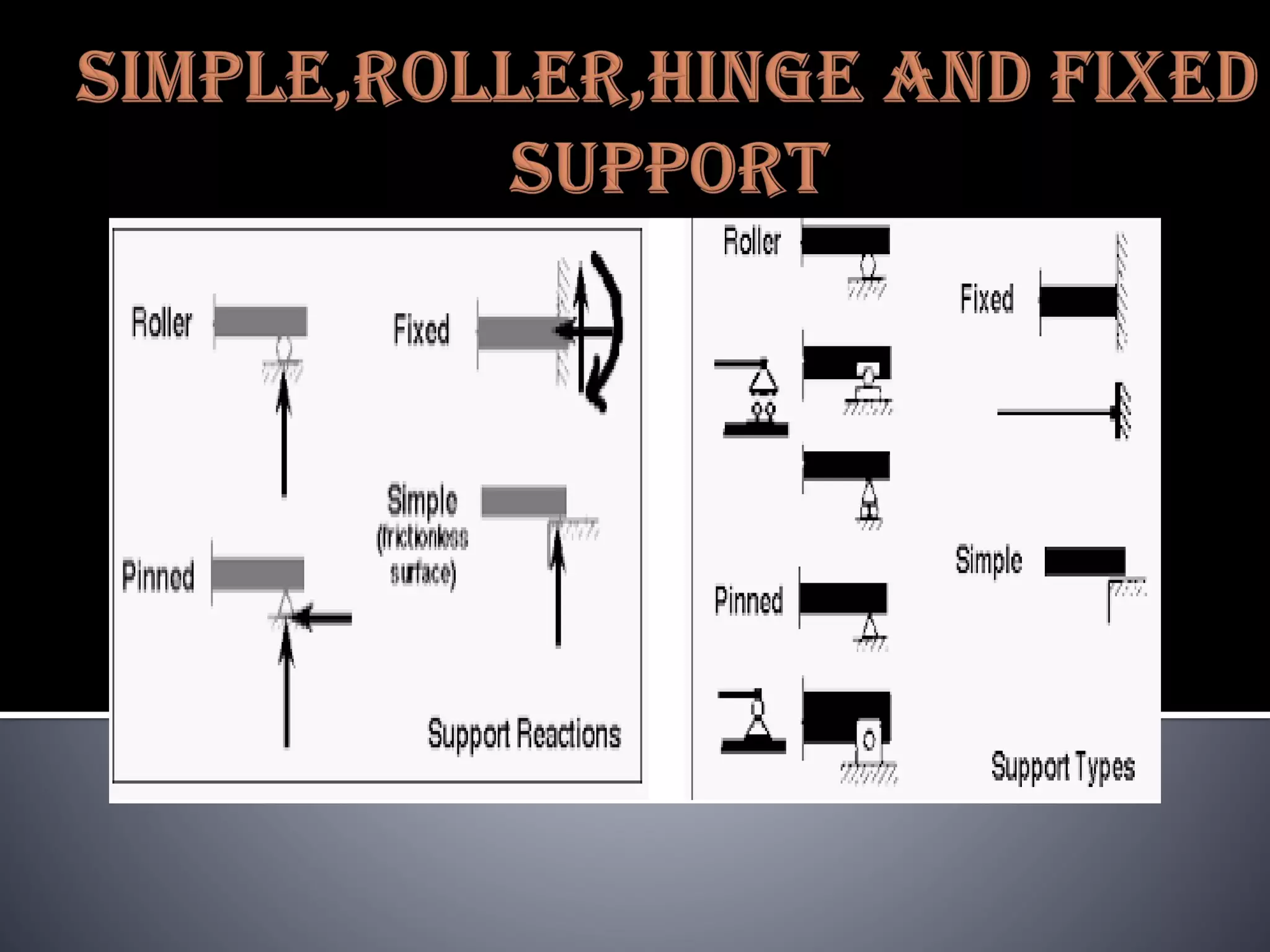
•SIMPLE SUPPORT
•ROLLER SUPPORT
•HINGED SUPPORT
•FIXED SUPPORT
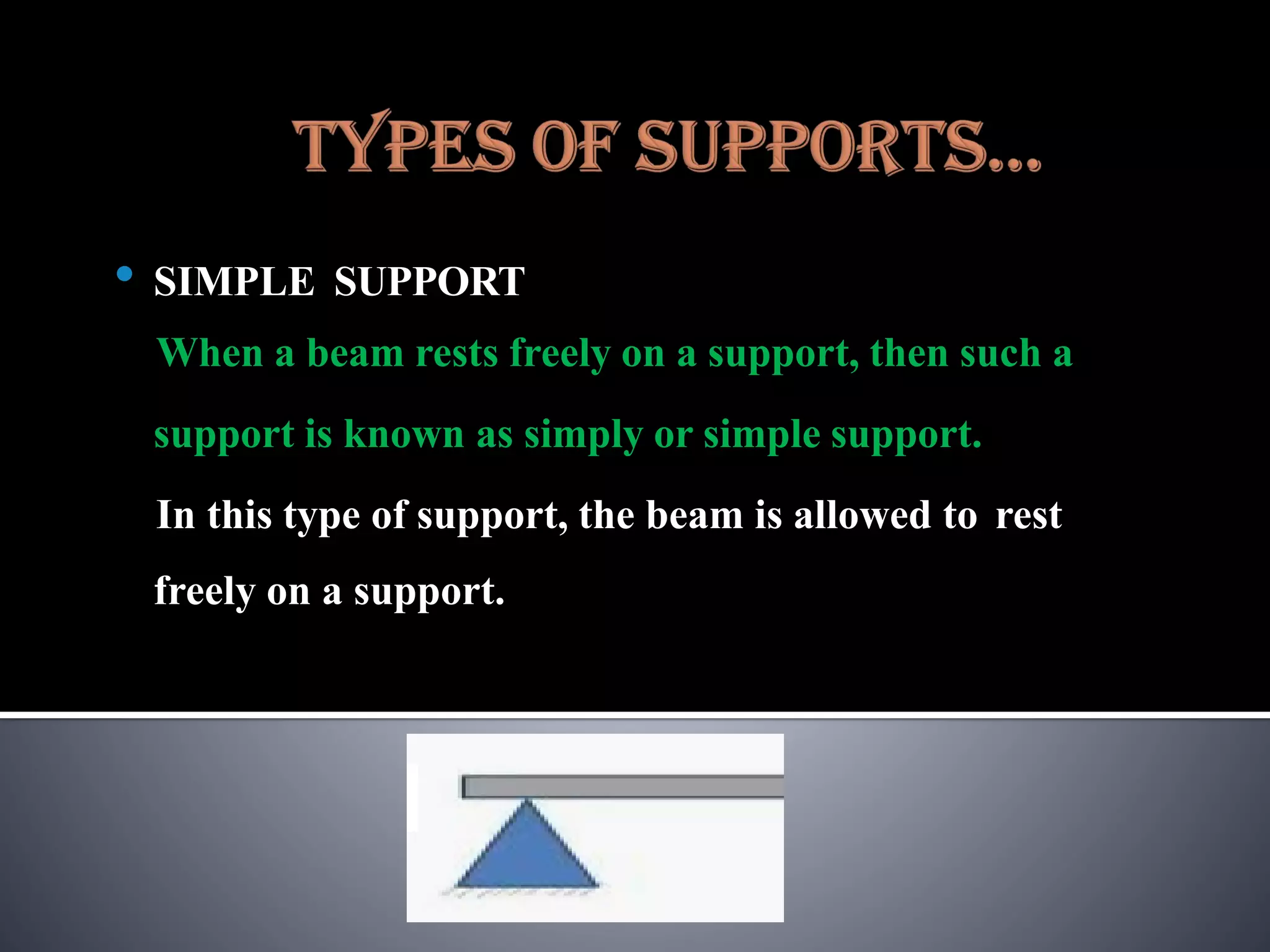
• SIMPLE SUPPORT
When a beam rests freely on a support, then such a
support is known as simply or simple support.
In this type of support, the beam is allowed to rest
freely on a support.
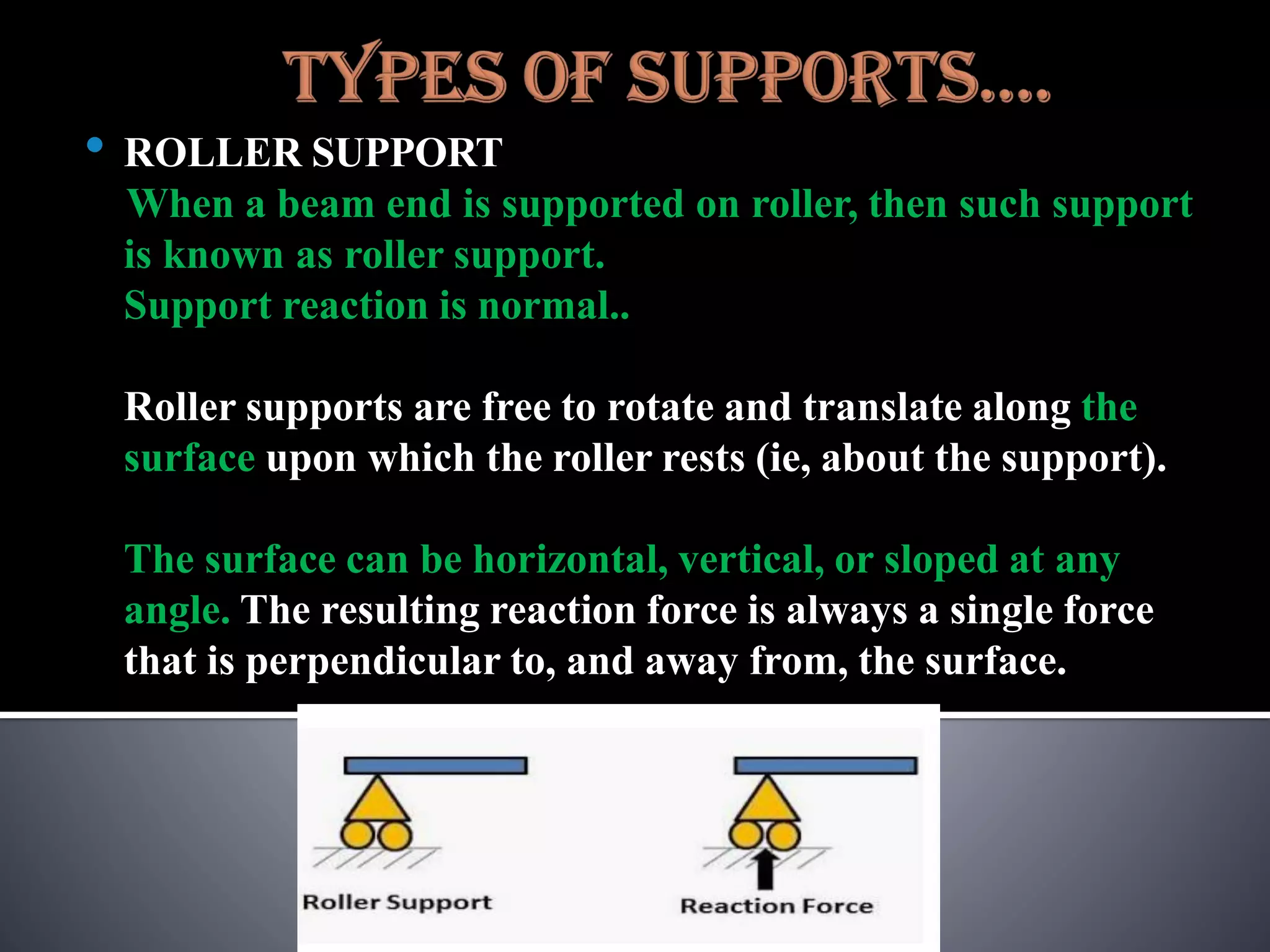
• ROLLER SUPPORT
When a beam end is supported on roller, then such support
is known as roller support.
Support reaction is normal..
Roller supports are free to rotate and translate along the
surface upon which the roller rests (ie, about the support).
The surface can be horizontal, vertical, or sloped at any
angle. The resulting reaction force is always a single force
that is perpendicular to, and away from, the surface.
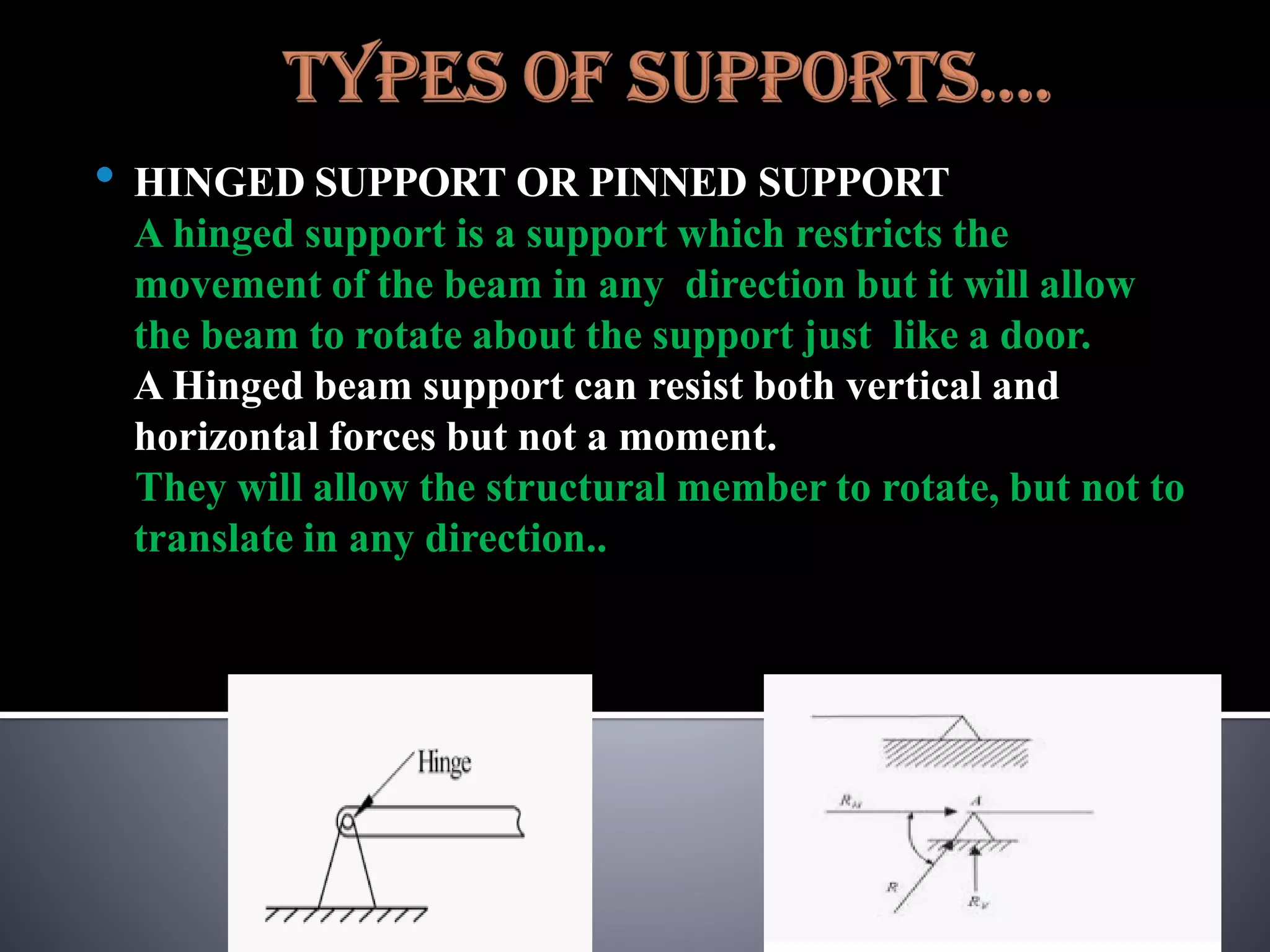
• HINGED SUPPORT OR PINNED SUPPORT
A hinged support is a support which restricts the
movement of the beam in any direction but it will allow
the beam to rotate about the support just like a door.
A Hinged beam support can resist both vertical and
horizontal forces but not a moment.
They will allow the structural member to rotate, but not to
translate in any direction..
• FIXED SUPPORT OR RIGID SUPPORT
Fixed supports can resist vertical and horizontal forces as
well as a moment.
Since they restrain both rotation and translation, they are
also known as rigid supports.
A structure only needs one fixed support in order to be
stable
.
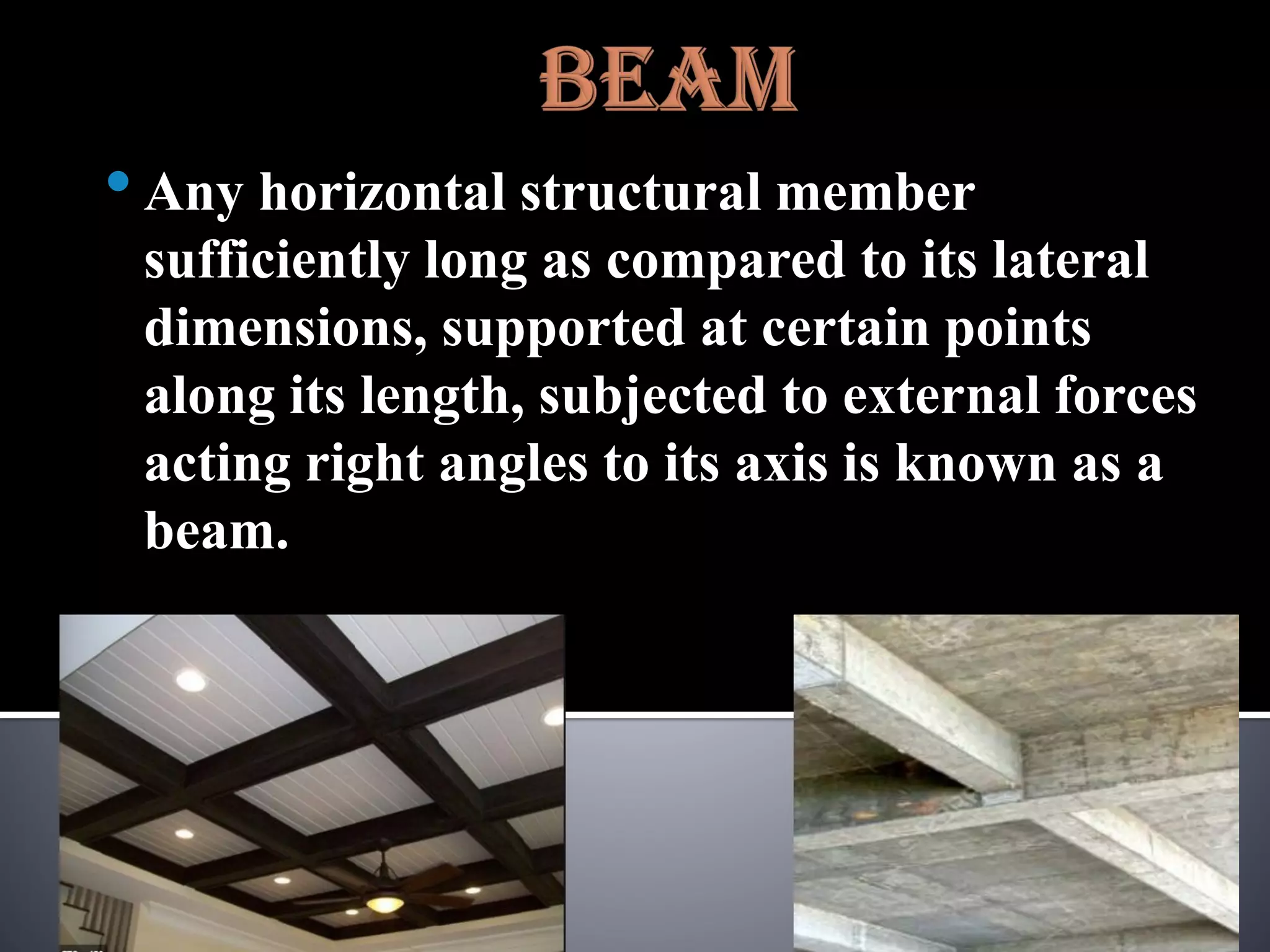
•Any horizontal structural member
sufficiently long as compared to its lateral
dimensions, supported at certain points
along its length, subjected to external forces
acting right angles to its axis is known as a
beam.
• SIMPLY SUPPORTED BEAM
• CANTILEVER BEAM
• FIXED BEAM
• OVER HANGING BEAM
• CONTINUOUS BEAM
• BEAM WITH ONE END HINGED AND THE
OTHER END ROLLER
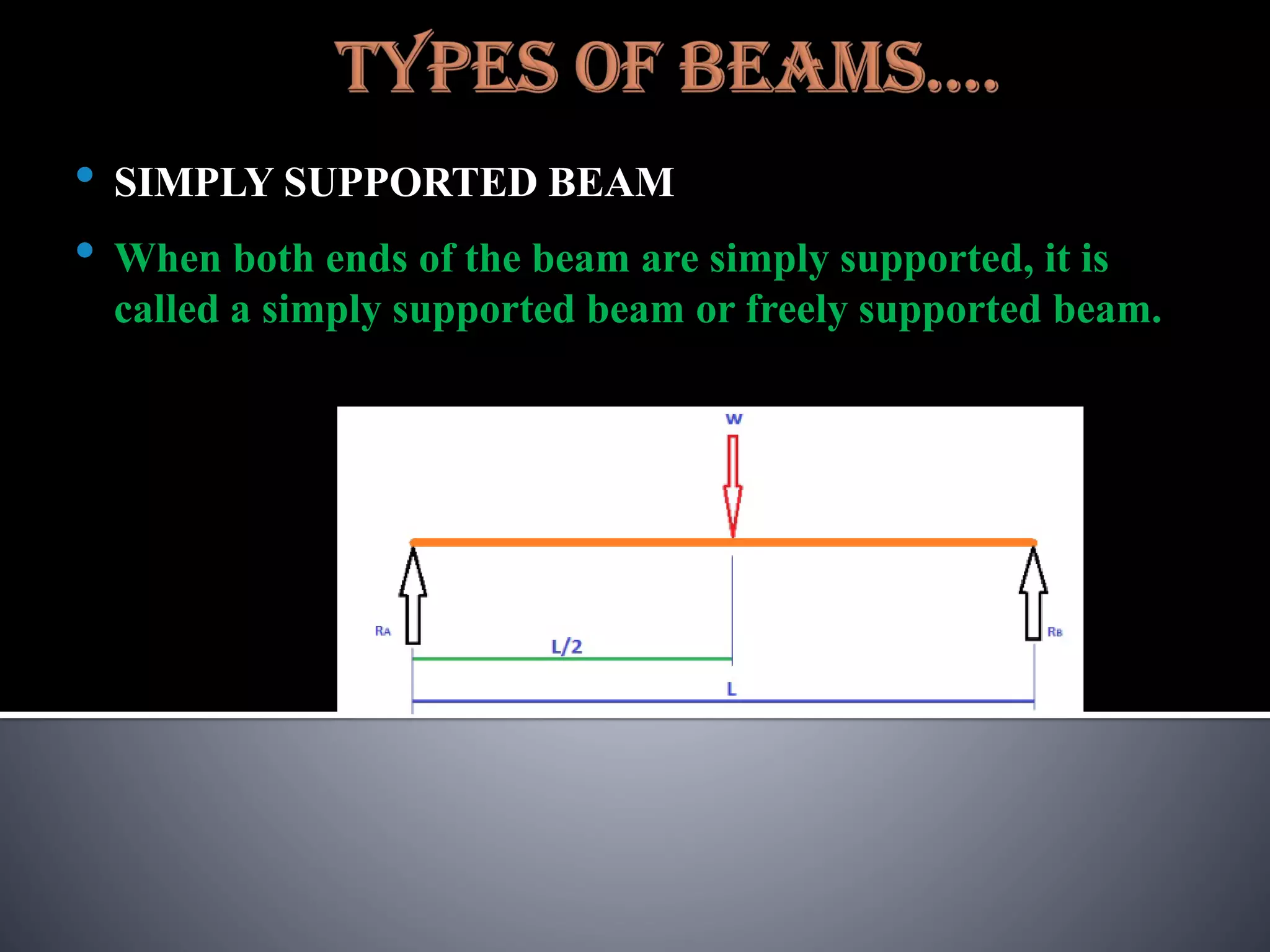
• SIMPLY SUPPORTED BEAM
• When both ends of the beam are simply supported, it is
called a simply supported beam or freely supported beam.
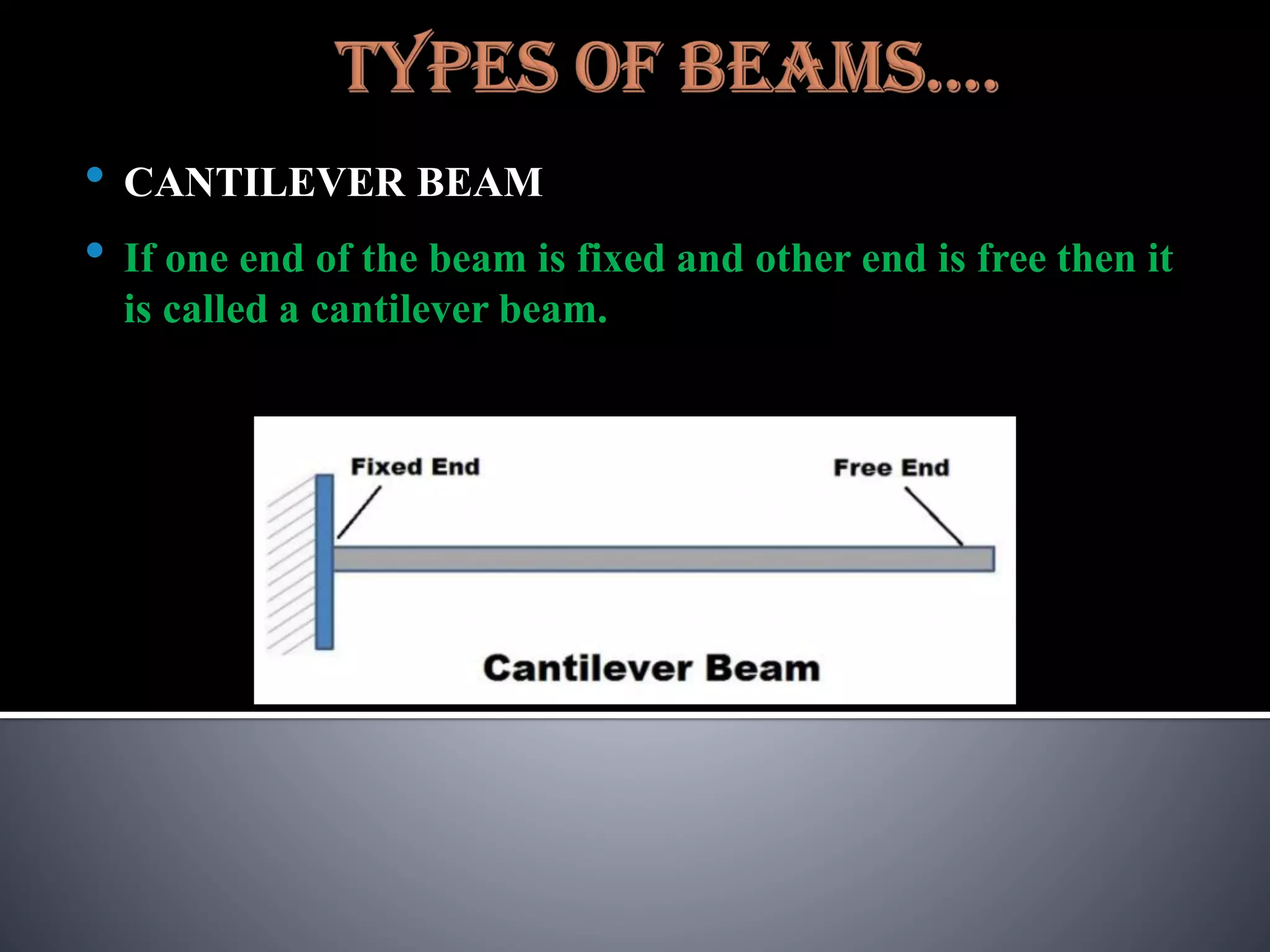
• CANTILEVER BEAM
• If one end of the beam is fixed and other end is free then it
is called a cantilever beam.
• FIXED BEAM
A beam whose both ends are rigidly fixed then it is
known as a fixed beam or encaster beam or rigid
beam or restrained beam.
• OVER HANGING BEAMS
If a beam is projecting beyond the support or supports
then it is called an overhanging beam.
If one or both ends of a beam is projecting beyond the
supports, then it is called an over hanging beam
• OVER HANGING BEAMS
• A. Right over hanging beam
• B. Left over hanging beam
• C. Both sides over hanging beam
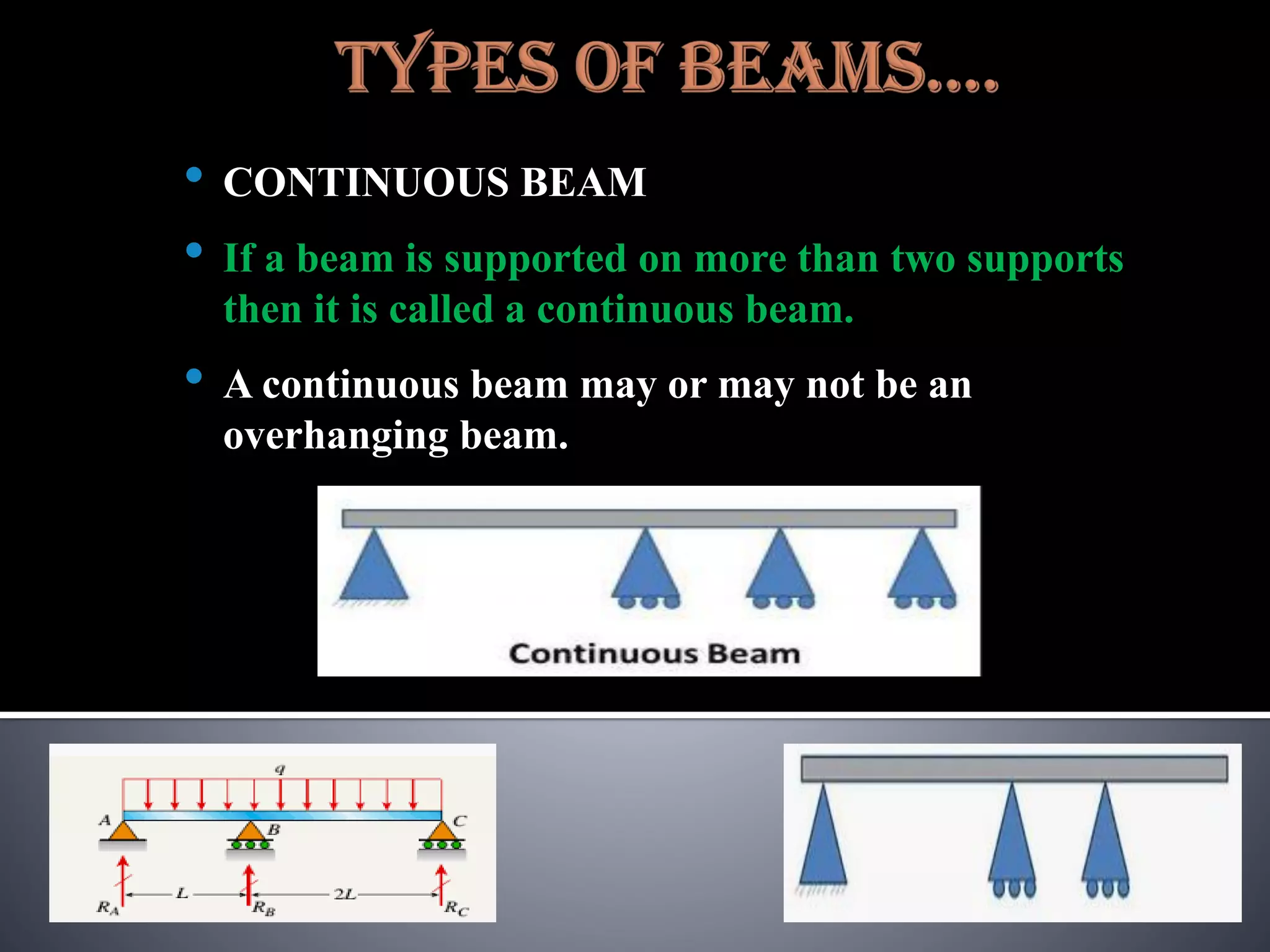
• CONTINUOUS BEAM
• If a beam is supported on more than two supports
then it is called a continuous beam.
• A continuous beam may or may not be an
overhanging beam.
• BEAM WITH ONE END HINGED AND THE OTHER
END ROLLER
This beam has one of its ends hinged and the other side of
the beam is supported with roller.
These kind of beams are capable to withstand loads in any
direction
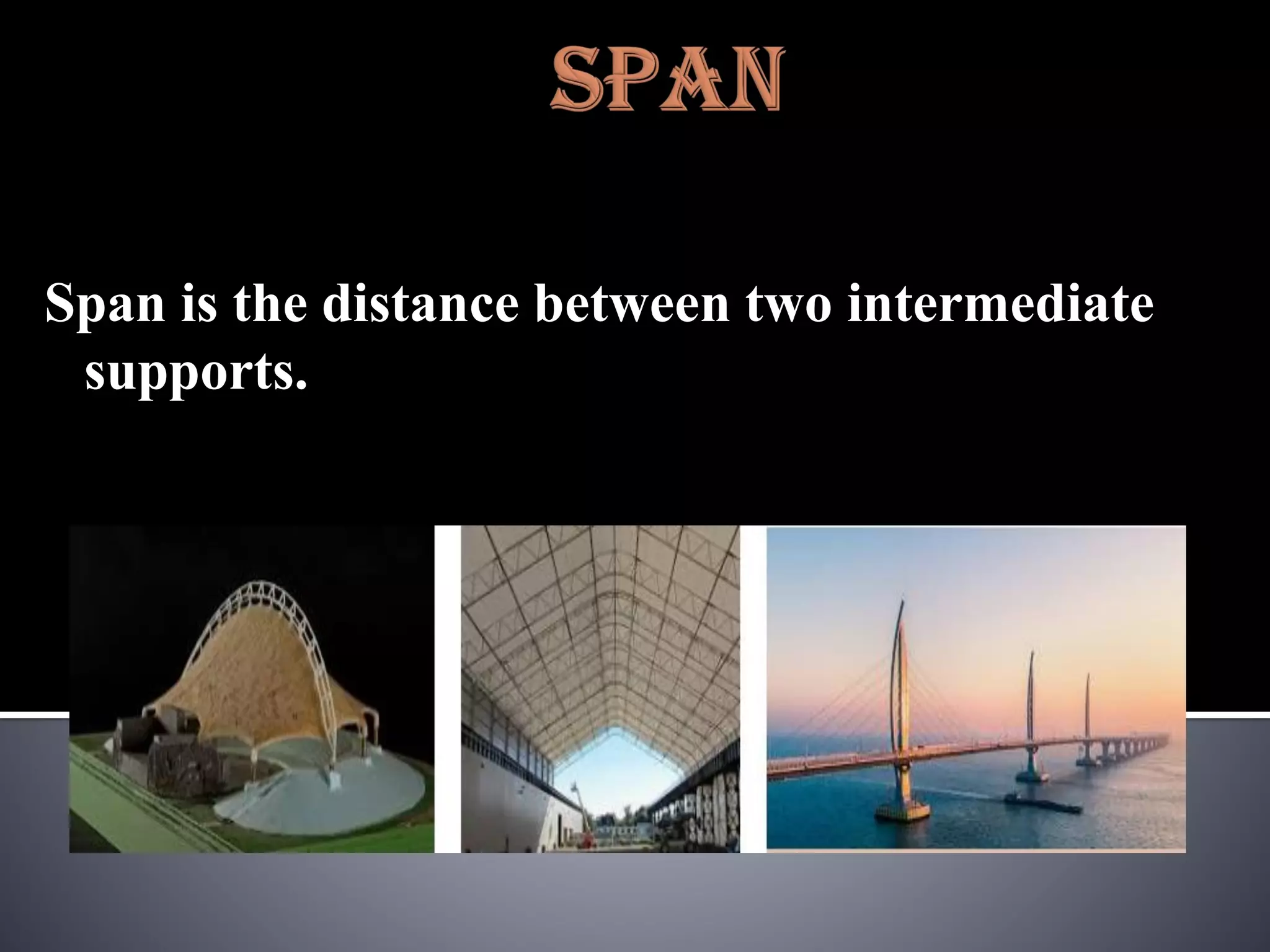
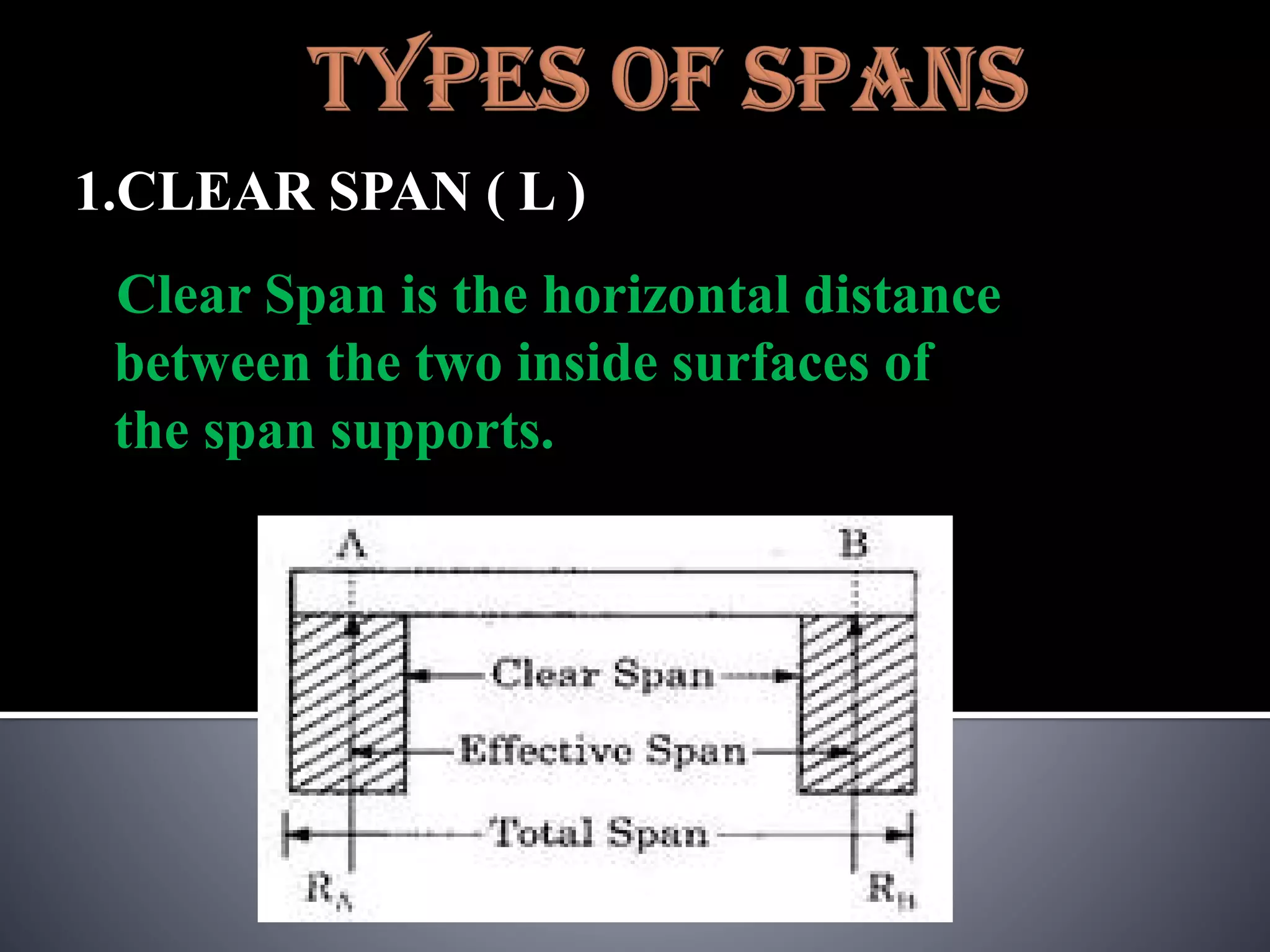
Span is the distance between two intermediate
supports.
1.CLEAR SPAN
2. EFFECTIVE SPAN
3. TOTAL SPAN
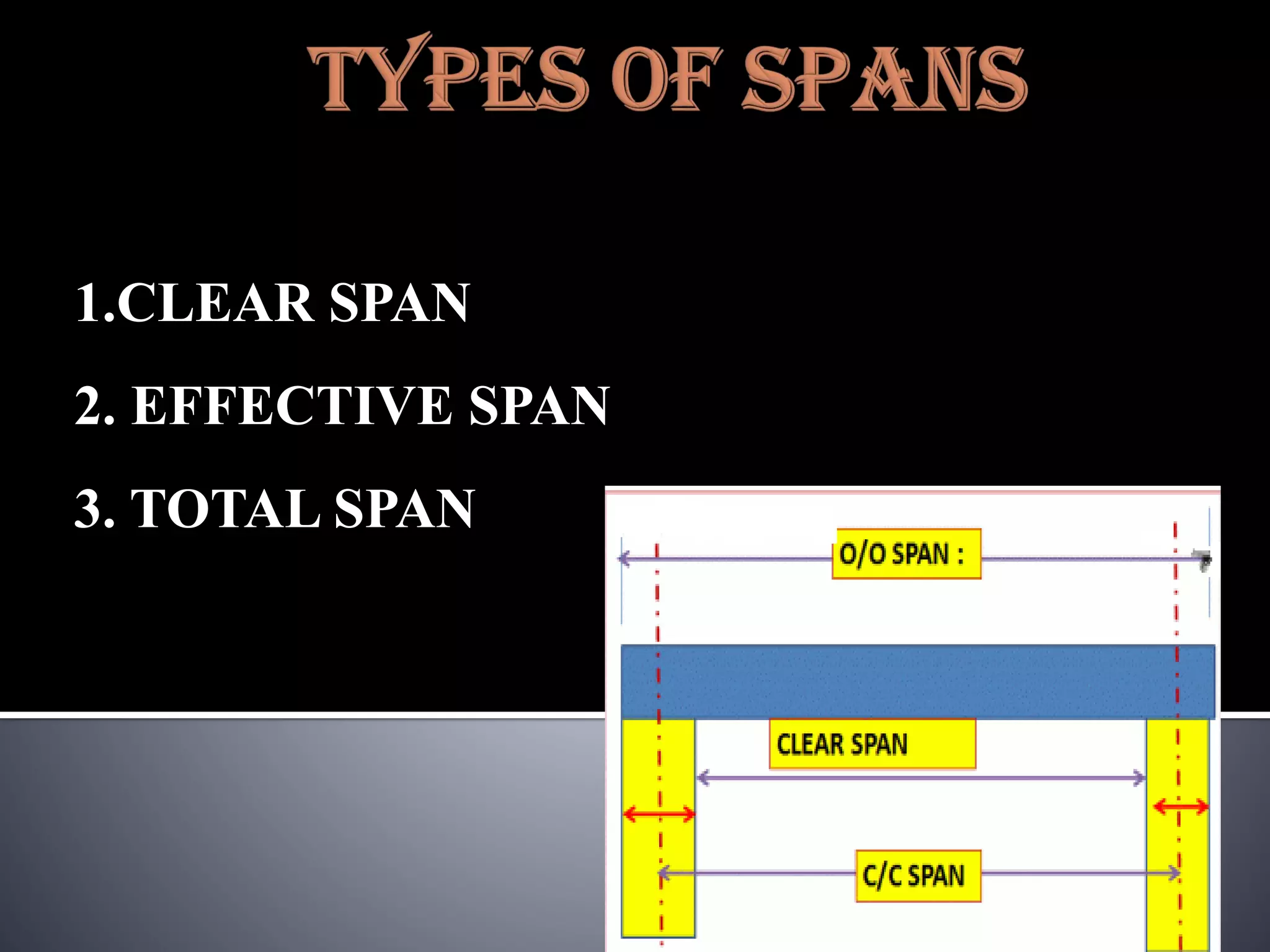
1.CLEAR SPAN ( L )
Clear Span is the horizontal distance
between the two inside surfaces of
the span supports.
2.EFFECTIVE SPAN ( l )
The centre to centre distance between two
supports is called effective span.
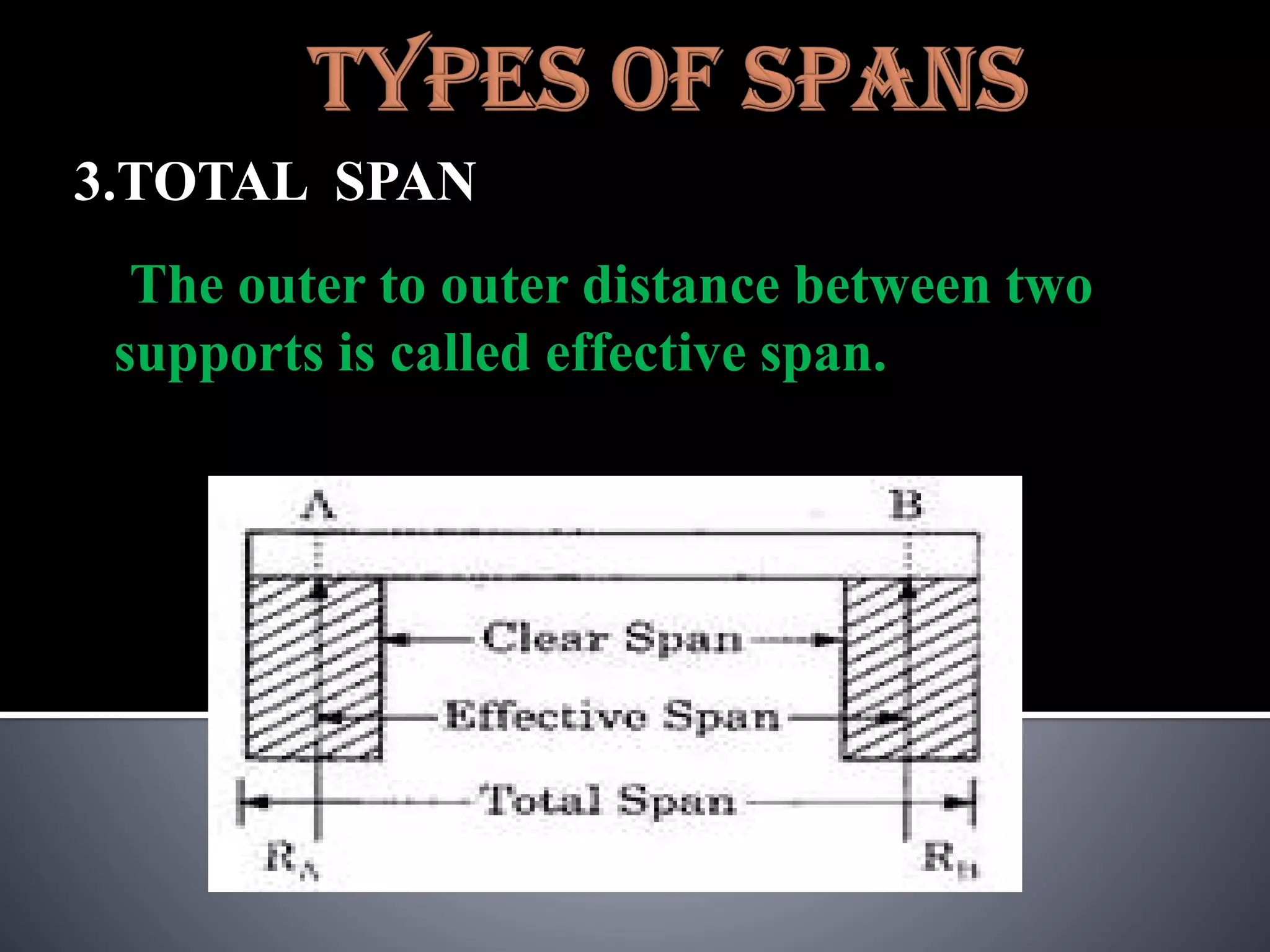
3.TOTAL SPAN
The outer to outer distance between two
supports is called effective span.
1. What are the different types of loading ?
2. Differentiate between udl and uvl
3. What is a rolling load ? Cite examples for it ?
4. What are the different types of supports? Explain it.
5. What is a beam?
6. What are the different types of beams? Explain it?
7. Differentiate between clear span and effective span.
1. Define a) Point load, b) Uniformly distributed load, 3) triangular loading
and d) Rolling load.
2. What is a Cantilever beam?
3. What is an overhanging beam?
4. What is a fixed beam?
5. What is a continuous beam?
6. What is total span?
7. What is clear span ?
8. What is effective span?
1. R.S.Khurmi : Applied Mechanics & Strength of Materials;
S. Chand Publishing
2. M.Chakrabroti : Strength of materials ; S.K Kataria &sons.
3. R.K.Rajput : Strength of Materials ; S. Chand Publishing
4. S.S.Bhavikatti : Strength of Materials ; Vikas Publishing
House Pvt Ltd,
5.K.N.A.G.K. Manikanta: Theory of structures –I; Radiant
Publishing House
Types of loads
Types of loads

Types of loads

  • 3.
    • POINT LOAD( CONCENTRATED LOAD) • UNIFORMLY DISTRIBUTED LOAD. ( UDL) • UNIFORMLY VARYING LOAD (UVL) • ROLLING LOAD
  • 4.
    •POINT LOAD (CONCENTRATED LOAD) Load acting at a definite point on a beam is known as a concentrated load or point load. Units - Newton, kilo Newton etc.
  • 5.
    •UNIFORMLY DISTRIBUTED LOAD (udl) OR RECTANGULAR LOADING A load which is spread over a beam in such a manner that each unit length is loaded to the same intensity is known as uniformly distributed load. It is measured in intensity with units Newton/Meter.
  • 6.
    •UNIFORMLY VARYING LOAD.( uvl) OR TRIANGULAR LOADING A load which is spread over a beam in such a manner that the intensity of loading varies uniformly on each unit length is known as uniformly varying load . It is measured in intensity with units Newton/Meter.
  • 7.
    •ROLLING LOAD Rolling loadsare those loads which roll over the given structural element from one end to the another. In this type of loading magnitude of Bending moment and shear force will go on change in position of loads Eg:- A train on the railway track, vehicles on the bridges or roads are rolling loads.
  • 8.
  • 9.
    • SIMPLE SUPPORT Whena beam rests freely on a support, then such a support is known as simply or simple support. In this type of support, the beam is allowed to rest freely on a support.
  • 10.
    • ROLLER SUPPORT Whena beam end is supported on roller, then such support is known as roller support. Support reaction is normal.. Roller supports are free to rotate and translate along the surface upon which the roller rests (ie, about the support). The surface can be horizontal, vertical, or sloped at any angle. The resulting reaction force is always a single force that is perpendicular to, and away from, the surface.
  • 11.
    • HINGED SUPPORTOR PINNED SUPPORT A hinged support is a support which restricts the movement of the beam in any direction but it will allow the beam to rotate about the support just like a door. A Hinged beam support can resist both vertical and horizontal forces but not a moment. They will allow the structural member to rotate, but not to translate in any direction..
  • 12.
    • FIXED SUPPORTOR RIGID SUPPORT Fixed supports can resist vertical and horizontal forces as well as a moment. Since they restrain both rotation and translation, they are also known as rigid supports. A structure only needs one fixed support in order to be stable .
  • 15.
    •Any horizontal structuralmember sufficiently long as compared to its lateral dimensions, supported at certain points along its length, subjected to external forces acting right angles to its axis is known as a beam.
  • 16.
    • SIMPLY SUPPORTEDBEAM • CANTILEVER BEAM • FIXED BEAM • OVER HANGING BEAM • CONTINUOUS BEAM • BEAM WITH ONE END HINGED AND THE OTHER END ROLLER
  • 17.
    • SIMPLY SUPPORTEDBEAM • When both ends of the beam are simply supported, it is called a simply supported beam or freely supported beam.
  • 18.
    • CANTILEVER BEAM •If one end of the beam is fixed and other end is free then it is called a cantilever beam.
  • 19.
    • FIXED BEAM Abeam whose both ends are rigidly fixed then it is known as a fixed beam or encaster beam or rigid beam or restrained beam.
  • 20.
    • OVER HANGINGBEAMS If a beam is projecting beyond the support or supports then it is called an overhanging beam. If one or both ends of a beam is projecting beyond the supports, then it is called an over hanging beam
  • 21.
    • OVER HANGINGBEAMS • A. Right over hanging beam • B. Left over hanging beam • C. Both sides over hanging beam
  • 22.
    • CONTINUOUS BEAM •If a beam is supported on more than two supports then it is called a continuous beam. • A continuous beam may or may not be an overhanging beam.
  • 23.
    • BEAM WITHONE END HINGED AND THE OTHER END ROLLER This beam has one of its ends hinged and the other side of the beam is supported with roller. These kind of beams are capable to withstand loads in any direction
  • 25.
    Span is thedistance between two intermediate supports.
  • 26.
    1.CLEAR SPAN 2. EFFECTIVESPAN 3. TOTAL SPAN
  • 27.
    1.CLEAR SPAN (L ) Clear Span is the horizontal distance between the two inside surfaces of the span supports.
  • 28.
    2.EFFECTIVE SPAN (l ) The centre to centre distance between two supports is called effective span.
  • 29.
    3.TOTAL SPAN The outerto outer distance between two supports is called effective span.
  • 30.
    1. What arethe different types of loading ? 2. Differentiate between udl and uvl 3. What is a rolling load ? Cite examples for it ? 4. What are the different types of supports? Explain it. 5. What is a beam? 6. What are the different types of beams? Explain it? 7. Differentiate between clear span and effective span.
  • 31.
    1. Define a)Point load, b) Uniformly distributed load, 3) triangular loading and d) Rolling load. 2. What is a Cantilever beam? 3. What is an overhanging beam? 4. What is a fixed beam? 5. What is a continuous beam? 6. What is total span? 7. What is clear span ? 8. What is effective span?
  • 32.
    1. R.S.Khurmi :Applied Mechanics & Strength of Materials; S. Chand Publishing 2. M.Chakrabroti : Strength of materials ; S.K Kataria &sons. 3. R.K.Rajput : Strength of Materials ; S. Chand Publishing 4. S.S.Bhavikatti : Strength of Materials ; Vikas Publishing House Pvt Ltd, 5.K.N.A.G.K. Manikanta: Theory of structures –I; Radiant Publishing House