Simply Supported
Beams
Done by:-
Crystal Mahabir, Vickash Boodram,
Hanson Ramdath, Krista London,
Adrian Whiteman, Anthony Abdool
What are beams?
• Beams are generally horizontal structural members which transfer loads
horizontally along their length to the supports.
• Beams are used for resisting vertical loads, shear forces and bending moments.
Beams are classified into four main types:
• Simply Supported Beams
• Fixed Beams
• Cantilever Beams
• Continuously Supported Beams
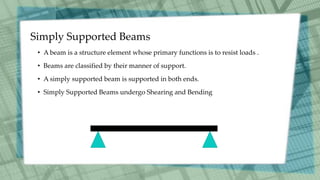
Simply Supported Beams
• A beam is a structure element whose primary functions is to resist loads .
• Beams are classified by their manner of support.
• A simply supported beam is supported in both ends.
• Simply Supported Beams undergo Shearing and Bending
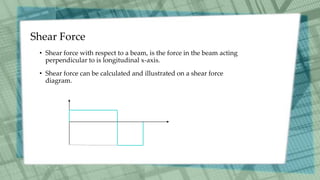
Shear Force
• Shear force with respect to a beam, is the force in the beam acting
perpendicular to is longitudinal x-axis.
• Shear force can be calculated and illustrated on a shear force
diagram.
Bending Moments
• The bending moment acting at a point on a beam is the resultant turning moment due to
all the forces acting to one side of the point.
• Two types of bending moments; Sagging bending moments (Positive) and Hogging
bending moments (Negative).
• Bending moments in the beam can be calculated and illustrated on a bending moment
diagram.
Various loading Conditions
• Loads are forces which causes stresses, deformation and displacements when
applied to a structure.
• There are several various loading conditions for simply supported beams.
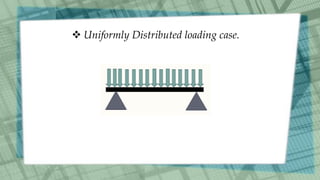
 Uniformly Distributed loading case.
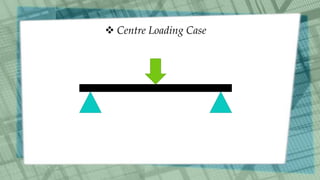
 Centre Loading Case
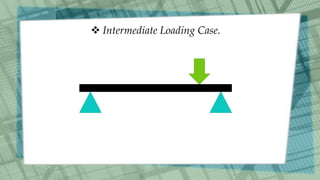
 Intermediate Loading Case.
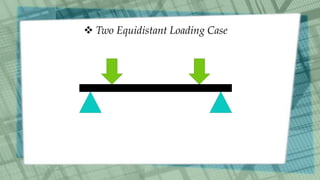
 Two Equidistant Loading Case
 Example of Simply Supported Beams in a
Everyday Scenario.
The most common example of simply supported beams are; bridge girders, post
and lintel structure.
Advantages
• It is quick and simple to analyse a simple supported beam
• Simply supported beams are quick and simple to install
• A simply supported beam has no ability to transfer moments at its
supports.
• Simply supported beams require no complicated connection to the
supporting member
• Simply supported beams transfer fewer loads into a central supporting
member than a continuous beam.
Disadvantages
• A disadvantage of simply supported beams is the reduce ability to resist
bending loads when compared to fixed end beams.
• The maximum positive moments in simple supported beams are always
higher than the maximum positive moment in fixed end beams.
• As a result, the size of the simple supported beam require typically is
larger than if a fixed end beam was used.

Simply supported beams

  • 1.
    Simply Supported Beams Done by:- CrystalMahabir, Vickash Boodram, Hanson Ramdath, Krista London, Adrian Whiteman, Anthony Abdool
  • 2.
    What are beams? •Beams are generally horizontal structural members which transfer loads horizontally along their length to the supports. • Beams are used for resisting vertical loads, shear forces and bending moments.
  • 3.
    Beams are classifiedinto four main types: • Simply Supported Beams • Fixed Beams • Cantilever Beams • Continuously Supported Beams
  • 4.
    Simply Supported Beams •A beam is a structure element whose primary functions is to resist loads . • Beams are classified by their manner of support. • A simply supported beam is supported in both ends. • Simply Supported Beams undergo Shearing and Bending
  • 5.
    Shear Force • Shearforce with respect to a beam, is the force in the beam acting perpendicular to is longitudinal x-axis. • Shear force can be calculated and illustrated on a shear force diagram.
  • 6.
    Bending Moments • Thebending moment acting at a point on a beam is the resultant turning moment due to all the forces acting to one side of the point. • Two types of bending moments; Sagging bending moments (Positive) and Hogging bending moments (Negative). • Bending moments in the beam can be calculated and illustrated on a bending moment diagram.
  • 7.
    Various loading Conditions •Loads are forces which causes stresses, deformation and displacements when applied to a structure. • There are several various loading conditions for simply supported beams.
  • 8.
  • 9.
  • 10.
  • 11.
     Two EquidistantLoading Case
  • 12.
     Example ofSimply Supported Beams in a Everyday Scenario. The most common example of simply supported beams are; bridge girders, post and lintel structure.
  • 13.
    Advantages • It isquick and simple to analyse a simple supported beam • Simply supported beams are quick and simple to install • A simply supported beam has no ability to transfer moments at its supports. • Simply supported beams require no complicated connection to the supporting member • Simply supported beams transfer fewer loads into a central supporting member than a continuous beam.
  • 14.
    Disadvantages • A disadvantageof simply supported beams is the reduce ability to resist bending loads when compared to fixed end beams. • The maximum positive moments in simple supported beams are always higher than the maximum positive moment in fixed end beams. • As a result, the size of the simple supported beam require typically is larger than if a fixed end beam was used.