By
Ar. Akshay H. Gandhi. +91 9970059926
2nd y. b. arch
2018-19
Building Technologies And Materials IV
TYPES
OF
SLABS
SEMESTER
IV
TYPES OF SLABS
Building
Technologies
And
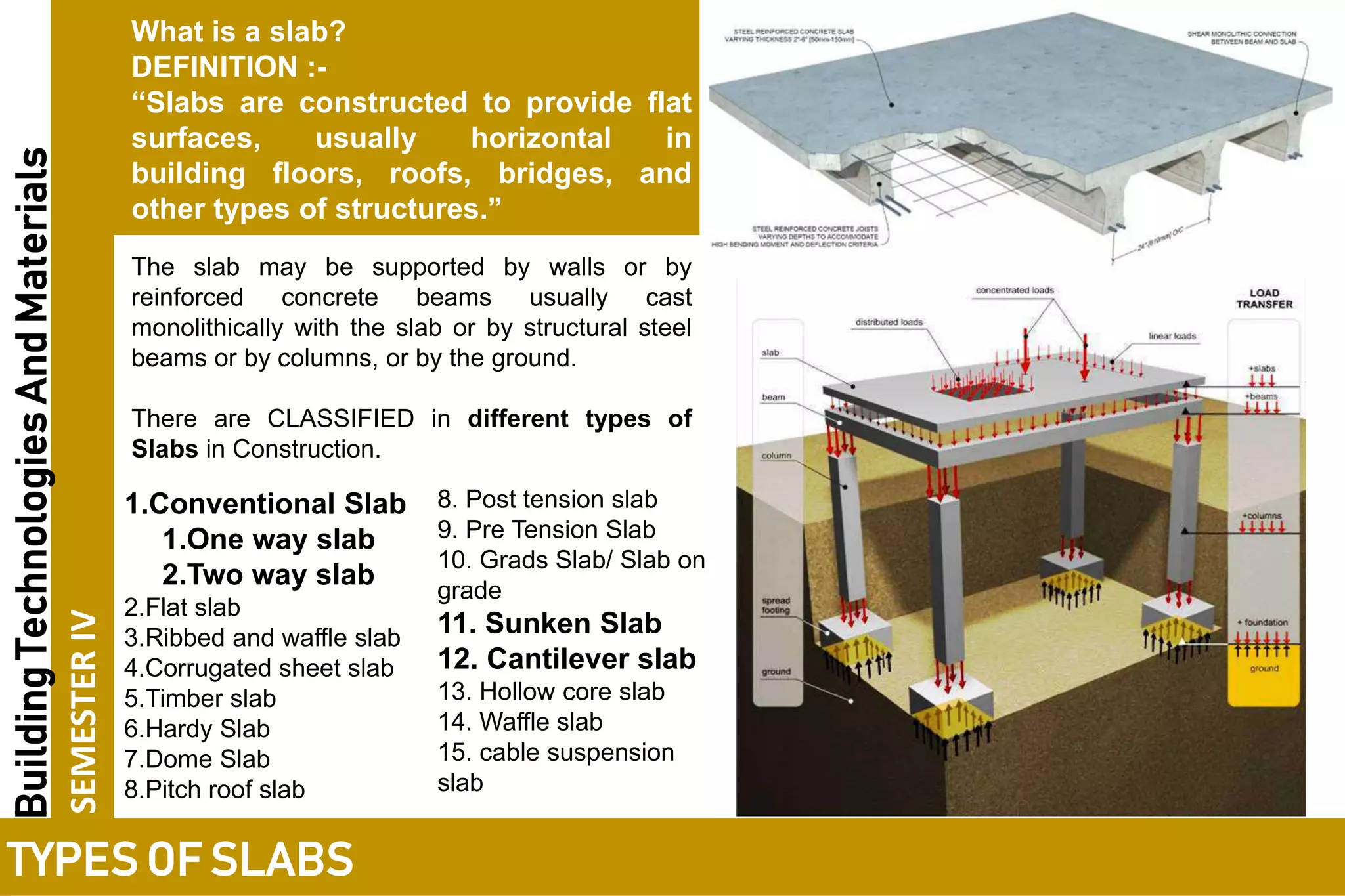
Materials What is a slab?
DEFINITION :-
“Slabs are constructed to provide flat
surfaces, usually horizontal in
building floors, roofs, bridges, and
other types of structures.”
The slab may be supported by walls or by
reinforced concrete beams usually cast
monolithically with the slab or by structural steel
beams or by columns, or by the ground.
There are CLASSIFIED in different types of
Slabs in Construction.
1.Conventional Slab
1.One way slab
2.Two way slab
2.Flat slab
3.Ribbed and waffle slab
4.Corrugated sheet slab
5.Timber slab
6.Hardy Slab
7.Dome Slab
8.Pitch roof slab
8. Post tension slab
9. Pre Tension Slab
10. Grads Slab/ Slab on
grade
11. Sunken Slab
12. Cantilever slab
13. Hollow core slab
14. Waffle slab
15. cable suspension
slab
TYPES OF SLABS
Building
Technologies
And
Materials CONVENTIONAL SLAB:-
1. The slab which is supported on Beams and columns is called conventional slab.
2. In this kind, the thickness of slab is small whereas depth of the beam is large and load is transferred
to beams and then to columns.
3. It requires more formwork when compared with the flat slab.
4. In conventional type of slab there is no need of providing column caps.
5. The thickness of conventional slab is 4″ or 10cm.
6. 5″ to 6″ inches is recommended if the concrete will receive occasional heavy loads, such as motor
homes or garbage trucks.
7. Conventional concrete slabs are square in shape and has a length of 4m.
8. Reinforcement is provided in conventional slab and the bars which are set in horizontal are called
Main Reinforcement Bars and bars which are set in vertical are called Distribution bars.
SEMESTER
IV
TYPES OF SLABS
Building
Technologies
And
Materials Based On Length And Breadth Of Conventional
Slab Is Classified Into Two Types:
1.One-way Slab
2.Two-way Slab
1. ONE WAY SLAB:
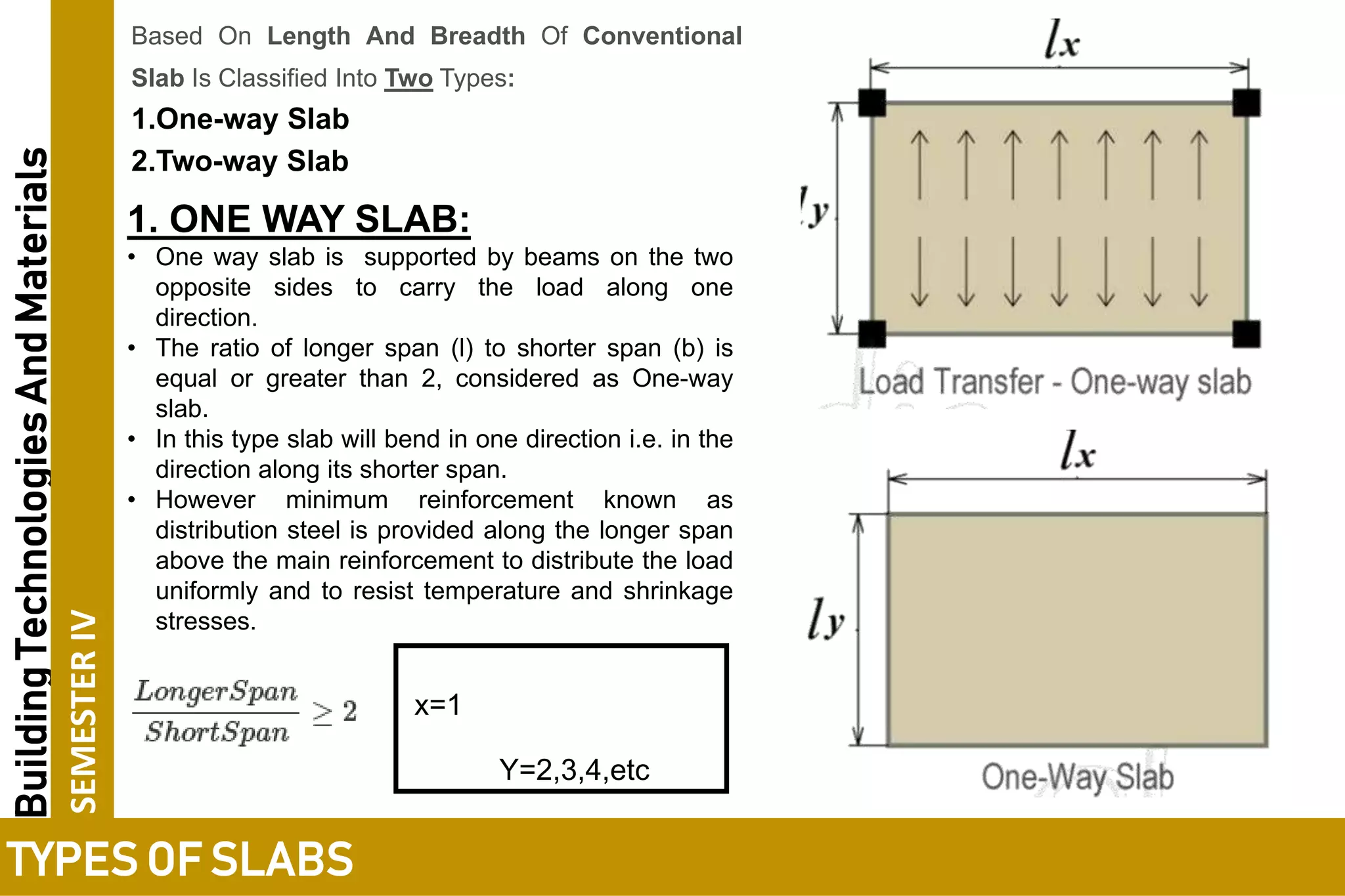
• One way slab is supported by beams on the two
opposite sides to carry the load along one
direction.
• The ratio of longer span (l) to shorter span (b) is
equal or greater than 2, considered as One-way
slab.
• In this type slab will bend in one direction i.e. in the
direction along its shorter span.
• However minimum reinforcement known as
distribution steel is provided along the longer span
above the main reinforcement to distribute the load
uniformly and to resist temperature and shrinkage
stresses.
x=1
Y=2,3,4,etc
SEMESTER
IV
TYPES OF SLABS
Building
Technologies
And
Materials • In general length of the slab is 4m. But in one
way slab one side length is 4m and another
side length is more than 4m. So it satisfies the
above equation.
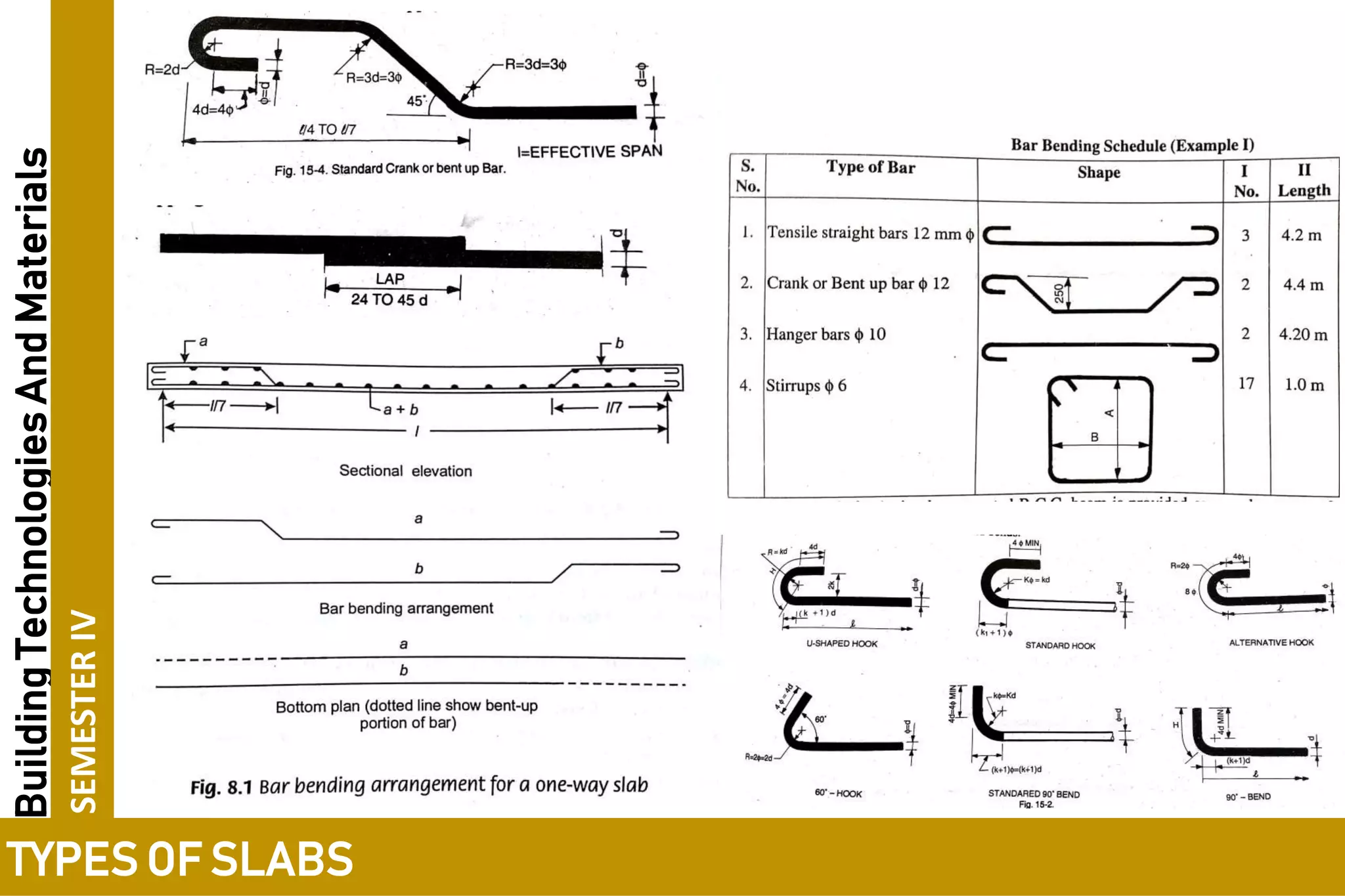
• Main reinforcement is provided in shorter span
and distribution reinforcement is provided in
longer span.
• Distribution bars are cranked to resist the
formation of stresses.
• From fig, it is clear that Ly/Lx = 8/3 =1 ≥ 2.66
• Hence, One way slab is adopted where Cranked
bars (main bars) are provided on shorter side of
the slab due to bending.
• Distribution bars (straight bars) provided on
longer side as shown in fig.
SEMESTER
IV
TYPES OF SLABS
Building
Technologies
And
Materials
SEMESTER
IV
TYPES OF SLABS
Building
Technologies
And
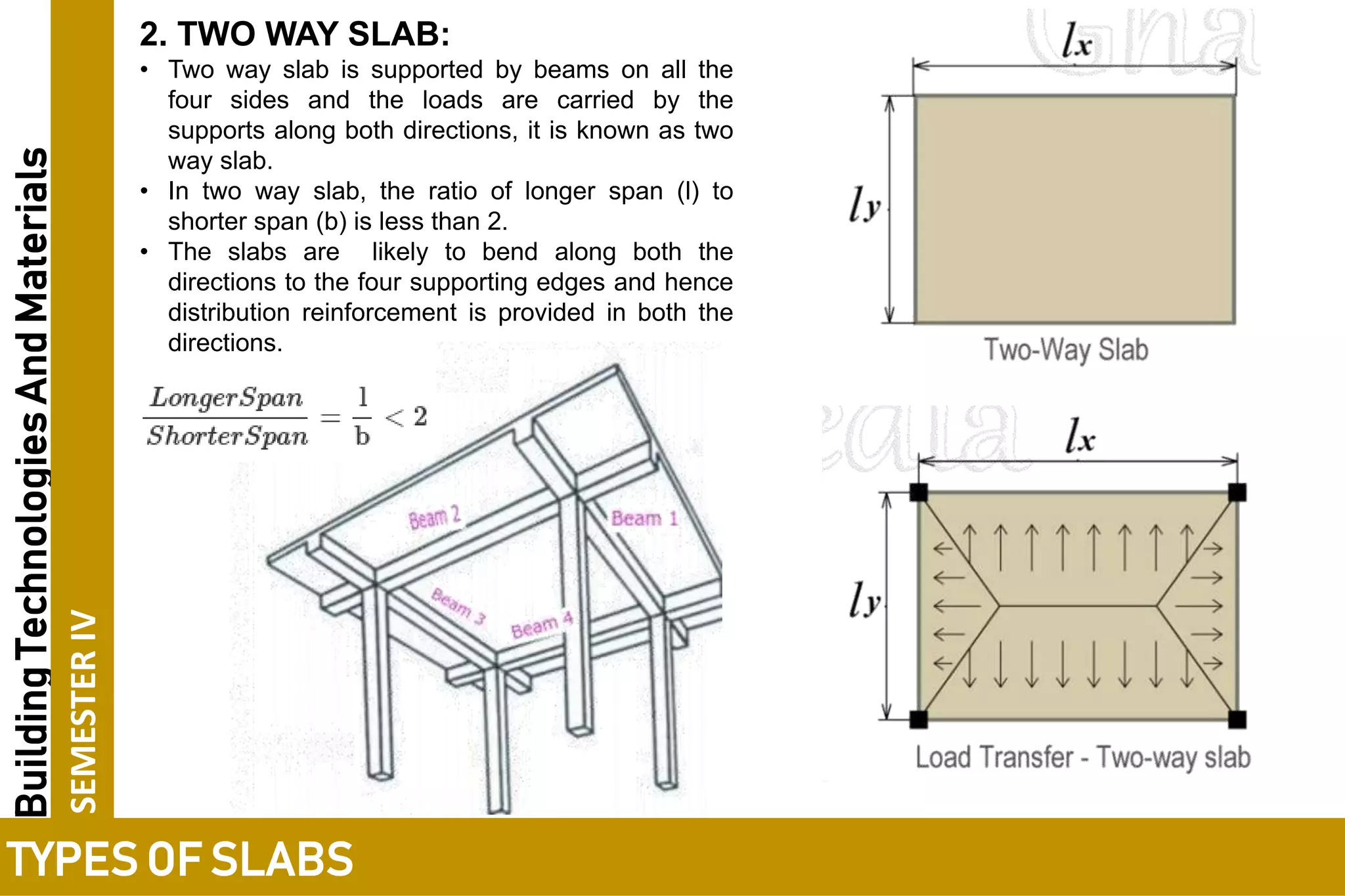
Materials 2. TWO WAY SLAB:
• Two way slab is supported by beams on all the
four sides and the loads are carried by the
supports along both directions, it is known as two
way slab.
• In two way slab, the ratio of longer span (l) to
shorter span (b) is less than 2.
• The slabs are likely to bend along both the
directions to the four supporting edges and hence
distribution reinforcement is provided in both the
directions.
SEMESTER
IV
TYPES OF SLABS
Building
Technologies
And
Materials
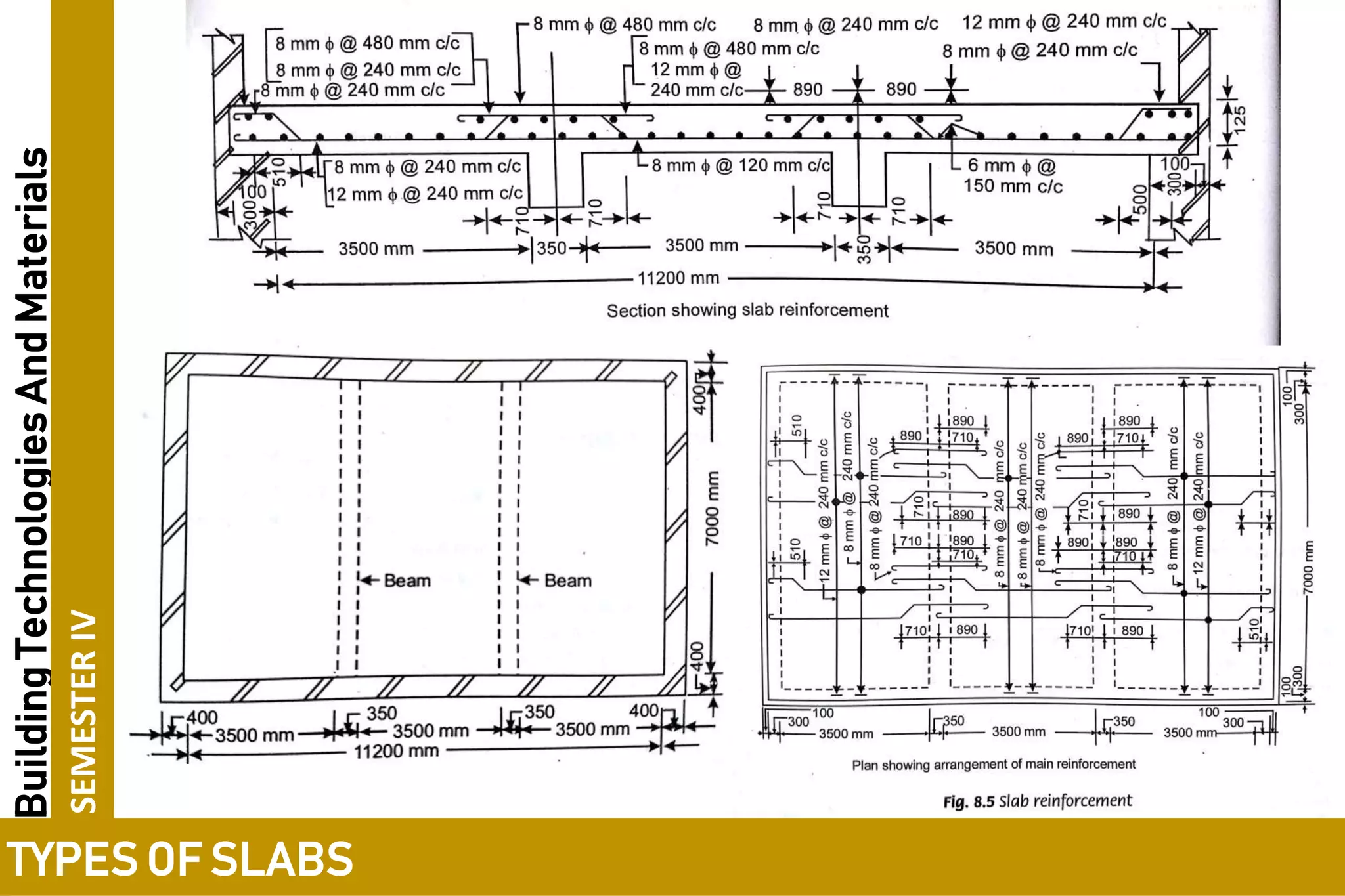
• As per below fig, it is clear that
Ly/Lx = 5/5 =1 < 2.
• Hence, two way slab is adopted where cranked
bars (main bars) are provided on both sides of the
slab.
• In this kind of slab, the length and breadth of
the slab are more than 4m. To resist the
formation of stresses distribution bars are
provided at both the ends in two way slab.
• These types of slabs are used in constructing
floors of multi-storeyed building.
SEMESTER
IV
TYPES OF SLABS
Building
Technologies
And
Materials
SEMESTER
IV
TYPES OF SLABS
Building
Technologies
And
Materials
SEMESTER
IV
TYPES OF SLABS
Building
Technologies
And
Materials
SEMESTER
IV
TYPES OF SLABS
Building
Technologies
And
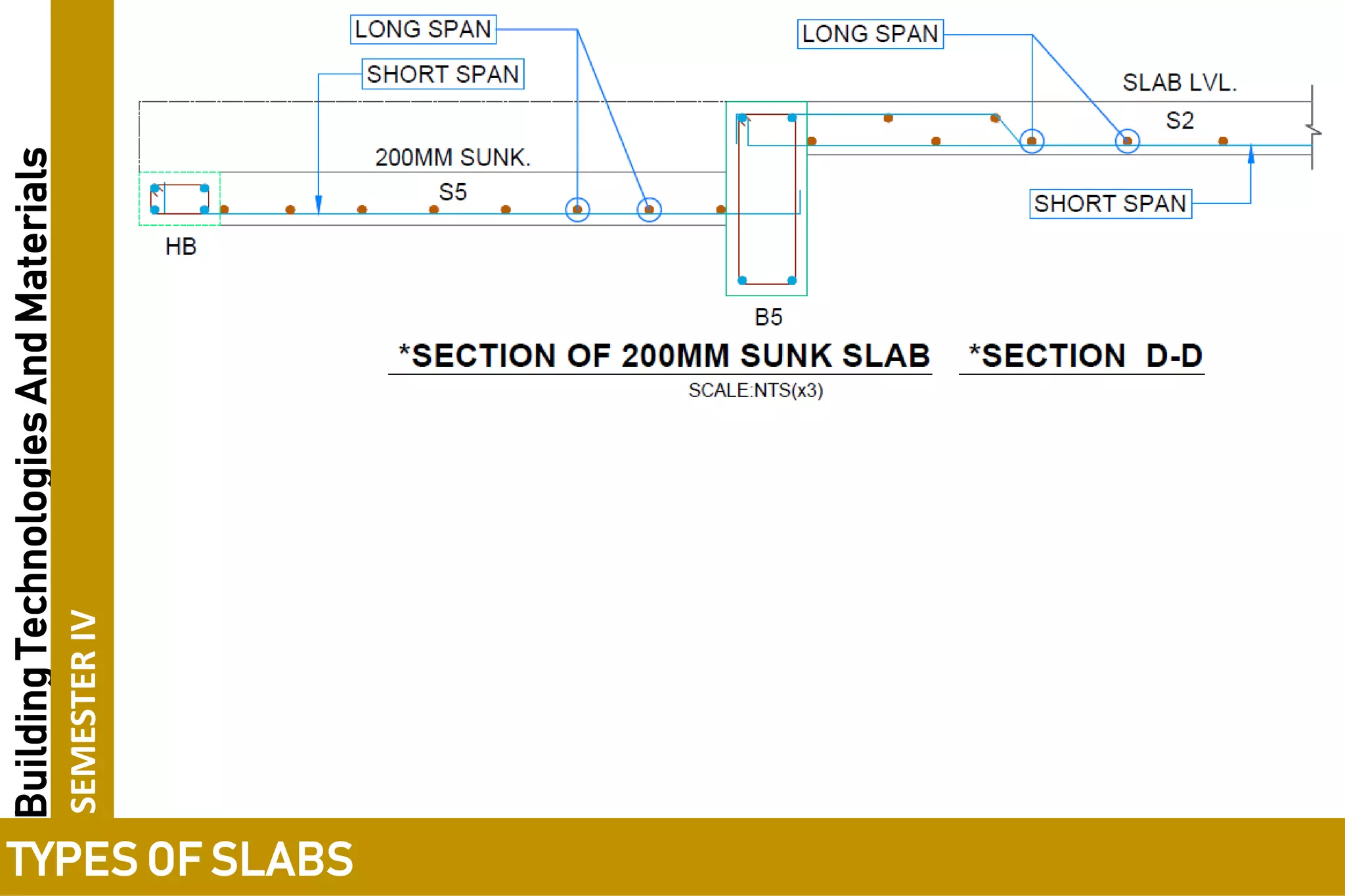
Materials SUNKEN SLAB :
• Slab which is provided below the washrooms to
hide the sewage pipes or sewerage pipes is
called Sunken slab.
• In this type, the pipes that carry water are
concealed below the floor. Special care has to be
taken to avoid leakage problems.
• After casting sewage pipes in the slab the slab is
filled with coal or broken pieces of bricks.
 There are two types of the sunken slab.
• The slab which is provided BELOW the normal floor
level at a depth of 200mm to 300 mm and filled with
broken pieces of bricks is called Sunken slab.
or
• The Slab which is provided ABOVE the normal floor
level at a height of 200mm to 300mm and filled with
coal or broken pieces of bricks called Sunken slab.
SEMESTER
IV
TYPES OF SLABS
Building
Technologies
And
Materials
SEMESTER
IV

one way two way slabs.pptx

  • 1.
    By Ar. Akshay H.Gandhi. +91 9970059926 2nd y. b. arch 2018-19 Building Technologies And Materials IV TYPES OF SLABS
  • 2.
    SEMESTER IV TYPES OF SLABS Building Technologies And MaterialsWhat is a slab? DEFINITION :- “Slabs are constructed to provide flat surfaces, usually horizontal in building floors, roofs, bridges, and other types of structures.” The slab may be supported by walls or by reinforced concrete beams usually cast monolithically with the slab or by structural steel beams or by columns, or by the ground. There are CLASSIFIED in different types of Slabs in Construction. 1.Conventional Slab 1.One way slab 2.Two way slab 2.Flat slab 3.Ribbed and waffle slab 4.Corrugated sheet slab 5.Timber slab 6.Hardy Slab 7.Dome Slab 8.Pitch roof slab 8. Post tension slab 9. Pre Tension Slab 10. Grads Slab/ Slab on grade 11. Sunken Slab 12. Cantilever slab 13. Hollow core slab 14. Waffle slab 15. cable suspension slab
  • 3.
    TYPES OF SLABS Building Technologies And MaterialsCONVENTIONAL SLAB:- 1. The slab which is supported on Beams and columns is called conventional slab. 2. In this kind, the thickness of slab is small whereas depth of the beam is large and load is transferred to beams and then to columns. 3. It requires more formwork when compared with the flat slab. 4. In conventional type of slab there is no need of providing column caps. 5. The thickness of conventional slab is 4″ or 10cm. 6. 5″ to 6″ inches is recommended if the concrete will receive occasional heavy loads, such as motor homes or garbage trucks. 7. Conventional concrete slabs are square in shape and has a length of 4m. 8. Reinforcement is provided in conventional slab and the bars which are set in horizontal are called Main Reinforcement Bars and bars which are set in vertical are called Distribution bars. SEMESTER IV
  • 4.
    TYPES OF SLABS Building Technologies And MaterialsBased On Length And Breadth Of Conventional Slab Is Classified Into Two Types: 1.One-way Slab 2.Two-way Slab 1. ONE WAY SLAB: • One way slab is supported by beams on the two opposite sides to carry the load along one direction. • The ratio of longer span (l) to shorter span (b) is equal or greater than 2, considered as One-way slab. • In this type slab will bend in one direction i.e. in the direction along its shorter span. • However minimum reinforcement known as distribution steel is provided along the longer span above the main reinforcement to distribute the load uniformly and to resist temperature and shrinkage stresses. x=1 Y=2,3,4,etc SEMESTER IV
  • 5.
    TYPES OF SLABS Building Technologies And Materials• In general length of the slab is 4m. But in one way slab one side length is 4m and another side length is more than 4m. So it satisfies the above equation. • Main reinforcement is provided in shorter span and distribution reinforcement is provided in longer span. • Distribution bars are cranked to resist the formation of stresses. • From fig, it is clear that Ly/Lx = 8/3 =1 ≥ 2.66 • Hence, One way slab is adopted where Cranked bars (main bars) are provided on shorter side of the slab due to bending. • Distribution bars (straight bars) provided on longer side as shown in fig. SEMESTER IV
  • 6.
  • 7.
    TYPES OF SLABS Building Technologies And Materials2. TWO WAY SLAB: • Two way slab is supported by beams on all the four sides and the loads are carried by the supports along both directions, it is known as two way slab. • In two way slab, the ratio of longer span (l) to shorter span (b) is less than 2. • The slabs are likely to bend along both the directions to the four supporting edges and hence distribution reinforcement is provided in both the directions. SEMESTER IV
  • 8.
    TYPES OF SLABS Building Technologies And Materials •As per below fig, it is clear that Ly/Lx = 5/5 =1 < 2. • Hence, two way slab is adopted where cranked bars (main bars) are provided on both sides of the slab. • In this kind of slab, the length and breadth of the slab are more than 4m. To resist the formation of stresses distribution bars are provided at both the ends in two way slab. • These types of slabs are used in constructing floors of multi-storeyed building. SEMESTER IV
  • 9.
  • 10.
  • 11.
  • 12.
    TYPES OF SLABS Building Technologies And MaterialsSUNKEN SLAB : • Slab which is provided below the washrooms to hide the sewage pipes or sewerage pipes is called Sunken slab. • In this type, the pipes that carry water are concealed below the floor. Special care has to be taken to avoid leakage problems. • After casting sewage pipes in the slab the slab is filled with coal or broken pieces of bricks.  There are two types of the sunken slab. • The slab which is provided BELOW the normal floor level at a depth of 200mm to 300 mm and filled with broken pieces of bricks is called Sunken slab. or • The Slab which is provided ABOVE the normal floor level at a height of 200mm to 300mm and filled with coal or broken pieces of bricks called Sunken slab. SEMESTER IV
  • 13.