Lect#05
Ranging
BY M.Z Jamali
Ranging
• When a survey line is longer than a chain
length, it is necessary to align intermediate
points on chain line so that the measurements
are along the line. The process of locating
intermediate points on survey line is known as
ranging. or process to make chain line straight.
Ranging must be done before a survey line is
chained. There are two methods of ranging viz.,
direct ranging and reciprocal ranging.
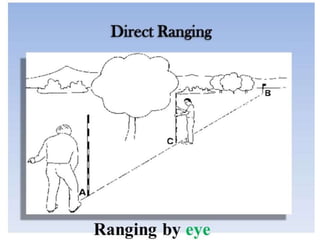
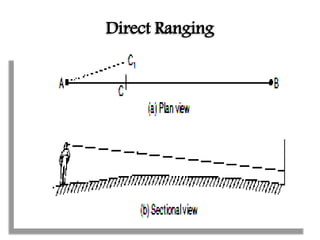
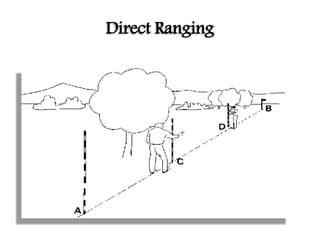
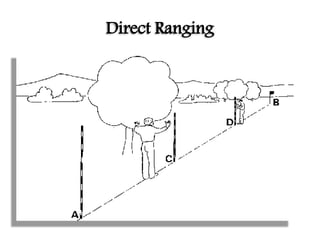
Direct Ranging
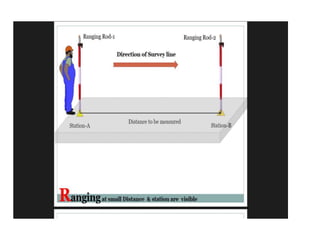
• If the first and last points are intervisible this
method is possible.
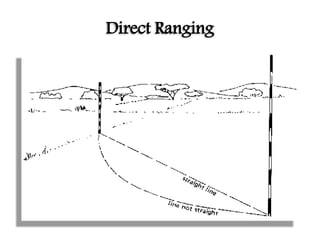
• When intermediate ranging rods are fixed on
straight line by direct observations from end
stations , the process is called direct ranging.
Procedure.
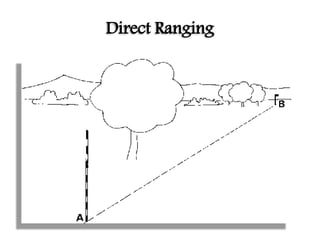
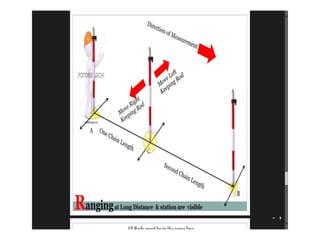
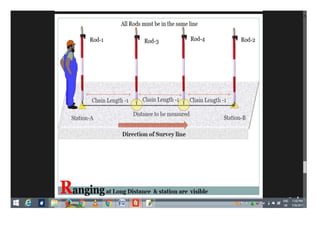
• Assume that A and B are two end stations of
chain line , where two ranging rods are already
fixed.
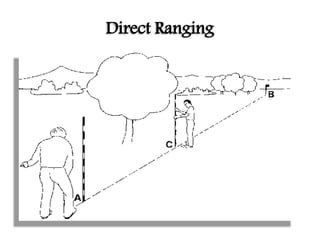
• Suppose it is required to fix ranging rod at
intermediate point C on chain line so that A,B
and C are in same straight line.
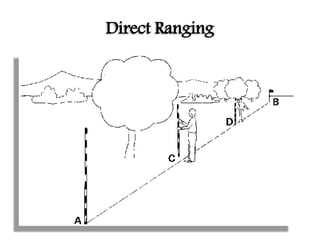
• The Surveyor positions himself approximately 2
m behind station A and looking along line AB
directs the assistant to move ranging rod right
or left to the line AB until three ranging rods
come exactly in same straight line.
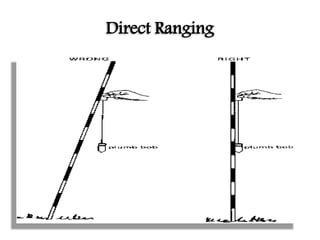
• To check verticality of rods , the surveyor
bends down and looks through bottom of
rods.
• The ranging will be perfect , when three
ranging rods coincide and appear as single
rod.
• When surveyor is satisfied he signals assistant
to fix ranging rod on ground by waving both
ends up and down.
Direct Ranging
Direct Ranging
Direct Ranging
Direct Ranging
Direct Ranging
Direct Ranging
Direct Ranging
Direct Ranging
Indirect /Reciprocal Ranging
Indirect or Reciprocal Ranging
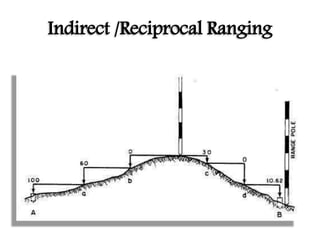
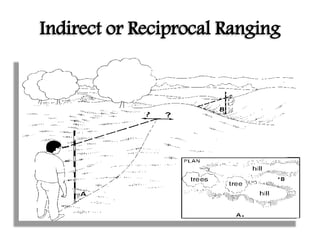
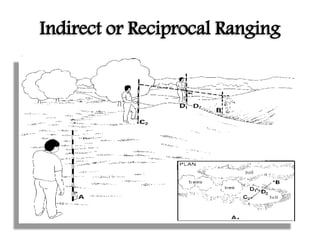
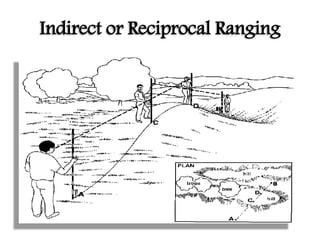
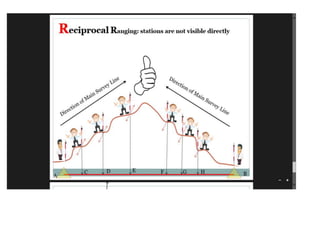
• Due to intervening ground, hill etc, if two station
are not visible to each other then reciprocal
ranging may be resorted.
• Suppose A and B are two station which are not
intervisible due to intervening raised ground.
• Suppose it is required to fix intermediate points
between A and B.
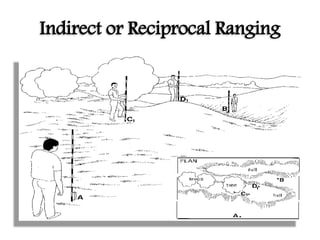
• Two Chainman take up positions at C1 and D1
with ranging rods in their hands, and one
surveyor at A and other at B.
• Chainman at C1 stands with hiss face towards B so that
he can see ranging rod at D1 and B.
• Similarly Chainman at D1 stands with his face towards
A, so that he can see ranging rod at C1 and A.
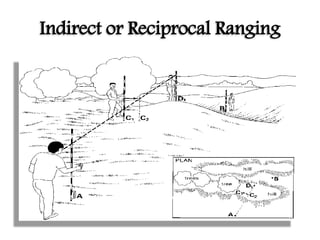
• Then chainmen proceed to range line by directing each
other alternatively.
• The chainman at C1 directs at D1 to come to the
position of D2 , similarly The chainman at D1 directs at
C1 to come to the position of C2, so that C2, D2 and A
are in same straight line.
• This procedure is continue until final to position C and
D which are in straight line. Mean until A,B, C and D are
in same straight line.
•
Indirect or Reciprocal Ranging
Line Ranger
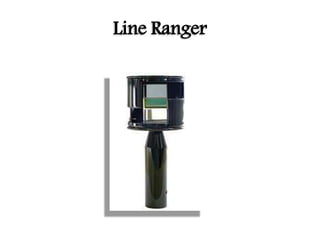
• It is an optical instrument used for
locating a point on a line and hence
useful for ranging. It consists of two
isosceles prisms placed one over the
other and fixed in an instrument with
handle. The diagonals of the prisms are
silvered so as to reflect the rays.
Line Ranger
• Its advantage is it needs only one person to
range. The instrument should be occasionally
tested by marking three points in a line and
standing on middle point observing the
coincidence of the ranging rods. If the images
of the two ranging rods do not appear in the
same line, one of the prism is adjusted by
operating the screw provided for it.
Line Ranger
Line Ranger
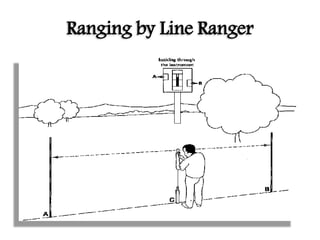
• To locate point C on line AB (ref. Fig.) the surveyor
holds the instrument in hand and stands near the
approximate position of C. If he is not exactly on line
AB, the ranging rods at A and B appear separated.
The surveyor moves to and fro at right angles to the
line AB till the images of ranging rods at A and B
appear in a single .It happens only when the optical
square is exactly on line AB. Thus the desired point C
is located on the line AB.
Ranging by Line Ranger
chaining
• Measuring a line.
• Follower- at 0 end
• Leader-moving forward.
• 10 arrows/pegs
• A ranging rod
• A chain or tape
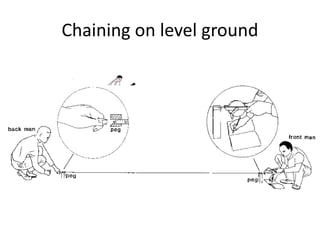
Chaining on level ground
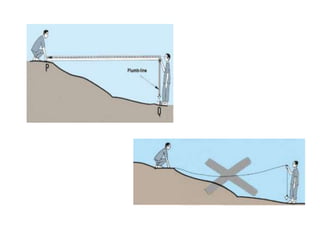
Chaining on sloping ground
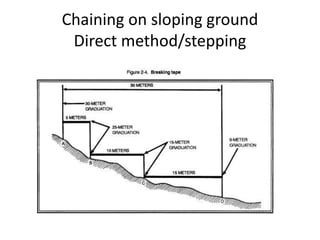
• (1) Direct method/stepping.
• This method is applied when ground is very
steep.
• In this method ground is divided in number of
horizontal and vertical strips like steps.
• The horizontal portion are measured and added
to get the total horizontal distance between the
points.
• Steps may not be uniform , depends upon nature
of ground.
Chaining on sloping ground
Direct method/stepping
Obstacle in chaining
 A chain may be interrupted in following
situations.
 When chaining is free but vision is obstructed(
like in jungle, hill, raising ground)
 When chaining is obstructed but vision is free(
like in rivers, ponds)
 Both vision and chaining is obstructed( like
building)

Ranging 170811123447

  • 1.
  • 2.
    Ranging • When asurvey line is longer than a chain length, it is necessary to align intermediate points on chain line so that the measurements are along the line. The process of locating intermediate points on survey line is known as ranging. or process to make chain line straight. Ranging must be done before a survey line is chained. There are two methods of ranging viz., direct ranging and reciprocal ranging.
  • 4.
    Direct Ranging • Ifthe first and last points are intervisible this method is possible. • When intermediate ranging rods are fixed on straight line by direct observations from end stations , the process is called direct ranging.
  • 5.
    Procedure. • Assume thatA and B are two end stations of chain line , where two ranging rods are already fixed. • Suppose it is required to fix ranging rod at intermediate point C on chain line so that A,B and C are in same straight line. • The Surveyor positions himself approximately 2 m behind station A and looking along line AB directs the assistant to move ranging rod right or left to the line AB until three ranging rods come exactly in same straight line.
  • 6.
    • To checkverticality of rods , the surveyor bends down and looks through bottom of rods. • The ranging will be perfect , when three ranging rods coincide and appear as single rod. • When surveyor is satisfied he signals assistant to fix ranging rod on ground by waving both ends up and down.
  • 7.
  • 8.
  • 9.
  • 10.
  • 11.
  • 12.
  • 13.
  • 14.
  • 15.
  • 16.
    Indirect or ReciprocalRanging • Due to intervening ground, hill etc, if two station are not visible to each other then reciprocal ranging may be resorted. • Suppose A and B are two station which are not intervisible due to intervening raised ground. • Suppose it is required to fix intermediate points between A and B. • Two Chainman take up positions at C1 and D1 with ranging rods in their hands, and one surveyor at A and other at B.
  • 17.
    • Chainman atC1 stands with hiss face towards B so that he can see ranging rod at D1 and B. • Similarly Chainman at D1 stands with his face towards A, so that he can see ranging rod at C1 and A. • Then chainmen proceed to range line by directing each other alternatively. • The chainman at C1 directs at D1 to come to the position of D2 , similarly The chainman at D1 directs at C1 to come to the position of C2, so that C2, D2 and A are in same straight line. • This procedure is continue until final to position C and D which are in straight line. Mean until A,B, C and D are in same straight line. •
  • 18.
  • 19.
  • 20.
  • 21.
  • 22.
  • 23.
    Line Ranger • Itis an optical instrument used for locating a point on a line and hence useful for ranging. It consists of two isosceles prisms placed one over the other and fixed in an instrument with handle. The diagonals of the prisms are silvered so as to reflect the rays.
  • 24.
    Line Ranger • Itsadvantage is it needs only one person to range. The instrument should be occasionally tested by marking three points in a line and standing on middle point observing the coincidence of the ranging rods. If the images of the two ranging rods do not appear in the same line, one of the prism is adjusted by operating the screw provided for it.
  • 25.
  • 26.
    Line Ranger • Tolocate point C on line AB (ref. Fig.) the surveyor holds the instrument in hand and stands near the approximate position of C. If he is not exactly on line AB, the ranging rods at A and B appear separated. The surveyor moves to and fro at right angles to the line AB till the images of ranging rods at A and B appear in a single .It happens only when the optical square is exactly on line AB. Thus the desired point C is located on the line AB.
  • 27.
  • 34.
    chaining • Measuring aline. • Follower- at 0 end • Leader-moving forward. • 10 arrows/pegs • A ranging rod • A chain or tape
  • 35.
  • 36.
    Chaining on slopingground • (1) Direct method/stepping. • This method is applied when ground is very steep. • In this method ground is divided in number of horizontal and vertical strips like steps. • The horizontal portion are measured and added to get the total horizontal distance between the points. • Steps may not be uniform , depends upon nature of ground.
  • 37.
    Chaining on slopingground Direct method/stepping
  • 38.
    Obstacle in chaining A chain may be interrupted in following situations.  When chaining is free but vision is obstructed( like in jungle, hill, raising ground)  When chaining is obstructed but vision is free( like in rivers, ponds)  Both vision and chaining is obstructed( like building)