WaterWater
PollutionPollution
QUCEST, LARAKANO,QUCEST, LARAKANO,
PAKISTANPAKISTAN
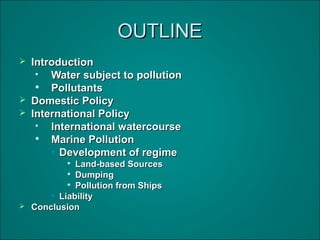
OUTLINEOUTLINE
 IntroductionIntroduction

Water subject to pollutionWater subject to pollution

PollutantsPollutants
 Domestic PolicyDomestic Policy
 International PolicyInternational Policy

International watercourseInternational watercourse

Marine PollutionMarine Pollution
• Development of regimeDevelopment of regime

Land-based SourcesLand-based Sources

DumpingDumping

Pollution from ShipsPollution from Ships
• LiabilityLiability
 ConclusionConclusion
IntroductionIntroduction
 TwoTwo types of water subject to pollutiontypes of water subject to pollution
 Surface water – rivers, lakes, oceansSurface water – rivers, lakes, oceans

Uses: drinking, recreational [fishing, boating,Uses: drinking, recreational [fishing, boating,
swimming], irrigation.swimming], irrigation.
 Groundwater- occurs beneath a water table inGroundwater- occurs beneath a water table in
soils or rocks; subject to pollution fromsoils or rocks; subject to pollution from
toxic chemicals.toxic chemicals.

Uses: drinking, irrigation, etcUses: drinking, irrigation, etc

ContaminationContamination

Nature of sources of contamination [point and non-Nature of sources of contamination [point and non-
point]point]
 Point source: discharge into surface waters at aPoint source: discharge into surface waters at a
specific location through a pipe, outfall or ditch.]specific location through a pipe, outfall or ditch.]
 Non-point: Indirect orNon-point: Indirect or
diffuse effect on waterdiffuse effect on water
[N/B. more difficult to[N/B. more difficult to
control]control]

e.g. agriculturale.g. agricultural
activities, urban run-offactivities, urban run-off
 Sources of contaminationSources of contamination

For GroundwaterFor Groundwater
• -polluting substances leach into a water--polluting substances leach into a water-
saturated region [e.g. toxic chemicals]saturated region [e.g. toxic chemicals]
• -Mainly due to migration of pollutants from-Mainly due to migration of pollutants from
sites with high concentrations of chemicalssites with high concentrations of chemicals
[e.g. industrial waste sites and farms][e.g. industrial waste sites and farms]
 Sources of contaminationSources of contamination

For Surface waterFor Surface water
• Rivers and lakesRivers and lakes

Point source: -sewage [municipal or private]Point source: -sewage [municipal or private]
-- industrial wastesindustrial wastes

Non-point source:Non-point source:
• Agricultural activity [e.g. pesticides, fertilizers].Agricultural activity [e.g. pesticides, fertilizers].
• urban and highway water runoff.urban and highway water runoff.
• Ocean [oil spills, dumping, land-based sources]Ocean [oil spills, dumping, land-based sources]

Oil spills – during transportation, either accidentally orOil spills – during transportation, either accidentally or
intentionallyintentionally

Dumping –sewage, chemical disposal, radioactiveDumping –sewage, chemical disposal, radioactive
materialsmaterials

Land-based sources –migration of chemicalLand-based sources –migration of chemical
substances.substances.
Types of Pollutants [Fund and accumulating pollutants]Types of Pollutants [Fund and accumulating pollutants]
 I) Fund pollutantsI) Fund pollutants

-Environment has some assimilative capacity. If-Environment has some assimilative capacity. If
capacity for absorption higher than rate of injection, theycapacity for absorption higher than rate of injection, they
may not accumulate.may not accumulate.
 a)a) DegradableDegradable

degrades/break into component parts within water. Aredegrades/break into component parts within water. Are
normally organic residuals attacked and broken down bynormally organic residuals attacked and broken down by
bacteria and become less harmful.bacteria and become less harmful.
 b) Thermal pollutionb) Thermal pollution

caused by injection of heat into watercourses by ancaused by injection of heat into watercourses by an
industrial plant or electric utility using surface waterindustrial plant or electric utility using surface water
as a coolant, and returning the heated water to theas a coolant, and returning the heated water to the
watercourse.watercourse.
 c) Plant nutrientsc) Plant nutrients [nitrogen and[nitrogen and phosphorus][eutrophic/phosphorus][eutrophic/
eutrophication =excess supply of nutrients in a lake]eutrophication =excess supply of nutrients in a lake]

stimulate growth of aquatic plant life, e.g. algae and waterstimulate growth of aquatic plant life, e.g. algae and water
weeds.weeds.

can produce odor if in excesscan produce odor if in excess..
 d) Infectious organismsd) Infectious organisms [e.g. bacteria and viruses[e.g. bacteria and viruses]]

carried into both ground and surface water by domestic andcarried into both ground and surface water by domestic and
animal wastes; industrial wastes e.g. tanning and meatanimal wastes; industrial wastes e.g. tanning and meat
packagingpackaging

Are live organisms that may thrive and multiply in water orAre live organisms that may thrive and multiply in water or
declinedecline..
II) Accumulating/stock pollutantsII) Accumulating/stock pollutants
 Environment has little or no absorptive capacity [i.e. noEnvironment has little or no absorptive capacity [i.e. no
natural process removes/transforms them].natural process removes/transforms them].

accumulate over time.accumulate over time.
 Examples: non-biodegradable bottles, heavy metals [e.g.Examples: non-biodegradable bottles, heavy metals [e.g.
lead, mercury]; persistent synthetic chemicals [e.g. dioxin,lead, mercury]; persistent synthetic chemicals [e.g. dioxin,
and PCBs –polychlorinated biphenyls]and PCBs –polychlorinated biphenyls]

not easily broken down; so can remain in water for long.not easily broken down; so can remain in water for long.

also accumulate in the food chain.also accumulate in the food chain.
Water Pollution Control Policy: Domestic DimensionWater Pollution Control Policy: Domestic Dimension
[U.S.][U.S.]
 Water Pollution Control Act, 1956Water Pollution Control Act, 1956

i)i) Federal financial support for construction of wasteFederal financial support for construction of waste
treatment plantstreatment plants
• focused on a control strategy based on subsidizingfocused on a control strategy based on subsidizing
construction of waste treatment plants as a particularconstruction of waste treatment plants as a particular
control activity.control activity.
• Municipalities would receive grant of upto 55% forMunicipalities would receive grant of upto 55% for
construction of waste treatment plants.construction of waste treatment plants.

ii)ii) Enforcement conference mechanismEnforcement conference mechanism
• sought to effect direct federal regulation of wastesought to effect direct federal regulation of waste
dischargesdischarges
• Federal authority could call for a conference of interstateFederal authority could call for a conference of interstate
water pollution problem.water pollution problem.
 Clean Water Act, 1972Clean Water Act, 1972

Two goalsTwo goals
• elimination of discharge of pollutants into navigableelimination of discharge of pollutants into navigable
waters by 1985waters by 1985
• achieve water quality for fishing and recreationachieve water quality for fishing and recreation
[swimming].[swimming].

New procedures for implementing the law introducedNew procedures for implementing the law introduced
• permits for all dischargers [qualification based on meetingpermits for all dischargers [qualification based on meeting
certain technology-based effluent standards]. especiallycertain technology-based effluent standards]. especially
sewage treatment plants and factories.sewage treatment plants and factories.

first ‘best practicable control technology currentlyfirst ‘best practicable control technology currently
available [BPT]available [BPT]

later, ‘best available technology economicallylater, ‘best available technology economically
achievable’[BAT]achievable’[BAT]

Raised ceiling of subsidizing municipal waste treatmentRaised ceiling of subsidizing municipal waste treatment
plants to 75%plants to 75%
 Safe Drinking Water Act, 1974, amended 1986Safe Drinking Water Act, 1974, amended 1986

Improvement on 1972 Act to include drinking water.Improvement on 1972 Act to include drinking water.

EPA regulations set maximum levels for pollutants forEPA regulations set maximum levels for pollutants for
community water systems.community water systems.

All community water systems must prepare andAll community water systems must prepare and
distribute annual reports about the water they provide,distribute annual reports about the water they provide,
including information on detected contaminants,including information on detected contaminants,
possible health effects, and the water's source.possible health effects, and the water's source.
Domestic policy on international waters: OceanDomestic policy on international waters: Ocean
 I) Oil spillsI) Oil spills – covered under the Clean Water Act:– covered under the Clean Water Act:

prohibits discharges of harmful quantities of oil intoprohibits discharges of harmful quantities of oil into
navigable watersnavigable waters

industry assume responsibility for any damage [clean up;industry assume responsibility for any damage [clean up;
compensation for environmental restorationcompensation for environmental restoration..
 II) DumpingII) Dumping

Marine Protection Research and Sanctuaries Act, 1972.Marine Protection Research and Sanctuaries Act, 1972.
• address discharges of wasteaddress discharges of waste

within U.S. territorial limitswithin U.S. territorial limits

by U.S. vessels or persons in any ocean waters.by U.S. vessels or persons in any ocean waters.
DomesticDomestic Policy on Non-Point sourcesPolicy on Non-Point sources
 Unlike point source, is largely state responsibilityUnlike point source, is largely state responsibility

Federal grants for state-initiated plans for waste treatmentFederal grants for state-initiated plans for waste treatment
management.management.

Federal programs for aiding control of non-point sourcesFederal programs for aiding control of non-point sources
• e.g. Conservation Reserve Programe.g. Conservation Reserve Program

aimed at removing 40-45 million acres of erodibleaimed at removing 40-45 million acres of erodible
land from cultivation.land from cultivation.
International Dimension:International Dimension:
Transboundary watercoursesTransboundary watercourses
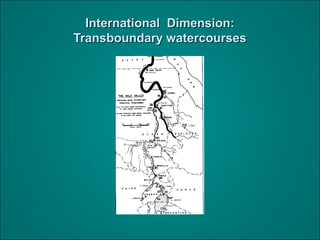
International WatercoursesInternational Watercourses
 rivers, lakes, or groundwater sources shared by two or morerivers, lakes, or groundwater sources shared by two or more
states.states.
 Geographical problem: how much of the watercourse is to beGeographical problem: how much of the watercourse is to be
included?included?
 i)i) portioportion that crosses or defines a boundary.n that crosses or defines a boundary.
 ProblemProblem: impedes efficient environmental management of: impedes efficient environmental management of
transboundary waters .transboundary waters .
 ii) entire watershed or riverii) entire watershed or river basinbasin [basin approach][basin approach]

associated lakes, tributaries, groundwater systems, andassociated lakes, tributaries, groundwater systems, and
connecting waterways wherever they are located.connecting waterways wherever they are located.
 Problem:Problem:

limitations on use of a substantial portion of a country’slimitations on use of a substantial portion of a country’s
water system and its associated catchment areaswater system and its associated catchment areas

requirements to provide an environmental good onrequirements to provide an environmental good on
watercourse states for themselves as well as otherswatercourse states for themselves as well as others
[neighbors].[neighbors].
Pollution permissible uses.Pollution permissible uses.
 Greater tolerance of polluting uses?Greater tolerance of polluting uses?

Few modern treaties endorse an absolute prohibition ofFew modern treaties endorse an absolute prohibition of
pollution. Modern trend require states to regulate andpollution. Modern trend require states to regulate and
control river pollution, prohibiting only certain forms ofcontrol river pollution, prohibiting only certain forms of
pollutant discharges.pollutant discharges.
 ExampleExample

North America: - prohibition of boundary waters only whenNorth America: - prohibition of boundary waters only when
human health or property were injured.human health or property were injured.

Until 1973, U.S. maintained it did not have an obligation toUntil 1973, U.S. maintained it did not have an obligation to
deliver quality water to Mexico from Colorado river, provideddeliver quality water to Mexico from Colorado river, provided
its polluting use of the river for irrigation was reasonable.its polluting use of the river for irrigation was reasonable.
 State practice, however, points to prohibition of certain toxicState practice, however, points to prohibition of certain toxic
discharges.discharges.
1997 UN Watercourses Convention1997 UN Watercourses Convention
 watercourse states prevent, reduce, and control pollution of awatercourse states prevent, reduce, and control pollution of a
watercourse causing significant harm to other states.watercourse causing significant harm to other states.

Not absolute prohibition, but means states act with dueNot absolute prohibition, but means states act with due
diligence.diligence.
 Thus,Thus, pollution permissiblepollution permissible if,if,
• Insignificant harm,Insignificant harm,
• Significant but unavoidable by exercise of due diligence.Significant but unavoidable by exercise of due diligence.
 Significant of above to pollution and environment:Significant of above to pollution and environment:

Protection of river environment and its living resourcesProtection of river environment and its living resources
must compete with other equitable claims.must compete with other equitable claims.
• No claim [e.g. industrial waste disposal vs. fishing] hasNo claim [e.g. industrial waste disposal vs. fishing] has
priority [although ‘special regard’ must be given to ‘vitalpriority [although ‘special regard’ must be given to ‘vital
human needs’]human needs’]
Unusual exampleUnusual example
 1976 Rhine Chlorides Convention [force, 1985]1976 Rhine Chlorides Convention [force, 1985]

reduce French Chloride discharges into the river, andreduce French Chloride discharges into the river, and
prevent increases in discharges by other states.prevent increases in discharges by other states.
 Reversal of the polluter pays principleReversal of the polluter pays principle

cost of measures taken by France to reduce chloridecost of measures taken by France to reduce chloride
distributed across all riparian states including injureddistributed across all riparian states including injured
ones.ones.
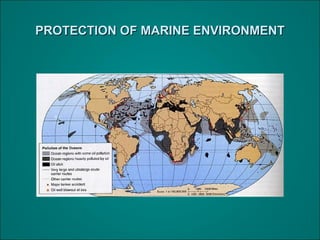
PROTECTION OF MARINE ENVIRONMENTPROTECTION OF MARINE ENVIRONMENT
 Development of regulation of marine pollution wasDevelopment of regulation of marine pollution was
slower than that of other aspects of the sea [[e.g.slower than that of other aspects of the sea [[e.g.
Fisheries 1911 convention on Fur Seals]Fisheries 1911 convention on Fur Seals]
 Two stages in developmentTwo stages in development

Laissez Faire : London Convention for PreventionLaissez Faire : London Convention for Prevention
of Pollution of the Sea by Oil.of Pollution of the Sea by Oil.
• did not entirely prohibit discharge of oil fromdid not entirely prohibit discharge of oil from
ships at sea. 1954.ships at sea. 1954.

Duty to protect environment from Pollution:Duty to protect environment from Pollution:
UNCLOS phaseUNCLOS phase
 1982 United Nations Convention on Law of the Seas1982 United Nations Convention on Law of the Seas
[UNCLOS][UNCLOS]

formulated obligation in terms comprehensive offormulated obligation in terms comprehensive of
all sources. [ships, land-based sources, seabedall sources. [ships, land-based sources, seabed
operations, dumping, and atmospheric pollution]operations, dumping, and atmospheric pollution]
I)I) OnOn land-based sourcesland-based sources
 Unlike pollution from ships and dumping, no requirementUnlike pollution from ships and dumping, no requirement
for adherence to any minimum international standards.for adherence to any minimum international standards.

Each state determine what measures to take, andEach state determine what measures to take, and
which substances to act on.which substances to act on.
 Reason for generality:Reason for generality:

balance environmental protection measures againstbalance environmental protection measures against
economic imperativeseconomic imperatives
 Regional regimesRegional regimes
International Policy on DumpingInternational Policy on Dumping
 Both London Dumping Convention and UNCLOS initially soughtBoth London Dumping Convention and UNCLOS initially sought
to control, not prohibit, dumping.to control, not prohibit, dumping.

Dumping was permissible unless proven harmful.Dumping was permissible unless proven harmful.
 Consequent to Rio in 1992 where the precautionary principleConsequent to Rio in 1992 where the precautionary principle
was adopted, dumping is now prohibited unless there is nowas adopted, dumping is now prohibited unless there is no
alternative, and can be proved to be harmless to environmentalternative, and can be proved to be harmless to environment
[shift in burden of proof][shift in burden of proof]
III) POLLUTION FROM SHIPSIII) POLLUTION FROM SHIPS
 purpose of regulation is minimize the risk and give coastalpurpose of regulation is minimize the risk and give coastal
states adequate means of protecting themselves and securingstates adequate means of protecting themselves and securing
compensationcompensation
 MARPOL, 1973/ amended 1978MARPOL, 1973/ amended 1978 ].].
 Jurisdiction to regulate PollutionJurisdiction to regulate Pollution

Flag stateFlag state –the state in which the ship is registered or–the state in which the ship is registered or
whose flag it is entitled to fly.whose flag it is entitled to fly.

cooperationcooperation of coastal states, port states and flag states inof coastal states, port states and flag states in
the system of certification, inspection and reportingthe system of certification, inspection and reporting ..
Responsibility and Liability for DamageResponsibility and Liability for Damage
 Two ConventionsTwo Conventions

1969 Convention on civil Liability for Oil Pollution1969 Convention on civil Liability for Oil Pollution
Damage; updated by 1992.Damage; updated by 1992.

1996 Convention on Liability and Compensation for the1996 Convention on Liability and Compensation for the
Carriage of Hazardous and Noxious Substances by sea.Carriage of Hazardous and Noxious Substances by sea.
 State responsibility for damageState responsibility for damage
 Civil liabilityCivil liability

Who claims liability costs:Who claims liability costs:
• e.g. fisherfolks and hoteliers.e.g. fisherfolks and hoteliers.
• Environmental DamageEnvironmental Damage

Compensation for impairment of the environment;Compensation for impairment of the environment;
limited to costs of reasonable measures oflimited to costs of reasonable measures of
reinstatement.reinstatement.
ConclusionConclusion
 Non-point source control is the leastNon-point source control is the least
developed of water pollution controldeveloped of water pollution control
programs/policies.programs/policies.

What is the source of this difficulty?What is the source of this difficulty?

In what two ways [at both domestic andIn what two ways [at both domestic and
international levels] can the difficulty beinternational levels] can the difficulty be
addressed/mitigated?addressed/mitigated?

Water pollution and source

  • 1.
  • 2.
    OUTLINEOUTLINE  IntroductionIntroduction  Water subjectto pollutionWater subject to pollution  PollutantsPollutants  Domestic PolicyDomestic Policy  International PolicyInternational Policy  International watercourseInternational watercourse  Marine PollutionMarine Pollution • Development of regimeDevelopment of regime  Land-based SourcesLand-based Sources  DumpingDumping  Pollution from ShipsPollution from Ships • LiabilityLiability  ConclusionConclusion
  • 3.
    IntroductionIntroduction  TwoTwo typesof water subject to pollutiontypes of water subject to pollution  Surface water – rivers, lakes, oceansSurface water – rivers, lakes, oceans  Uses: drinking, recreational [fishing, boating,Uses: drinking, recreational [fishing, boating, swimming], irrigation.swimming], irrigation.  Groundwater- occurs beneath a water table inGroundwater- occurs beneath a water table in soils or rocks; subject to pollution fromsoils or rocks; subject to pollution from toxic chemicals.toxic chemicals.  Uses: drinking, irrigation, etcUses: drinking, irrigation, etc
  • 4.
     ContaminationContamination  Nature of sourcesof contamination [point and non-Nature of sources of contamination [point and non- point]point]  Point source: discharge into surface waters at aPoint source: discharge into surface waters at a specific location through a pipe, outfall or ditch.]specific location through a pipe, outfall or ditch.]
  • 5.
     Non-point: IndirectorNon-point: Indirect or diffuse effect on waterdiffuse effect on water [N/B. more difficult to[N/B. more difficult to control]control]  e.g. agriculturale.g. agricultural activities, urban run-offactivities, urban run-off
  • 6.
     Sources ofcontaminationSources of contamination  For GroundwaterFor Groundwater • -polluting substances leach into a water--polluting substances leach into a water- saturated region [e.g. toxic chemicals]saturated region [e.g. toxic chemicals] • -Mainly due to migration of pollutants from-Mainly due to migration of pollutants from sites with high concentrations of chemicalssites with high concentrations of chemicals [e.g. industrial waste sites and farms][e.g. industrial waste sites and farms]
  • 7.
     Sources ofcontaminationSources of contamination  For Surface waterFor Surface water • Rivers and lakesRivers and lakes  Point source: -sewage [municipal or private]Point source: -sewage [municipal or private] -- industrial wastesindustrial wastes  Non-point source:Non-point source: • Agricultural activity [e.g. pesticides, fertilizers].Agricultural activity [e.g. pesticides, fertilizers]. • urban and highway water runoff.urban and highway water runoff. • Ocean [oil spills, dumping, land-based sources]Ocean [oil spills, dumping, land-based sources]  Oil spills – during transportation, either accidentally orOil spills – during transportation, either accidentally or intentionallyintentionally  Dumping –sewage, chemical disposal, radioactiveDumping –sewage, chemical disposal, radioactive materialsmaterials  Land-based sources –migration of chemicalLand-based sources –migration of chemical substances.substances.
  • 8.
    Types of Pollutants[Fund and accumulating pollutants]Types of Pollutants [Fund and accumulating pollutants]  I) Fund pollutantsI) Fund pollutants  -Environment has some assimilative capacity. If-Environment has some assimilative capacity. If capacity for absorption higher than rate of injection, theycapacity for absorption higher than rate of injection, they may not accumulate.may not accumulate.  a)a) DegradableDegradable  degrades/break into component parts within water. Aredegrades/break into component parts within water. Are normally organic residuals attacked and broken down bynormally organic residuals attacked and broken down by bacteria and become less harmful.bacteria and become less harmful.  b) Thermal pollutionb) Thermal pollution  caused by injection of heat into watercourses by ancaused by injection of heat into watercourses by an industrial plant or electric utility using surface waterindustrial plant or electric utility using surface water as a coolant, and returning the heated water to theas a coolant, and returning the heated water to the watercourse.watercourse.
  • 9.
     c) Plantnutrientsc) Plant nutrients [nitrogen and[nitrogen and phosphorus][eutrophic/phosphorus][eutrophic/ eutrophication =excess supply of nutrients in a lake]eutrophication =excess supply of nutrients in a lake]  stimulate growth of aquatic plant life, e.g. algae and waterstimulate growth of aquatic plant life, e.g. algae and water weeds.weeds.  can produce odor if in excesscan produce odor if in excess..  d) Infectious organismsd) Infectious organisms [e.g. bacteria and viruses[e.g. bacteria and viruses]]  carried into both ground and surface water by domestic andcarried into both ground and surface water by domestic and animal wastes; industrial wastes e.g. tanning and meatanimal wastes; industrial wastes e.g. tanning and meat packagingpackaging  Are live organisms that may thrive and multiply in water orAre live organisms that may thrive and multiply in water or declinedecline..
  • 10.
    II) Accumulating/stock pollutantsII)Accumulating/stock pollutants  Environment has little or no absorptive capacity [i.e. noEnvironment has little or no absorptive capacity [i.e. no natural process removes/transforms them].natural process removes/transforms them].  accumulate over time.accumulate over time.  Examples: non-biodegradable bottles, heavy metals [e.g.Examples: non-biodegradable bottles, heavy metals [e.g. lead, mercury]; persistent synthetic chemicals [e.g. dioxin,lead, mercury]; persistent synthetic chemicals [e.g. dioxin, and PCBs –polychlorinated biphenyls]and PCBs –polychlorinated biphenyls]  not easily broken down; so can remain in water for long.not easily broken down; so can remain in water for long.  also accumulate in the food chain.also accumulate in the food chain.
  • 11.
    Water Pollution ControlPolicy: Domestic DimensionWater Pollution Control Policy: Domestic Dimension [U.S.][U.S.]  Water Pollution Control Act, 1956Water Pollution Control Act, 1956  i)i) Federal financial support for construction of wasteFederal financial support for construction of waste treatment plantstreatment plants • focused on a control strategy based on subsidizingfocused on a control strategy based on subsidizing construction of waste treatment plants as a particularconstruction of waste treatment plants as a particular control activity.control activity. • Municipalities would receive grant of upto 55% forMunicipalities would receive grant of upto 55% for construction of waste treatment plants.construction of waste treatment plants.  ii)ii) Enforcement conference mechanismEnforcement conference mechanism • sought to effect direct federal regulation of wastesought to effect direct federal regulation of waste dischargesdischarges • Federal authority could call for a conference of interstateFederal authority could call for a conference of interstate water pollution problem.water pollution problem.
  • 12.
     Clean WaterAct, 1972Clean Water Act, 1972  Two goalsTwo goals • elimination of discharge of pollutants into navigableelimination of discharge of pollutants into navigable waters by 1985waters by 1985 • achieve water quality for fishing and recreationachieve water quality for fishing and recreation [swimming].[swimming].  New procedures for implementing the law introducedNew procedures for implementing the law introduced • permits for all dischargers [qualification based on meetingpermits for all dischargers [qualification based on meeting certain technology-based effluent standards]. especiallycertain technology-based effluent standards]. especially sewage treatment plants and factories.sewage treatment plants and factories.  first ‘best practicable control technology currentlyfirst ‘best practicable control technology currently available [BPT]available [BPT]  later, ‘best available technology economicallylater, ‘best available technology economically achievable’[BAT]achievable’[BAT]  Raised ceiling of subsidizing municipal waste treatmentRaised ceiling of subsidizing municipal waste treatment plants to 75%plants to 75%
  • 13.
     Safe DrinkingWater Act, 1974, amended 1986Safe Drinking Water Act, 1974, amended 1986  Improvement on 1972 Act to include drinking water.Improvement on 1972 Act to include drinking water.  EPA regulations set maximum levels for pollutants forEPA regulations set maximum levels for pollutants for community water systems.community water systems.  All community water systems must prepare andAll community water systems must prepare and distribute annual reports about the water they provide,distribute annual reports about the water they provide, including information on detected contaminants,including information on detected contaminants, possible health effects, and the water's source.possible health effects, and the water's source.
  • 14.
    Domestic policy oninternational waters: OceanDomestic policy on international waters: Ocean  I) Oil spillsI) Oil spills – covered under the Clean Water Act:– covered under the Clean Water Act:  prohibits discharges of harmful quantities of oil intoprohibits discharges of harmful quantities of oil into navigable watersnavigable waters  industry assume responsibility for any damage [clean up;industry assume responsibility for any damage [clean up; compensation for environmental restorationcompensation for environmental restoration..  II) DumpingII) Dumping  Marine Protection Research and Sanctuaries Act, 1972.Marine Protection Research and Sanctuaries Act, 1972. • address discharges of wasteaddress discharges of waste  within U.S. territorial limitswithin U.S. territorial limits  by U.S. vessels or persons in any ocean waters.by U.S. vessels or persons in any ocean waters.
  • 15.
    DomesticDomestic Policy onNon-Point sourcesPolicy on Non-Point sources  Unlike point source, is largely state responsibilityUnlike point source, is largely state responsibility  Federal grants for state-initiated plans for waste treatmentFederal grants for state-initiated plans for waste treatment management.management.  Federal programs for aiding control of non-point sourcesFederal programs for aiding control of non-point sources • e.g. Conservation Reserve Programe.g. Conservation Reserve Program  aimed at removing 40-45 million acres of erodibleaimed at removing 40-45 million acres of erodible land from cultivation.land from cultivation.
  • 16.
  • 17.
    International WatercoursesInternational Watercourses rivers, lakes, or groundwater sources shared by two or morerivers, lakes, or groundwater sources shared by two or more states.states.  Geographical problem: how much of the watercourse is to beGeographical problem: how much of the watercourse is to be included?included?  i)i) portioportion that crosses or defines a boundary.n that crosses or defines a boundary.  ProblemProblem: impedes efficient environmental management of: impedes efficient environmental management of transboundary waters .transboundary waters .  ii) entire watershed or riverii) entire watershed or river basinbasin [basin approach][basin approach]  associated lakes, tributaries, groundwater systems, andassociated lakes, tributaries, groundwater systems, and connecting waterways wherever they are located.connecting waterways wherever they are located.  Problem:Problem:  limitations on use of a substantial portion of a country’slimitations on use of a substantial portion of a country’s water system and its associated catchment areaswater system and its associated catchment areas  requirements to provide an environmental good onrequirements to provide an environmental good on watercourse states for themselves as well as otherswatercourse states for themselves as well as others [neighbors].[neighbors].
  • 18.
    Pollution permissible uses.Pollutionpermissible uses.  Greater tolerance of polluting uses?Greater tolerance of polluting uses?  Few modern treaties endorse an absolute prohibition ofFew modern treaties endorse an absolute prohibition of pollution. Modern trend require states to regulate andpollution. Modern trend require states to regulate and control river pollution, prohibiting only certain forms ofcontrol river pollution, prohibiting only certain forms of pollutant discharges.pollutant discharges.  ExampleExample  North America: - prohibition of boundary waters only whenNorth America: - prohibition of boundary waters only when human health or property were injured.human health or property were injured.  Until 1973, U.S. maintained it did not have an obligation toUntil 1973, U.S. maintained it did not have an obligation to deliver quality water to Mexico from Colorado river, provideddeliver quality water to Mexico from Colorado river, provided its polluting use of the river for irrigation was reasonable.its polluting use of the river for irrigation was reasonable.  State practice, however, points to prohibition of certain toxicState practice, however, points to prohibition of certain toxic discharges.discharges.
  • 19.
    1997 UN WatercoursesConvention1997 UN Watercourses Convention  watercourse states prevent, reduce, and control pollution of awatercourse states prevent, reduce, and control pollution of a watercourse causing significant harm to other states.watercourse causing significant harm to other states.  Not absolute prohibition, but means states act with dueNot absolute prohibition, but means states act with due diligence.diligence.  Thus,Thus, pollution permissiblepollution permissible if,if, • Insignificant harm,Insignificant harm, • Significant but unavoidable by exercise of due diligence.Significant but unavoidable by exercise of due diligence.  Significant of above to pollution and environment:Significant of above to pollution and environment:  Protection of river environment and its living resourcesProtection of river environment and its living resources must compete with other equitable claims.must compete with other equitable claims. • No claim [e.g. industrial waste disposal vs. fishing] hasNo claim [e.g. industrial waste disposal vs. fishing] has priority [although ‘special regard’ must be given to ‘vitalpriority [although ‘special regard’ must be given to ‘vital human needs’]human needs’]
  • 20.
    Unusual exampleUnusual example 1976 Rhine Chlorides Convention [force, 1985]1976 Rhine Chlorides Convention [force, 1985]  reduce French Chloride discharges into the river, andreduce French Chloride discharges into the river, and prevent increases in discharges by other states.prevent increases in discharges by other states.  Reversal of the polluter pays principleReversal of the polluter pays principle  cost of measures taken by France to reduce chloridecost of measures taken by France to reduce chloride distributed across all riparian states including injureddistributed across all riparian states including injured ones.ones.
  • 21.
    PROTECTION OF MARINEENVIRONMENTPROTECTION OF MARINE ENVIRONMENT
  • 22.
    PROTECTION OF MARINEENVIRONMENTPROTECTION OF MARINE ENVIRONMENT  Development of regulation of marine pollution wasDevelopment of regulation of marine pollution was slower than that of other aspects of the sea [[e.g.slower than that of other aspects of the sea [[e.g. Fisheries 1911 convention on Fur Seals]Fisheries 1911 convention on Fur Seals]  Two stages in developmentTwo stages in development  Laissez Faire : London Convention for PreventionLaissez Faire : London Convention for Prevention of Pollution of the Sea by Oil.of Pollution of the Sea by Oil. • did not entirely prohibit discharge of oil fromdid not entirely prohibit discharge of oil from ships at sea. 1954.ships at sea. 1954.  Duty to protect environment from Pollution:Duty to protect environment from Pollution: UNCLOS phaseUNCLOS phase  1982 United Nations Convention on Law of the Seas1982 United Nations Convention on Law of the Seas [UNCLOS][UNCLOS]  formulated obligation in terms comprehensive offormulated obligation in terms comprehensive of all sources. [ships, land-based sources, seabedall sources. [ships, land-based sources, seabed operations, dumping, and atmospheric pollution]operations, dumping, and atmospheric pollution]
  • 23.
    I)I) OnOn land-basedsourcesland-based sources  Unlike pollution from ships and dumping, no requirementUnlike pollution from ships and dumping, no requirement for adherence to any minimum international standards.for adherence to any minimum international standards.  Each state determine what measures to take, andEach state determine what measures to take, and which substances to act on.which substances to act on.  Reason for generality:Reason for generality:  balance environmental protection measures againstbalance environmental protection measures against economic imperativeseconomic imperatives  Regional regimesRegional regimes
  • 24.
    International Policy onDumpingInternational Policy on Dumping  Both London Dumping Convention and UNCLOS initially soughtBoth London Dumping Convention and UNCLOS initially sought to control, not prohibit, dumping.to control, not prohibit, dumping.  Dumping was permissible unless proven harmful.Dumping was permissible unless proven harmful.  Consequent to Rio in 1992 where the precautionary principleConsequent to Rio in 1992 where the precautionary principle was adopted, dumping is now prohibited unless there is nowas adopted, dumping is now prohibited unless there is no alternative, and can be proved to be harmless to environmentalternative, and can be proved to be harmless to environment [shift in burden of proof][shift in burden of proof]
  • 25.
    III) POLLUTION FROMSHIPSIII) POLLUTION FROM SHIPS  purpose of regulation is minimize the risk and give coastalpurpose of regulation is minimize the risk and give coastal states adequate means of protecting themselves and securingstates adequate means of protecting themselves and securing compensationcompensation  MARPOL, 1973/ amended 1978MARPOL, 1973/ amended 1978 ].].  Jurisdiction to regulate PollutionJurisdiction to regulate Pollution  Flag stateFlag state –the state in which the ship is registered or–the state in which the ship is registered or whose flag it is entitled to fly.whose flag it is entitled to fly.  cooperationcooperation of coastal states, port states and flag states inof coastal states, port states and flag states in the system of certification, inspection and reportingthe system of certification, inspection and reporting ..
  • 26.
    Responsibility and Liabilityfor DamageResponsibility and Liability for Damage  Two ConventionsTwo Conventions  1969 Convention on civil Liability for Oil Pollution1969 Convention on civil Liability for Oil Pollution Damage; updated by 1992.Damage; updated by 1992.  1996 Convention on Liability and Compensation for the1996 Convention on Liability and Compensation for the Carriage of Hazardous and Noxious Substances by sea.Carriage of Hazardous and Noxious Substances by sea.  State responsibility for damageState responsibility for damage  Civil liabilityCivil liability  Who claims liability costs:Who claims liability costs: • e.g. fisherfolks and hoteliers.e.g. fisherfolks and hoteliers. • Environmental DamageEnvironmental Damage  Compensation for impairment of the environment;Compensation for impairment of the environment; limited to costs of reasonable measures oflimited to costs of reasonable measures of reinstatement.reinstatement.
  • 27.
    ConclusionConclusion  Non-point sourcecontrol is the leastNon-point source control is the least developed of water pollution controldeveloped of water pollution control programs/policies.programs/policies.  What is the source of this difficulty?What is the source of this difficulty?  In what two ways [at both domestic andIn what two ways [at both domestic and international levels] can the difficulty beinternational levels] can the difficulty be addressed/mitigated?addressed/mitigated?