’‫ةةةةمنكننثنثل‬mmmLA
Buckling
types
In science, buckling is a mathematical instability, leading to a failure mode.
Buckling is characterized by a sudden sideways failure of a structural member subjected to high compressive
stress, where the compressive stress at the point of failure is less than the ultimate compressive stress that the
material is capable of withstanding.
Made by : Maged Salama
Page 3
Buckling types
Local buckling1.
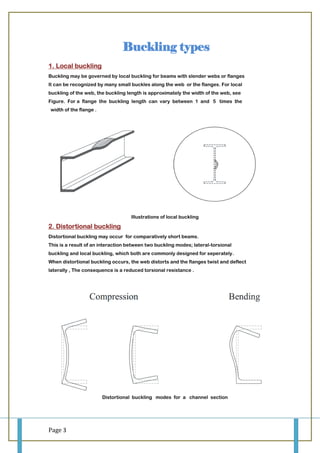
Buckling may be governed by local buckling for beams with slender webs or flanges
It can be recognized by many small buckles along the web or the flanges. For local
buckling of the web, the buckling length is approximately the width of the web, see
Figure. For a flange the buckling length can vary between 1 and 5 times the
.width of the flange
Illustrations of local buckling
Distortional buckling2.
Distortional buckling may occur for comparatively short beams.
This is a result of an interaction between two buckling modes; lateral-torsional
buckling and local buckling, which both are commonly designed for seperately.
When distortional buckling occurs, the web distorts and the flanges twist and deflect
laterally , The consequence is a reduced torsional resistance .
Distortional buckling modes for a channel section
Page 3
Global buckling3.
Buckling that occurs and influences the beam globally is called global buckling. This
type of buckling can be subdivided further depending on what kind of deformation
takes place and the type of load acting on the beam.
4.Overall buckling
Flexural buckling(a)
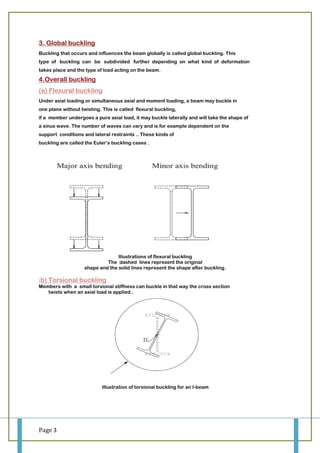
Under axial loading or simultaneous axial and moment loading, a beam may buckle in
one plane without twisting. This is called flexural buckling,
if a member undergoes a pure axial load, it may buckle laterally and will take the shape of
a sinus wave. The number of waves can vary and is for example dependent on the
support conditions and lateral restraints .. These kinds of
buckling are called the Euler’s buckling cases .
Illustrations of flexural buckling
The dashed lines represent the original
shape and the solid lines represent the shape after buckling.
b) Torsional buckling(
Members with a small torsional stiffness can buckle in that way the cross section
..twists when an axial load is applied
Illustration of torsional buckling for an I-beam
Page 3
flexural buckling-© Torsional
torsional buckling-Lateral
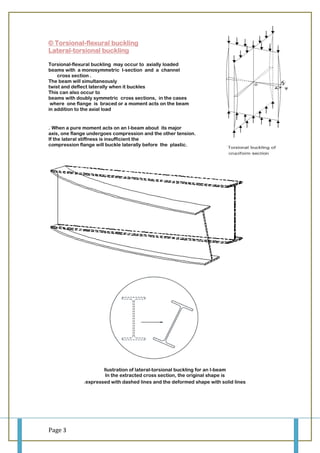
Torsional-flexural buckling may occur to axially loaded
beams with a monosymmetric I-section and a channel
.cross section
The beam will simultaneously
twist and deflect laterally when it buckles
This can also occur to
beams with doubly symmetric cross sections, in the cases
where one flange is braced or a moment acts on the beam
in addition to the axial load
. When a pure moment acts on an I-beam about its major
axis, one flange undergoes compression and the other tension.
If the lateral stiffness is insufficient the
compression flange will buckle laterally before the plastic.
llustration of lateral-torsional buckling for an I-beam
In the extracted cross section, the original shape is
expressed with dashed lines and the deformed shape with solid lines.

Buckling types

  • 1.
    ’‫ةةةةمنكننثنثل‬mmmLA Buckling types In science, bucklingis a mathematical instability, leading to a failure mode. Buckling is characterized by a sudden sideways failure of a structural member subjected to high compressive stress, where the compressive stress at the point of failure is less than the ultimate compressive stress that the material is capable of withstanding. Made by : Maged Salama
  • 2.
    Page 3 Buckling types Localbuckling1. Buckling may be governed by local buckling for beams with slender webs or flanges It can be recognized by many small buckles along the web or the flanges. For local buckling of the web, the buckling length is approximately the width of the web, see Figure. For a flange the buckling length can vary between 1 and 5 times the .width of the flange Illustrations of local buckling Distortional buckling2. Distortional buckling may occur for comparatively short beams. This is a result of an interaction between two buckling modes; lateral-torsional buckling and local buckling, which both are commonly designed for seperately. When distortional buckling occurs, the web distorts and the flanges twist and deflect laterally , The consequence is a reduced torsional resistance . Distortional buckling modes for a channel section
  • 3.
    Page 3 Global buckling3. Bucklingthat occurs and influences the beam globally is called global buckling. This type of buckling can be subdivided further depending on what kind of deformation takes place and the type of load acting on the beam. 4.Overall buckling Flexural buckling(a) Under axial loading or simultaneous axial and moment loading, a beam may buckle in one plane without twisting. This is called flexural buckling, if a member undergoes a pure axial load, it may buckle laterally and will take the shape of a sinus wave. The number of waves can vary and is for example dependent on the support conditions and lateral restraints .. These kinds of buckling are called the Euler’s buckling cases . Illustrations of flexural buckling The dashed lines represent the original shape and the solid lines represent the shape after buckling. b) Torsional buckling( Members with a small torsional stiffness can buckle in that way the cross section ..twists when an axial load is applied Illustration of torsional buckling for an I-beam
  • 4.
    Page 3 flexural buckling-©Torsional torsional buckling-Lateral Torsional-flexural buckling may occur to axially loaded beams with a monosymmetric I-section and a channel .cross section The beam will simultaneously twist and deflect laterally when it buckles This can also occur to beams with doubly symmetric cross sections, in the cases where one flange is braced or a moment acts on the beam in addition to the axial load . When a pure moment acts on an I-beam about its major axis, one flange undergoes compression and the other tension. If the lateral stiffness is insufficient the compression flange will buckle laterally before the plastic. llustration of lateral-torsional buckling for an I-beam In the extracted cross section, the original shape is expressed with dashed lines and the deformed shape with solid lines.