TYPE METHOD
According to a precise set of rules laid down in the International Code of Zoological N
omenclature (ICZN) and the International Code of Nomenclature for algae, fungi, and
plants(ICN), the scientific name of every taxon is almost always based on one particul
ar specimen, or in some cases specimens. Types are of great significance to biologist
s, especially to taxonomists. Types are usually physical specimens that are kept in
a museum or herbarium research collection, but failing that, an image of an individual
of that taxon has sometimes been designated as a type.] Describing species and app
ointing type specimens is part of scientific nomenclature and alpha taxonomy.
When identifying material, a scientist attempts to apply a taxon name to a specimen o
r group of specimens based on his or her understanding of the relevant taxa, based o
n (at least) having read the type description(s), preferably based on an examination o
f all the type material of all of the relevant taxa.
Introduction:
If there is more than one named type that all appear to be the same taxon, the
n the oldest name takes precedence, and is considered to be the correct name
of the material in hand. If on the other hand the taxon appears never to have b
een named at all, then the scientist or another qualified expert picks a type spe
cimen and publishes a new name and an official description.
This process is crucial to the science of biological taxonomy. People's ideas of
how living things should be grouped change and shift over time. How do we kn
ow that what we call "Canis lupus" is the same thing, or approximately the sam
e thing, as what they will be calling "Canis lupus" in 200 years' time? It is possi
ble to check this because there is a particular wolf specimen preserved in Swe
den] and everyone who uses that name – no matter what else they may mean
by it – will include that particular specimen.
Depending on the nomenclature code applied to the organism in question, a ty
pe can be a specimen, a culture, an illustration, or (under the bacteriological co
de) a description. Some codes consider a subordinate taxon to be the type, but
under the botanical code the type is always a specimen or illustration.
.
For example, in the research collection of the Natural History Museum in London, the
re is a bird specimen numbered 1886.6.24.20. This is a specimen of a kind of bird co
mmonly known as the spotted harrier, which currently bears the scientific name Circu
s assimilis. This particular specimen is the holotype for that species; the name Circus
assimilis refers, by definition, to the species of that particular specimen.
That species was named and described by Jardine and Selby in 1828, and the holoty
pe was placed in the museum collection so that other scientists might refer to it as ne
cessary. Note that at least for type specimens there is no requirement for a "typical" in
dividual to be used. Genera and families, particularly those established by early taxon
omists, tend to be named after species that are more "typical" for them, but here too t
his is not always the case and due to changes in systematics cannot be. Hence, the t
erm name-bearing type or onomatophore is sometimes used, to denote the fact that b
iological types do not define "typical" individuals or taxa, but rather fix a scientific nam
e to a specific operational taxonomic unit. Type specimens are theoretically even allo
wed to be aberrant or deformed individuals or color variations, though this is rarely ch
osen to be the case, as it makes it hard to determine to which population the individu
al belonged.
The usage of the term type is somewhat complicated by slightly different uses i
n botany and zoology. In the PhyloCode, type-based definitions are replaced b
y phylogenetic definitions.
Older terminology:
In some older taxonomic works the word "type" has sometimes been u
sed differently. The meaning was similar in the first Laws of Botanical
Nomenclature, but has a meaning closer to the term taxon in some ot
her works:
Ce seul caractère permet de distinguer ce type de toutes les autres es
pèces de la section. … Après avoir étudié ces diverses formes, j'en ar
rivai à les considérer comme appartenant à un seul et même type spé
cifique.
Translation: This single character permits [one to] distinguish this type
from all other species of the section ... After studying the diverse form
s, I came to consider them as belonging to the one and the same spe
cific type
IN ZOOLOGY:
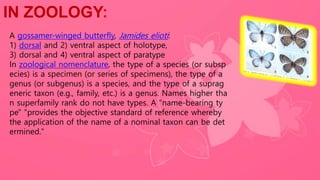
A gossamer-winged butterfly, Jamides elioti:
1) dorsal and 2) ventral aspect of holotype,
3) dorsal and 4) ventral aspect of paratype
In zoological nomenclature, the type of a species (or subsp
ecies) is a specimen (or series of specimens), the type of a
genus (or subgenus) is a species, and the type of a suprag
eneric taxon (e.g., family, etc.) is a genus. Names higher tha
n superfamily rank do not have types. A "name-bearing ty
pe" "provides the objective standard of reference whereby
the application of the name of a nominal taxon can be det
ermined."
Definations:
A type specimen is a vernacular term (not a formally defined term) ty
pically used for an individual or fossil that is any of the various name-
bearing types for a species. For example, the type specimen for the s
pecies Homo neanderthalensis was the specimen "Neanderthal-1" di
scovered by Johann Karl Fuhlrott in 1856 at Feldhofer in the Neander
Valley in Germany, consisting of a skullcap, thigh bones, part of a pel
vis, some ribs, and some arm and shoulder bones. There may be mo
re than one type specimen, but there is (at least in modern times) onl
y one holotype.
A type species is the nominal species that is the name-bearing type o
f a nominal genus or subgenus.
A type genus is the nominal genus that is the name-bearing type of a nominal family-group
taxon.
The type series are all those specimens included by the author in a taxon's formal descripti
on, unless the author explicitly or implicitly excludes them as part of the series.
USE OF TYPE SPECIM
EN:
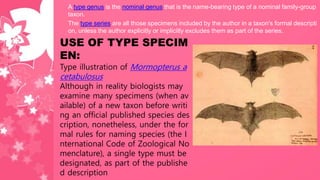
Type illustration of Mormopterus a
cetabulosus
Although in reality biologists may
examine many specimens (when av
ailable) of a new taxon before writi
ng an official published species des
cription, nonetheless, under the for
mal rules for naming species (the I
nternational Code of Zoological No
menclature), a single type must be
designated, as part of the publishe
d description
A type description must include a diagnosis (typically, a discussion of similarities to an
d differences from closely related species), and an indication of where the type speci
men or specimens are deposited for examination. The geographical location where a
type specimen was originally found is known as its type locality. In the case of paras
ites, the term type host (or symbiotype) is used to indicate the host organism from w
hich the type specimen was obtained.
Zoological collections are maintained by universities and museums. Ensuring that typ
es are kept in good condition and made available for examination by taxonomists are
two important functions of such collections. And, while there is only one holotype desi
gnated, there can be other "type" specimens, the following of which are formally defin
ed
Holotype:
When a single specimen is clearly designated in the original description, this specime
n is known as the holotype of that species. The holotype is typically placed in a major
museum, or similar well-known public collection, so that it is freely available for later e
xamination by other biologists
. Paratype
When the original description designated a holotype, there may still be
additional specimens listed in the type series and those are termed pa
ratypes. These are not name-bearing types.
. Allotype
An allotype is a specimen of the opposite sex to the holotype, designa
ted from among paratypes. It was also formerly used for a specimen t
hat shows features not seen in the holotype of a fossil.[11] The term is
not regulated by the ICZN.
. Neotype
A neotype is a specimen later selected to serve as the single type spe
cimen when an original holotype has been lost or destroyed or where t
he original author never cited a specimen.
Syntype
A syntype is any one of two or more specimens that is listed in a species description where no h
olotype was designated; historically, syntypes were often explicitly designated as such, and und
er the present ICZN this is a requirement, but modern attempts to publish species description ba
sed on syntypes are generally frowned upon by practicing taxonomists, and most are gradually
being replaced by lectotypes. Those that still exist are still considered name-bearing types.
Lectotype
A lectotype is a specimen later selected to serve as the single type specimen for spec
ies originally described from a set of syntypes. In zoology, a lectotype is a kind of na
me-bearing type. When a species was originally described on the basis of a name-be
aring type consisting of multiple specimens, one of those may be designated as the le
ctotype. Having a single name-bearing type reduces the potential for confusion, espe
cially considering that it is not uncommon for a series of syntypes to contain specime
ns of more than one species.
A notable example is that Carl Linnaeus is the lectotype for the species Homo sapien
s.
Paralectotype
A paralectotype is any additional specimen from among a set of synty
pes, after a lectotype has been designated from among them. These
are not name-bearing types.
Hapantotype
A special case in Protistans where the type consists of two or more s
pecimens of "directly related individuals representing distinct stages i
n the life cycle"; these are collectively treated as a single entity, and l
ectotypes cannot be designated from among them.
Ergatotype
An ergatotype is a specimen selected to represent a worker member i
n hymenopterans which have polymorphic castes
Alternatives to preserved specimens
Type illustrations have also been used by zoologists, as in the case of the Réunion p
arakeet, which is known only from historical illustrations and descriptions.
Recently, some species have been described where the type specimen was released
alive back into the wild, such as the Bulo Burti boubou (a bushshrike), described as L
aniarius liberatus, in which the species description included DNA sequences from blo
od and feather samples. Assuming there is no future question as to the status of such
a species, the absence of a type specimen does not invalidate the name, but it may b
e necessary in the future to designate a neotype for such a taxon, should any questio
ns arise. However, in the case of the bushshrike, ornithologists have argued that the
specimen was a rare and hitherto unknown color morph of a long-known species, usi
ng only the available blood and feather samples. While there is still some debate on t
he need to deposit actual killed individuals as type specimens, it can be observed tha
t given proper vouchering and storage, tissue samples can be just as valuable should
disputes about the validity of a species arise.
Formalisation of the type system
The various types listed above are necessary[citation needed] because many specie
s were described one or two centuries ago, when a single type specimen, a hol
otype, was often not designated. Also, types were not always carefully preserv
ed, and intervening events such as wars and fires have resulted in destruction
of original type material. The validity of a species name often rests upon the av
ailability of original type specimens; or, if the type cannot be found, or one has
never existed, upon the clarity of the description.
The ICZN has existed only since 1961, when the first edition of the Code was
published. The ICZN does not always demand a type specimen for the historic
al validity of a species, and many "type-less" species do exist. The current editi
on of the Code, Article 75.3, prohibits the designation of a neotype unless ther
e is "an exceptional need" for "clarifying the taxonomic status" of a species (Art
icle 75.2).
There are many other permutations and variations on terms using the suffix "-t
ype" (e.g., allotype, cotype, topotype, generitype, isotype, isoneotype, isolectot
ype, etc.) but these are not formally regulated by the Code, and a great many
are obsolete and/or idiosyncratic.
However, some of these categories can potentially apply to g
enuine type specimens, such as a neotype; e.g., isotypic/topo
typic specimens are preferred to other specimens, when they
are available at the time a neotype is chosen (because they a
re from the same time and/or place as the original type).
The term fixation is used by the Code for the declaration of a
name-bearing type, whether by original or subsequent design
ation.
Type species
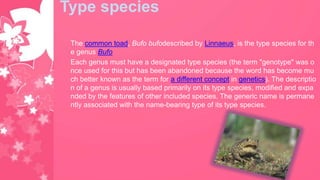
The common toad, Bufo bufodescribed by Linnaeus, is the type species for th
e genus Bufo
Each genus must have a designated type species (the term "genotype" was o
nce used for this but has been abandoned because the word has become mu
ch better known as the term for a different concept in genetics). The descriptio
n of a genus is usually based primarily on its type species, modified and expa
nded by the features of other included species. The generic name is permane
ntly associated with the name-bearing type of its type species.
Ideally, a type species best exemplifies the essential characteristics of the genus to w
hich it belongs, but this is subjective and, ultimately, technically irrelevant, as it is not
a requirement of the Code. If the type species proves, upon closer examination, to be
long to a pre-existing genus (a common occurrence), then all of the constituent speci
es must be either moved into the pre-existing genus, or disassociated from the origin
al type species and given a new generic name; the old generic name passes into syn
onymy and is abandoned unless there is a pressing need to make an exception (deci
ded case-by-case, via petition to the International Commission on Zoological Nomenc
lature
Type genus
A type genus is that genus from which the name of a fa
mily or subfamily is formed. As with type species, the ty
pe genus is not necessarily the most representative, bu
t is usually the earliest described, largest or best know
n genus. It is not uncommon for the name of a family to
be based upon the name of a type genus that has pass
ed into synonymy; the family name does not need to b
e changed in such a situation.
Type method

Type method

  • 1.
  • 2.
    According to aprecise set of rules laid down in the International Code of Zoological N omenclature (ICZN) and the International Code of Nomenclature for algae, fungi, and plants(ICN), the scientific name of every taxon is almost always based on one particul ar specimen, or in some cases specimens. Types are of great significance to biologist s, especially to taxonomists. Types are usually physical specimens that are kept in a museum or herbarium research collection, but failing that, an image of an individual of that taxon has sometimes been designated as a type.] Describing species and app ointing type specimens is part of scientific nomenclature and alpha taxonomy. When identifying material, a scientist attempts to apply a taxon name to a specimen o r group of specimens based on his or her understanding of the relevant taxa, based o n (at least) having read the type description(s), preferably based on an examination o f all the type material of all of the relevant taxa. Introduction:
  • 3.
    If there ismore than one named type that all appear to be the same taxon, the n the oldest name takes precedence, and is considered to be the correct name of the material in hand. If on the other hand the taxon appears never to have b een named at all, then the scientist or another qualified expert picks a type spe cimen and publishes a new name and an official description. This process is crucial to the science of biological taxonomy. People's ideas of how living things should be grouped change and shift over time. How do we kn ow that what we call "Canis lupus" is the same thing, or approximately the sam e thing, as what they will be calling "Canis lupus" in 200 years' time? It is possi ble to check this because there is a particular wolf specimen preserved in Swe den] and everyone who uses that name – no matter what else they may mean by it – will include that particular specimen. Depending on the nomenclature code applied to the organism in question, a ty pe can be a specimen, a culture, an illustration, or (under the bacteriological co de) a description. Some codes consider a subordinate taxon to be the type, but under the botanical code the type is always a specimen or illustration. .
  • 4.
    For example, inthe research collection of the Natural History Museum in London, the re is a bird specimen numbered 1886.6.24.20. This is a specimen of a kind of bird co mmonly known as the spotted harrier, which currently bears the scientific name Circu s assimilis. This particular specimen is the holotype for that species; the name Circus assimilis refers, by definition, to the species of that particular specimen. That species was named and described by Jardine and Selby in 1828, and the holoty pe was placed in the museum collection so that other scientists might refer to it as ne cessary. Note that at least for type specimens there is no requirement for a "typical" in dividual to be used. Genera and families, particularly those established by early taxon omists, tend to be named after species that are more "typical" for them, but here too t his is not always the case and due to changes in systematics cannot be. Hence, the t erm name-bearing type or onomatophore is sometimes used, to denote the fact that b iological types do not define "typical" individuals or taxa, but rather fix a scientific nam e to a specific operational taxonomic unit. Type specimens are theoretically even allo wed to be aberrant or deformed individuals or color variations, though this is rarely ch osen to be the case, as it makes it hard to determine to which population the individu al belonged.
  • 5.
    The usage ofthe term type is somewhat complicated by slightly different uses i n botany and zoology. In the PhyloCode, type-based definitions are replaced b y phylogenetic definitions. Older terminology: In some older taxonomic works the word "type" has sometimes been u sed differently. The meaning was similar in the first Laws of Botanical Nomenclature, but has a meaning closer to the term taxon in some ot her works: Ce seul caractère permet de distinguer ce type de toutes les autres es pèces de la section. … Après avoir étudié ces diverses formes, j'en ar rivai à les considérer comme appartenant à un seul et même type spé cifique. Translation: This single character permits [one to] distinguish this type from all other species of the section ... After studying the diverse form s, I came to consider them as belonging to the one and the same spe cific type
  • 6.
    IN ZOOLOGY: A gossamer-wingedbutterfly, Jamides elioti: 1) dorsal and 2) ventral aspect of holotype, 3) dorsal and 4) ventral aspect of paratype In zoological nomenclature, the type of a species (or subsp ecies) is a specimen (or series of specimens), the type of a genus (or subgenus) is a species, and the type of a suprag eneric taxon (e.g., family, etc.) is a genus. Names higher tha n superfamily rank do not have types. A "name-bearing ty pe" "provides the objective standard of reference whereby the application of the name of a nominal taxon can be det ermined."
  • 7.
    Definations: A type specimenis a vernacular term (not a formally defined term) ty pically used for an individual or fossil that is any of the various name- bearing types for a species. For example, the type specimen for the s pecies Homo neanderthalensis was the specimen "Neanderthal-1" di scovered by Johann Karl Fuhlrott in 1856 at Feldhofer in the Neander Valley in Germany, consisting of a skullcap, thigh bones, part of a pel vis, some ribs, and some arm and shoulder bones. There may be mo re than one type specimen, but there is (at least in modern times) onl y one holotype. A type species is the nominal species that is the name-bearing type o f a nominal genus or subgenus.
  • 8.
    A type genusis the nominal genus that is the name-bearing type of a nominal family-group taxon. The type series are all those specimens included by the author in a taxon's formal descripti on, unless the author explicitly or implicitly excludes them as part of the series. USE OF TYPE SPECIM EN: Type illustration of Mormopterus a cetabulosus Although in reality biologists may examine many specimens (when av ailable) of a new taxon before writi ng an official published species des cription, nonetheless, under the for mal rules for naming species (the I nternational Code of Zoological No menclature), a single type must be designated, as part of the publishe d description
  • 9.
    A type descriptionmust include a diagnosis (typically, a discussion of similarities to an d differences from closely related species), and an indication of where the type speci men or specimens are deposited for examination. The geographical location where a type specimen was originally found is known as its type locality. In the case of paras ites, the term type host (or symbiotype) is used to indicate the host organism from w hich the type specimen was obtained. Zoological collections are maintained by universities and museums. Ensuring that typ es are kept in good condition and made available for examination by taxonomists are two important functions of such collections. And, while there is only one holotype desi gnated, there can be other "type" specimens, the following of which are formally defin ed Holotype: When a single specimen is clearly designated in the original description, this specime n is known as the holotype of that species. The holotype is typically placed in a major museum, or similar well-known public collection, so that it is freely available for later e xamination by other biologists
  • 10.
    . Paratype When theoriginal description designated a holotype, there may still be additional specimens listed in the type series and those are termed pa ratypes. These are not name-bearing types. . Allotype An allotype is a specimen of the opposite sex to the holotype, designa ted from among paratypes. It was also formerly used for a specimen t hat shows features not seen in the holotype of a fossil.[11] The term is not regulated by the ICZN. . Neotype A neotype is a specimen later selected to serve as the single type spe cimen when an original holotype has been lost or destroyed or where t he original author never cited a specimen.
  • 11.
    Syntype A syntype isany one of two or more specimens that is listed in a species description where no h olotype was designated; historically, syntypes were often explicitly designated as such, and und er the present ICZN this is a requirement, but modern attempts to publish species description ba sed on syntypes are generally frowned upon by practicing taxonomists, and most are gradually being replaced by lectotypes. Those that still exist are still considered name-bearing types. Lectotype A lectotype is a specimen later selected to serve as the single type specimen for spec ies originally described from a set of syntypes. In zoology, a lectotype is a kind of na me-bearing type. When a species was originally described on the basis of a name-be aring type consisting of multiple specimens, one of those may be designated as the le ctotype. Having a single name-bearing type reduces the potential for confusion, espe cially considering that it is not uncommon for a series of syntypes to contain specime ns of more than one species. A notable example is that Carl Linnaeus is the lectotype for the species Homo sapien s.
  • 12.
    Paralectotype A paralectotype isany additional specimen from among a set of synty pes, after a lectotype has been designated from among them. These are not name-bearing types. Hapantotype A special case in Protistans where the type consists of two or more s pecimens of "directly related individuals representing distinct stages i n the life cycle"; these are collectively treated as a single entity, and l ectotypes cannot be designated from among them. Ergatotype An ergatotype is a specimen selected to represent a worker member i n hymenopterans which have polymorphic castes
  • 13.
    Alternatives to preservedspecimens Type illustrations have also been used by zoologists, as in the case of the Réunion p arakeet, which is known only from historical illustrations and descriptions. Recently, some species have been described where the type specimen was released alive back into the wild, such as the Bulo Burti boubou (a bushshrike), described as L aniarius liberatus, in which the species description included DNA sequences from blo od and feather samples. Assuming there is no future question as to the status of such a species, the absence of a type specimen does not invalidate the name, but it may b e necessary in the future to designate a neotype for such a taxon, should any questio ns arise. However, in the case of the bushshrike, ornithologists have argued that the specimen was a rare and hitherto unknown color morph of a long-known species, usi ng only the available blood and feather samples. While there is still some debate on t he need to deposit actual killed individuals as type specimens, it can be observed tha t given proper vouchering and storage, tissue samples can be just as valuable should disputes about the validity of a species arise.
  • 14.
    Formalisation of thetype system The various types listed above are necessary[citation needed] because many specie s were described one or two centuries ago, when a single type specimen, a hol otype, was often not designated. Also, types were not always carefully preserv ed, and intervening events such as wars and fires have resulted in destruction of original type material. The validity of a species name often rests upon the av ailability of original type specimens; or, if the type cannot be found, or one has never existed, upon the clarity of the description. The ICZN has existed only since 1961, when the first edition of the Code was published. The ICZN does not always demand a type specimen for the historic al validity of a species, and many "type-less" species do exist. The current editi on of the Code, Article 75.3, prohibits the designation of a neotype unless ther e is "an exceptional need" for "clarifying the taxonomic status" of a species (Art icle 75.2). There are many other permutations and variations on terms using the suffix "-t ype" (e.g., allotype, cotype, topotype, generitype, isotype, isoneotype, isolectot ype, etc.) but these are not formally regulated by the Code, and a great many are obsolete and/or idiosyncratic.
  • 15.
    However, some ofthese categories can potentially apply to g enuine type specimens, such as a neotype; e.g., isotypic/topo typic specimens are preferred to other specimens, when they are available at the time a neotype is chosen (because they a re from the same time and/or place as the original type). The term fixation is used by the Code for the declaration of a name-bearing type, whether by original or subsequent design ation.
  • 16.
    Type species The commontoad, Bufo bufodescribed by Linnaeus, is the type species for th e genus Bufo Each genus must have a designated type species (the term "genotype" was o nce used for this but has been abandoned because the word has become mu ch better known as the term for a different concept in genetics). The descriptio n of a genus is usually based primarily on its type species, modified and expa nded by the features of other included species. The generic name is permane ntly associated with the name-bearing type of its type species.
  • 17.
    Ideally, a typespecies best exemplifies the essential characteristics of the genus to w hich it belongs, but this is subjective and, ultimately, technically irrelevant, as it is not a requirement of the Code. If the type species proves, upon closer examination, to be long to a pre-existing genus (a common occurrence), then all of the constituent speci es must be either moved into the pre-existing genus, or disassociated from the origin al type species and given a new generic name; the old generic name passes into syn onymy and is abandoned unless there is a pressing need to make an exception (deci ded case-by-case, via petition to the International Commission on Zoological Nomenc lature
  • 18.
    Type genus A typegenus is that genus from which the name of a fa mily or subfamily is formed. As with type species, the ty pe genus is not necessarily the most representative, bu t is usually the earliest described, largest or best know n genus. It is not uncommon for the name of a family to be based upon the name of a type genus that has pass ed into synonymy; the family name does not need to b e changed in such a situation.