Historical Foundations
of Curriculum
Prepared by
Siti Maryam binti Kamaruzaman
THE COLONIAL PERIOD
1642-1776
COLONIAL SCHOOLS
IMPORTANT !
A MUCH SMALLER OF CHILDREN THAN NOWADAYS.
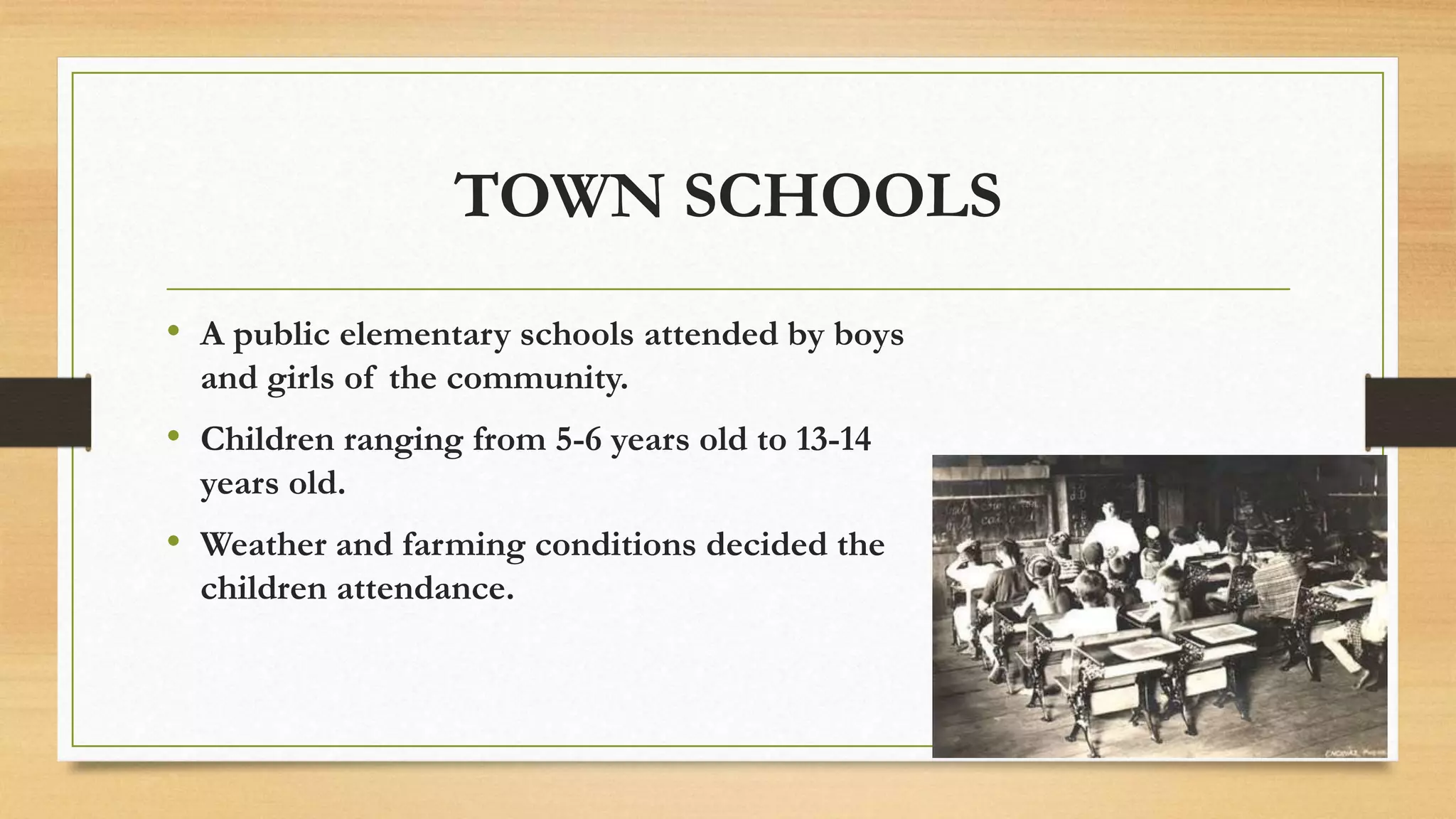
TOWN SCHOOLS
• A public elementary schools attended by boys
and girls of the community.
• Children ranging from 5-6 years old to 13-14
years old.
• Weather and farming conditions decided the
children attendance.
• Elementary schools based on
religion and ethnicity.
• Focused on reading, writing and
religious sermons.
• Attended by upper-class
children.
• Focused on reading, writing,
arithmetic, primer and bible.
PAROCHIAL
SCHOOLS
PRIVATE
SCHOOLS
CHARITY
SCHOOLS
• Attended by less fortunate children.
• Learned to recite religious hymns and
vocational skills.
LATIN GRAMMAR SCHOOLS
• Secondary level for upper-class
boys as preparation for college.
• For boys at age 8 or 9 and
remains for 8 years.
• Catered to those who planned to
enter the professions
Medicine, law, teaching, the
ministry, business or merchants
• Latin apparently three-quarters
of the curriculum taught.
• One of colonial America’s
closest links to European
schools.
• The classical humanist
curriculum of the Renaissance
 Support the era's religious and
social institutions
ACADEMIES (1751)
• Second American institution
provide education.
• Based on Benjamin Franklin’s
ideas and offered practical
studies.
• Commons studies
• English grammar, classics,
composition, rhetoric and
public speaking.
• Students can choose foreign
language based on their
vocational needs.
• Introduced practical and manual
skills
• Carpentry, engraving, printing,
painting, cabinet making,
farming and bookkeeping.
COLLEGES
• Harvard or
Yale.
• Admitted into
college upon
examination.
• College curriculum
- Latin - Ethics
- Grammar - Logic
- Metaphysics - Natural
- Rhetoric - Sciences
- Arithmetic
- Astronomy
Showing competency
in being able to
- Read
- Construe
- Parce Tully
- Vergil and the Greek
Testament
- write in Latin
- understand the Rules
of Prosodia
- Common Arithmetic
TEXTBOOKS
FOR THE COLONIOL PERIOD
Example of textbooks:
Hornbook, Primer,
Westminster Catechism, Old
Testament and Bible
• Children learned the alphabet, the
Lord’s prayer and some syllables,
words and sentences by memorizing
hornbook.
• In 1960’s, the New England Primer
was published.
• Most used textbooks for 100 years.
• 3 millions copies were sold
• ABC’s were learned through rote and
drill.
In 1740, the new guide to
English tongue was
published followed by
The School Master’s
Assistant
(Mathematics text)
THE NATIONAL PERIOD
1776 - 1850
Dr. Benjamin Rush (1745-1813)
Science, Progress and Free Education
• Outlined a plan
of education for
Pennsylvania
• Free elementary schools for
towns with 100 or more families.
• A free academy at the country
level
• Free colleges and universities at
the state level for societies future
leaders
• Tax dollars pay for expenses, but ultimately reduced taxes because a productive, well
managed work force was a result of the plan
Elementary schools
- Reading
- Writing
- Arithmetic
Secondary and college
- English
- German
- Arts
- Sciences
All levels
- Good manners
- Moral principles
Thomas Jefferson (1743-1826)
Education for Citizenship
• Created a bill for Virginia to
allows taxes to finance schools.
• Divides Virginia’s counties into
wards
• free elementary schools for
teaching of reading, writing,
arithmetic and history.
• There was an Elementary
school, secondary school and
William and Mary school.
• The proposal was never enacted.
But did provide good education
for society.
Noah Webster (1758-1843)
Schoolmaster and Cultural Nationalist
“unshackle your mind and act like
independent being”
• Created the US American
Language.
• Known for Webster dictionary.
• Identified the US as nation.
• The use of a US language would
eliminate the European language,
and make the US more uniform.
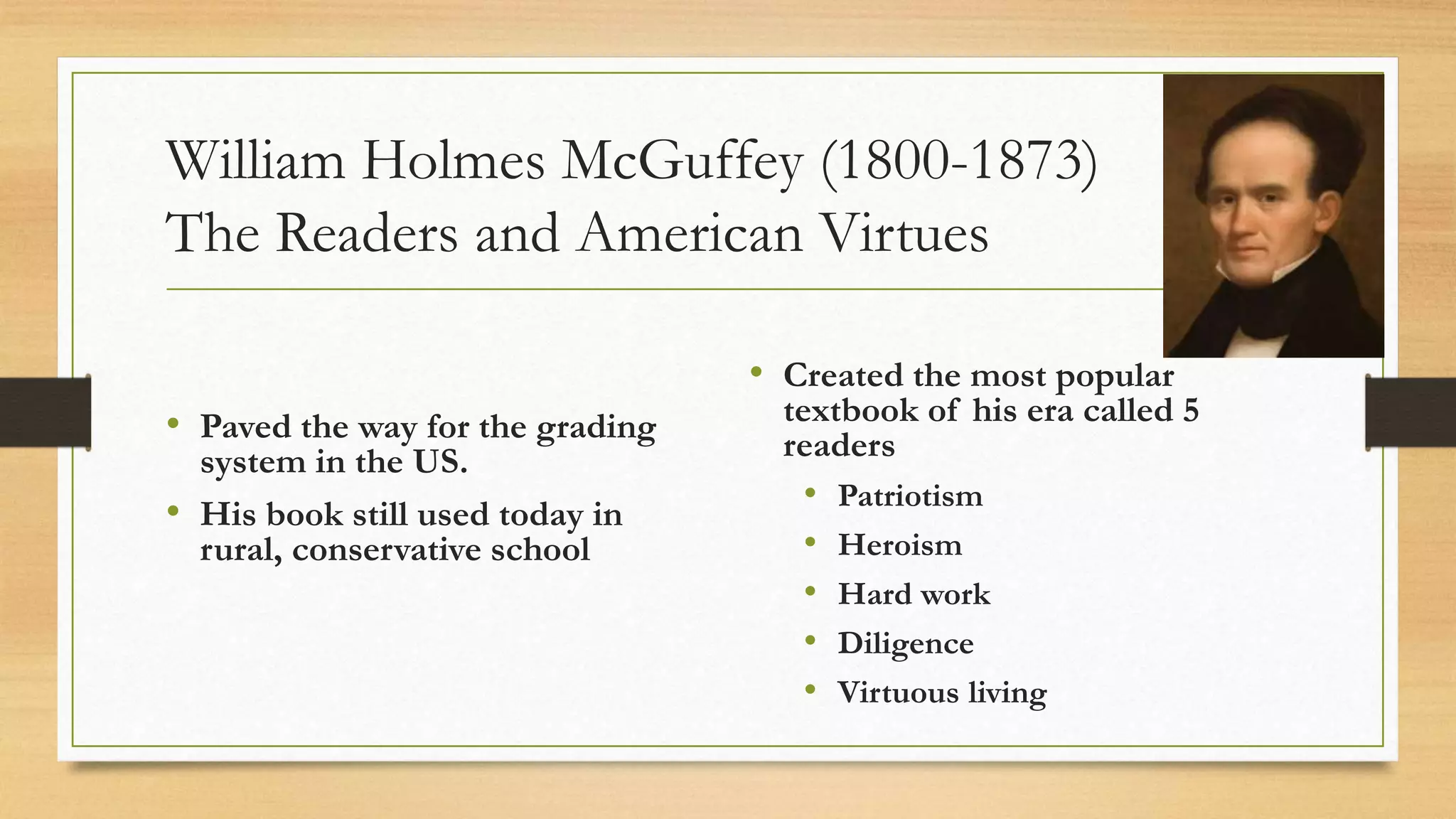
William Holmes McGuffey (1800-1873)
The Readers and American Virtues
• Paved the way for the grading
system in the US.
• His book still used today in
rural, conservative school
• Created the most popular
textbook of his era called 5
readers
• Patriotism
• Heroism
• Hard work
• Diligence
• Virtuous living
NINTEENTH-CENTURY
EUROPEAN EDUCATORS
Johann Pestalozzi (1746-1827)
General and Special Methods
Created the basics
principals in
education
• General Teaching
• Educators provide emotional
security and affection.
• Special teaching
• Considers children’s auditory
and visual senses.
McClure, Neef, Mann and Barnard introduced these ideas to US schools.
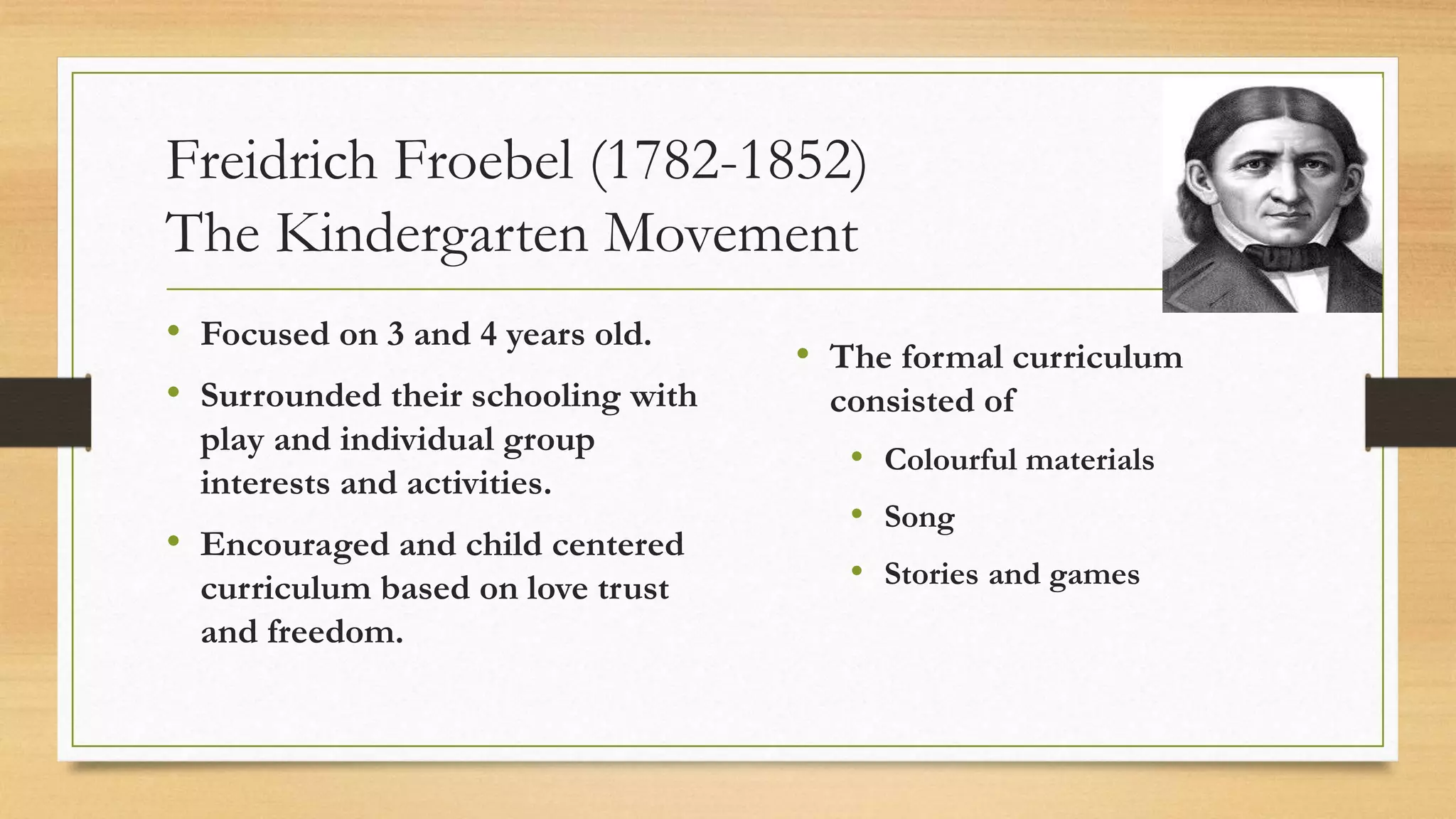
Freidrich Froebel (1782-1852)
The Kindergarten Movement
• Focused on 3 and 4 years old.
• Surrounded their schooling with
play and individual group
interests and activities.
• Encouraged and child centered
curriculum based on love trust
and freedom.
• The formal curriculum
consisted of
• Colourful materials
• Song
• Stories and games
Johann Herbart (1776-1841)
Moral and Intellectual Development
• Contributed to morals in education.
• Five ideas to found moral character
• Inner freedom
• Perfection
• Benevolence
• Justice
• Retribution
• Two major bodies of interest
• Knowledge of interest
• Factual data and
speculative ideas
• Ethical interest
• Sympathy and social
relationship
Herbart Spencer (1820-1903)
Utilitarian and Scientific Education
• English social scientist
• Based on his ideas of education on
Charles Darwin’s theory:
“Survival of the fittest”
• Teach HOW to think not WHAT
to think.
• His popular books
• “What knowledge is of most
worth”
If you were lazy or weak,
you would not survive
THE RISE
OF UNIVERSAL
EDUCATION
1820-1900
Monitorial Schools
• European invention.
• Highly structured school with
lots of rote learning and drilling
the three R’s education.
• Focused on systematic
instruction and good
citizenship.
• Monitorial teaching kept all
students busy while teacher
could focus on one student.
• It was mechanical way of
teaching and the students were
poorly informed by their
educators.
Common schools
• Established by Massachusetts
(1826).
• Every town was able to choose a
board of education to be
responsible for the local schools.
• Devoted to elementary
education with large emphasis
on the Three R’s of Education.
• Attended by children from 6-14
years old and the school districts
elected the schools board.
• It flourished on the frontier with
all of the pioneers.
• Abe Lincoln said that, it was a
boring school but it was where
common kids could come learn
the basic.
Elementary Schools
• Through 1800’s people could not
agree on the appropriate
curriculum for a child.
• It was ever changing which
reading, spelling, grammar and
arithmetic.
• In 1825 Religion mandated that,
morality and manners should be
taught as well.
• 1850
• Geography and history
• 1875
• Science and visual arts
• 1900s
• nature study and biology
• music and homemaking
Secondary schools
• Attendance was very rare in 1900s.
• 1930
• School enrolment figure exceed
50%.
• 1970
• 98% of elementary children would
move on to secondary school.
• Form of high school students to
graduate up to after elementary school
Academies
• 1800’s, academies replaced the
Latin Grammar School.
• Offered better range in
curriculum.
• Taught useful things and
subjects of modern nature.
• Help focus on preparing
students for college.
• Academies taught
• Latin, Greek, English Grammar,
Geography, Arithmetic, Algebra,
Composition, Rhetoric, Natural
philosophy and US history.
• Continued through the 1870’s
High Schools
• Kalamazoo School Case.
• Attended by only small amount
of youth.
• Many families did not care about
college preparatory.
• Curriculum continued expand.
• Making it easier for student to
determine their interest and
capabilities
THE TRANSITIONAL
PERIOD
1893-1918
Committee of Fifteen
• Harvard University President
Charles Eliot influenced the
committee.
• The committee adopted Eliot’s
plan to move from 10 grades to 8 in
elementary school.
• Emphasizes of the three R’s,
English Grammar, literature,
geography and history.
• Hygiene, culture, vocal music and
drawing were part of curriculum.
• 7th and 8th grades
• Sewing, manual training, cooking,
algebra and Latin
Committee of ten
• Also chaired by Charles Eliot.
• 9 subject matters in the high
school curriculum
• Latin, Greek, English, Other
Modern Languages,
Mathematics, Physical
sciences, Natural history, Social
sciences and geography.
• Committee recommended four
different tracks
• Classical, Latin scientific,
modern language and English
• The committee ignored
physical education and arts.
• The committee started
college preparatory courses.
Committee on College Entrance
Requirements
• Met in 1985
• Affirmation of the college
preparatory curriculum.
• Created college admission
requirements
• Discussed credits required for
different subjects during college,
• Discussed credits for admission
imposed during high school
Harris and Eliot
Two Conservative Reformers
• Dominated the reform movement during the transitional period.
• Eliot played a role in shaping
higher education.
• He allowed independent
learning.
• Advocated for vocational schools
to be different from high school
• Harris wrote that common
high schools should teach
morality and citizenship.
• Instill social order.
• View school as one of the
many factors in educating and
socializing children
Vocational education
• 1917, Smith - Hughes act provided
federal aid for vocational education.
• Working class students were placed
in vocational programs due to
biases of middle class educators
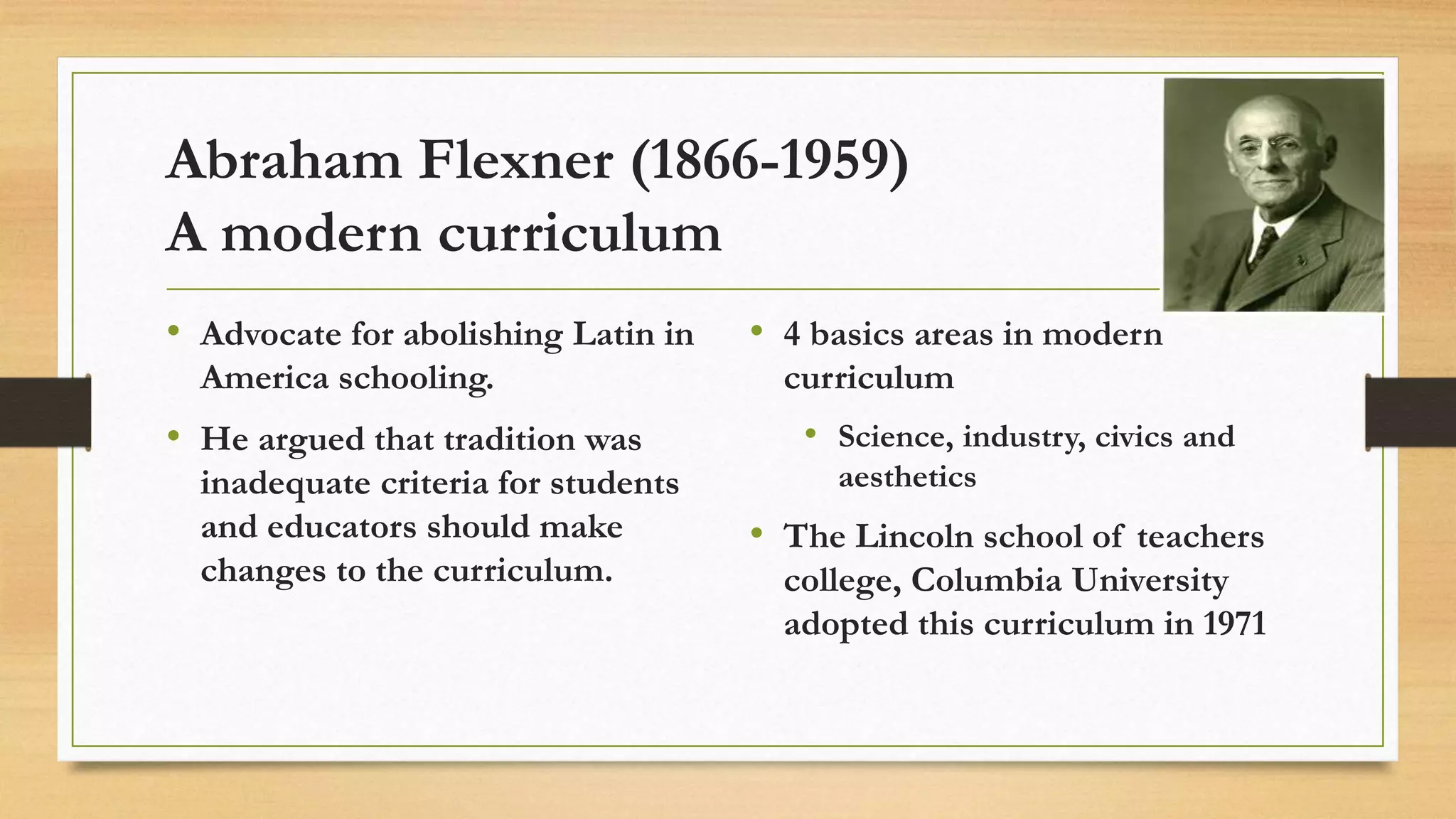
Abraham Flexner (1866-1959)
A modern curriculum
• Advocate for abolishing Latin in
America schooling.
• He argued that tradition was
inadequate criteria for students
and educators should make
changes to the curriculum.
• 4 basics areas in modern
curriculum
• Science, industry, civics and
aesthetics
• The Lincoln school of teachers
college, Columbia University
adopted this curriculum in 1971
Dewey
Pragmatic and scientific principles of
education
• Believes in democracy and
education (has a book)
• Democracy was a social process
that needed to be enhanced
through schooling
• Study of any subject could
enhance a child’s development.
• He formed the basis of child
development movement in the
1930’s and 1940’s.
Charles Judd (1873-1946)
Systematic studies and social sciences
• An evolutionist who believed in
laws of nature.
• Prepare to change the world
• Believed in preparing students
to deal with problems and not
acquire endless knowledge.
• Emphasized reading, writing
and spelling based on words,
science and mathematics
Commission on Reorganization of
Secondary Education
• 1918’s, NEA’s Commission published the “cardinal principles of secondary
education”
• The principles for democratic society
• Educations should promotes seven aims
• High schools should be a comprehensive institution
• High schools curriculum should meet varied needs of students
• Current educational psychology should be applied to secondary education
• US educational should function with one another
Franklin Bobbitt (1876-1956)
W.W.Charters (1875-1952)
• A major goal in the 1920’s was to
eliminate small classes and increase
the students to teacher ratio.
• Behaviourist ideas included
• Objectives derived from students
needs
• Learning experiences relate to
objectives
• Activities organized by teacher
should be integrated into subjects
matter
• Instructional outcomes should be
evaluated
• Bobbitt curriculum should outline
the knowledge important for each
subjects.
• Bobbitt guideline for objectives
• Eliminate objectives
• Emphasizes objectives
• Avoid objectives opposed by
communities
• Involve the community
Kilpatrick
The Progressive Influence
• Divided methodology in four steps
• Purposing, planning, executing and
judging
• He argued for integrated subject
matter and a general education
emphasizing values and social
issues.
• Organized experiences or activities
that related and developmental in
nature:
• One activity should lead to another
• Curriculum should derive from real
life experiences not organized
bodies of subject matter.
The 26th
Yearbook
The books outlining of the ideal curriculum
 Focus on affairs on human life.
 Deal with local national and international issues.
 Enable students to think critically about various forms
of government.
 Foster open minds.
 Consider students interests and needs.
 Deal with the issues of modern life and society’s
cultural historical aspects.
 Consider problem activities.
 Organize problems and exercise in graded
organization
 Deal with humanitari an themes in purposeful way.
• The committee that
developed the yearbook
• Rugg, Bagley, Bobbitt,
Charters, Counts, Judd
and Kilpatrick.
• Created in 1930
Harold Rugg and Hollis Caswell
Curriculum should address the students needs and provide proper
scope and sequences of subject matter
• Caswell wanted to improve
instruction and help teachers to
coordinate their activities with
students needs.
• Caswell coordinated step by step
curriculum building procedures.
• Rugg insisted that teacher
should pre-plan and implement
the curriculum needed for the
students
• Rugg advocated for cooperation
among educational professionals
Eight Year Study (1932-1940)
• Launched by The Progressive
Education Association.
• A study designated to show that
curriculum can meet the needs of
students interests as well as a
curriculum based on tests.
• Members understood that
evaluation must determine whether
a curriculum objectives had been
achieved.
• The showed that they needed data
on
• Students achievement
• Social factors
• Teaching and learning processes
• Instructional methods
Ralph Tyler (1902-1994)
Basic principles
• Created more than 700 articles and
16 books
• Known for his books “Basic
Principles of Curriculum and
Instruction”
• Created 4 basics questions for any
curriculum
• What educational goals should a
school seeks?
• What educational experiences are
likely to lead these goals?
• How can these educational
experiences be effectively
organizes?
• How can we determine whether a
school’s goal are being
accomplished?
John Goodlad (1920-)
School Reform
• He views that schools should
helps individuals fulfil their
potential but should promote
societal goals.
• He launched a study of 260
kindergarten and first grade
classrooms in 100 schools to
discuss curriculums.
• His conclusion in his study
showed that schools are
emphasis on test score and they
are the bottom line!
THE END
THANK YOU

Historical foundations of curriculum

  • 1.
    Historical Foundations of Curriculum Preparedby Siti Maryam binti Kamaruzaman
  • 2.
  • 3.
    COLONIAL SCHOOLS IMPORTANT ! AMUCH SMALLER OF CHILDREN THAN NOWADAYS.
  • 4.
    TOWN SCHOOLS • Apublic elementary schools attended by boys and girls of the community. • Children ranging from 5-6 years old to 13-14 years old. • Weather and farming conditions decided the children attendance.
  • 5.
    • Elementary schoolsbased on religion and ethnicity. • Focused on reading, writing and religious sermons. • Attended by upper-class children. • Focused on reading, writing, arithmetic, primer and bible. PAROCHIAL SCHOOLS PRIVATE SCHOOLS CHARITY SCHOOLS • Attended by less fortunate children. • Learned to recite religious hymns and vocational skills.
  • 6.
    LATIN GRAMMAR SCHOOLS •Secondary level for upper-class boys as preparation for college. • For boys at age 8 or 9 and remains for 8 years. • Catered to those who planned to enter the professions Medicine, law, teaching, the ministry, business or merchants • Latin apparently three-quarters of the curriculum taught. • One of colonial America’s closest links to European schools. • The classical humanist curriculum of the Renaissance  Support the era's religious and social institutions
  • 7.
    ACADEMIES (1751) • SecondAmerican institution provide education. • Based on Benjamin Franklin’s ideas and offered practical studies. • Commons studies • English grammar, classics, composition, rhetoric and public speaking. • Students can choose foreign language based on their vocational needs. • Introduced practical and manual skills • Carpentry, engraving, printing, painting, cabinet making, farming and bookkeeping.
  • 8.
    COLLEGES • Harvard or Yale. •Admitted into college upon examination. • College curriculum - Latin - Ethics - Grammar - Logic - Metaphysics - Natural - Rhetoric - Sciences - Arithmetic - Astronomy Showing competency in being able to - Read - Construe - Parce Tully - Vergil and the Greek Testament - write in Latin - understand the Rules of Prosodia - Common Arithmetic
  • 9.
  • 10.
    Example of textbooks: Hornbook,Primer, Westminster Catechism, Old Testament and Bible • Children learned the alphabet, the Lord’s prayer and some syllables, words and sentences by memorizing hornbook. • In 1960’s, the New England Primer was published. • Most used textbooks for 100 years. • 3 millions copies were sold • ABC’s were learned through rote and drill. In 1740, the new guide to English tongue was published followed by The School Master’s Assistant (Mathematics text)
  • 11.
  • 12.
    Dr. Benjamin Rush(1745-1813) Science, Progress and Free Education • Outlined a plan of education for Pennsylvania • Free elementary schools for towns with 100 or more families. • A free academy at the country level • Free colleges and universities at the state level for societies future leaders
  • 13.
    • Tax dollarspay for expenses, but ultimately reduced taxes because a productive, well managed work force was a result of the plan Elementary schools - Reading - Writing - Arithmetic Secondary and college - English - German - Arts - Sciences All levels - Good manners - Moral principles
  • 14.
    Thomas Jefferson (1743-1826) Educationfor Citizenship • Created a bill for Virginia to allows taxes to finance schools. • Divides Virginia’s counties into wards • free elementary schools for teaching of reading, writing, arithmetic and history. • There was an Elementary school, secondary school and William and Mary school. • The proposal was never enacted. But did provide good education for society.
  • 15.
    Noah Webster (1758-1843) Schoolmasterand Cultural Nationalist “unshackle your mind and act like independent being” • Created the US American Language. • Known for Webster dictionary. • Identified the US as nation. • The use of a US language would eliminate the European language, and make the US more uniform.
  • 16.
    William Holmes McGuffey(1800-1873) The Readers and American Virtues • Paved the way for the grading system in the US. • His book still used today in rural, conservative school • Created the most popular textbook of his era called 5 readers • Patriotism • Heroism • Hard work • Diligence • Virtuous living
  • 17.
  • 18.
    Johann Pestalozzi (1746-1827) Generaland Special Methods Created the basics principals in education • General Teaching • Educators provide emotional security and affection. • Special teaching • Considers children’s auditory and visual senses. McClure, Neef, Mann and Barnard introduced these ideas to US schools.
  • 19.
    Freidrich Froebel (1782-1852) TheKindergarten Movement • Focused on 3 and 4 years old. • Surrounded their schooling with play and individual group interests and activities. • Encouraged and child centered curriculum based on love trust and freedom. • The formal curriculum consisted of • Colourful materials • Song • Stories and games
  • 20.
    Johann Herbart (1776-1841) Moraland Intellectual Development • Contributed to morals in education. • Five ideas to found moral character • Inner freedom • Perfection • Benevolence • Justice • Retribution • Two major bodies of interest • Knowledge of interest • Factual data and speculative ideas • Ethical interest • Sympathy and social relationship
  • 21.
    Herbart Spencer (1820-1903) Utilitarianand Scientific Education • English social scientist • Based on his ideas of education on Charles Darwin’s theory: “Survival of the fittest” • Teach HOW to think not WHAT to think. • His popular books • “What knowledge is of most worth” If you were lazy or weak, you would not survive
  • 22.
  • 23.
    Monitorial Schools • Europeaninvention. • Highly structured school with lots of rote learning and drilling the three R’s education. • Focused on systematic instruction and good citizenship. • Monitorial teaching kept all students busy while teacher could focus on one student. • It was mechanical way of teaching and the students were poorly informed by their educators.
  • 24.
    Common schools • Establishedby Massachusetts (1826). • Every town was able to choose a board of education to be responsible for the local schools. • Devoted to elementary education with large emphasis on the Three R’s of Education. • Attended by children from 6-14 years old and the school districts elected the schools board. • It flourished on the frontier with all of the pioneers. • Abe Lincoln said that, it was a boring school but it was where common kids could come learn the basic.
  • 25.
    Elementary Schools • Through1800’s people could not agree on the appropriate curriculum for a child. • It was ever changing which reading, spelling, grammar and arithmetic. • In 1825 Religion mandated that, morality and manners should be taught as well. • 1850 • Geography and history • 1875 • Science and visual arts • 1900s • nature study and biology • music and homemaking
  • 26.
    Secondary schools • Attendancewas very rare in 1900s. • 1930 • School enrolment figure exceed 50%. • 1970 • 98% of elementary children would move on to secondary school. • Form of high school students to graduate up to after elementary school
  • 27.
    Academies • 1800’s, academiesreplaced the Latin Grammar School. • Offered better range in curriculum. • Taught useful things and subjects of modern nature. • Help focus on preparing students for college. • Academies taught • Latin, Greek, English Grammar, Geography, Arithmetic, Algebra, Composition, Rhetoric, Natural philosophy and US history. • Continued through the 1870’s
  • 28.
    High Schools • KalamazooSchool Case. • Attended by only small amount of youth. • Many families did not care about college preparatory. • Curriculum continued expand. • Making it easier for student to determine their interest and capabilities
  • 29.
  • 30.
    Committee of Fifteen •Harvard University President Charles Eliot influenced the committee. • The committee adopted Eliot’s plan to move from 10 grades to 8 in elementary school. • Emphasizes of the three R’s, English Grammar, literature, geography and history. • Hygiene, culture, vocal music and drawing were part of curriculum. • 7th and 8th grades • Sewing, manual training, cooking, algebra and Latin
  • 31.
    Committee of ten •Also chaired by Charles Eliot. • 9 subject matters in the high school curriculum • Latin, Greek, English, Other Modern Languages, Mathematics, Physical sciences, Natural history, Social sciences and geography. • Committee recommended four different tracks • Classical, Latin scientific, modern language and English • The committee ignored physical education and arts. • The committee started college preparatory courses.
  • 32.
    Committee on CollegeEntrance Requirements • Met in 1985 • Affirmation of the college preparatory curriculum. • Created college admission requirements • Discussed credits required for different subjects during college, • Discussed credits for admission imposed during high school
  • 33.
    Harris and Eliot TwoConservative Reformers • Dominated the reform movement during the transitional period. • Eliot played a role in shaping higher education. • He allowed independent learning. • Advocated for vocational schools to be different from high school • Harris wrote that common high schools should teach morality and citizenship. • Instill social order. • View school as one of the many factors in educating and socializing children
  • 34.
    Vocational education • 1917,Smith - Hughes act provided federal aid for vocational education. • Working class students were placed in vocational programs due to biases of middle class educators
  • 35.
    Abraham Flexner (1866-1959) Amodern curriculum • Advocate for abolishing Latin in America schooling. • He argued that tradition was inadequate criteria for students and educators should make changes to the curriculum. • 4 basics areas in modern curriculum • Science, industry, civics and aesthetics • The Lincoln school of teachers college, Columbia University adopted this curriculum in 1971
  • 36.
    Dewey Pragmatic and scientificprinciples of education • Believes in democracy and education (has a book) • Democracy was a social process that needed to be enhanced through schooling • Study of any subject could enhance a child’s development. • He formed the basis of child development movement in the 1930’s and 1940’s.
  • 37.
    Charles Judd (1873-1946) Systematicstudies and social sciences • An evolutionist who believed in laws of nature. • Prepare to change the world • Believed in preparing students to deal with problems and not acquire endless knowledge. • Emphasized reading, writing and spelling based on words, science and mathematics
  • 38.
    Commission on Reorganizationof Secondary Education • 1918’s, NEA’s Commission published the “cardinal principles of secondary education” • The principles for democratic society • Educations should promotes seven aims • High schools should be a comprehensive institution • High schools curriculum should meet varied needs of students • Current educational psychology should be applied to secondary education • US educational should function with one another
  • 39.
    Franklin Bobbitt (1876-1956) W.W.Charters(1875-1952) • A major goal in the 1920’s was to eliminate small classes and increase the students to teacher ratio. • Behaviourist ideas included • Objectives derived from students needs • Learning experiences relate to objectives • Activities organized by teacher should be integrated into subjects matter • Instructional outcomes should be evaluated • Bobbitt curriculum should outline the knowledge important for each subjects. • Bobbitt guideline for objectives • Eliminate objectives • Emphasizes objectives • Avoid objectives opposed by communities • Involve the community
  • 40.
    Kilpatrick The Progressive Influence •Divided methodology in four steps • Purposing, planning, executing and judging • He argued for integrated subject matter and a general education emphasizing values and social issues. • Organized experiences or activities that related and developmental in nature: • One activity should lead to another • Curriculum should derive from real life experiences not organized bodies of subject matter.
  • 41.
    The 26th Yearbook The booksoutlining of the ideal curriculum  Focus on affairs on human life.  Deal with local national and international issues.  Enable students to think critically about various forms of government.  Foster open minds.  Consider students interests and needs.  Deal with the issues of modern life and society’s cultural historical aspects.  Consider problem activities.  Organize problems and exercise in graded organization  Deal with humanitari an themes in purposeful way. • The committee that developed the yearbook • Rugg, Bagley, Bobbitt, Charters, Counts, Judd and Kilpatrick. • Created in 1930
  • 42.
    Harold Rugg andHollis Caswell Curriculum should address the students needs and provide proper scope and sequences of subject matter • Caswell wanted to improve instruction and help teachers to coordinate their activities with students needs. • Caswell coordinated step by step curriculum building procedures. • Rugg insisted that teacher should pre-plan and implement the curriculum needed for the students • Rugg advocated for cooperation among educational professionals
  • 43.
    Eight Year Study(1932-1940) • Launched by The Progressive Education Association. • A study designated to show that curriculum can meet the needs of students interests as well as a curriculum based on tests. • Members understood that evaluation must determine whether a curriculum objectives had been achieved. • The showed that they needed data on • Students achievement • Social factors • Teaching and learning processes • Instructional methods
  • 44.
    Ralph Tyler (1902-1994) Basicprinciples • Created more than 700 articles and 16 books • Known for his books “Basic Principles of Curriculum and Instruction” • Created 4 basics questions for any curriculum • What educational goals should a school seeks? • What educational experiences are likely to lead these goals? • How can these educational experiences be effectively organizes? • How can we determine whether a school’s goal are being accomplished?
  • 45.
    John Goodlad (1920-) SchoolReform • He views that schools should helps individuals fulfil their potential but should promote societal goals. • He launched a study of 260 kindergarten and first grade classrooms in 100 schools to discuss curriculums. • His conclusion in his study showed that schools are emphasis on test score and they are the bottom line!
  • 46.