Discuss three
models of
Curriculum
Development
P R ES E N T E D BY
P R I M RO S E C H I U Y U N 0 2 3 1 2 7 0 9 B
JA M ES G O RO RO N 0 2 3 1 4 0 3 2 Q
Introduction
 In the field of education, curriculum development refers to the process of
designing and organizing educational programs and courses.
 Over the years, several models of curriculum development have been proposed
and implemented in educational institutions.
 We will discuss three commonly recognized models: the Tyler Model, the Taba
Model, and the Wheeler Model.
Definition of key terms: Model
It is a simplified representation of reality
which is often depicted in a diagrammatic
form, (Parthasarathy & Premalatha, 2022)
a model refers to a systematic framework or
representation that guides the design,
development, implementation, and
evaluation of educational curricula.
(McLeod, 2018)
It provides a structured approach for
curriculum planners and educators to
organize and conceptualize the various
components of a curriculum.
Model (continued)
From these definitions we can clearly see that a model is a format for curriculum
design developed to meet unique needs, context and purposes. In order to address
these goals, curriculum developers design, reconfigure/rearrange one or more key
curriculum components.
Models serve as a guideline to action and are found almost in every form of
education
The education profession has models of instruction, of administration, of
evaluation and of supervision.
Curriculum Development
According to Dutta, (2022) Curriculum
development is a step-by-step procedure for
making constructive changes to a school’s,
college’s, or university’s course offerings.
The Association for Supervision and Curriculum
Development (ASCD) defines Curriculum
development as the process of planning,
implementing, and evaluating a curriculum to
meet the educational needs of students.
It involves making decisions about what
knowledge, skills, and dispositions students will
develop and how they will learn and demonstrate
their learning.
Curriculum Development (continued)
From these two definitions, we can clearly see that curriculum development is
the process of designing, selecting, organizing, evaluating, and supporting
learning experiences for students. It encompasses the planning, implementation,
and assessment of instructional materials, methods, and content, as well as the
development of teacher expertise related to the teaching and learning process
1.Tyler’s Model
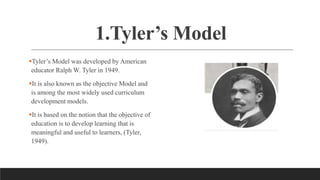
Tyler’s Model was developed by American
educator Ralph W. Tyler in 1949.
It is also known as the objective Model and
is among the most widely used curriculum
development models.
It is based on the notion that the objective of
education is to develop learning that is
meaningful and useful to learners, (Tyler,
1949).
Tyler’s Model
 It lays importance on the planning phase.
 It focuses on maintaining consistency among objectives, outcomes, and educational experiences.
 Tyler proposed four key questions that serve as the foundation of curriculum development:
- What educational purposes should the curriculum seek to attain?
- What educational experiences are likely to achieve these purposes?
- How can these educational experiences be effectively organized?
- How can we determine whether these purposes are being achieved?
Advantages of Tyler’s Model
 it allows for flexibility.
 Educators can easily apply this Model to develop curriculum for any level of
education and subject area.
 Since it gives importance to the evaluation of the curriculum, Tyler’s Model
enables educators to assess the effectiveness of their educational plans and
introduce required changes.
Disadvantages of Tyler’s Model
 It does not give much importance to social learning.
Its specific learning objectives don’t address critical thinking or emotional
development.
As such, this Model may not meet the diverse requirements of students.
2. Taba’s Model
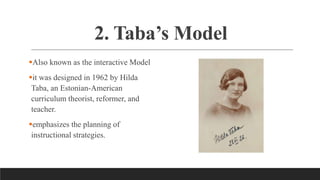
Also known as the interactive Model
it was designed in 1962 by Hilda
Taba, an Estonian-American
curriculum theorist, reformer, and
teacher.
emphasizes the planning of
instructional strategies.
Taba’s Model
Taba's model emphasizes a holistic and learner-centered approach to curriculum development. She presented
her model in her book, "Curriculum Development: Theory and Practice" (1962), and proposed a seven-step
process:
- Diagnosis of the needs of students.
- Formulation of specific objectives.
- Selection of content.
- Organization of content.
- Selection of learning experiences.
- Organization of learning experiences.
- Evaluation.
Advantages of Taba’s Model
promotes open-ended questions rather than focusing on right or wrong
responses.
it offers scope to explore a concept at a deeper level using critical thinking skills.
Disadvantages of Taba’s Model
Taba’s inductive model may not appeal to curriculum developers who prefer to
consider the more global aspects of the curriculum before proceeding to
specifics.
3. Wheeler’s Model
Wheeler's model emphasizes the cyclical nature of curriculum planning and development.
Was devised by D. K. Wheeler, a British educator and researcher.
It uses a systematic and structured process to design and implement a curriculum.
It aims to help educators create and implement a dynamic curriculum that is relevant, effective,
and efficient.
Wheeler’s Model
Wheeler’s Model comprises five phases of curriculum development models, which are as follows:
 Selection of aims, goals, and objectives
 Selection of learning experiences
 Selection of content or subject matter
 Organization and integration of learning experiences and content
 Evaluation and revision of curriculum
Advantages of Wheeler’s Model
Wheeler developed this Model to address the shortcomings of Tyler’s concept of
curriculum development. Since Tyler’s Model is linear and basic, it overlooks the
relationship between different curriculum elements. In response to it, Wheeler
proposed this cyclic Model.
It underlines the interconnectedness of the various curriculum aspects.
This Model enables curriculum designers to begin working on it at any stage.
It also focuses on situational analysis.
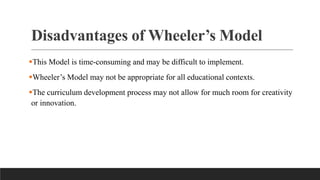
Disadvantages of Wheeler’s Model
This Model is time-consuming and may be difficult to implement.
Wheeler’s Model may not be appropriate for all educational contexts.
The curriculum development process may not allow for much room for creativity
or innovation.
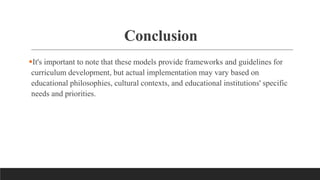
Conclusion
It's important to note that these models provide frameworks and guidelines for
curriculum development, but actual implementation may vary based on
educational philosophies, cultural contexts, and educational institutions' specific
needs and priorities.
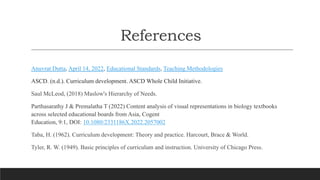
References
Anuvrat Dutta, April 14, 2022, Educational Standards, Teaching Methodologies
ASCD. (n.d.). Curriculum development. ASCD Whole Child Initiative.
Saul McLeod, (2018) Maslow's Hierarchy of Needs.
Parthasarathy J & Premalatha T (2022) Content analysis of visual representations in biology textbooks
across selected educational boards from Asia, Cogent
Education, 9:1, DOI: 10.1080/2331186X.2022.2057002
Taba, H. (1962). Curriculum development: Theory and practice. Harcourt, Brace & World.
Tyler, R. W. (1949). Basic principles of curriculum and instruction. University of Chicago Press.

Discuss three models of Curriculum Development.pptx

  • 1.
    Discuss three models of Curriculum Development PR ES E N T E D BY P R I M RO S E C H I U Y U N 0 2 3 1 2 7 0 9 B JA M ES G O RO RO N 0 2 3 1 4 0 3 2 Q
  • 2.
    Introduction  In thefield of education, curriculum development refers to the process of designing and organizing educational programs and courses.  Over the years, several models of curriculum development have been proposed and implemented in educational institutions.  We will discuss three commonly recognized models: the Tyler Model, the Taba Model, and the Wheeler Model.
  • 3.
    Definition of keyterms: Model It is a simplified representation of reality which is often depicted in a diagrammatic form, (Parthasarathy & Premalatha, 2022) a model refers to a systematic framework or representation that guides the design, development, implementation, and evaluation of educational curricula. (McLeod, 2018) It provides a structured approach for curriculum planners and educators to organize and conceptualize the various components of a curriculum.
  • 4.
    Model (continued) From thesedefinitions we can clearly see that a model is a format for curriculum design developed to meet unique needs, context and purposes. In order to address these goals, curriculum developers design, reconfigure/rearrange one or more key curriculum components. Models serve as a guideline to action and are found almost in every form of education The education profession has models of instruction, of administration, of evaluation and of supervision.
  • 5.
    Curriculum Development According toDutta, (2022) Curriculum development is a step-by-step procedure for making constructive changes to a school’s, college’s, or university’s course offerings. The Association for Supervision and Curriculum Development (ASCD) defines Curriculum development as the process of planning, implementing, and evaluating a curriculum to meet the educational needs of students. It involves making decisions about what knowledge, skills, and dispositions students will develop and how they will learn and demonstrate their learning.
  • 6.
    Curriculum Development (continued) Fromthese two definitions, we can clearly see that curriculum development is the process of designing, selecting, organizing, evaluating, and supporting learning experiences for students. It encompasses the planning, implementation, and assessment of instructional materials, methods, and content, as well as the development of teacher expertise related to the teaching and learning process
  • 7.
    1.Tyler’s Model Tyler’s Modelwas developed by American educator Ralph W. Tyler in 1949. It is also known as the objective Model and is among the most widely used curriculum development models. It is based on the notion that the objective of education is to develop learning that is meaningful and useful to learners, (Tyler, 1949).
  • 8.
    Tyler’s Model  Itlays importance on the planning phase.  It focuses on maintaining consistency among objectives, outcomes, and educational experiences.  Tyler proposed four key questions that serve as the foundation of curriculum development: - What educational purposes should the curriculum seek to attain? - What educational experiences are likely to achieve these purposes? - How can these educational experiences be effectively organized? - How can we determine whether these purposes are being achieved?
  • 9.
    Advantages of Tyler’sModel  it allows for flexibility.  Educators can easily apply this Model to develop curriculum for any level of education and subject area.  Since it gives importance to the evaluation of the curriculum, Tyler’s Model enables educators to assess the effectiveness of their educational plans and introduce required changes.
  • 10.
    Disadvantages of Tyler’sModel  It does not give much importance to social learning. Its specific learning objectives don’t address critical thinking or emotional development. As such, this Model may not meet the diverse requirements of students.
  • 11.
    2. Taba’s Model Alsoknown as the interactive Model it was designed in 1962 by Hilda Taba, an Estonian-American curriculum theorist, reformer, and teacher. emphasizes the planning of instructional strategies.
  • 12.
    Taba’s Model Taba's modelemphasizes a holistic and learner-centered approach to curriculum development. She presented her model in her book, "Curriculum Development: Theory and Practice" (1962), and proposed a seven-step process: - Diagnosis of the needs of students. - Formulation of specific objectives. - Selection of content. - Organization of content. - Selection of learning experiences. - Organization of learning experiences. - Evaluation.
  • 13.
    Advantages of Taba’sModel promotes open-ended questions rather than focusing on right or wrong responses. it offers scope to explore a concept at a deeper level using critical thinking skills.
  • 14.
    Disadvantages of Taba’sModel Taba’s inductive model may not appeal to curriculum developers who prefer to consider the more global aspects of the curriculum before proceeding to specifics.
  • 15.
    3. Wheeler’s Model Wheeler'smodel emphasizes the cyclical nature of curriculum planning and development. Was devised by D. K. Wheeler, a British educator and researcher. It uses a systematic and structured process to design and implement a curriculum. It aims to help educators create and implement a dynamic curriculum that is relevant, effective, and efficient.
  • 16.
    Wheeler’s Model Wheeler’s Modelcomprises five phases of curriculum development models, which are as follows:  Selection of aims, goals, and objectives  Selection of learning experiences  Selection of content or subject matter  Organization and integration of learning experiences and content  Evaluation and revision of curriculum
  • 17.
    Advantages of Wheeler’sModel Wheeler developed this Model to address the shortcomings of Tyler’s concept of curriculum development. Since Tyler’s Model is linear and basic, it overlooks the relationship between different curriculum elements. In response to it, Wheeler proposed this cyclic Model. It underlines the interconnectedness of the various curriculum aspects. This Model enables curriculum designers to begin working on it at any stage. It also focuses on situational analysis.
  • 18.
    Disadvantages of Wheeler’sModel This Model is time-consuming and may be difficult to implement. Wheeler’s Model may not be appropriate for all educational contexts. The curriculum development process may not allow for much room for creativity or innovation.
  • 19.
    Conclusion It's important tonote that these models provide frameworks and guidelines for curriculum development, but actual implementation may vary based on educational philosophies, cultural contexts, and educational institutions' specific needs and priorities.
  • 20.
    References Anuvrat Dutta, April14, 2022, Educational Standards, Teaching Methodologies ASCD. (n.d.). Curriculum development. ASCD Whole Child Initiative. Saul McLeod, (2018) Maslow's Hierarchy of Needs. Parthasarathy J & Premalatha T (2022) Content analysis of visual representations in biology textbooks across selected educational boards from Asia, Cogent Education, 9:1, DOI: 10.1080/2331186X.2022.2057002 Taba, H. (1962). Curriculum development: Theory and practice. Harcourt, Brace & World. Tyler, R. W. (1949). Basic principles of curriculum and instruction. University of Chicago Press.