CURRICULUM
DEVELOPMENT:
PROCESSES AND MODELS
The Teacher as a Knower of Curriculum
Tr. Analyn B. Clado
DR. RAY SAMUEL G. GRECALDA
Professor
CURRICULUM DEVELOPMENT:
PROCESSES AND MODELS
OBJECTIVES:
Explain and Summarize the Curriculum
Development processes and models.
The Teacher as a Knower of Curriculum
01
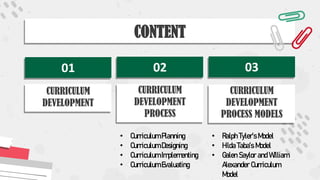
CURRICULUM
DEVELOPMENT
CONTENT
02 03
CURRICULUM
DEVELOPMENT
PROCESS
CURRICULUM
DEVELOPMENT
PROCESS MODELS
• Curriculum Planning
• Curriculum Designing
• Curriculum Implementing
• Curriculum Evaluating
• Ralph Tyler’s Model
• Hilda Taba’s Model
• Galen Saylor and William
Alexander Curriculum
Model
01
CURRICULUM DEVELOPMENT
What is Curriculum Development?
It is defined as the process of Selecting,
Organizing, Executing, and Evaluating
learning experiences on the basis of the
needs, abilities and interest of the learners
and the nature of the society or
community.
CURRICULUM DEVELOPMENT
● Curriculum is a Dynamic Process.
● In Curriculum Development there are always changes
that occur that are intended for improvement.
● There are models presented to us from well-known
curricularist like Ralph Tyler, Hilda Taba, Galen Saylor
and William Alexander which would help clarify the
process of curriculum Development.
CURRICULUM DEVELOPMENT
02
CURRICULUM DEVELOPMENT
PROCESS
What are the 4 curriculum development processes?
CURRICULUM DEVELOPMENT PROCESS
• Curriculum is a dynamic process involving many different
people and procedures.
• Development connotes changes which is systematic.
• A changes for the better means alteration, modification, or
improvement of existing condition.
• To produce positive changes, development should be
purposeful, planned, and progressive.
CURRICULUM DEVELOPMENT PROCESS
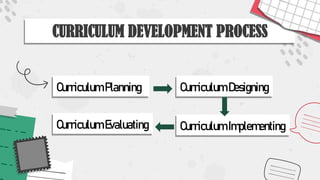
Curriculum Planning Curriculum Designing
Curriculum Implementing
Curriculum Evaluating
CURRICULUM PLANNING
• Considers the School Vision, Mission and Goals.
• It also includes the Philosophy or Strong education
beliefs of the School.
• All of theses will eventually translated to classroom
desired learning outcomes for the learners.
CURRICULUM DESIGNING
• Is the way school is conceptualize to include the
selection and organization of the content, the
selection and organization of learning experience or
activities and the selection of the assessment
procedure and tools to measure achieved learning
outcomes.
CURRICULUM DESIGNING
• A curriculum design will also include the resources
to be utilized and the statement of the intended
learning outcomes.
CURRICULUM IMPLEMENTING
• Is putting into action the plan which is based on the
curriculum design in the classroom setting or the learning
environment.
• The teacher is the facilitator of Learning, and together with
the learners, uses the curriculum design as guide to what
will transpire in the classroom with the end in view of
achieving the intended learning outcomes.
CURRICULUM IMPLEMENTING
• Implementation of Curriculum is where the action take
place; involves all the activities in the classroom where
learning becomes an active process.
CURRICULUM EVALUATING
• Determined the extent to which the desired outcomes have
been achieved.
• This procedure is on going as in finding out the progress of
learning (formative) or the mastery of learning (summative)
• Along the way, evaluation will determine the factors that
hindered or supported the implementation.
CURRICULUM EVALUATING
• Evaluation also pinpoint where improvement can be
made and corrective measures introduced.
• The result of evaluation is very important for
decision making of curriculum planners, and
implementors.
03
CURRICULUM DEVELOPMENT
PROCESS MODELS
CURRICULUM DEVELOPMENT PROCESS MODELS
• Some well known curricularist developed models to
help in the process of curriculum development.
- Ralph Tyler
- Hilda Taba
- Galen Saylor and William Alexander
Ralph Tyler
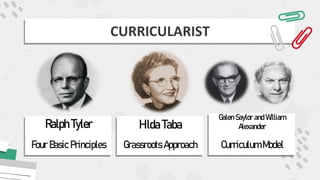
CURRICULARIST
Hilda Taba
Galen Saylor and William
Alexander
Four Basic Principles Grassroots Approach Curriculum Model
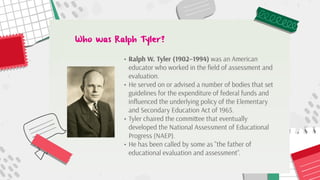
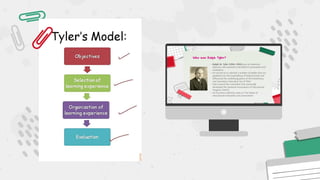
RALPH TYLER’S MODEL: FOUR BASIC PRINCIPLES
• Also known as Tyler’s Rationale, the curriculum
development model emphasizes the planning phase;
presented in his book Basic Principles of Curriculum and
Instruction.
• He posited four fundamental principles which are illustrated
as answers to the following questions:
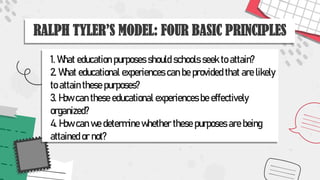
RALPH TYLER’S MODEL: FOUR BASIC PRINCIPLES
1. What education purposes should schools seek to attain?
2. What educational experiences can be provided that are likely
to attain these purposes?
3. How can these educational experiences be effectively
organized?
4. How can we determine whether these purposes are being
attained or not?
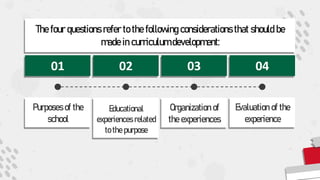
The four questions refer to the following considerations that should be
made in curriculum development:
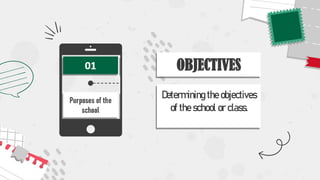
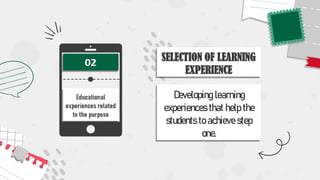
01 02 03 04
Purposes of the
school
Educational
experiences related
to the purpose
Organization of
the experiences
Evaluation of the
experience
Determining the objectives
of the school or class.
OBJECTIVES
Developing learning
experiences that help the
students to achieve step
one.
SELECTION OF LEARNING
EXPERIENCE
The teacher needs to
determine a logical order
of experiences for the
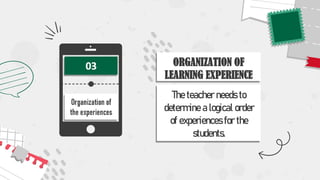
students.
ORGANIZATION OF
LEARNING EXPERIENCE
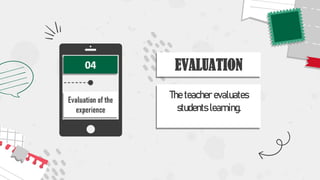
The teacher evaluates
students learning.
EVALUATION
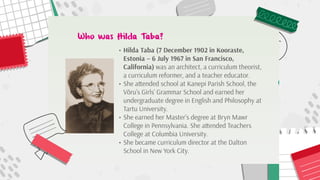
HILDA TABA'S MODEL: GRASSROOTS APPROACH
• Hilda Taba's theory of curriculum development is
considered a more grassroots, inductive approach than
other traditionalist models, such as Ralph Tyler's objectives
model, or rational model, of curriculum design.
• She believed that teachers should participate in developing
a curriculum rather than higher authorities dictating the
curriculum to the teachers.
HILDA TABA'S MODEL: GRASSROOTS APPROACH
• She also believed that curriculum was best designed
inductively, starting with specifics and building up to a
more general design.
• Taba improved on Tyler's model in 1962, adding three
additional stages that involved diagnosing the needs of the
learners as a first step and added the selection and
organization of content as additional steps.
• Thus, Taba's linear model presented seven major steps to
curriculum development.
HILDA TABA'S MODEL: GRASSROOTS APPROACH
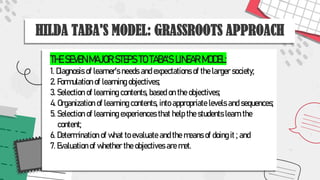
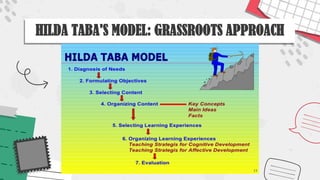
THE SEVEN MAJOR STEPS TO TABA'S LINEAR MODEL:
1. Diagnosis of learner’s needs and expectations of the larger society;
2. Formulation of learning objectives;
3. Selection of learning contents, based on the objectives;
4. Organization of learning contents, into appropriate levels and sequences;
5. Selection of learning experiences that help the students learn the
content;
6. Determination of what to evaluate and the means of doing it ; and
7. Evaluation of whether the objectives are met.
HILDA TABA'S MODEL: GRASSROOTS APPROACH
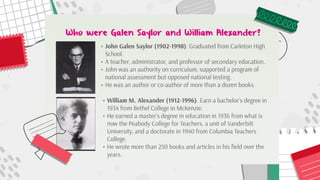
Galen Saylor and William Alexander Curriculum Model
• Saylor and Alexander (1974) viewed curriculum
development as consisting of four steps.
• According to them, curriculum is “a plan for providing sets
of learning opportunities to achieve broad educational
goals and related specific objectives for an identifiable
population served by a single school center."
Galen Saylor and William Alexander Curriculum Model
• The four steps of curriculum development according to
Saylor and Alexander are the following:
1. Goals, Objectives and Domains
2. Curriculum Designing
3. Curriculum Implementing
4. Evaluation
Galen Saylor and William Alexander Curriculum Model
GOALS, OBJECTIVES AND DOMAINS:
• Curriculum planners begin by specifying the major
educational goals and specific objectives they wish to
accomplish.
• Each major goal represents a curriculum domain: personal
development, human relations, continued learning skills
and specialization.
• These are identified and chosen based on research
findings, accreditation standards, and views of the different
stakeholders.
Galen Saylor and William Alexander Curriculum Model
CURRICULUM DESIGNING:
• Once the goals, objectives and domains have been established,
planners move into the process of designing the curriculum.
• Here decision is made on the appropriate learning opportunities for
each domain and how and when these opportunities will be provided.
• Will the curriculum be designed along the lines of academic disciplines,
or according to student needs and interests or along themes?
• These are some of the questions that need to be answered at this stage
of the development process.
Galen Saylor and William Alexander Curriculum Model
CURRICULUM IMPLEMENTATION:
• After the designs have been created the next step is
implementation of the designs by teachers.
• Based on the design of the curriculum plan, teachers would
specify instructional objectives and then select relevant
teaching methods and strategies to achieve the desired
learning outcomes among students in the classroom.
Galen Saylor and William Alexander Curriculum Model
CURRICULUM EVALUATION:
• Finally, curriculum planner and teachers engage
in evaluation.
• The model proposed that evaluation should be
comprehensive using a variety of evaluation
techniques.
Galen Saylor and William Alexander Curriculum Model
CURRICULUM EVALUATION:
• Evaluation should involve the total educational programme
of the school and the curriculum plan, the effectiveness of
instruction and the achievement of students.
• Through the evaluation process, curriculum planner and
developers can determine whether or nor the goals of the
school and the objectives of instruction have been met.
SUMMARY
• All the models utilized the process of (1) curriculum planning, (2) curriculum
designing, (3) curriculum implementing, and (4) curriculum evaluating.
• Tyler's, and Saylor and Alexander's models are deductive in nature which proceed
from general to specific whereas that of Taba is inductive.
• All models are LINEAR: Propose an order/sequence of how to progress through the
different steps of curriculum development.
• All models combine a scheme for curriculum development and a design for
instruction.
• All models are PRESCRIPTIVE: That means it suggest what 'ought' to be done.
Refference:
https://prezi.com/rhvkec8muemr/curriculum-development-
processes-and-
models/?fbclid=IwAR0xkMmKOGMqABfjR8mER26NteNkS83Y
mJz6w_IpvyKkoiyqC-6t7OOQyLg

CURDEV-PROCESS AND MODELS.pdf

  • 1.
    CURRICULUM DEVELOPMENT: PROCESSES AND MODELS TheTeacher as a Knower of Curriculum
  • 2.
    Tr. Analyn B.Clado DR. RAY SAMUEL G. GRECALDA Professor
  • 3.
    CURRICULUM DEVELOPMENT: PROCESSES ANDMODELS OBJECTIVES: Explain and Summarize the Curriculum Development processes and models. The Teacher as a Knower of Curriculum
  • 4.
    01 CURRICULUM DEVELOPMENT CONTENT 02 03 CURRICULUM DEVELOPMENT PROCESS CURRICULUM DEVELOPMENT PROCESS MODELS •Curriculum Planning • Curriculum Designing • Curriculum Implementing • Curriculum Evaluating • Ralph Tyler’s Model • Hilda Taba’s Model • Galen Saylor and William Alexander Curriculum Model
  • 5.
    01 CURRICULUM DEVELOPMENT What isCurriculum Development?
  • 6.
    It is definedas the process of Selecting, Organizing, Executing, and Evaluating learning experiences on the basis of the needs, abilities and interest of the learners and the nature of the society or community. CURRICULUM DEVELOPMENT
  • 7.
    ● Curriculum isa Dynamic Process. ● In Curriculum Development there are always changes that occur that are intended for improvement. ● There are models presented to us from well-known curricularist like Ralph Tyler, Hilda Taba, Galen Saylor and William Alexander which would help clarify the process of curriculum Development. CURRICULUM DEVELOPMENT
  • 8.
    02 CURRICULUM DEVELOPMENT PROCESS What arethe 4 curriculum development processes?
  • 9.
    CURRICULUM DEVELOPMENT PROCESS •Curriculum is a dynamic process involving many different people and procedures. • Development connotes changes which is systematic. • A changes for the better means alteration, modification, or improvement of existing condition. • To produce positive changes, development should be purposeful, planned, and progressive.
  • 10.
    CURRICULUM DEVELOPMENT PROCESS CurriculumPlanning Curriculum Designing Curriculum Implementing Curriculum Evaluating
  • 11.
    CURRICULUM PLANNING • Considersthe School Vision, Mission and Goals. • It also includes the Philosophy or Strong education beliefs of the School. • All of theses will eventually translated to classroom desired learning outcomes for the learners.
  • 12.
    CURRICULUM DESIGNING • Isthe way school is conceptualize to include the selection and organization of the content, the selection and organization of learning experience or activities and the selection of the assessment procedure and tools to measure achieved learning outcomes.
  • 13.
    CURRICULUM DESIGNING • Acurriculum design will also include the resources to be utilized and the statement of the intended learning outcomes.
  • 14.
    CURRICULUM IMPLEMENTING • Isputting into action the plan which is based on the curriculum design in the classroom setting or the learning environment. • The teacher is the facilitator of Learning, and together with the learners, uses the curriculum design as guide to what will transpire in the classroom with the end in view of achieving the intended learning outcomes.
  • 15.
    CURRICULUM IMPLEMENTING • Implementationof Curriculum is where the action take place; involves all the activities in the classroom where learning becomes an active process.
  • 16.
    CURRICULUM EVALUATING • Determinedthe extent to which the desired outcomes have been achieved. • This procedure is on going as in finding out the progress of learning (formative) or the mastery of learning (summative) • Along the way, evaluation will determine the factors that hindered or supported the implementation.
  • 17.
    CURRICULUM EVALUATING • Evaluationalso pinpoint where improvement can be made and corrective measures introduced. • The result of evaluation is very important for decision making of curriculum planners, and implementors.
  • 18.
  • 19.
    CURRICULUM DEVELOPMENT PROCESSMODELS • Some well known curricularist developed models to help in the process of curriculum development. - Ralph Tyler - Hilda Taba - Galen Saylor and William Alexander
  • 20.
    Ralph Tyler CURRICULARIST Hilda Taba GalenSaylor and William Alexander Four Basic Principles Grassroots Approach Curriculum Model
  • 24.
    RALPH TYLER’S MODEL:FOUR BASIC PRINCIPLES • Also known as Tyler’s Rationale, the curriculum development model emphasizes the planning phase; presented in his book Basic Principles of Curriculum and Instruction. • He posited four fundamental principles which are illustrated as answers to the following questions:
  • 25.
    RALPH TYLER’S MODEL:FOUR BASIC PRINCIPLES 1. What education purposes should schools seek to attain? 2. What educational experiences can be provided that are likely to attain these purposes? 3. How can these educational experiences be effectively organized? 4. How can we determine whether these purposes are being attained or not?
  • 26.
    The four questionsrefer to the following considerations that should be made in curriculum development: 01 02 03 04 Purposes of the school Educational experiences related to the purpose Organization of the experiences Evaluation of the experience
  • 28.
    Determining the objectives ofthe school or class. OBJECTIVES
  • 29.
    Developing learning experiences thathelp the students to achieve step one. SELECTION OF LEARNING EXPERIENCE
  • 30.
    The teacher needsto determine a logical order of experiences for the students. ORGANIZATION OF LEARNING EXPERIENCE
  • 31.
    The teacher evaluates studentslearning. EVALUATION
  • 32.
    HILDA TABA'S MODEL:GRASSROOTS APPROACH • Hilda Taba's theory of curriculum development is considered a more grassroots, inductive approach than other traditionalist models, such as Ralph Tyler's objectives model, or rational model, of curriculum design. • She believed that teachers should participate in developing a curriculum rather than higher authorities dictating the curriculum to the teachers.
  • 33.
    HILDA TABA'S MODEL:GRASSROOTS APPROACH • She also believed that curriculum was best designed inductively, starting with specifics and building up to a more general design. • Taba improved on Tyler's model in 1962, adding three additional stages that involved diagnosing the needs of the learners as a first step and added the selection and organization of content as additional steps. • Thus, Taba's linear model presented seven major steps to curriculum development.
  • 34.
    HILDA TABA'S MODEL:GRASSROOTS APPROACH THE SEVEN MAJOR STEPS TO TABA'S LINEAR MODEL: 1. Diagnosis of learner’s needs and expectations of the larger society; 2. Formulation of learning objectives; 3. Selection of learning contents, based on the objectives; 4. Organization of learning contents, into appropriate levels and sequences; 5. Selection of learning experiences that help the students learn the content; 6. Determination of what to evaluate and the means of doing it ; and 7. Evaluation of whether the objectives are met.
  • 35.
    HILDA TABA'S MODEL:GRASSROOTS APPROACH
  • 36.
    Galen Saylor andWilliam Alexander Curriculum Model • Saylor and Alexander (1974) viewed curriculum development as consisting of four steps. • According to them, curriculum is “a plan for providing sets of learning opportunities to achieve broad educational goals and related specific objectives for an identifiable population served by a single school center."
  • 37.
    Galen Saylor andWilliam Alexander Curriculum Model • The four steps of curriculum development according to Saylor and Alexander are the following: 1. Goals, Objectives and Domains 2. Curriculum Designing 3. Curriculum Implementing 4. Evaluation
  • 38.
    Galen Saylor andWilliam Alexander Curriculum Model GOALS, OBJECTIVES AND DOMAINS: • Curriculum planners begin by specifying the major educational goals and specific objectives they wish to accomplish. • Each major goal represents a curriculum domain: personal development, human relations, continued learning skills and specialization. • These are identified and chosen based on research findings, accreditation standards, and views of the different stakeholders.
  • 39.
    Galen Saylor andWilliam Alexander Curriculum Model CURRICULUM DESIGNING: • Once the goals, objectives and domains have been established, planners move into the process of designing the curriculum. • Here decision is made on the appropriate learning opportunities for each domain and how and when these opportunities will be provided. • Will the curriculum be designed along the lines of academic disciplines, or according to student needs and interests or along themes? • These are some of the questions that need to be answered at this stage of the development process.
  • 40.
    Galen Saylor andWilliam Alexander Curriculum Model CURRICULUM IMPLEMENTATION: • After the designs have been created the next step is implementation of the designs by teachers. • Based on the design of the curriculum plan, teachers would specify instructional objectives and then select relevant teaching methods and strategies to achieve the desired learning outcomes among students in the classroom.
  • 41.
    Galen Saylor andWilliam Alexander Curriculum Model CURRICULUM EVALUATION: • Finally, curriculum planner and teachers engage in evaluation. • The model proposed that evaluation should be comprehensive using a variety of evaluation techniques.
  • 42.
    Galen Saylor andWilliam Alexander Curriculum Model CURRICULUM EVALUATION: • Evaluation should involve the total educational programme of the school and the curriculum plan, the effectiveness of instruction and the achievement of students. • Through the evaluation process, curriculum planner and developers can determine whether or nor the goals of the school and the objectives of instruction have been met.
  • 43.
    SUMMARY • All themodels utilized the process of (1) curriculum planning, (2) curriculum designing, (3) curriculum implementing, and (4) curriculum evaluating. • Tyler's, and Saylor and Alexander's models are deductive in nature which proceed from general to specific whereas that of Taba is inductive. • All models are LINEAR: Propose an order/sequence of how to progress through the different steps of curriculum development. • All models combine a scheme for curriculum development and a design for instruction. • All models are PRESCRIPTIVE: That means it suggest what 'ought' to be done.
  • 44.