GENETIC COUNSELING
By
DEVI PRIYA SUGATHAN
MSC BIOCHEMISTRY AND
MOLECULAR BIOLOGY
CONTENT
o What is genetic counseling?
o Purpose
o Types of genetic counseling
o Genetic counselor
o When to refer to a genetic counselor?
o Genetic Screening & Genetic Test
o Diagonosis
o Genetic counselling today….
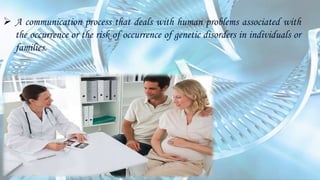
 A communication process that deals with human problems associated with
the occurrence or the risk of occurrence of genetic disorders in individuals or
families.
PURPOSE
Explaining alternatives to reduce the risk of genetic disorders.
Reducing the impact of genetic disorders.
Reduce the family’s anxiety.
Assisting families in choosing the options most appropriate for them.
To comprehend the medical facts, including diagnostic, probable
course of the disorder and available management.
Providing psychosocial support.
Discussing the options available for dealing with the disorder.
TYPES OF GENETIC COUNSELING
• Two types of genetic counseling
Prospective
Retrospective
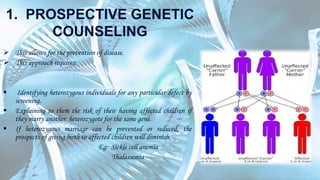
1. PROSPECTIVE GENETIC
COUNSELING
 This allows for the prevention of disease.
 This approach requires:
 Identifying heterozygous individuals for any particular defect by
screening.
 Explaining to them the risk of their having affected children if
they marry another heterozygote for the same gene.
 If heterozygous marriage can be prevented or reduced, the
prospects of giving birth to affected children will diminish.
Eg: Sickle cell anemia
Thalassemia
2. RETROSPECTIVE GENETIC
COUNSELING
• Most genetic counseling at present is retrospective i.e the
heriditary disorder has already occurred within the family.
Ex : Mental retardation
Inborn errors of metabolism
Psychiatric illness
• The method which could be suggested under retrospective
genetic counselling:
1. Contraception
2. Pregnancy termination
3. Sterilization
GENETIC COUNSELOR
 Genetic counselors are professionals trained in the
fields of genetics and psychosocial counseling.
 They act as advocates for families affected by genetic
disorders.
 They help patients understand the concepts of
heredity.
 Assist them in planning for treatment of affected
individuals as well as providing options for future
offspring.
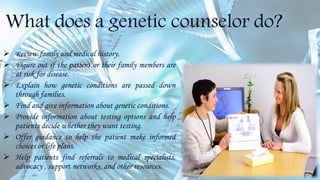
What does a genetic counselor do?
 Review family and medical history.
 Figure out if the patient or their family members are
at risk for disease.
 Explain how genetic conditions are passed down
through families.
 Find and give information about genetic conditions.
 Provide information about testing options and help
patients decide whether they want testing.
 Offer guidance to help the patient make informed
choices or life plans.
 Help patients find referrals to medical specialists,
advocacy , support networks, and other resources.
n to refer to a Genetic Specialist?
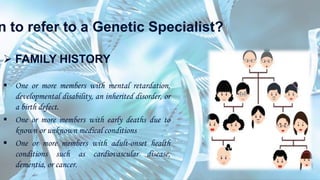
 FAMILY HISTORY
 One or more members with mental retardation,
developmental disability, an inherited disorder, or
a birth defect.
 One or more members with early deaths due to
known or unknown medical conditions
 One or more members with adult-onset health
conditions such as cardiovascular disease,
dementia, or cancer.
 DELAYED GROWTH AND
DEVELOPMENT
 Those who have or are concerned that their child has
developmental delays that may be due to an inherited
disorder or birth defect.
 REPRODUCTIVE
ISSUES
 Women who have experienced multiple
pregnancy losses or babies who died in
infancy.
 People concerned that their jobs, lifestyles
or medical history may pose a risk to the
outcome of a pregnancy. Common causes of
concern include exposure to radiations,
medications, illegal drugs, chemicals or
infections.
 Couples who are first cousins or other close
blood relatives.
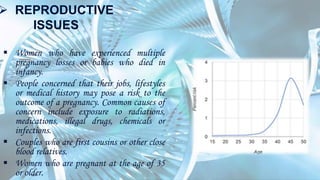
 Women who are pregnant at the age of 35
or older.
ENETIC SCREENING
 It is the newest and most sophisticated technique used to
test for genetic disorders.
 Genetic screening is often used to detect faulty or
abnormal genes in an organism.
 Can detect some genes related to an increased risk of
cancer.
 Can detect some genes known to cause genetic disorders.
 GENETIC TEST - The analysis of chromosomes
(DNA), proteins, and certain metabolites in order to detect
heritable disease-related genotypes, mutations,
phenotypes, or karyotype for clinical purposes.
DIAGONOSIS
• Use of family history.
• Prenatal diagonosis.
• Screening of inborn infants.
FAMILY
HISTORY
 A proper record of the history of the individual is
necessary.
 History of abortion or still births in the family has to be
recorded.
 Enquiry should be made about consanguinity.
 With reference to the family history a pedigree chart can
be made and the pattern of inheritance can be revealed.
 There are 3 types of pedigree that you need to know about
1] Autosomal recessive inheritance
2] Autosomal dominant inheritance
3] Sex-linked recessive trait.
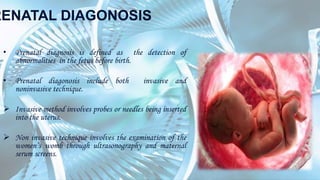
RENATAL DIAGONOSIS
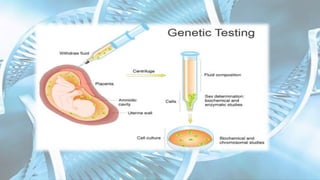
• Prenatal diagnosis is defined as the detection of
abnormalities in the fetus before birth.
• Prenatal diagonosis include both invasive and
noninvasive technique.
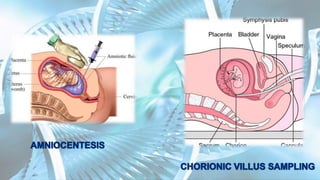
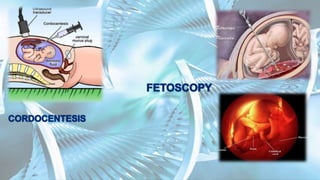
 Invasive method involves probes or needles being inserted
into the uterus.
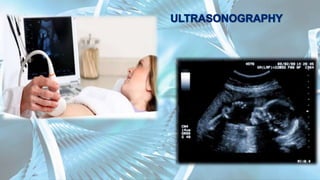
 Non invasive technique involves the examination of the
women’s womb through ultrasonography and maternal
serum screens.
INVASIVE
1. Amniocentesis
2. Chorionic villus sampling
3. Cordosentesis
4. Preimplantation genetic diagonosis
5. Fetoscopy
NON INVASIVE
1. Maternal serum AFP
2. Maternal serum screening
3. Ultrasonography
4. Isolation of fetal cells from
maternal circulation
ONS FOR PRENATAL DIAGONOSIS
There are three purposes of prenatal diagnosis:
 to enable timely medical or surgical treatment of a
condition before or after birth.
 to give the parents the chance to abort a fetus with the
diagnosed condition .
 to give parents the chance to "prepare" psychologically,
socially, financially, and medically for a baby with a
health problem or disability, or for the likelihood of a
stillbirth.
REENING OF INBORN INFANTS
• Newborn screening is a public health
program of screening in infants shortly after
birth for a list of conditions that are
treatable.
• Most newborn screening test are done by
measuring metabolites and enzyme activity
in whole blood samples collected on
specialized filter paper.
GENETIC COUNSELLING TODAY
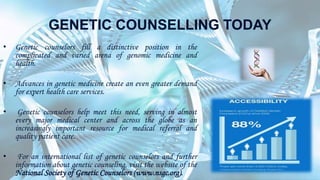
• Genetic counselors fill a distinctive position in the
complicated and varied arena of genomic medicine and
health.
• Advances in genetic medicine create an even greater demand
for expert health care services.
• Genetic counselors help meet this need, serving in almost
every major medical center and across the globe as an
increasingly important resource for medical referral and
quality patient care.
• For an international list of genetic counselors and further
information about genetic counseling, visit the website of the
National Society of Genetic Counselors (www.nsgc.org).
Genetic counselling

Genetic counselling

  • 1.
    GENETIC COUNSELING By DEVI PRIYASUGATHAN MSC BIOCHEMISTRY AND MOLECULAR BIOLOGY
  • 2.
    CONTENT o What isgenetic counseling? o Purpose o Types of genetic counseling o Genetic counselor o When to refer to a genetic counselor? o Genetic Screening & Genetic Test o Diagonosis o Genetic counselling today….
  • 3.
     A communicationprocess that deals with human problems associated with the occurrence or the risk of occurrence of genetic disorders in individuals or families.
  • 4.
    PURPOSE Explaining alternatives toreduce the risk of genetic disorders. Reducing the impact of genetic disorders. Reduce the family’s anxiety. Assisting families in choosing the options most appropriate for them. To comprehend the medical facts, including diagnostic, probable course of the disorder and available management. Providing psychosocial support. Discussing the options available for dealing with the disorder.
  • 5.
    TYPES OF GENETICCOUNSELING • Two types of genetic counseling Prospective Retrospective
  • 6.
    1. PROSPECTIVE GENETIC COUNSELING This allows for the prevention of disease.  This approach requires:  Identifying heterozygous individuals for any particular defect by screening.  Explaining to them the risk of their having affected children if they marry another heterozygote for the same gene.  If heterozygous marriage can be prevented or reduced, the prospects of giving birth to affected children will diminish. Eg: Sickle cell anemia Thalassemia
  • 7.
    2. RETROSPECTIVE GENETIC COUNSELING •Most genetic counseling at present is retrospective i.e the heriditary disorder has already occurred within the family. Ex : Mental retardation Inborn errors of metabolism Psychiatric illness • The method which could be suggested under retrospective genetic counselling: 1. Contraception 2. Pregnancy termination 3. Sterilization
  • 8.
    GENETIC COUNSELOR  Geneticcounselors are professionals trained in the fields of genetics and psychosocial counseling.  They act as advocates for families affected by genetic disorders.  They help patients understand the concepts of heredity.  Assist them in planning for treatment of affected individuals as well as providing options for future offspring.
  • 9.
    What does agenetic counselor do?  Review family and medical history.  Figure out if the patient or their family members are at risk for disease.  Explain how genetic conditions are passed down through families.  Find and give information about genetic conditions.  Provide information about testing options and help patients decide whether they want testing.  Offer guidance to help the patient make informed choices or life plans.  Help patients find referrals to medical specialists, advocacy , support networks, and other resources.
  • 10.
    n to referto a Genetic Specialist?  FAMILY HISTORY  One or more members with mental retardation, developmental disability, an inherited disorder, or a birth defect.  One or more members with early deaths due to known or unknown medical conditions  One or more members with adult-onset health conditions such as cardiovascular disease, dementia, or cancer.
  • 11.
     DELAYED GROWTHAND DEVELOPMENT  Those who have or are concerned that their child has developmental delays that may be due to an inherited disorder or birth defect.
  • 12.
     REPRODUCTIVE ISSUES  Womenwho have experienced multiple pregnancy losses or babies who died in infancy.  People concerned that their jobs, lifestyles or medical history may pose a risk to the outcome of a pregnancy. Common causes of concern include exposure to radiations, medications, illegal drugs, chemicals or infections.  Couples who are first cousins or other close blood relatives.  Women who are pregnant at the age of 35 or older.
  • 13.
    ENETIC SCREENING  Itis the newest and most sophisticated technique used to test for genetic disorders.  Genetic screening is often used to detect faulty or abnormal genes in an organism.  Can detect some genes related to an increased risk of cancer.  Can detect some genes known to cause genetic disorders.  GENETIC TEST - The analysis of chromosomes (DNA), proteins, and certain metabolites in order to detect heritable disease-related genotypes, mutations, phenotypes, or karyotype for clinical purposes.
  • 14.
    DIAGONOSIS • Use offamily history. • Prenatal diagonosis. • Screening of inborn infants.
  • 15.
    FAMILY HISTORY  A properrecord of the history of the individual is necessary.  History of abortion or still births in the family has to be recorded.  Enquiry should be made about consanguinity.  With reference to the family history a pedigree chart can be made and the pattern of inheritance can be revealed.  There are 3 types of pedigree that you need to know about 1] Autosomal recessive inheritance 2] Autosomal dominant inheritance 3] Sex-linked recessive trait.
  • 16.
    RENATAL DIAGONOSIS • Prenataldiagnosis is defined as the detection of abnormalities in the fetus before birth. • Prenatal diagonosis include both invasive and noninvasive technique.  Invasive method involves probes or needles being inserted into the uterus.  Non invasive technique involves the examination of the women’s womb through ultrasonography and maternal serum screens.
  • 17.
    INVASIVE 1. Amniocentesis 2. Chorionicvillus sampling 3. Cordosentesis 4. Preimplantation genetic diagonosis 5. Fetoscopy NON INVASIVE 1. Maternal serum AFP 2. Maternal serum screening 3. Ultrasonography 4. Isolation of fetal cells from maternal circulation
  • 22.
    ONS FOR PRENATALDIAGONOSIS There are three purposes of prenatal diagnosis:  to enable timely medical or surgical treatment of a condition before or after birth.  to give the parents the chance to abort a fetus with the diagnosed condition .  to give parents the chance to "prepare" psychologically, socially, financially, and medically for a baby with a health problem or disability, or for the likelihood of a stillbirth.
  • 23.
    REENING OF INBORNINFANTS • Newborn screening is a public health program of screening in infants shortly after birth for a list of conditions that are treatable. • Most newborn screening test are done by measuring metabolites and enzyme activity in whole blood samples collected on specialized filter paper.
  • 24.
    GENETIC COUNSELLING TODAY •Genetic counselors fill a distinctive position in the complicated and varied arena of genomic medicine and health. • Advances in genetic medicine create an even greater demand for expert health care services. • Genetic counselors help meet this need, serving in almost every major medical center and across the globe as an increasingly important resource for medical referral and quality patient care. • For an international list of genetic counselors and further information about genetic counseling, visit the website of the National Society of Genetic Counselors (www.nsgc.org).