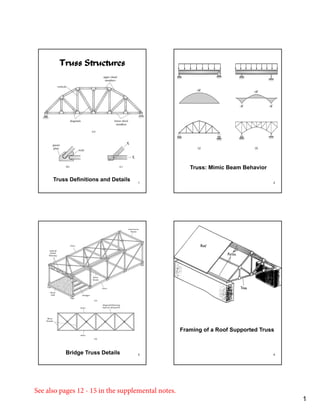
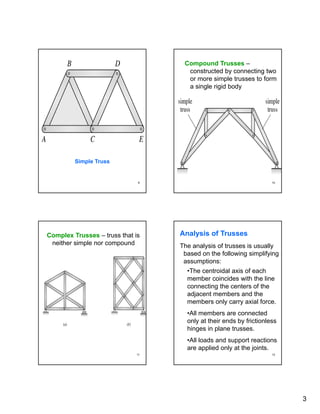
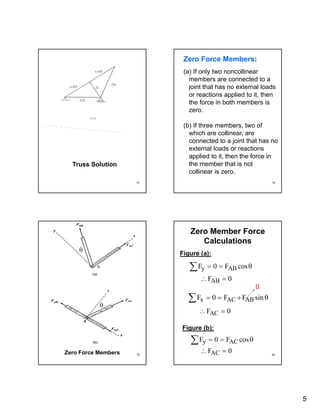
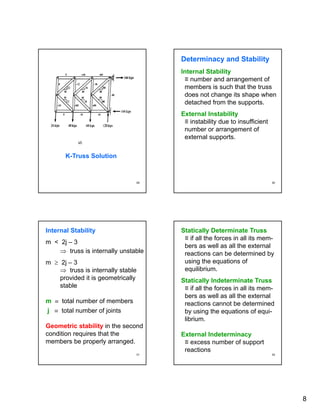
Trusses are structures composed of individual structural elements called members that form triangular patterns to support loads. Truss analysis assumes members only experience axial forces and joints allow frictionless rotation. There are two main methods for analyzing trusses - the method of joints, which considers force equilibrium at each joint, and the method of sections, which cuts the truss into parts to analyze member forces. For a truss to be stable and determinate, the number of members and reactions must equal the number of joints based on the equation m + R = 2j, where m is members, R is reactions, and j is joints.






![Lecture truss [compatibility mode]](https://cdn.slidesharecdn.com/ss_thumbnails/lecturetrusscompatibilitymode-160126134009-thumbnail.jpg?width=640&height=640&fit=bounds)


