Application of Trusses


Name          M.Umar


Roll number   BSME01113128


Sec           0


Department     Mech. Engg


Instructor     M Adeel Butt
What is Truss?
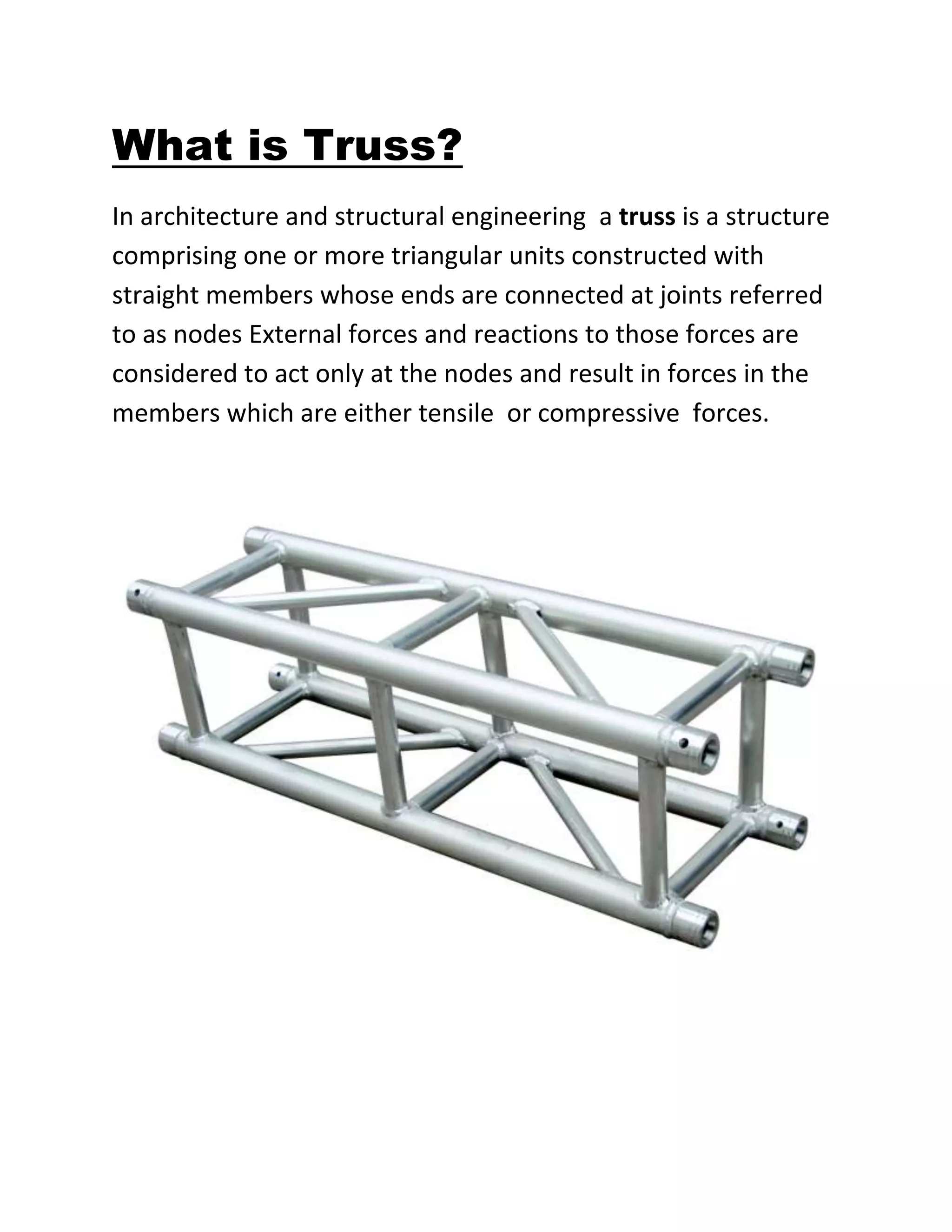
In architecture and structural engineering a truss is a structure
comprising one or more triangular units constructed with
straight members whose ends are connected at joints referred
to as nodes External forces and reactions to those forces are
considered to act only at the nodes and result in forces in the
members which are either tensile or compressive forces.
Types of truss?
There are two basic types of truss.

       1.The pitched Truss
       2.The parallel chord Truss

a)

The pitched truss, or common truss, is characterized by its
triangular shape. It is most often used for roof construction.
Some common trusses are named according to their web
configuration. The chord size and web configuration are
determined by span, load and spacing.

b)
     The parallel chord truss, or flat truss, gets its name from its
     parallel top and bottom chords. It is often used for floor
     construction.
A combination of the two is a truncated truss, used in roof
construction. A metal plate-connected wood truss is a roof or
floor truss whose wood members are connected with metal
connector plates.
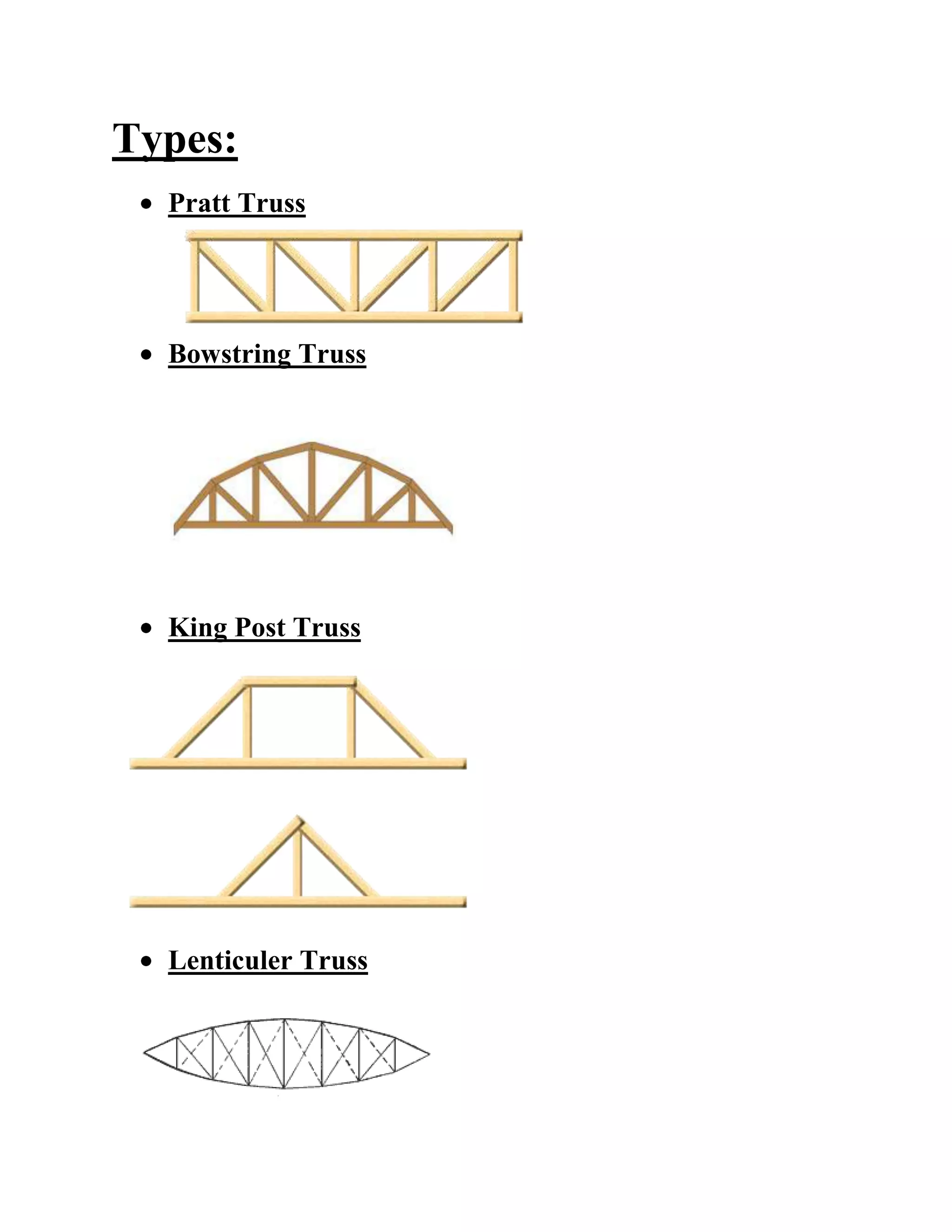
Types:
  Pratt Truss


  Bowstring Truss


  King Post Truss


  Lenticuler Truss
Explanations:
A
The Pratt truss was patented in 1844 by two Boston railway
engineer, Caleb Pratt and his son Thomas Willis Pratt .The
design uses vertical members for compression and horizontal
members to respond to tension .What is remarkable about this
style is that it remained popular even as wood gave way to iron,
and even still as iron gave way to steel. The continued
popularity of the Pratt truss is probably due to the fact that the
configuration of the members means that longer diagonal
members are only in tension for gravity load effects. This allows
these members to be used more efficiently, as slenderness
effects related to buckling under compression loads (which are
compounded by the length of the member) will typically not
control the design. Therefore, for given planar truss with a fixed
depth, the Pratt configuration is usually the most efficient
under static, vertical loading.
B
Named for their shape, bowstring trusses were first used for
arched truss bridges known as tied-arch bridges
Thousands of bowstring trusses were used during World War II
for holding up the curved roofs of aircraft hangars and other
military buildings. Many variations exist in the arrangements of
the members connecting the nodes of the upper arc with those of
the lower, straight sequence of members, from nearly isosceles
triangles to a variant of the Platt truss
C
One of the simplest truss styles to implement, the king post
consists of two angled supports leaning into a common vertical
support

The queen post truss, sometimes queen post or queen’s post is
similar to a king post truss in that the outer supports are angled
towards the center of the structure. The primary difference is
the horizontal extension at the centre which relies on beam
action to provide mechanical stability. This truss style is only
suitable for relatively short spans


D
A Lenticuler pony truss bridge is a bridge design that involves a
Lenticuler truss extending above and below the roadbed.


Applications:
Component connections are critical to the structural integrity of
a framing system. In buildings with large, clear span wood
trusses, the most critical connections are those between the truss
and its supports. In addition to gravity-induced forces (a.k.a.
bearing loads), these connections must resist shear forces acting
perpendicular to the plane of the truss and uplift forces due to
wind. Depending upon overall building design, the connections
may also be required to transfer bending moment.
Wood posts enable the fabrication of strong, direct, yet
inexpensive connections between large trusses and walls. Exact
details for post-to-truss connections vary from designer to
designer, and may be influenced by post type. Solid-sawn timber
and gleam posts are generally notched to form a truss bearing
surface. The truss is rested on the notches and bolted into place.
A special plate/bracket may be added to increase connection
load transfer capabilities. With mechanically-laminated posts,
the truss may rest on a shortened outer-ply or on a shortened
inner-ply. The later scenario places the bolts in double shear and
is a very effective connection

Application of the trusses

  • 1.
    Application of Trusses Name M.Umar Roll number BSME01113128 Sec 0 Department Mech. Engg Instructor M Adeel Butt
  • 2.
    What is Truss? Inarchitecture and structural engineering a truss is a structure comprising one or more triangular units constructed with straight members whose ends are connected at joints referred to as nodes External forces and reactions to those forces are considered to act only at the nodes and result in forces in the members which are either tensile or compressive forces.
  • 3.
    Types of truss? Thereare two basic types of truss. 1.The pitched Truss 2.The parallel chord Truss a) The pitched truss, or common truss, is characterized by its triangular shape. It is most often used for roof construction. Some common trusses are named according to their web configuration. The chord size and web configuration are determined by span, load and spacing. b) The parallel chord truss, or flat truss, gets its name from its parallel top and bottom chords. It is often used for floor construction. A combination of the two is a truncated truss, used in roof construction. A metal plate-connected wood truss is a roof or floor truss whose wood members are connected with metal connector plates.
  • 4.
    Types: PrattTruss Bowstring Truss King Post Truss Lenticuler Truss
  • 5.
    Explanations: A The Pratt trusswas patented in 1844 by two Boston railway engineer, Caleb Pratt and his son Thomas Willis Pratt .The design uses vertical members for compression and horizontal members to respond to tension .What is remarkable about this style is that it remained popular even as wood gave way to iron, and even still as iron gave way to steel. The continued popularity of the Pratt truss is probably due to the fact that the configuration of the members means that longer diagonal members are only in tension for gravity load effects. This allows these members to be used more efficiently, as slenderness effects related to buckling under compression loads (which are compounded by the length of the member) will typically not control the design. Therefore, for given planar truss with a fixed depth, the Pratt configuration is usually the most efficient under static, vertical loading. B Named for their shape, bowstring trusses were first used for arched truss bridges known as tied-arch bridges Thousands of bowstring trusses were used during World War II for holding up the curved roofs of aircraft hangars and other military buildings. Many variations exist in the arrangements of the members connecting the nodes of the upper arc with those of the lower, straight sequence of members, from nearly isosceles triangles to a variant of the Platt truss
  • 6.
    C One of thesimplest truss styles to implement, the king post consists of two angled supports leaning into a common vertical support The queen post truss, sometimes queen post or queen’s post is similar to a king post truss in that the outer supports are angled towards the center of the structure. The primary difference is the horizontal extension at the centre which relies on beam action to provide mechanical stability. This truss style is only suitable for relatively short spans D A Lenticuler pony truss bridge is a bridge design that involves a Lenticuler truss extending above and below the roadbed. Applications: Component connections are critical to the structural integrity of a framing system. In buildings with large, clear span wood trusses, the most critical connections are those between the truss and its supports. In addition to gravity-induced forces (a.k.a. bearing loads), these connections must resist shear forces acting perpendicular to the plane of the truss and uplift forces due to wind. Depending upon overall building design, the connections may also be required to transfer bending moment.
  • 7.
    Wood posts enablethe fabrication of strong, direct, yet inexpensive connections between large trusses and walls. Exact details for post-to-truss connections vary from designer to designer, and may be influenced by post type. Solid-sawn timber and gleam posts are generally notched to form a truss bearing surface. The truss is rested on the notches and bolted into place. A special plate/bracket may be added to increase connection load transfer capabilities. With mechanically-laminated posts, the truss may rest on a shortened outer-ply or on a shortened inner-ply. The later scenario places the bolts in double shear and is a very effective connection