Mechanics of
Deformable Bodies
Mapúa Institute of Technology
MEC32/A1 Group 1 4Q 2014
MAGBOJOS, Redentor V. ; RIGOR, Lady Krista V. ; SALIDO, Lisette S.
Major
Divisions of
Mechanics
1. Mechanics of Rigid Bodies
• Engineering mechanics
• Study of external forces and motions
with particles and rigid bodies
• rigid body does not change in size
and shape after applying a force
• Statics and dynamics
2. Mechanics of Deformable Bodies
• Strength of materials
• Study of internal effects caused by
external loads on deformable bodies
• deformable body can stretch, bend,
or twist
3. Mechanics of Fluids
 Hydraulics
Importance
of studying
internal
effects on
objects
SAFE AND
SUCCESSFUL
DESIGN
Strength, Stiffness, Stability
Simple Stress:
Normal Stress
Mapúa Institute of Technology
MEC32/A1 Group 1 4Q 2014
MAGBOJOS, Redentor V. ; RIGOR, Lady Krista V. ; SALIDO, Lisette S.
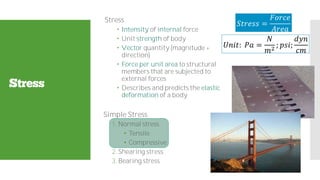
Stress
Stress
 Intensity of internal force
 Unit strength of body
 Vector quantity (magnitude +
direction)
 Force per unit area to structural
members that are subjected to
external forces
 Describes and predicts the elastic
deformation of a body
Simple Stress
1. Normal stress
• Tensile
• Compressive
2. Shearing stress
3. Bearing stress
𝑆𝑡𝑟𝑒𝑠𝑠 =
𝐹𝑜𝑟𝑐𝑒
𝐴𝑟𝑒𝑎
𝑃𝑎 =
𝑁
𝑚2
; 𝑝𝑠𝑖;
𝑑𝑦𝑛
𝑐𝑚2
; 𝑘𝑖𝑝𝑠
Normal
stress under
axial
loading
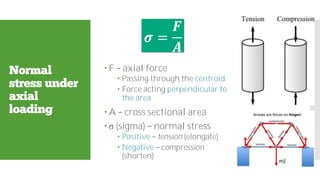
 F axial force
 Passing through the centroid
 Force acting perpendicular to
the area
 A cross sectional area
 σ (sigma) normal stress
 Positive tension (elongate)
 Negative compression
(shorten)
𝝈 =
𝑭
𝑨
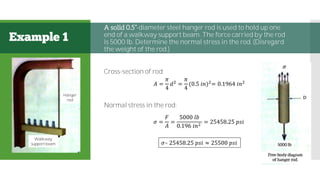
Example 1
-diameter steel hanger rod is used to hold up one
end of a walkway support beam. The force carried by the rod
is 5000 lb. Determine the normal stress in the rod. (Disregard
the weight of the rod.)
Cross-section of rod:
Normal stress in the rod:
𝐴 =
𝜋
4
𝑑2 =
𝜋
4
(0.5 𝑖𝑛)2= 0.1964 𝑖𝑛2
𝜎 =
𝐹
𝐴
=
5000 𝑙𝑏
0.196 𝑖𝑛2
= 25458.25 𝑝𝑠𝑖
𝜎= 25458.25 𝑝𝑠𝑖 ≈ 25500 𝑝𝑠𝑖
Walkway
support beam
Hanger
rod
Example 2
Rigid bar ABC is supported by a pin at A and axial member (1),
which has a cross sectional area of 540 mm2. The weight of
rigid bar ABC can be neglected.
(a)
𝜎1 =
𝐹1
𝐴1
=
(11 𝑘𝑁)(1000
𝑁
𝑘𝑁
)
540 𝑚𝑚2 = 20.37 𝑁/ 𝑚𝑚2
𝜎1 = 20.4 𝑀𝑃𝑎
(a) Determine the normal
stress in member (1) if a
load of P = 8 kN is applied
at C.
Σ𝑀𝐴 = 8 𝑘𝑁 2.2 𝑚 − 1.6 𝑚 𝐹1 = 0 ∴ 𝐹1 = 11 𝑘𝑁
Example 2
Rigid bar ABC is supported by a pin at A and axial member (1),
which has a cross sectional area of 540 mm2. The weight of
rigid bar ABC can be neglected.
(b)
𝑃 = 19.64 𝑘𝑁
(b) If the maximum
normal stress in member
(1) must be limited to 50
MPa, what is the
maximum load
magnitude P that may
be applied to the rigid
bar at C?
Σ𝑀𝐴 = 2.2 𝑚 𝑃 − (1.6 𝑚)(27 𝑘𝑁)
∴ 𝐹1 = 𝜎1 𝐴1 = 50 𝑀𝑃𝑎 540 𝑚𝑚2
= 50 𝑁/ 𝑚𝑚2
540 𝑚𝑚2
= 27000 N = 27 kN
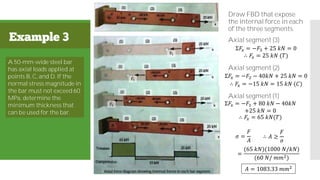
Example 3
Draw FBD that expose
the internal force in each
of the three segments.
Axial segment (3)
Axial segment (2)
Axial segment (1)
𝐴 = 1083.33 𝑚𝑚2
A 50-mm-wide steel bar
has axial loads applied at
points B, C, and D. If the
normal stress magnitude in
the bar must not exceed 60
MPa, determine the
minimum thickness that
can be used for the bar.
Σ𝐹𝑥 = −𝐹3 + 25 𝑘𝑁 = 0
∴ 𝐹3 = 25 𝑘𝑁 (𝑇)
Σ𝐹𝑥 = −𝐹2 − 40𝑘𝑁 + 25 𝑘𝑁 = 0
∴ 𝐹2 = −15 𝑘𝑁 = 15 𝑘𝑁 (𝐶)
Σ𝐹𝑥 = −𝐹1 + 80 𝑘𝑁 − 40𝑘𝑁
+25 𝑘𝑁 = 0
∴ 𝐹1 = 65 𝑘𝑁(𝑇)
𝜎 =
𝐹
𝐴
∴ 𝐴 ≥
𝐹
𝜎
=
(65 𝑘𝑁)(1000 𝑁/𝑘𝑁)
(60 𝑁/ 𝑚𝑚2)
𝑡 𝑚𝑖𝑛 ≥
1083333 𝑚𝑚2
50 𝑚𝑚
𝑡 𝑚𝑖𝑛 = 21.7 mm
F3
F2
Example 4
The homogeneous bar shown is supported by a smooth pin at
C and a cable that runs from A to B around the smooth peg at
D. Find the stress in the cable if its diameter is 0.6 inch and the
bar weighs 6000 lb.
3
5 𝜎 = 1.0458 𝑥 104 𝑝𝑠𝑖 𝑜𝑟
= 10460 𝑝𝑠𝑖
Example 5
Rigid bar ABC is supported by a pin at A and axial member (1),
which has a cross sectional area of 540 mm2. The weight of
rigid bar ABC can be neglected.
Determine the largest
weight W that can be
supported by two wires.
The stress in either wire is
not to exceed 30 ksi. The
cross-sectional areas of
wires AB and AC are 0.4
in2 and 0.5 in2, respectively.
Example 6
For the truss shown,
calculate the stresses in
members CE, DE, and DF.
The cross-sectional area of
each member is
1.8 in2. Indicate tension (T)
or compression (C).
Wrap up!
 Strength of materials is the study of internal effects
caused by external loads on deformable bodies.
 Stress is the strength of internal force. It is a vector
quantity.
 The direction of normal stress is denoted by a sign
(positive tension, negative compression).
 σ = F / A
 The axial force P is perpendicular to cross-sectional
area A.
References
1. Gonzales, Divina R. (n.d.) Simple Stress [Class Handout].
Mechanics of Deformable Bodies, Mapúa Institute of
Technology, Intrauros, Manila.
2. Philpot, Timothy A. (2008). Mechanics of Materials: An
Integrated Learning System. USA: John Wiley & Sons, Inc.
3. Verterra, Romel. (2014). Normal Stresses. Retrieved from
http://www.mathalino.com/reviewer/mechanics-and-
strength-of-materials/normal-stresses
Download
this
presentation!
On slideshare:
www.slideshare.net/ellekaie
On onedrive:
http://tinyurl.com/mec32-a1-
grp1-simplestress

Simple Stress: Normal Stress

  • 1.
    Mechanics of Deformable Bodies MapúaInstitute of Technology MEC32/A1 Group 1 4Q 2014 MAGBOJOS, Redentor V. ; RIGOR, Lady Krista V. ; SALIDO, Lisette S.
  • 2.
    Major Divisions of Mechanics 1. Mechanicsof Rigid Bodies • Engineering mechanics • Study of external forces and motions with particles and rigid bodies • rigid body does not change in size and shape after applying a force • Statics and dynamics 2. Mechanics of Deformable Bodies • Strength of materials • Study of internal effects caused by external loads on deformable bodies • deformable body can stretch, bend, or twist 3. Mechanics of Fluids  Hydraulics
  • 3.
    Importance of studying internal effects on objects SAFEAND SUCCESSFUL DESIGN Strength, Stiffness, Stability
  • 4.
    Simple Stress: Normal Stress MapúaInstitute of Technology MEC32/A1 Group 1 4Q 2014 MAGBOJOS, Redentor V. ; RIGOR, Lady Krista V. ; SALIDO, Lisette S.
  • 6.
    Stress Stress  Intensity ofinternal force  Unit strength of body  Vector quantity (magnitude + direction)  Force per unit area to structural members that are subjected to external forces  Describes and predicts the elastic deformation of a body Simple Stress 1. Normal stress • Tensile • Compressive 2. Shearing stress 3. Bearing stress 𝑆𝑡𝑟𝑒𝑠𝑠 = 𝐹𝑜𝑟𝑐𝑒 𝐴𝑟𝑒𝑎 𝑃𝑎 = 𝑁 𝑚2 ; 𝑝𝑠𝑖; 𝑑𝑦𝑛 𝑐𝑚2 ; 𝑘𝑖𝑝𝑠
  • 7.
    Normal stress under axial loading  Faxial force  Passing through the centroid  Force acting perpendicular to the area  A cross sectional area  σ (sigma) normal stress  Positive tension (elongate)  Negative compression (shorten) 𝝈 = 𝑭 𝑨
  • 8.
    Example 1 -diameter steelhanger rod is used to hold up one end of a walkway support beam. The force carried by the rod is 5000 lb. Determine the normal stress in the rod. (Disregard the weight of the rod.) Cross-section of rod: Normal stress in the rod: 𝐴 = 𝜋 4 𝑑2 = 𝜋 4 (0.5 𝑖𝑛)2= 0.1964 𝑖𝑛2 𝜎 = 𝐹 𝐴 = 5000 𝑙𝑏 0.196 𝑖𝑛2 = 25458.25 𝑝𝑠𝑖 𝜎= 25458.25 𝑝𝑠𝑖 ≈ 25500 𝑝𝑠𝑖 Walkway support beam Hanger rod
  • 9.
    Example 2 Rigid barABC is supported by a pin at A and axial member (1), which has a cross sectional area of 540 mm2. The weight of rigid bar ABC can be neglected. (a) 𝜎1 = 𝐹1 𝐴1 = (11 𝑘𝑁)(1000 𝑁 𝑘𝑁 ) 540 𝑚𝑚2 = 20.37 𝑁/ 𝑚𝑚2 𝜎1 = 20.4 𝑀𝑃𝑎 (a) Determine the normal stress in member (1) if a load of P = 8 kN is applied at C. Σ𝑀𝐴 = 8 𝑘𝑁 2.2 𝑚 − 1.6 𝑚 𝐹1 = 0 ∴ 𝐹1 = 11 𝑘𝑁
  • 10.
    Example 2 Rigid barABC is supported by a pin at A and axial member (1), which has a cross sectional area of 540 mm2. The weight of rigid bar ABC can be neglected. (b) 𝑃 = 19.64 𝑘𝑁 (b) If the maximum normal stress in member (1) must be limited to 50 MPa, what is the maximum load magnitude P that may be applied to the rigid bar at C? Σ𝑀𝐴 = 2.2 𝑚 𝑃 − (1.6 𝑚)(27 𝑘𝑁) ∴ 𝐹1 = 𝜎1 𝐴1 = 50 𝑀𝑃𝑎 540 𝑚𝑚2 = 50 𝑁/ 𝑚𝑚2 540 𝑚𝑚2 = 27000 N = 27 kN
  • 11.
    Example 3 Draw FBDthat expose the internal force in each of the three segments. Axial segment (3) Axial segment (2) Axial segment (1) 𝐴 = 1083.33 𝑚𝑚2 A 50-mm-wide steel bar has axial loads applied at points B, C, and D. If the normal stress magnitude in the bar must not exceed 60 MPa, determine the minimum thickness that can be used for the bar. Σ𝐹𝑥 = −𝐹3 + 25 𝑘𝑁 = 0 ∴ 𝐹3 = 25 𝑘𝑁 (𝑇) Σ𝐹𝑥 = −𝐹2 − 40𝑘𝑁 + 25 𝑘𝑁 = 0 ∴ 𝐹2 = −15 𝑘𝑁 = 15 𝑘𝑁 (𝐶) Σ𝐹𝑥 = −𝐹1 + 80 𝑘𝑁 − 40𝑘𝑁 +25 𝑘𝑁 = 0 ∴ 𝐹1 = 65 𝑘𝑁(𝑇) 𝜎 = 𝐹 𝐴 ∴ 𝐴 ≥ 𝐹 𝜎 = (65 𝑘𝑁)(1000 𝑁/𝑘𝑁) (60 𝑁/ 𝑚𝑚2) 𝑡 𝑚𝑖𝑛 ≥ 1083333 𝑚𝑚2 50 𝑚𝑚 𝑡 𝑚𝑖𝑛 = 21.7 mm F3 F2
  • 12.
    Example 4 The homogeneousbar shown is supported by a smooth pin at C and a cable that runs from A to B around the smooth peg at D. Find the stress in the cable if its diameter is 0.6 inch and the bar weighs 6000 lb. 3 5 𝜎 = 1.0458 𝑥 104 𝑝𝑠𝑖 𝑜𝑟 = 10460 𝑝𝑠𝑖
  • 13.
    Example 5 Rigid barABC is supported by a pin at A and axial member (1), which has a cross sectional area of 540 mm2. The weight of rigid bar ABC can be neglected. Determine the largest weight W that can be supported by two wires. The stress in either wire is not to exceed 30 ksi. The cross-sectional areas of wires AB and AC are 0.4 in2 and 0.5 in2, respectively.
  • 14.
    Example 6 For thetruss shown, calculate the stresses in members CE, DE, and DF. The cross-sectional area of each member is 1.8 in2. Indicate tension (T) or compression (C).
  • 15.
    Wrap up!  Strengthof materials is the study of internal effects caused by external loads on deformable bodies.  Stress is the strength of internal force. It is a vector quantity.  The direction of normal stress is denoted by a sign (positive tension, negative compression).  σ = F / A  The axial force P is perpendicular to cross-sectional area A.
  • 16.
    References 1. Gonzales, DivinaR. (n.d.) Simple Stress [Class Handout]. Mechanics of Deformable Bodies, Mapúa Institute of Technology, Intrauros, Manila. 2. Philpot, Timothy A. (2008). Mechanics of Materials: An Integrated Learning System. USA: John Wiley & Sons, Inc. 3. Verterra, Romel. (2014). Normal Stresses. Retrieved from http://www.mathalino.com/reviewer/mechanics-and- strength-of-materials/normal-stresses
  • 17.