11/29/2013
1
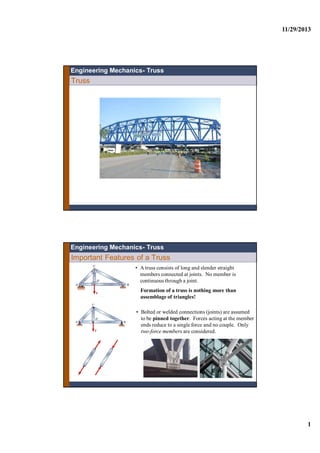
Truss
Engineering Mechanics- Truss
Important Features of a Truss
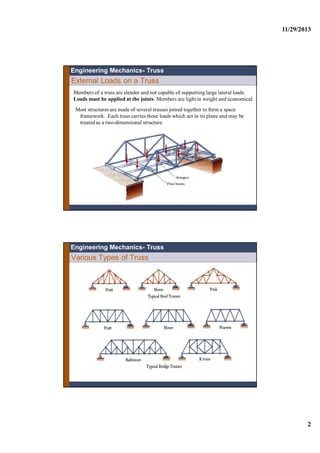
• A truss consists of long and slender straight
members connected at joints. No member is
continuous through a joint.
• Bolted or welded connections (joints) are assumed
to be pinned together. Forces acting at the member
ends reduce to a single force and no couple. Only
two-force members are considered.
Engineering Mechanics- Truss
Formation of a truss is nothing more than
assemblage of triangles!
11/29/2013
2
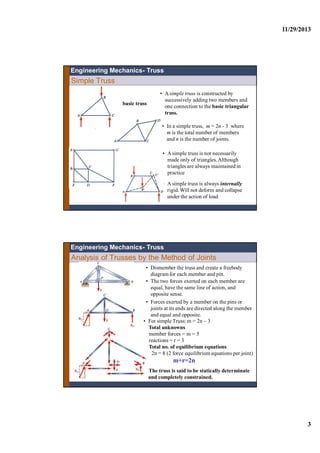
External Loads on a Truss
Members of a truss are slender and not capable of supporting large lateral loads.
Loads must be applied at the joints. Members are light in weight and economical.
Engineering Mechanics- Truss
Most structures are made of several trusses joined together to form a space
framework. Each truss carries those loads which act in its plane and may be
treated as a two-dimensional structure.
Various Types of Truss
Engineering Mechanics- Truss
11/29/2013
3
Simple Truss
• A simple truss is constructed by
successively adding two members and
one connection to the basic triangular
truss.
• A simple truss is not necessarily
made only of triangles.Although
triangles are always maintained in
practice
Engineering Mechanics- Truss
• In a simple truss, m = 2n - 3 where
m is the total number of members
and n is the number of joints.
basic truss
• A simple truss is always internally
rigid. Will not deform and collapse
under the action of load
Analysis of Trusses by the Method of Joints
• Dismember the truss and create a freebody
diagram for each member and pin.
• The two forces exerted on each member are
equal, have the same line of action, and
opposite sense.
• Forces exerted by a member on the pins or
joints at its ends are directed along the member
and equal and opposite.
• For simple Truss: m = 2n – 3
Total unknowns
member forces = m = 5
reactions = r = 3
Total no. of equilibrium equations
2n = 8 (2 force equilibrium equations per joint)
m+r=2n
The truss is said to be statically determinate
and completely constrained.
Engineering Mechanics- Truss
11/29/2013
4
Analysis of Trusses by the Method of Joints
Engineering Mechanics- Truss
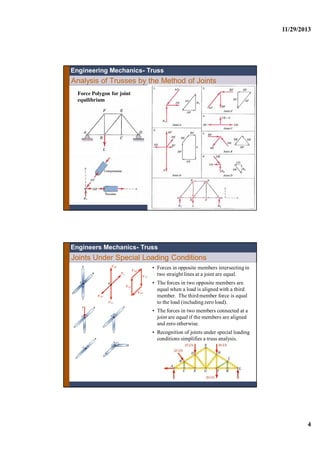
Force Polygon for joint
equilibrium
Joints Under Special Loading Conditions
• Forces in opposite members intersectingin
two straight lines at a joint are equal.
• The forces in two opposite members are
equal when a load is aligned with a third
member. The thirdmember force is equal
to the load (includingzero load).
• The forces in two members connected at a
joint are equal if the members are aligned
and zero otherwise.
• Recognition of joints under special loading
conditions simplifies a truss analysis.
Engineers Mechanics- Truss
11/29/2013
5
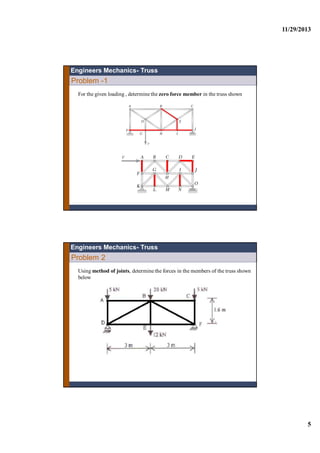
Problem -1
For the given loading , determine the zero force member in the truss shown
Engineers Mechanics- Truss
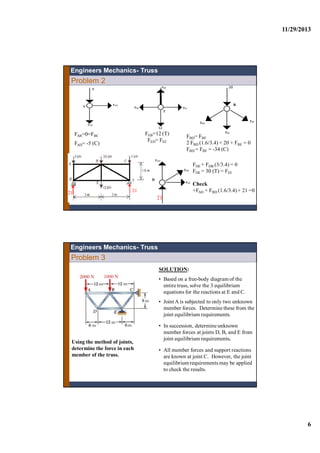
Problem 2
Using method of joints, determine the forces in the members of the truss shown
below
Engineers Mechanics- Truss
11/29/2013
6
Problem 2
Engineers Mechanics- Truss
FAB=0=FBC
FAD= -5 (C)
FBD= FBF
2 FBD (1.6/3.4) + 20 + FBE = 0
FBD = FBF = -34 (C)
B
FEB=12 (T)
FED= FEF
D
FDE + FDB (3/3.4) = 0
FDE = 30 (T) = FEF
Check
+FAD + FBD (1.6/3.4) + 21 =0
21
2121
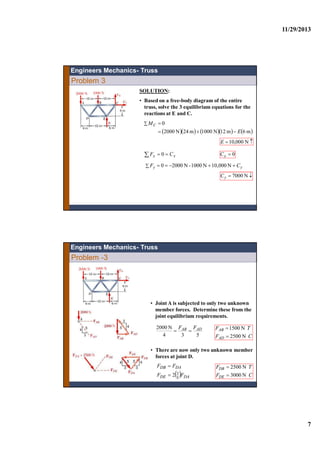
Problem 3
Using the method of joints,
determine the force in each
member of the truss.
SOLUTION:
• Based on a free-body diagram of the
entire truss, solve the 3 equilibrium
equations for the reactions at E and C.
• JointA is subjected to only two unknown
member forces. Determine these from the
joint equilibrium requirements.
• In succession, determine unknown
member forces at joints D, B, and E from
joint equilibrium requirements.
• All member forces and support reactions
are known at joint C. However, the joint
equilibriumrequirements may be applied
to check the results.
Engineers Mechanics- Truss
11/29/2013
7
Problem 3
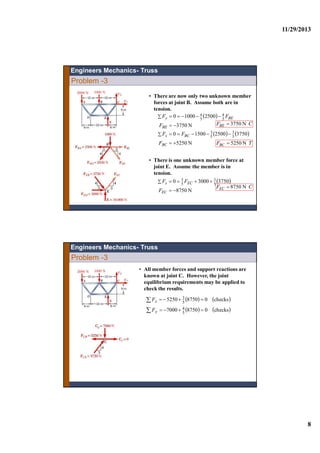
SOLUTION:
• Based on a free-body diagram of the entire
truss, solve the 3 equilibrium equations for the
reactions at E and C.
       m6m12N1000m24N2000
0
E
MC


 N000,10E
  xx CF 0 0xC
  yy CF N10,000N1000-N20000
 N7000yC
Engineers Mechanics- Truss
Problem -3
• Joint A is subjected to only two unknown
member forces. Determine these from the
joint equilibrium requirements.
534
N2000 ADAB FF

CF
TF
AD
AB
N2500
N1500


• There are now only two unknown member
forces at joint D.
  DADE
DADB
FF
FF
5
32

CF
TF
DE
DB
N3000
N2500


Engineers Mechanics- Truss
11/29/2013
8
• There are now only two unknown member
forces at joint B. Assume both are in
tension.
 
N3750
250010000 5
4
5
4


BE
BEy
F
FF
CFBE N3750
   
N5250
3750250015000 5
3
5
3


BC
BCx
F
FF
TFBC N5250
• There is one unknown member force at
joint E. Assume the member is in
tension.
 
N8750
375030000 5
3
5
3


EC
ECx
F
FF
CFEC N8750
Engineers Mechanics- Truss
Problem -3
• All member forces and support reactions are
known at joint C. However, the joint
equilibrium requirements may be applied to
check the results.
   
   checks087507000
checks087505250
5
4
5
3




y
x
F
F
Problem -3
Engineers Mechanics- Truss
11/29/2013
9
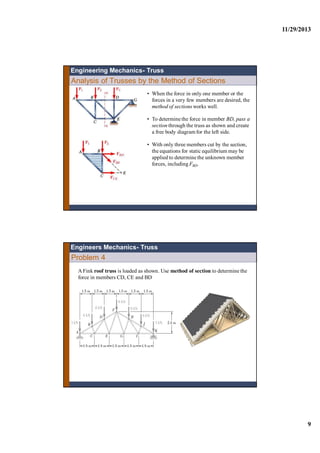
Analysis of Trusses by the Method of Sections
• When the force in only one member or the
forces in a very few members are desired, the
method of sections works well.
• To determine the force in member BD, pass a
section through the truss as shown and create
a free body diagramfor the left side.
• With only three members cut by the section,
the equations for static equilibrium may be
applied to determine the unknown member
forces, including FBD.
Engineering Mechanics- Truss
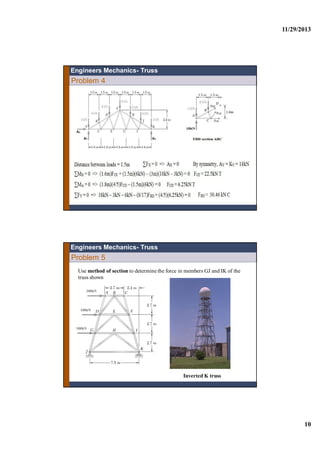
Problem 4
A Fink roof truss is loaded as shown. Use method of section to determine the
force in members CD, CE and BD
Engineers Mechanics- Truss
11/29/2013
10
Problem 4
Engineers Mechanics- Truss
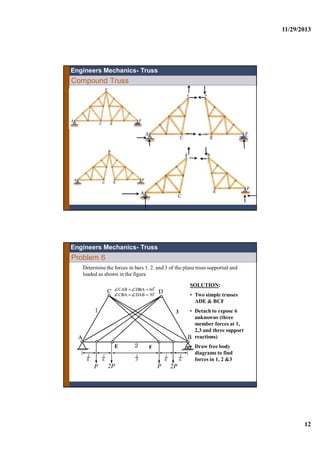
Problem 5
Use method of section to determine the force in members GJ and IK of the
truss shown
Engineers Mechanics- Truss
100kN
100kN
100kN
Inverted K truss
11/29/2013
11
Problem-5
Engineers Mechanics- Truss
100kN
100kN
100kN
G
Solution JX = -300
KY = -JY = 100*(2.7 + 5.4 +8.1)/7.5 = 1620/7.5 = 216
Section XX, lower FBD,
∑MG = 0
-FKI [ 5.9( ] + JY(0.8) –JX(2.7) – KY(6.7) = 0
FKI = -143.19 kN (C )
∑MI = 0
FJG[ 5.9 ( ] + JY(6.7) –JX(2.7) – KY(0.8) = 0
FJG = 143.19 kN (T )
Compound Truss
• Compound trusses are composed of two or more
simple trusses . The trusses shown are statically
determinant, rigid, and completely constrained,
nrm 2
Engineers Mechanics- Truss
11/29/2013
12
Engineers Mechanics- Truss
Compound Truss
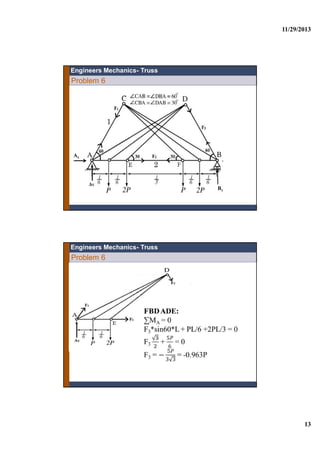
Determine the forces in bars 1. 2. and 3 of the plane truss supported and
loaded as shown in the figure
Problem 6
Engineers Mechanics- Truss
SOLUTION:
• Two simple trusses
ADE & BCF
• Detach to expose 6
unknowns (three
member forces at 1,
2,3 and three support
reactions)
• Draw free body
diagrams to find
forces in 1, 2 &3
E F
3
11/29/2013
13
Problem 6
Engineers Mechanics- Truss
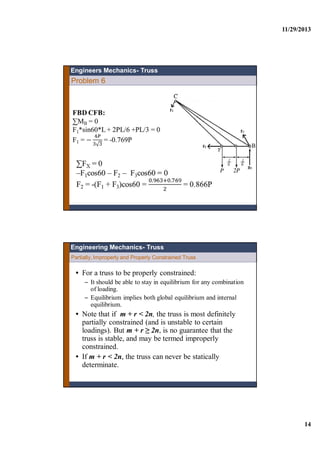
By
Ax
Problem 6
Engineers Mechanics- Truss
11/29/2013
14
Engineers Mechanics- Truss
Problem 6
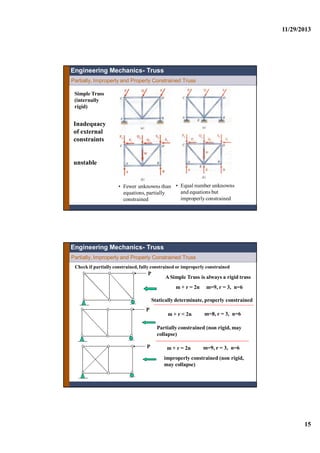
Partially, Improperly and Properly Constrained Truss
Engineering Mechanics- Truss
• For a truss to be properly constrained:
– It should be able to stay in equilibrium for any combination
of loading.
– Equilibrium implies both global equilibrium and internal
equilibrium.
• Note that if m + r < 2n, the truss is most definitely
partially constrained (and is unstable to certain
loadings). But m + r ≥ 2n, is no guarantee that the
truss is stable, and may be termed improperly
constrained.
• If m + r < 2n, the truss can never be statically
determinate.
11/29/2013
15
• Fewer unknowns than
equations, partially
constrained
• Equal number unknowns
and equations but
improperlyconstrained
Partially, Improperly and Properly Constrained Truss
Inadequacy
of external
constraints
unstable
Simple Truss
(internally
rigid)
Engineering Mechanics- Truss
Partially, Improperly and Properly Constrained Truss
Engineering Mechanics- Truss
Check if partially constrained, fully constrained or improperly constrained
P
P
P
Statically determinate, properly constrained
A Simple Truss is always a rigid truss
m + r = 2n m=9, r = 3, n=6
m=9, r = 3, n=6m + r = 2n
improperly constrained (non rigid,
may collapse)
m + r < 2n
Partially constrained (non rigid, may
collapse)
m=8, r = 3, n=6
11/29/2013
16
Engineers Mechanics- Truss
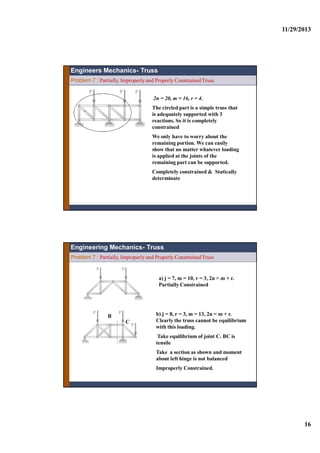
Problem 7 : Partially, Improperly and Properly ConstrainedTruss
`
2n = 20, m = 16, r = 4.
The circled part is a simple truss that
is adequately supported with 3
reactions. So it is completely
constrained
We only have to worry about the
remaining portion. We can easily
show that no matter whatever loading
is applied at the joints of the
remaining part can be supported.
Completely constrained & Statically
determinate
Problem 7 : Partially, Improperly and Properly ConstrainedTruss
Engineering Mechanics- Truss
a) j = 7, m = 10, r = 3, 2n > m + r.
Partially Constrained
b) j = 8, r = 3, m = 13, 2n = m + r.
Clearly the truss cannot be equilibrium
with this loading.
Take equilibrium of joint C. BC is
tensile
Take a section as shown and moment
about left hinge is not balanced
Improperly Constrained.
B
C

Lecture truss [compatibility mode]

  • 1.
    11/29/2013 1 Truss Engineering Mechanics- Truss ImportantFeatures of a Truss • A truss consists of long and slender straight members connected at joints. No member is continuous through a joint. • Bolted or welded connections (joints) are assumed to be pinned together. Forces acting at the member ends reduce to a single force and no couple. Only two-force members are considered. Engineering Mechanics- Truss Formation of a truss is nothing more than assemblage of triangles!
  • 2.
    11/29/2013 2 External Loads ona Truss Members of a truss are slender and not capable of supporting large lateral loads. Loads must be applied at the joints. Members are light in weight and economical. Engineering Mechanics- Truss Most structures are made of several trusses joined together to form a space framework. Each truss carries those loads which act in its plane and may be treated as a two-dimensional structure. Various Types of Truss Engineering Mechanics- Truss
  • 3.
    11/29/2013 3 Simple Truss • Asimple truss is constructed by successively adding two members and one connection to the basic triangular truss. • A simple truss is not necessarily made only of triangles.Although triangles are always maintained in practice Engineering Mechanics- Truss • In a simple truss, m = 2n - 3 where m is the total number of members and n is the number of joints. basic truss • A simple truss is always internally rigid. Will not deform and collapse under the action of load Analysis of Trusses by the Method of Joints • Dismember the truss and create a freebody diagram for each member and pin. • The two forces exerted on each member are equal, have the same line of action, and opposite sense. • Forces exerted by a member on the pins or joints at its ends are directed along the member and equal and opposite. • For simple Truss: m = 2n – 3 Total unknowns member forces = m = 5 reactions = r = 3 Total no. of equilibrium equations 2n = 8 (2 force equilibrium equations per joint) m+r=2n The truss is said to be statically determinate and completely constrained. Engineering Mechanics- Truss
  • 4.
    11/29/2013 4 Analysis of Trussesby the Method of Joints Engineering Mechanics- Truss Force Polygon for joint equilibrium Joints Under Special Loading Conditions • Forces in opposite members intersectingin two straight lines at a joint are equal. • The forces in two opposite members are equal when a load is aligned with a third member. The thirdmember force is equal to the load (includingzero load). • The forces in two members connected at a joint are equal if the members are aligned and zero otherwise. • Recognition of joints under special loading conditions simplifies a truss analysis. Engineers Mechanics- Truss
  • 5.
    11/29/2013 5 Problem -1 For thegiven loading , determine the zero force member in the truss shown Engineers Mechanics- Truss Problem 2 Using method of joints, determine the forces in the members of the truss shown below Engineers Mechanics- Truss
  • 6.
    11/29/2013 6 Problem 2 Engineers Mechanics-Truss FAB=0=FBC FAD= -5 (C) FBD= FBF 2 FBD (1.6/3.4) + 20 + FBE = 0 FBD = FBF = -34 (C) B FEB=12 (T) FED= FEF D FDE + FDB (3/3.4) = 0 FDE = 30 (T) = FEF Check +FAD + FBD (1.6/3.4) + 21 =0 21 2121 Problem 3 Using the method of joints, determine the force in each member of the truss. SOLUTION: • Based on a free-body diagram of the entire truss, solve the 3 equilibrium equations for the reactions at E and C. • JointA is subjected to only two unknown member forces. Determine these from the joint equilibrium requirements. • In succession, determine unknown member forces at joints D, B, and E from joint equilibrium requirements. • All member forces and support reactions are known at joint C. However, the joint equilibriumrequirements may be applied to check the results. Engineers Mechanics- Truss
  • 7.
    11/29/2013 7 Problem 3 SOLUTION: • Basedon a free-body diagram of the entire truss, solve the 3 equilibrium equations for the reactions at E and C.        m6m12N1000m24N2000 0 E MC    N000,10E   xx CF 0 0xC   yy CF N10,000N1000-N20000  N7000yC Engineers Mechanics- Truss Problem -3 • Joint A is subjected to only two unknown member forces. Determine these from the joint equilibrium requirements. 534 N2000 ADAB FF  CF TF AD AB N2500 N1500   • There are now only two unknown member forces at joint D.   DADE DADB FF FF 5 32  CF TF DE DB N3000 N2500   Engineers Mechanics- Truss
  • 8.
    11/29/2013 8 • There arenow only two unknown member forces at joint B. Assume both are in tension.   N3750 250010000 5 4 5 4   BE BEy F FF CFBE N3750     N5250 3750250015000 5 3 5 3   BC BCx F FF TFBC N5250 • There is one unknown member force at joint E. Assume the member is in tension.   N8750 375030000 5 3 5 3   EC ECx F FF CFEC N8750 Engineers Mechanics- Truss Problem -3 • All member forces and support reactions are known at joint C. However, the joint equilibrium requirements may be applied to check the results.        checks087507000 checks087505250 5 4 5 3     y x F F Problem -3 Engineers Mechanics- Truss
  • 9.
    11/29/2013 9 Analysis of Trussesby the Method of Sections • When the force in only one member or the forces in a very few members are desired, the method of sections works well. • To determine the force in member BD, pass a section through the truss as shown and create a free body diagramfor the left side. • With only three members cut by the section, the equations for static equilibrium may be applied to determine the unknown member forces, including FBD. Engineering Mechanics- Truss Problem 4 A Fink roof truss is loaded as shown. Use method of section to determine the force in members CD, CE and BD Engineers Mechanics- Truss
  • 10.
    11/29/2013 10 Problem 4 Engineers Mechanics-Truss Problem 5 Use method of section to determine the force in members GJ and IK of the truss shown Engineers Mechanics- Truss 100kN 100kN 100kN Inverted K truss
  • 11.
    11/29/2013 11 Problem-5 Engineers Mechanics- Truss 100kN 100kN 100kN G SolutionJX = -300 KY = -JY = 100*(2.7 + 5.4 +8.1)/7.5 = 1620/7.5 = 216 Section XX, lower FBD, ∑MG = 0 -FKI [ 5.9( ] + JY(0.8) –JX(2.7) – KY(6.7) = 0 FKI = -143.19 kN (C ) ∑MI = 0 FJG[ 5.9 ( ] + JY(6.7) –JX(2.7) – KY(0.8) = 0 FJG = 143.19 kN (T ) Compound Truss • Compound trusses are composed of two or more simple trusses . The trusses shown are statically determinant, rigid, and completely constrained, nrm 2 Engineers Mechanics- Truss
  • 12.
    11/29/2013 12 Engineers Mechanics- Truss CompoundTruss Determine the forces in bars 1. 2. and 3 of the plane truss supported and loaded as shown in the figure Problem 6 Engineers Mechanics- Truss SOLUTION: • Two simple trusses ADE & BCF • Detach to expose 6 unknowns (three member forces at 1, 2,3 and three support reactions) • Draw free body diagrams to find forces in 1, 2 &3 E F 3
  • 13.
    11/29/2013 13 Problem 6 Engineers Mechanics-Truss By Ax Problem 6 Engineers Mechanics- Truss
  • 14.
    11/29/2013 14 Engineers Mechanics- Truss Problem6 Partially, Improperly and Properly Constrained Truss Engineering Mechanics- Truss • For a truss to be properly constrained: – It should be able to stay in equilibrium for any combination of loading. – Equilibrium implies both global equilibrium and internal equilibrium. • Note that if m + r < 2n, the truss is most definitely partially constrained (and is unstable to certain loadings). But m + r ≥ 2n, is no guarantee that the truss is stable, and may be termed improperly constrained. • If m + r < 2n, the truss can never be statically determinate.
  • 15.
    11/29/2013 15 • Fewer unknownsthan equations, partially constrained • Equal number unknowns and equations but improperlyconstrained Partially, Improperly and Properly Constrained Truss Inadequacy of external constraints unstable Simple Truss (internally rigid) Engineering Mechanics- Truss Partially, Improperly and Properly Constrained Truss Engineering Mechanics- Truss Check if partially constrained, fully constrained or improperly constrained P P P Statically determinate, properly constrained A Simple Truss is always a rigid truss m + r = 2n m=9, r = 3, n=6 m=9, r = 3, n=6m + r = 2n improperly constrained (non rigid, may collapse) m + r < 2n Partially constrained (non rigid, may collapse) m=8, r = 3, n=6
  • 16.
    11/29/2013 16 Engineers Mechanics- Truss Problem7 : Partially, Improperly and Properly ConstrainedTruss ` 2n = 20, m = 16, r = 4. The circled part is a simple truss that is adequately supported with 3 reactions. So it is completely constrained We only have to worry about the remaining portion. We can easily show that no matter whatever loading is applied at the joints of the remaining part can be supported. Completely constrained & Statically determinate Problem 7 : Partially, Improperly and Properly ConstrainedTruss Engineering Mechanics- Truss a) j = 7, m = 10, r = 3, 2n > m + r. Partially Constrained b) j = 8, r = 3, m = 13, 2n = m + r. Clearly the truss cannot be equilibrium with this loading. Take equilibrium of joint C. BC is tensile Take a section as shown and moment about left hinge is not balanced Improperly Constrained. B C