INTERNAL QUALITY ASSURANCE IN LABORATORY
Prepared By :
Dr. Amareswar Reddy
Ms. Sankara subbulakshmi
MS. S.Thanga mariammal
Ms. Kavitha
Mr. Sridhar Natarajan
Mrs. Jeevitha
Ms. Vaishnavi
Ms. Kannagi
Reviewed By :
Dr. Lallu Joseph
Dr. Anuradha Pichumani
Ms. Sudha Srinivasan
Dr. Joseph Fidelis
Dr. Waseem
TEAM MEMBERS
 Dr.Amareswar Reddy
 Ms. Sankara subbulakshmi
 MS. S.Thanga mariammal
 Ms. Kavitha
 Mr. Sridhar Natarajan
 Mrs. Jeevitha
 Ms.Vaishnavi
 Ms. kannagi
INTRODUCTION
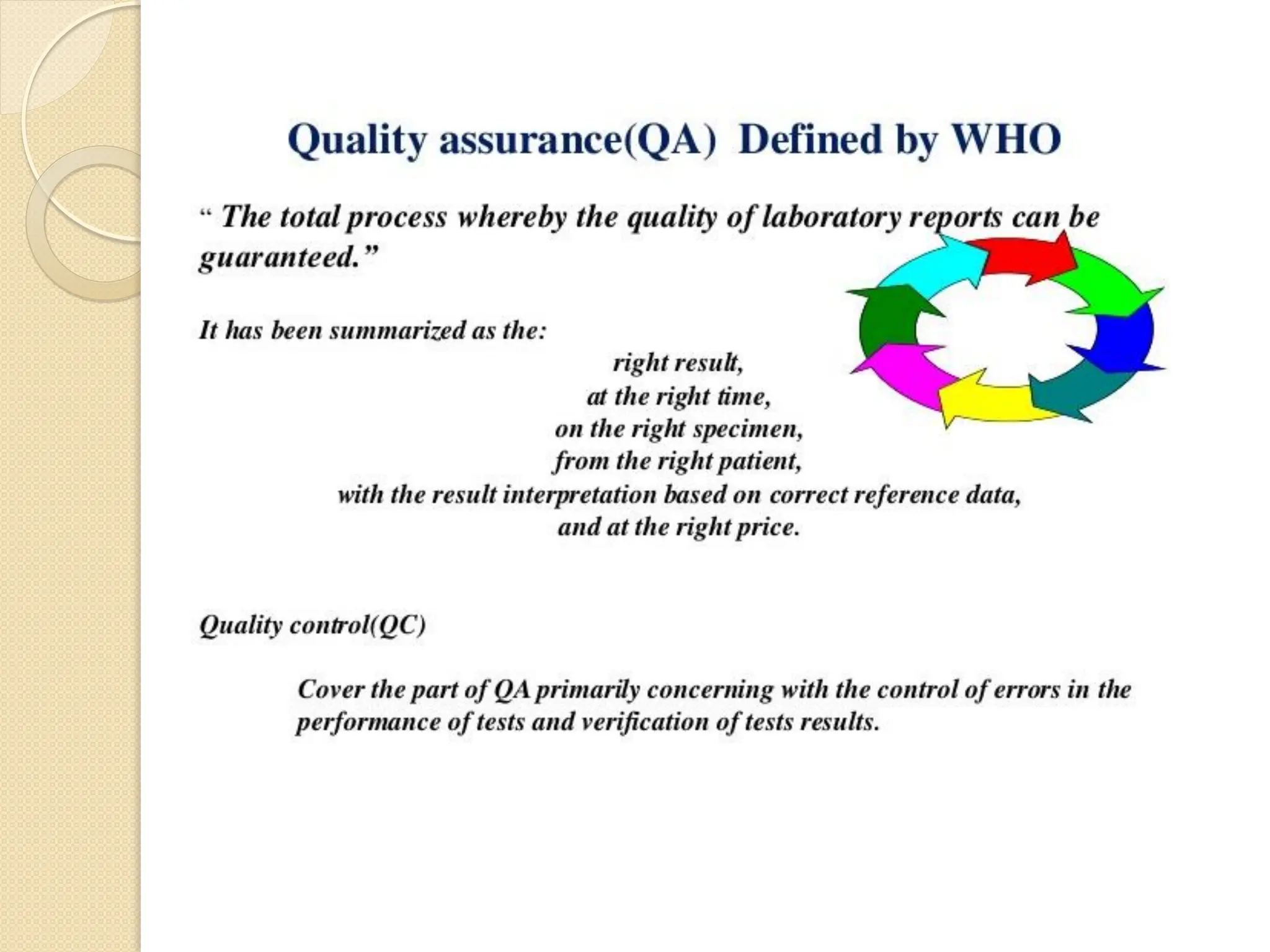
 A quality assurance (QA) programme is the sum
of all activities and procedures undertaken by
medical laboratories to improve the quality and
clinical usefulness of laboratory test results.
 Quality assurance includes training of personnel,
purchase and maintenance of equipment and
reagents, the analytical process itself, and
reporting and interpretation of results.
 The ultimate goal of any quality system is to
obtain test results that are reliable, relevant and
reproducible.
IMPORTANCE
 Quality laboratory services lead to the:
(a) Establishment of an accurate diagnosis in a patient;
(b) Institution of appropriate treatment;
(c) Assessment of prognosis;
(d) Confirmation of successful treatment;
(e) Detection of the source of infection (environmental analysis);
(f) Early diagnosis of an outbreak or epidemic;
(g) Selection of appropriate chemoprophylaxis for individual
patient and community;
(h) Tracing of the spread of infection to control it, and
(i) Identification of the role of environmental factors
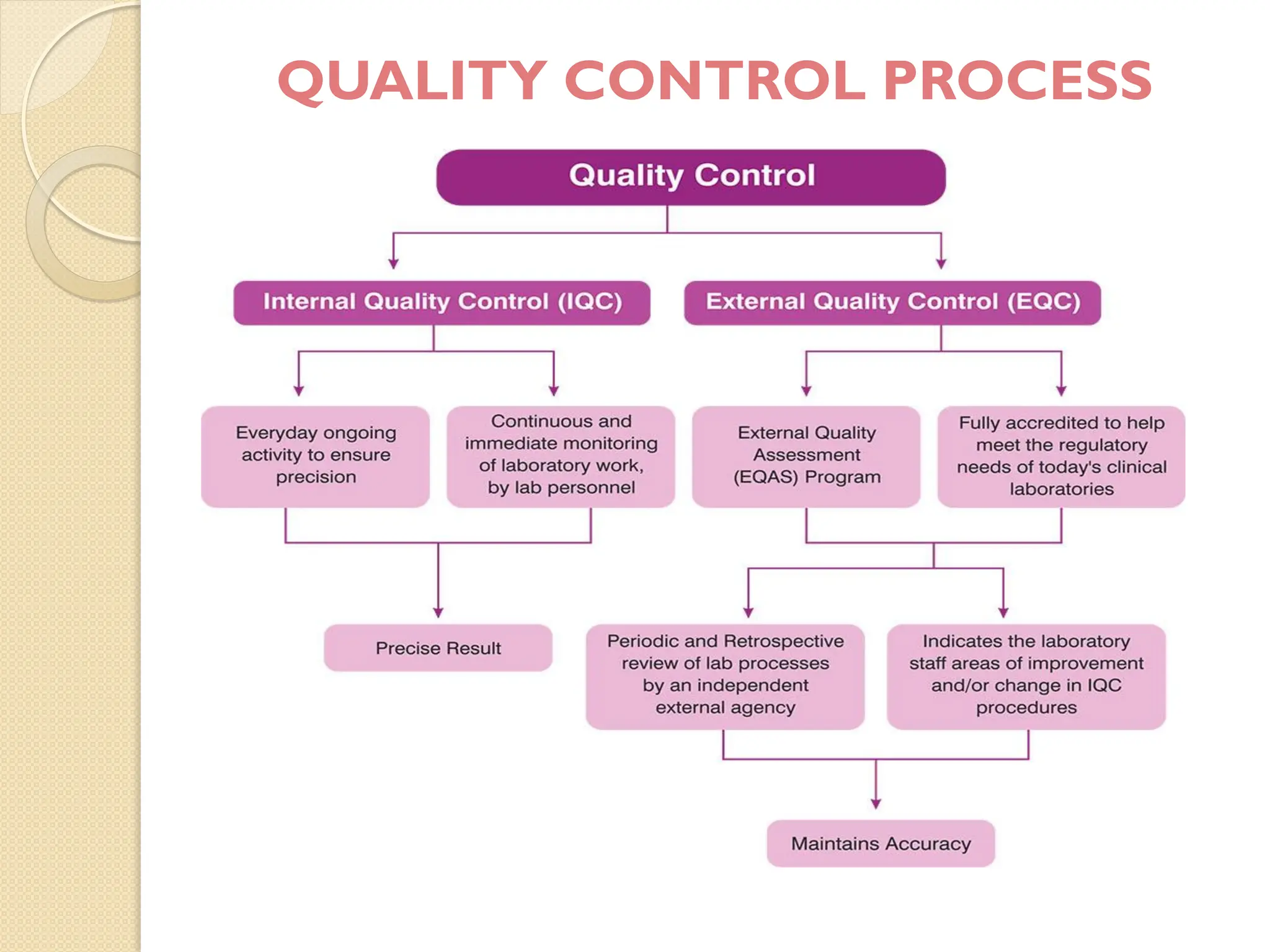
QUALITY CONTROL PROCESS
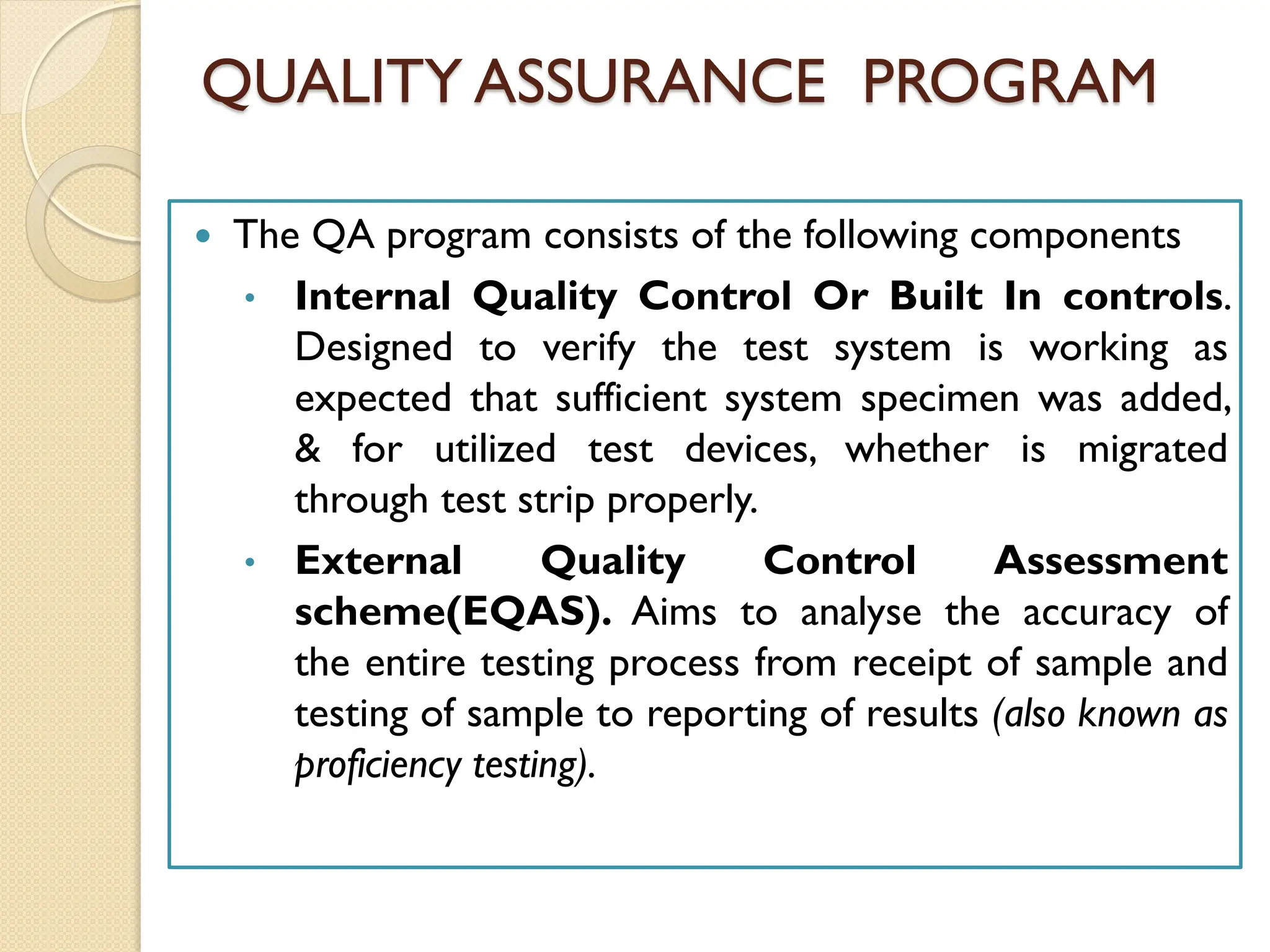
QUALITY ASSURANCE PROGRAM
 The QA program consists of the following components
• Internal Quality Control Or Built In controls.
Designed to verify the test system is working as
expected that sufficient system specimen was added,
& for utilized test devices, whether is migrated
through test strip properly.
• External Quality Control Assessment
scheme(EQAS). Aims to analyse the accuracy of
the entire testing process from receipt of sample and
testing of sample to reporting of results (also known as
proficiency testing).
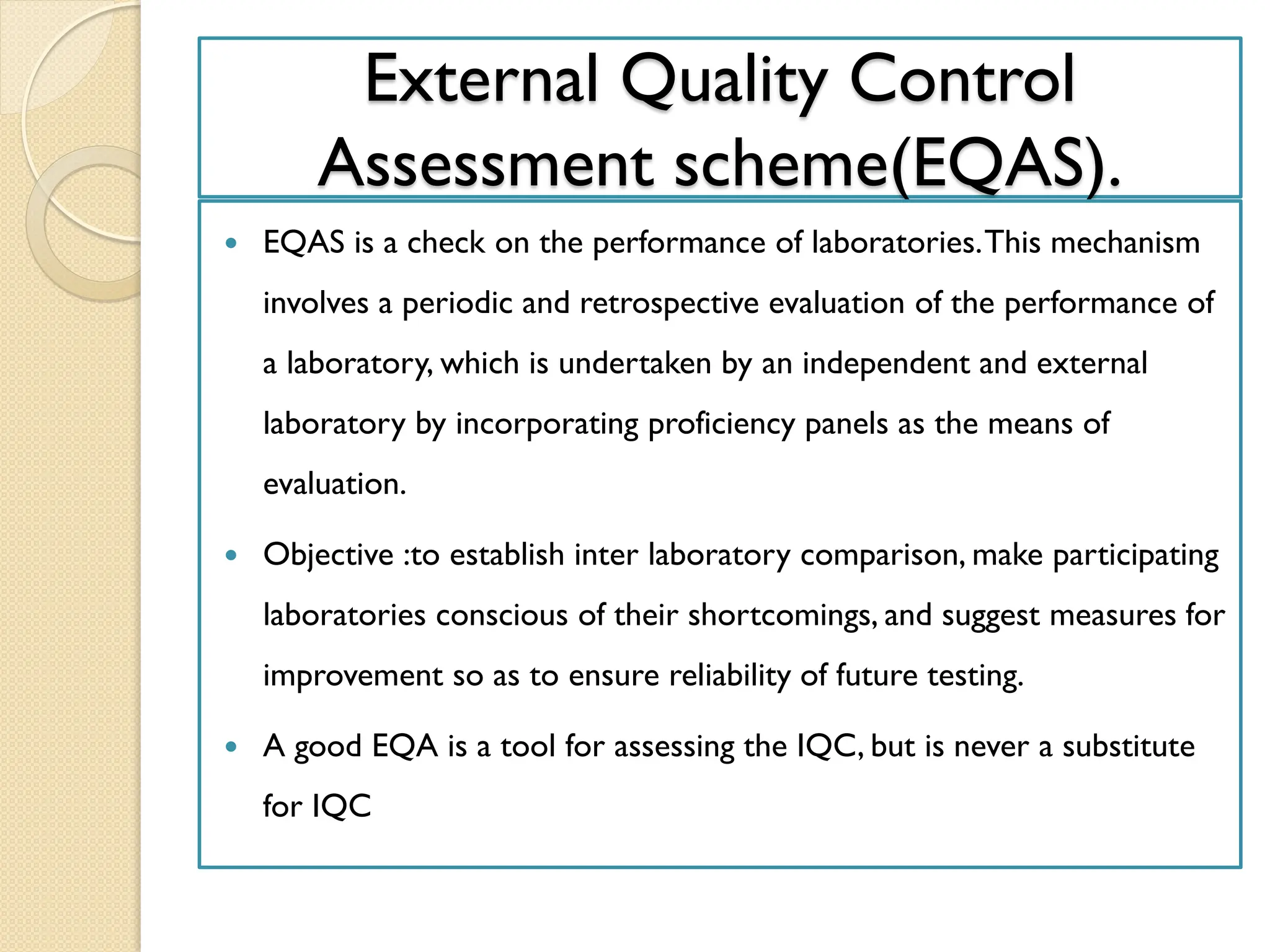
External Quality Control
Assessment scheme(EQAS).
 EQAS is a check on the performance of laboratories.This mechanism
involves a periodic and retrospective evaluation of the performance of
a laboratory, which is undertaken by an independent and external
laboratory by incorporating proficiency panels as the means of
evaluation.
 Objective :to establish inter laboratory comparison, make participating
laboratories conscious of their shortcomings, and suggest measures for
improvement so as to ensure reliability of future testing.
 A good EQA is a tool for assessing the IQC, but is never a substitute
for IQC
IQA STEPS
IQA PROCEDURES
CONTROL MATERIALS
 Controls are substances that contains an established amount of the
substance being tested.
 Controls are tested at the same time and in the same way as patient
samples.
 The purpose of the control is to validate the reliability of the system
and evaluate operator’s performance (Machine) & environmental
conditions that might impact results.
 Control materials may be purchased, obtained from a central or
reference lab.
 QC materials are serum based so standard precautions should be
followed when handling.
 When preparing and storing QC, always adhere manufacturer’s
instructions for reconstitution & storage.
ESTABLISHING VALUE RANGE FOR CONTROL
 Once appropriate control materials are purchased or
prepared, next step is determine the range & acceptable
values.
 This will help the lab to determine if the test run is “In
Control” or “Out of control”.
 Once data collected, the lab have to calculate the mean &
SD of results.
 MEAN – Arithmetic average of results.
 SD – Measurement of variation in a set of results.
GRAPHICAL REPRESENTATION OF CONTROL RANGES
 The distance from the mean is measured in standard deviations.
It is named after S. Levey and E. R. Jennings who in 1950
suggested the use of Shewhart's individuals control chart in the
clinical laboratory. On the x-axis the date and time, or more
usually the number of the control run, are plotted.
 Levey – Jenning Chart can be drawn showing mean value as well
as + or – 1, 2, 3 SD.
In General
 If the value is within + or – 2 SD, the run can be accepted as “IN
CONTROL”.
 Errors that occurs may be either Random or Systemic.
 Accuracy:
 A test method is said to be accurate when it measures what
it is supposed to measure. This means it is able to measure
the true amount or concentration of a substance in a
sample.
 Picture a bull’s-eye target with a dart correctly hitting the
centre ring and you see what an accurate test produces: the
method is capable of hitting the intended target.
 Precision
 A test method is said to be precise when repeated
determinations (analyses) on the same sample give similar
results. When a test method is precise, the amount of
random variation is small. The test method can be trusted
because results are reliably reproduced time after time.
 Root Cause Analysis
• To determine: – What happened – Why it happened –
What to do to prevent it from happening again
• Must be impartial, methodical, information driven
• Include all personnel involved in the error for the
analysis rather than speculate
• Clearly state the purpose is not to assign blame
RANDOM & SYSTEMIC ERRORS
RANDOM
 Variations in QC results that has no pattern.
 Reflects failure in some part of testing system.
 Not likely to reoccur.
SYSTEMIC
 Not acceptable
 Indicates failure in system.
 Should be corrected.
 Shifts & Trend.
SHIFTS & TRENDS
SHIFTS
 When the control is on the same side of the mean for five
consecutive runs.
SYSTEMIC
 When the control is moving in one direction and appears
to be heading towards out of control value.
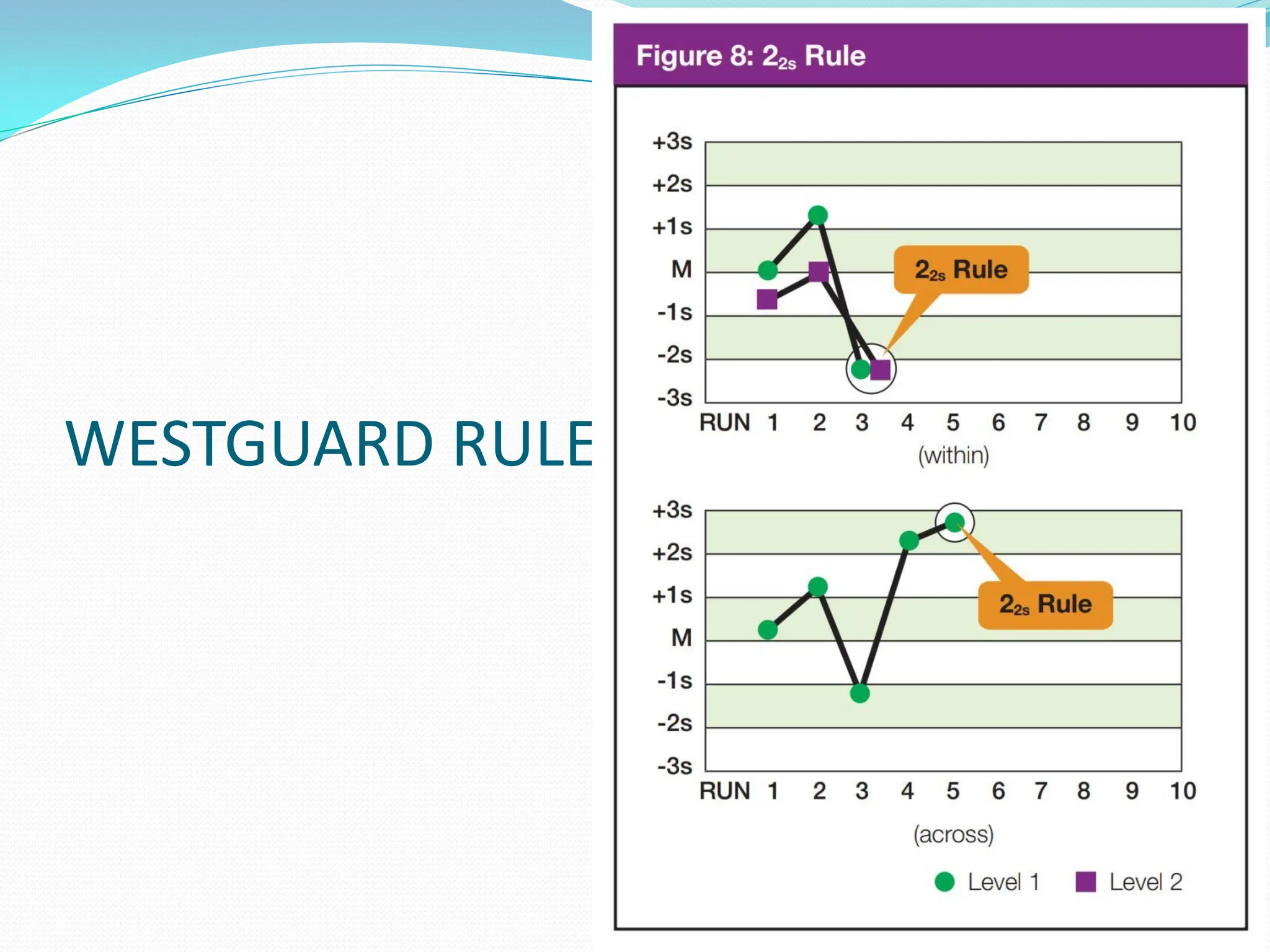
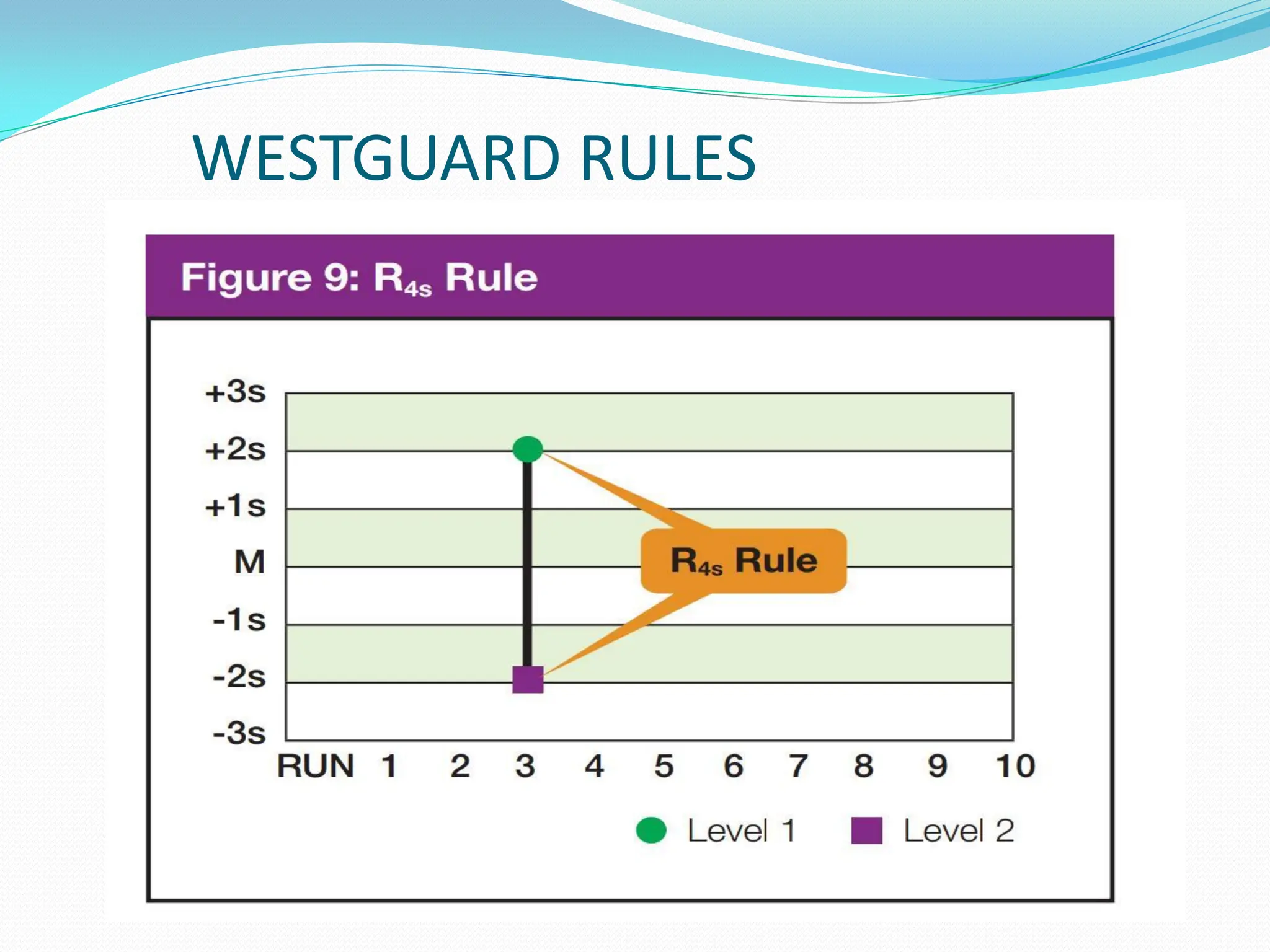
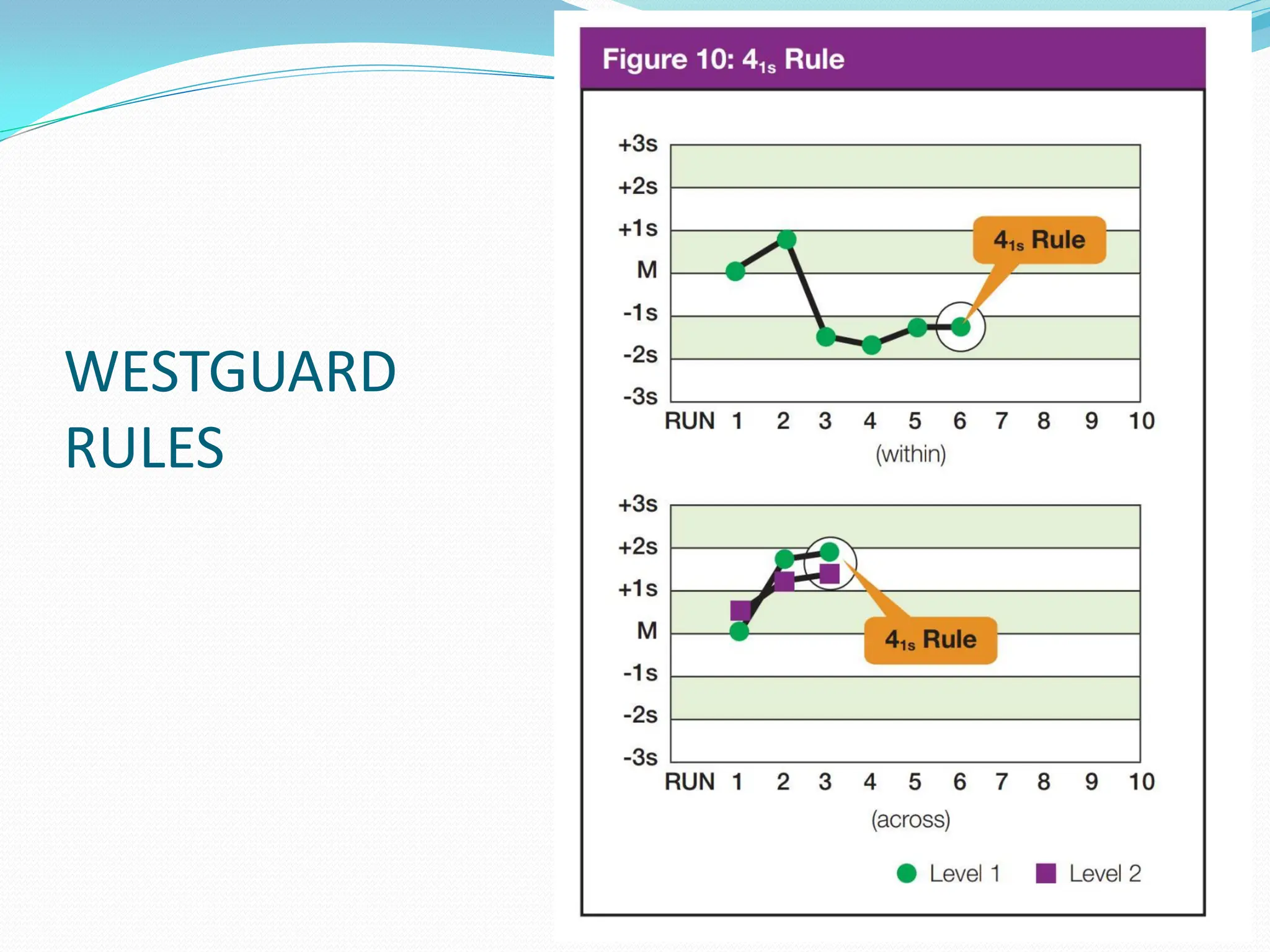
WESTGUARD RULES
WESTGUARD RULES
WESTGUARD RULES
WESTGUARD
RULES
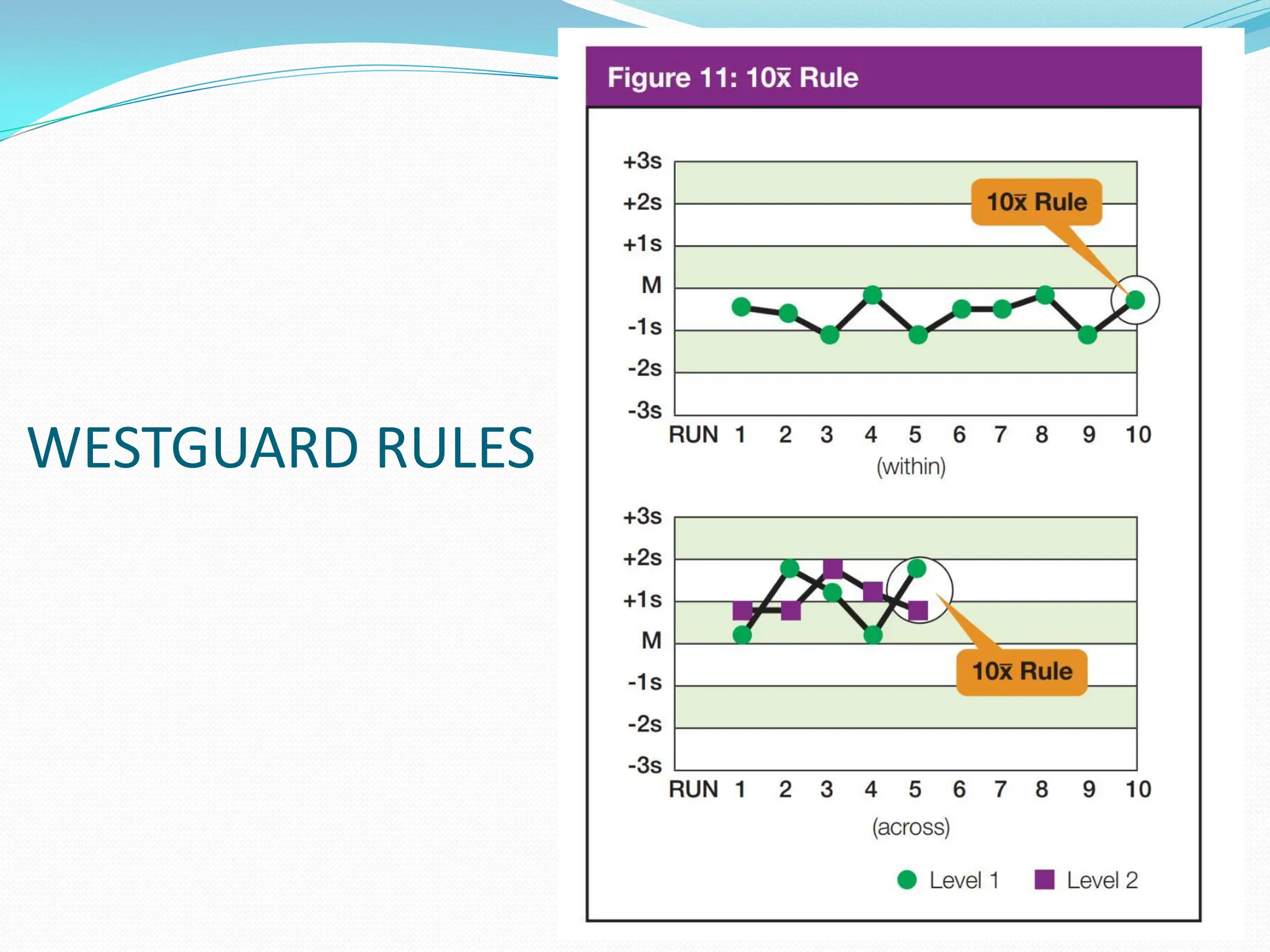
WESTGUARD RULES
Group 2 - Internal Quality Assurance In Laboratory.pdf

Group 2 - Internal Quality Assurance In Laboratory.pdf

  • 1.
    INTERNAL QUALITY ASSURANCEIN LABORATORY Prepared By : Dr. Amareswar Reddy Ms. Sankara subbulakshmi MS. S.Thanga mariammal Ms. Kavitha Mr. Sridhar Natarajan Mrs. Jeevitha Ms. Vaishnavi Ms. Kannagi Reviewed By : Dr. Lallu Joseph Dr. Anuradha Pichumani Ms. Sudha Srinivasan Dr. Joseph Fidelis Dr. Waseem
  • 2.
    TEAM MEMBERS  Dr.AmareswarReddy  Ms. Sankara subbulakshmi  MS. S.Thanga mariammal  Ms. Kavitha  Mr. Sridhar Natarajan  Mrs. Jeevitha  Ms.Vaishnavi  Ms. kannagi
  • 3.
    INTRODUCTION  A qualityassurance (QA) programme is the sum of all activities and procedures undertaken by medical laboratories to improve the quality and clinical usefulness of laboratory test results.  Quality assurance includes training of personnel, purchase and maintenance of equipment and reagents, the analytical process itself, and reporting and interpretation of results.  The ultimate goal of any quality system is to obtain test results that are reliable, relevant and reproducible.
  • 5.
    IMPORTANCE  Quality laboratoryservices lead to the: (a) Establishment of an accurate diagnosis in a patient; (b) Institution of appropriate treatment; (c) Assessment of prognosis; (d) Confirmation of successful treatment; (e) Detection of the source of infection (environmental analysis); (f) Early diagnosis of an outbreak or epidemic; (g) Selection of appropriate chemoprophylaxis for individual patient and community; (h) Tracing of the spread of infection to control it, and (i) Identification of the role of environmental factors
  • 6.
  • 7.
    QUALITY ASSURANCE PROGRAM The QA program consists of the following components • Internal Quality Control Or Built In controls. Designed to verify the test system is working as expected that sufficient system specimen was added, & for utilized test devices, whether is migrated through test strip properly. • External Quality Control Assessment scheme(EQAS). Aims to analyse the accuracy of the entire testing process from receipt of sample and testing of sample to reporting of results (also known as proficiency testing).
  • 8.
    External Quality Control Assessmentscheme(EQAS).  EQAS is a check on the performance of laboratories.This mechanism involves a periodic and retrospective evaluation of the performance of a laboratory, which is undertaken by an independent and external laboratory by incorporating proficiency panels as the means of evaluation.  Objective :to establish inter laboratory comparison, make participating laboratories conscious of their shortcomings, and suggest measures for improvement so as to ensure reliability of future testing.  A good EQA is a tool for assessing the IQC, but is never a substitute for IQC
  • 9.
  • 10.
  • 11.
    CONTROL MATERIALS  Controlsare substances that contains an established amount of the substance being tested.  Controls are tested at the same time and in the same way as patient samples.  The purpose of the control is to validate the reliability of the system and evaluate operator’s performance (Machine) & environmental conditions that might impact results.  Control materials may be purchased, obtained from a central or reference lab.  QC materials are serum based so standard precautions should be followed when handling.  When preparing and storing QC, always adhere manufacturer’s instructions for reconstitution & storage.
  • 12.
    ESTABLISHING VALUE RANGEFOR CONTROL  Once appropriate control materials are purchased or prepared, next step is determine the range & acceptable values.  This will help the lab to determine if the test run is “In Control” or “Out of control”.  Once data collected, the lab have to calculate the mean & SD of results.  MEAN – Arithmetic average of results.  SD – Measurement of variation in a set of results.
  • 13.
    GRAPHICAL REPRESENTATION OFCONTROL RANGES  The distance from the mean is measured in standard deviations. It is named after S. Levey and E. R. Jennings who in 1950 suggested the use of Shewhart's individuals control chart in the clinical laboratory. On the x-axis the date and time, or more usually the number of the control run, are plotted.  Levey – Jenning Chart can be drawn showing mean value as well as + or – 1, 2, 3 SD. In General  If the value is within + or – 2 SD, the run can be accepted as “IN CONTROL”.  Errors that occurs may be either Random or Systemic.
  • 14.
     Accuracy:  Atest method is said to be accurate when it measures what it is supposed to measure. This means it is able to measure the true amount or concentration of a substance in a sample.  Picture a bull’s-eye target with a dart correctly hitting the centre ring and you see what an accurate test produces: the method is capable of hitting the intended target.  Precision  A test method is said to be precise when repeated determinations (analyses) on the same sample give similar results. When a test method is precise, the amount of random variation is small. The test method can be trusted because results are reliably reproduced time after time.
  • 15.
     Root CauseAnalysis • To determine: – What happened – Why it happened – What to do to prevent it from happening again • Must be impartial, methodical, information driven • Include all personnel involved in the error for the analysis rather than speculate • Clearly state the purpose is not to assign blame
  • 16.
    RANDOM & SYSTEMICERRORS RANDOM  Variations in QC results that has no pattern.  Reflects failure in some part of testing system.  Not likely to reoccur. SYSTEMIC  Not acceptable  Indicates failure in system.  Should be corrected.  Shifts & Trend.
  • 17.
    SHIFTS & TRENDS SHIFTS When the control is on the same side of the mean for five consecutive runs. SYSTEMIC  When the control is moving in one direction and appears to be heading towards out of control value.
  • 18.
  • 19.
  • 20.
  • 21.
  • 22.