QUALITY
MANAGEMENT
IN
LABORATORY
Presented By- Dr. Ayushi Agarwal
Guided By- Dr. Yamini Guttikonda
(18.12.2025)
QUALITY IS……..
A measure of excellence, or
State of being free from defects,
deficiencies, and significant
variations
Invisible when GOOD
Impossible to ignore when
BAD
• Quality Assurance
An
overall management
plan to
guarantee the
integrity of data
(THE SYSTEM)
• Quality Control
A series of
analytical
measurements used
to assess the quality
of the analytical
data (THE TOOLS)
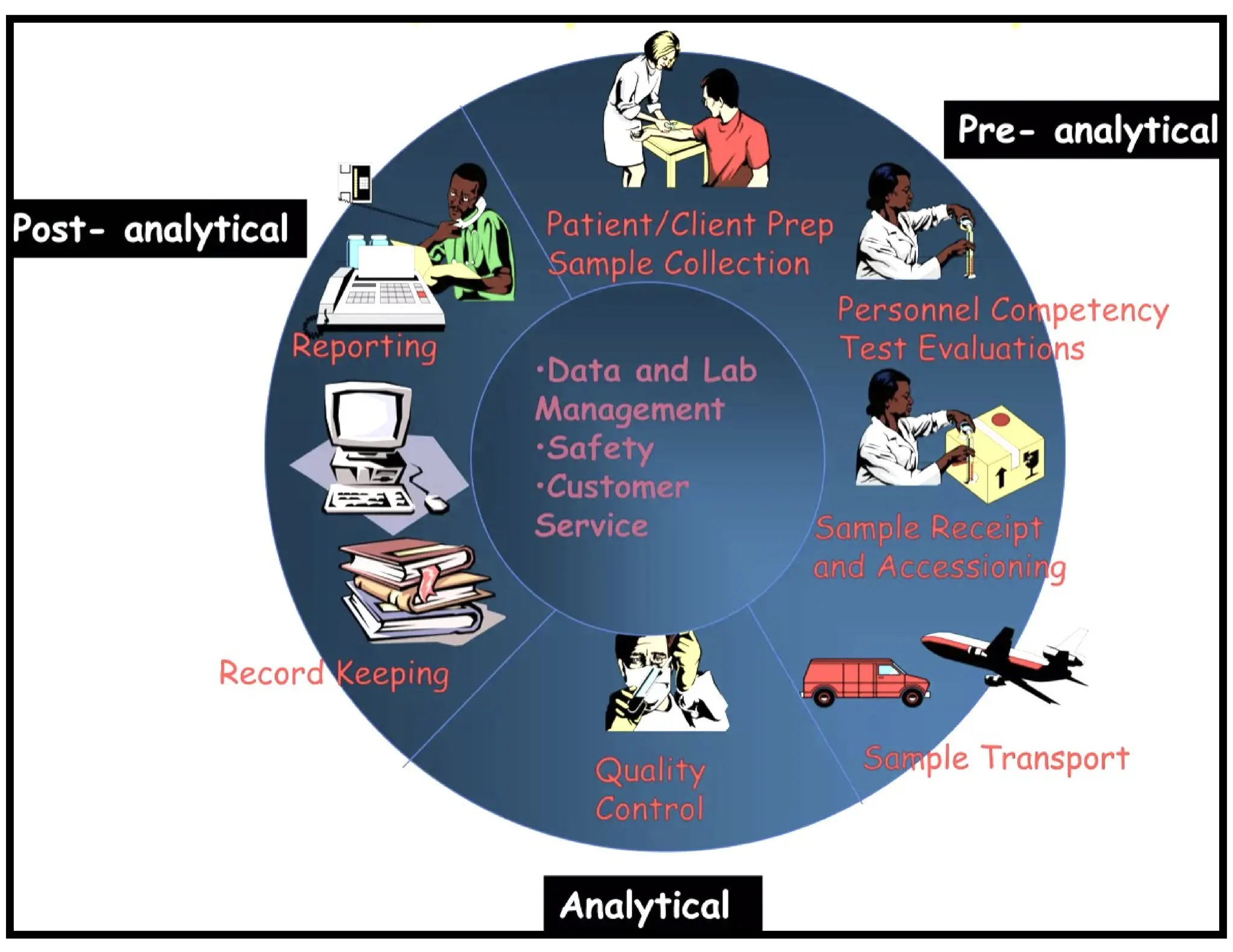
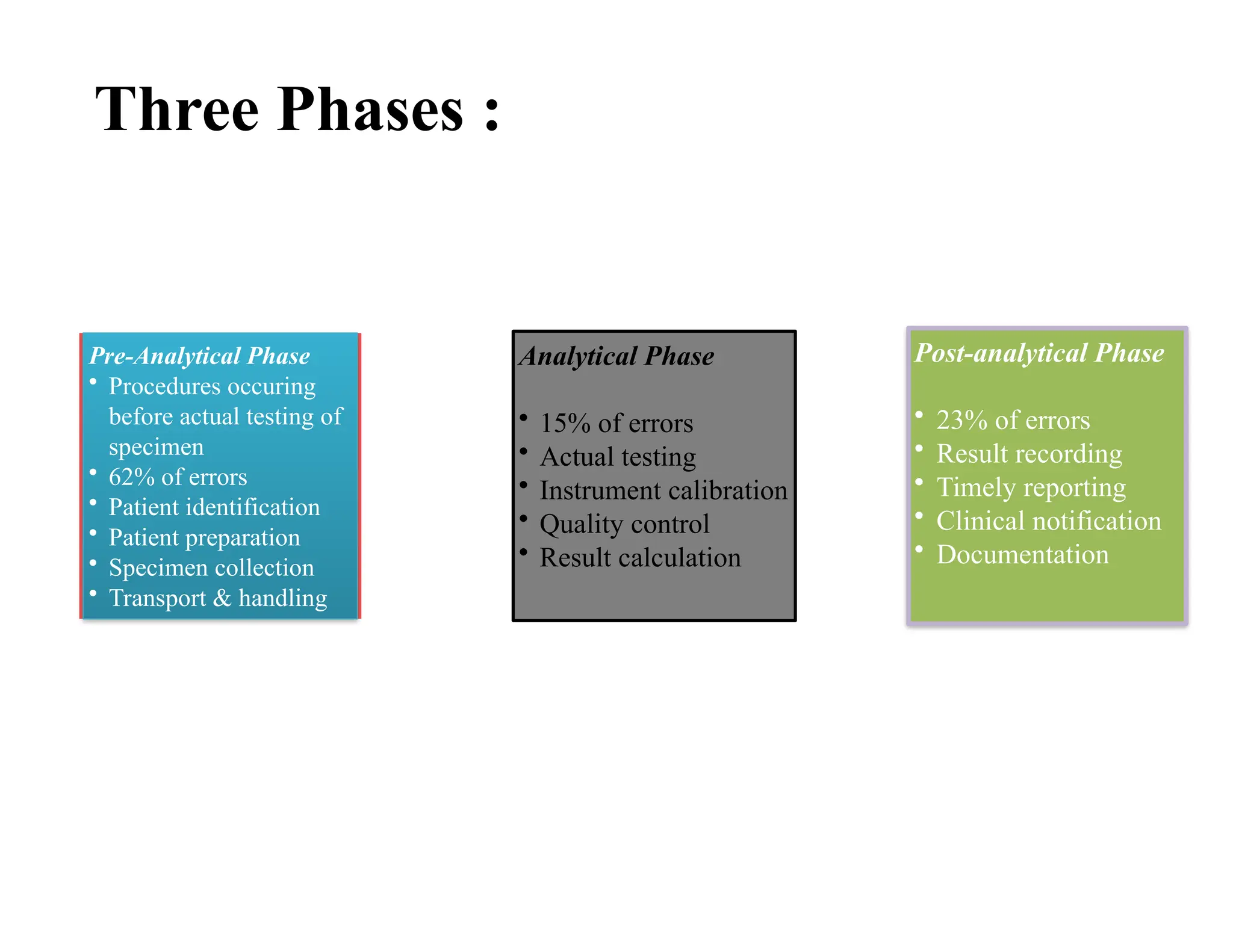
Three Phases :
Pre-Analytical Phase
• Procedures occuring
before actual testing of
specimen
• 62% of errors
• Patient identification
• Patient preparation
• Specimen collection
• Transport & handling
Analytical Phase
• 15% of errors
• Actual testing
• Instrument calibration
• Quality control
• Result calculation
Post-analytical Phase
• 23% of errors
• Result recording
• Timely reporting
• Clinical notification
• Documentation
Quality Assessment??
Also known as proficiency testing
It is to determine the quality of results generated by
the laboratory
It is a challenge to the QA and QC programs
It can be external or internal
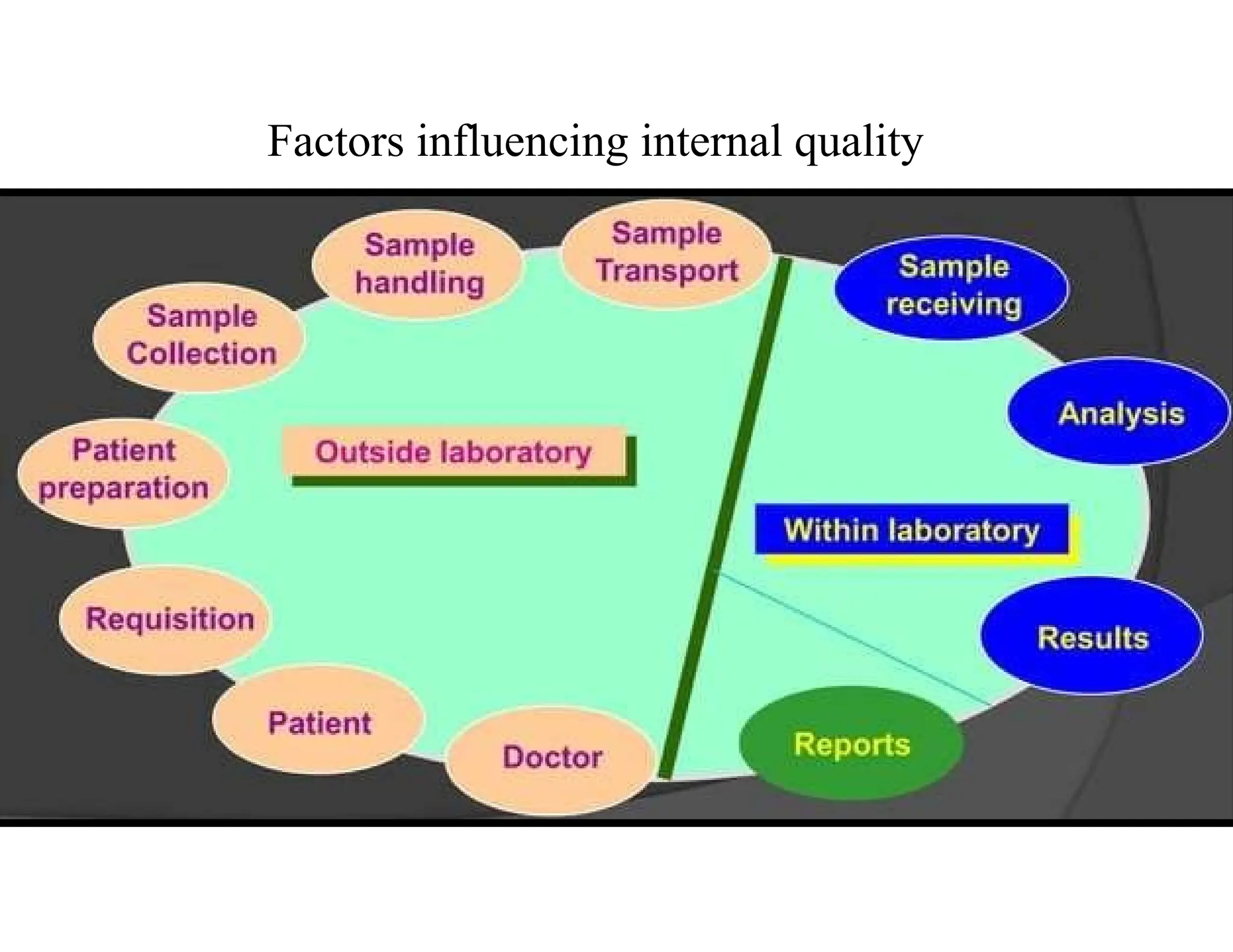
Factors influencing internal quality
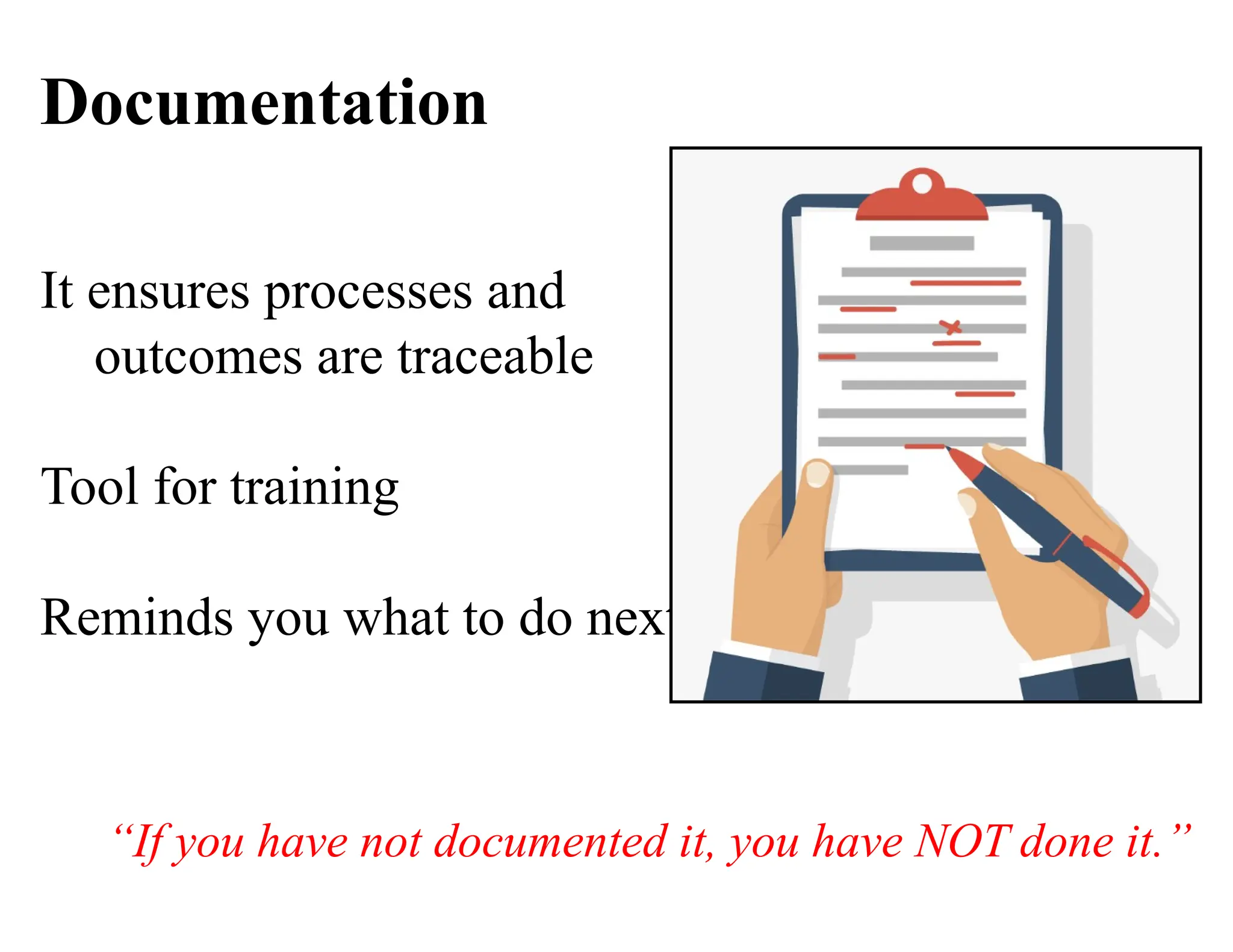
Documentation
It ensures processes and
outcomes are traceable
Tool for training
Reminds you what to do next
“If you have not documented it, you have NOT done it.”
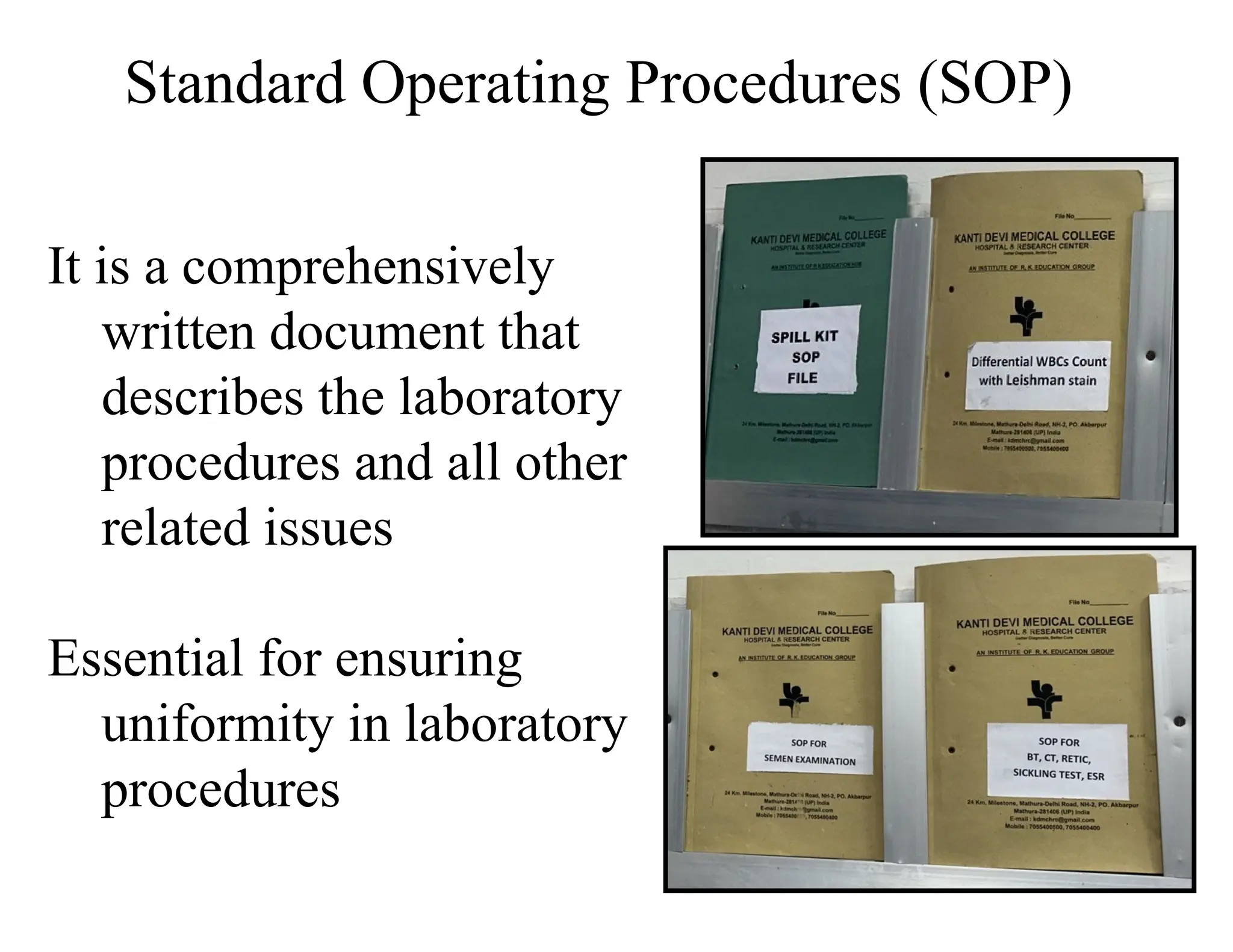
It is a comprehensively
written document that
describes the laboratory
procedures and all other
related issues
Essential for ensuring
uniformity in laboratory
procedures
Standard Operating Procedures (SOP)
TERMINOLOGY
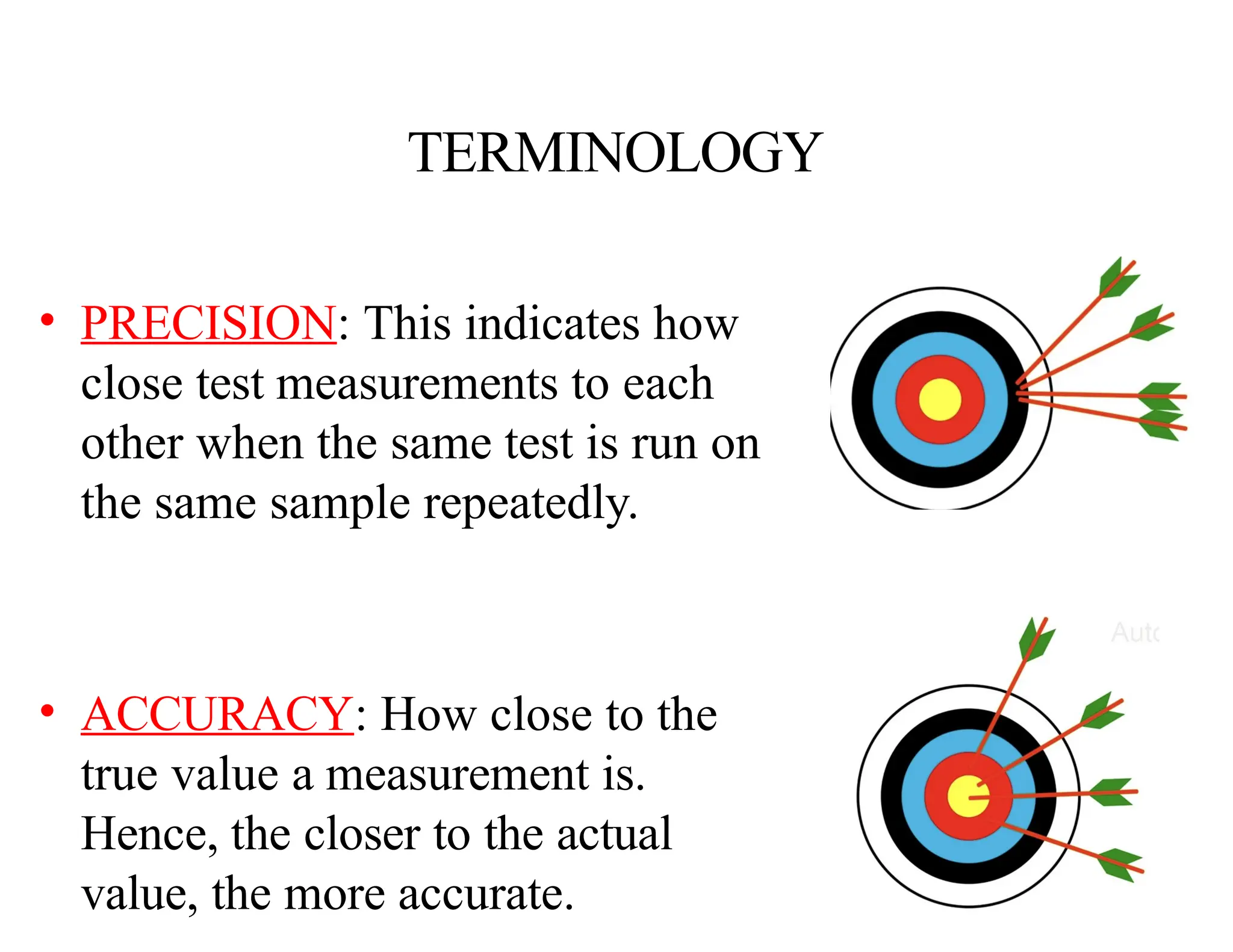
• PRECISION: This indicates how
close test measurements to each
other when the same test is run on
the same sample repeatedly.
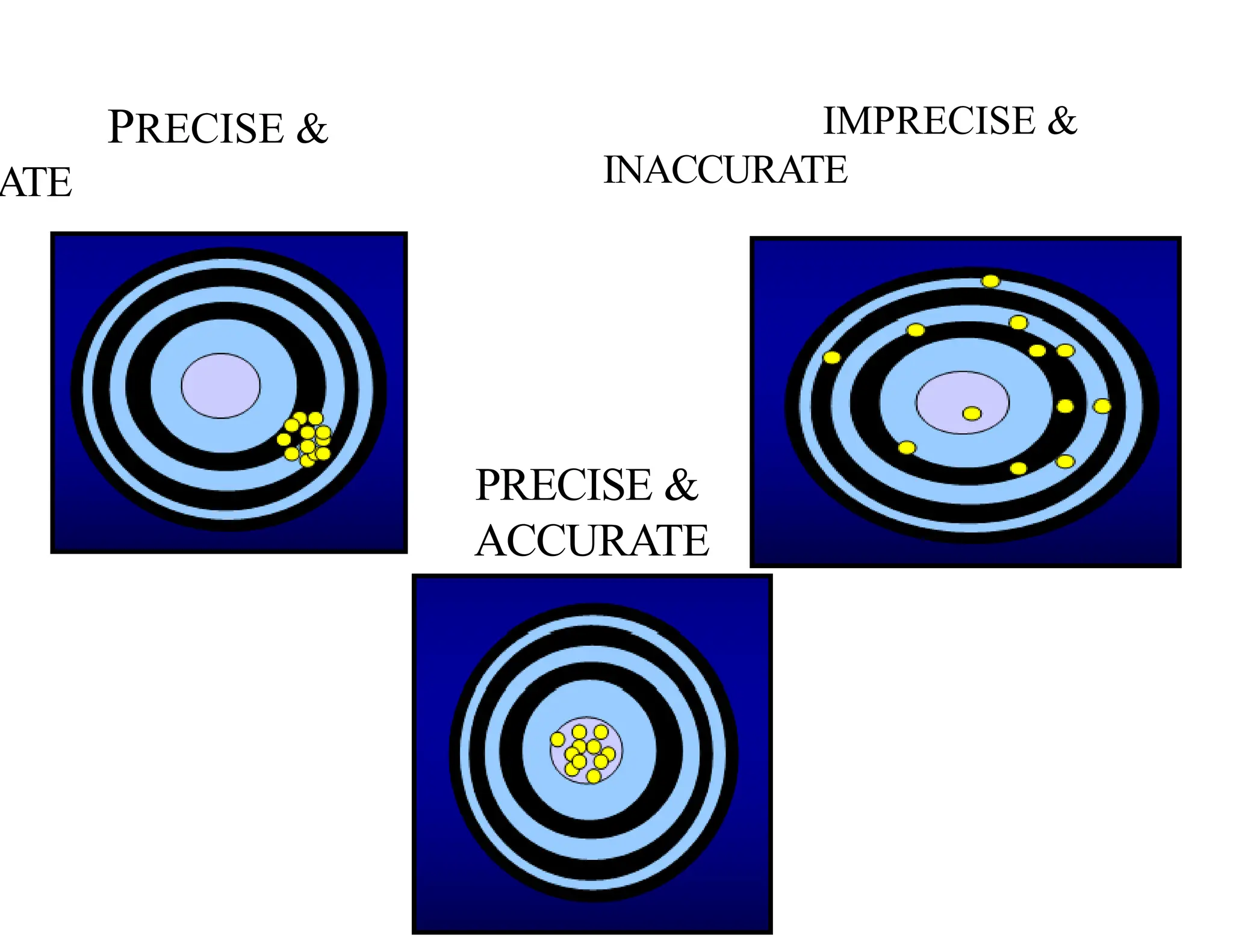
• ACCURACY: How close to the
true value a measurement is.
Hence, the closer to the actual
value, the more accurate.
PRECISE &
ATE
IMPRECISE &
INACCURATE
PRECISE &
ACCURATE
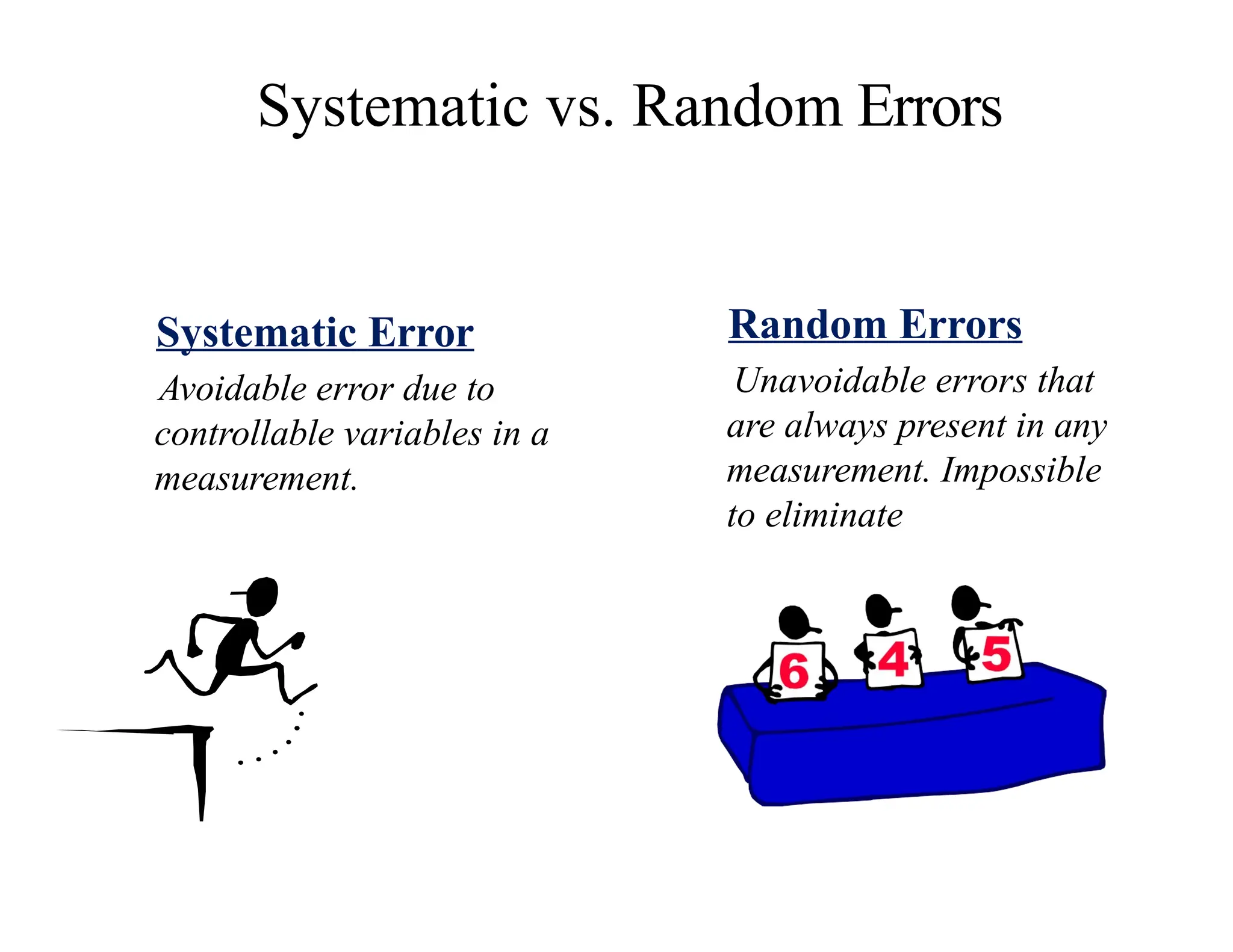
Systematic vs. Random Errors
Systematic Error
Avoidable error due to
controllable variables in a
measurement.
Random Errors
Unavoidable errors that
are always present in any
measurement. Impossible
to eliminate
Statistical Quality Control Exercise
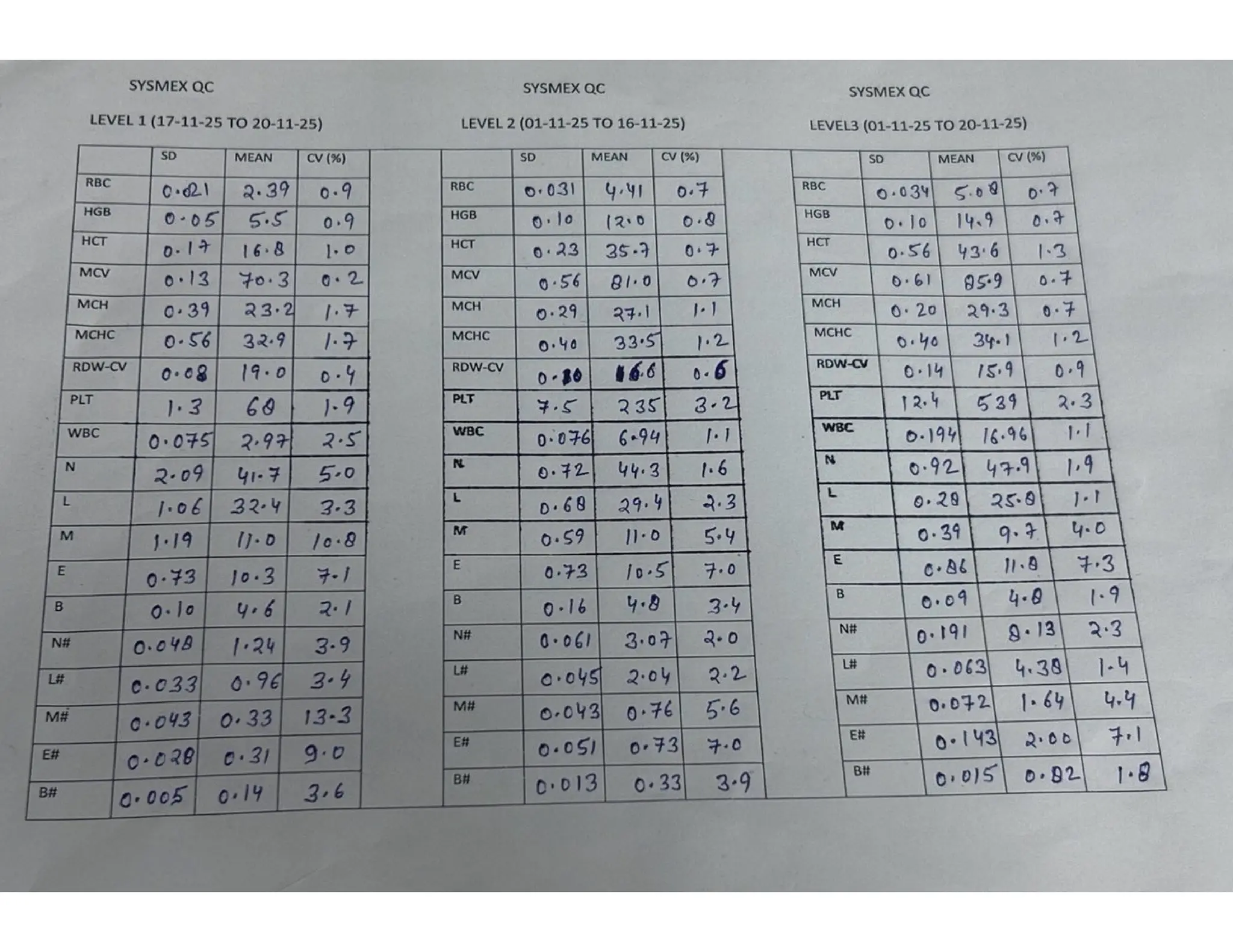
•Standard Control values (3 levels of control)
•Calculation of mean
•Calculation of standard deviation
•Creation of Levey-Jennings chart
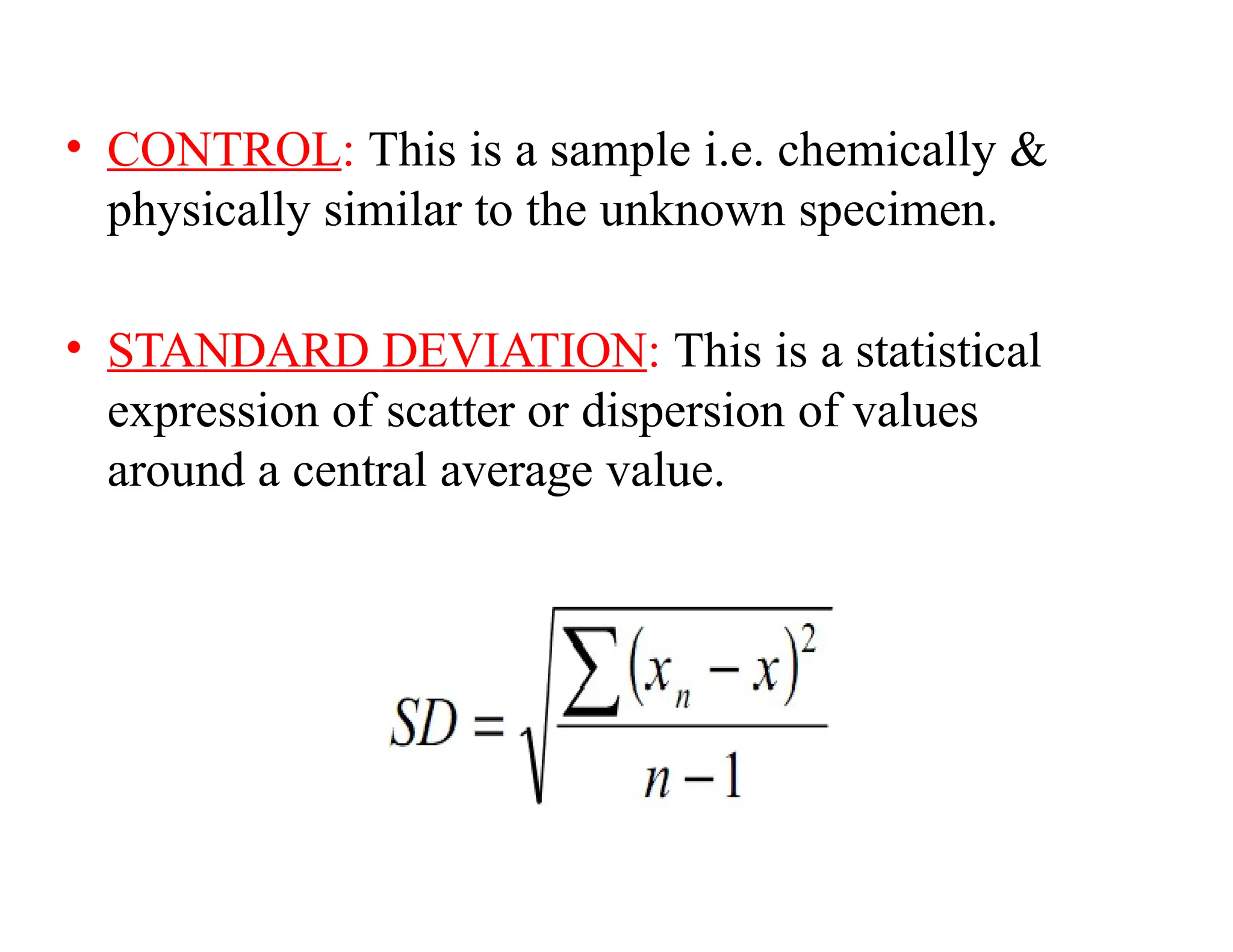
• CONTROL: This is a sample i.e. chemically &
physically similar to the unknown specimen.
• STANDARD DEVIATION: This is a statistical
expression of scatter or dispersion of values
around a central average value.
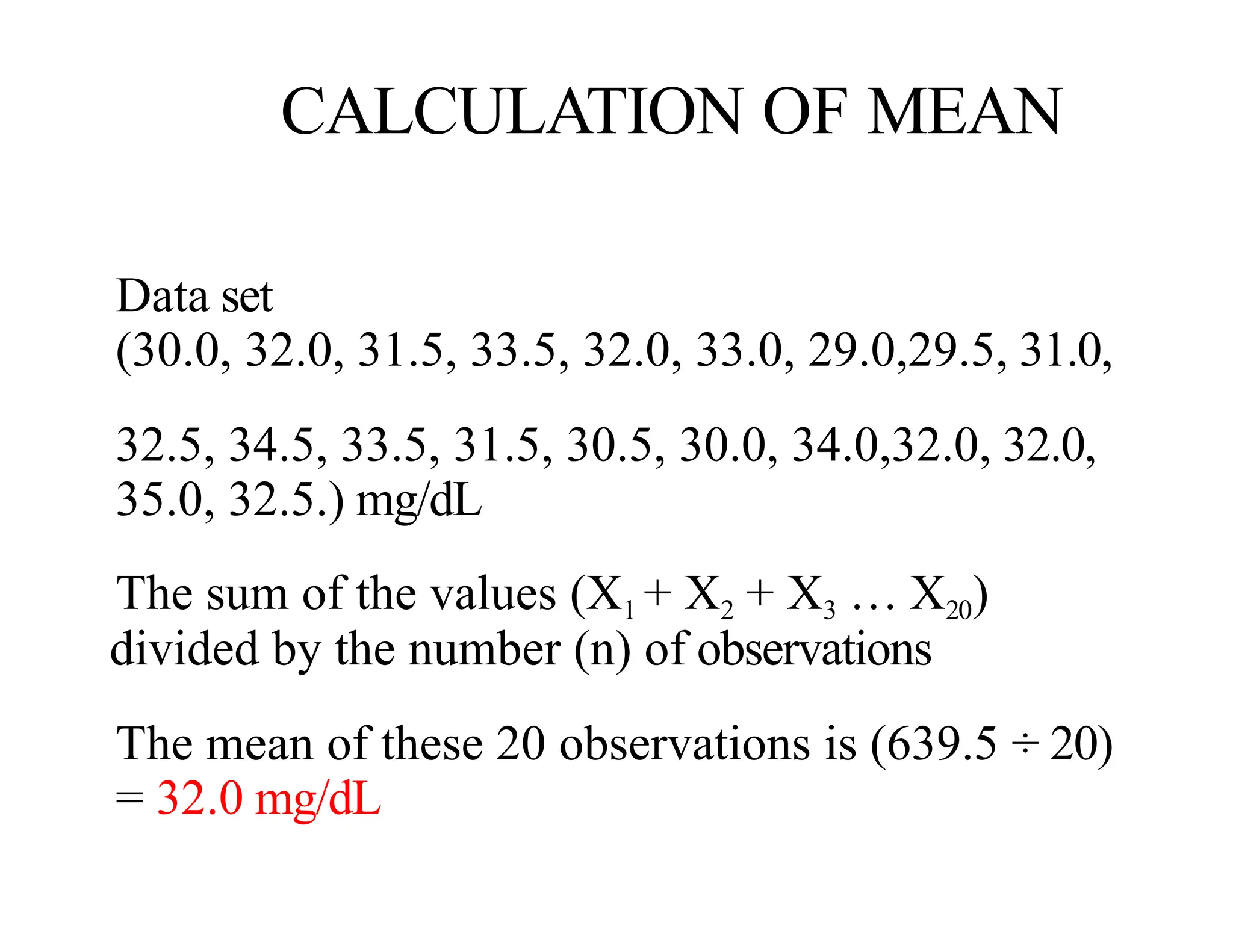
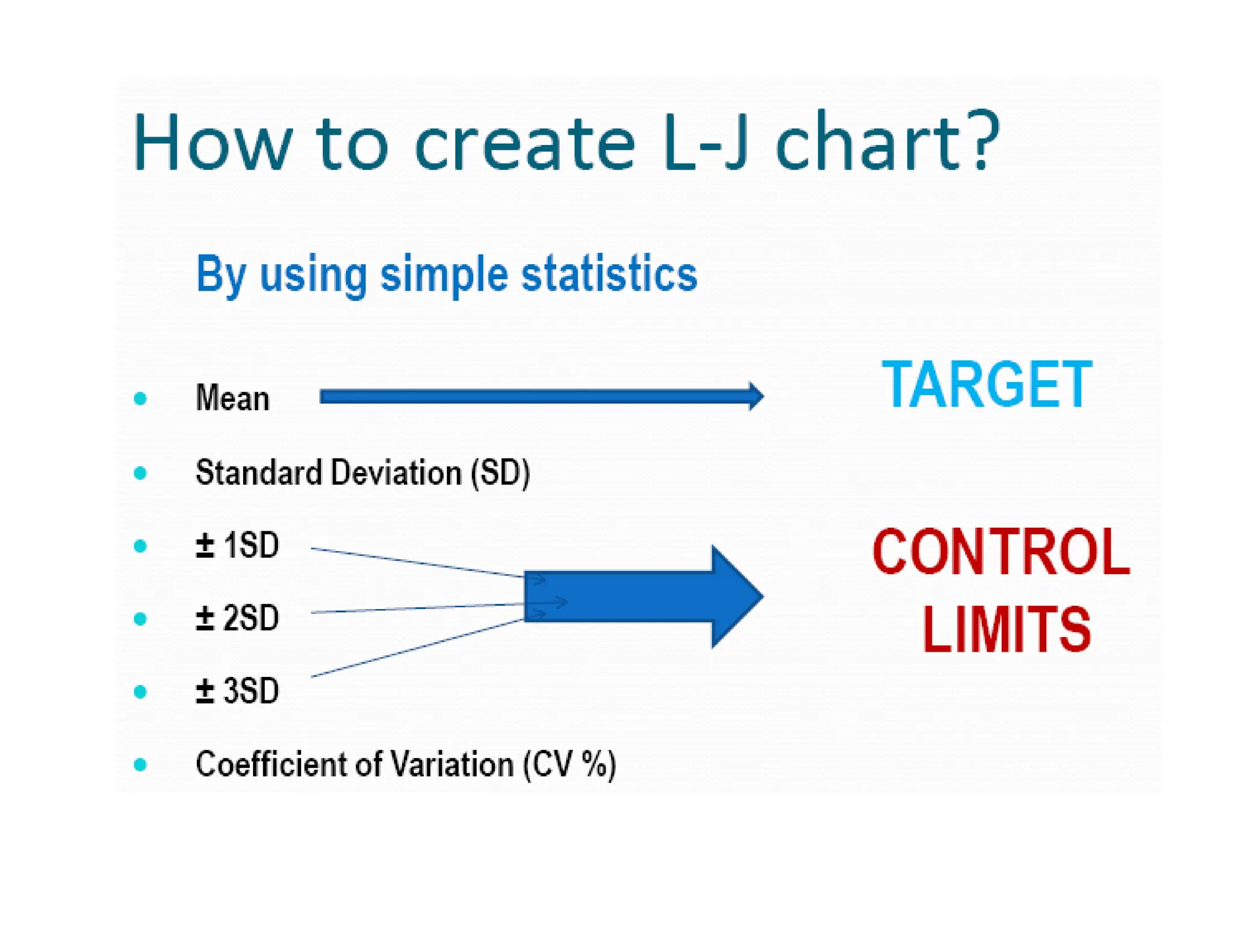
CALCULATION OF MEAN
Data set
(30.0, 32.0, 31.5, 33.5, 32.0, 33.0, 29.0,29.5, 31.0,
32.5, 34.5, 33.5, 31.5, 30.5, 30.0, 34.0,32.0, 32.0,
35.0, 32.5.) mg/dL
The sum of the values (X1 + X2 + X3 … X20)
divided by the number (n) of observations
The mean of these 20 observations is (639.5 ÷ 20)
= 32.0 mg/dL
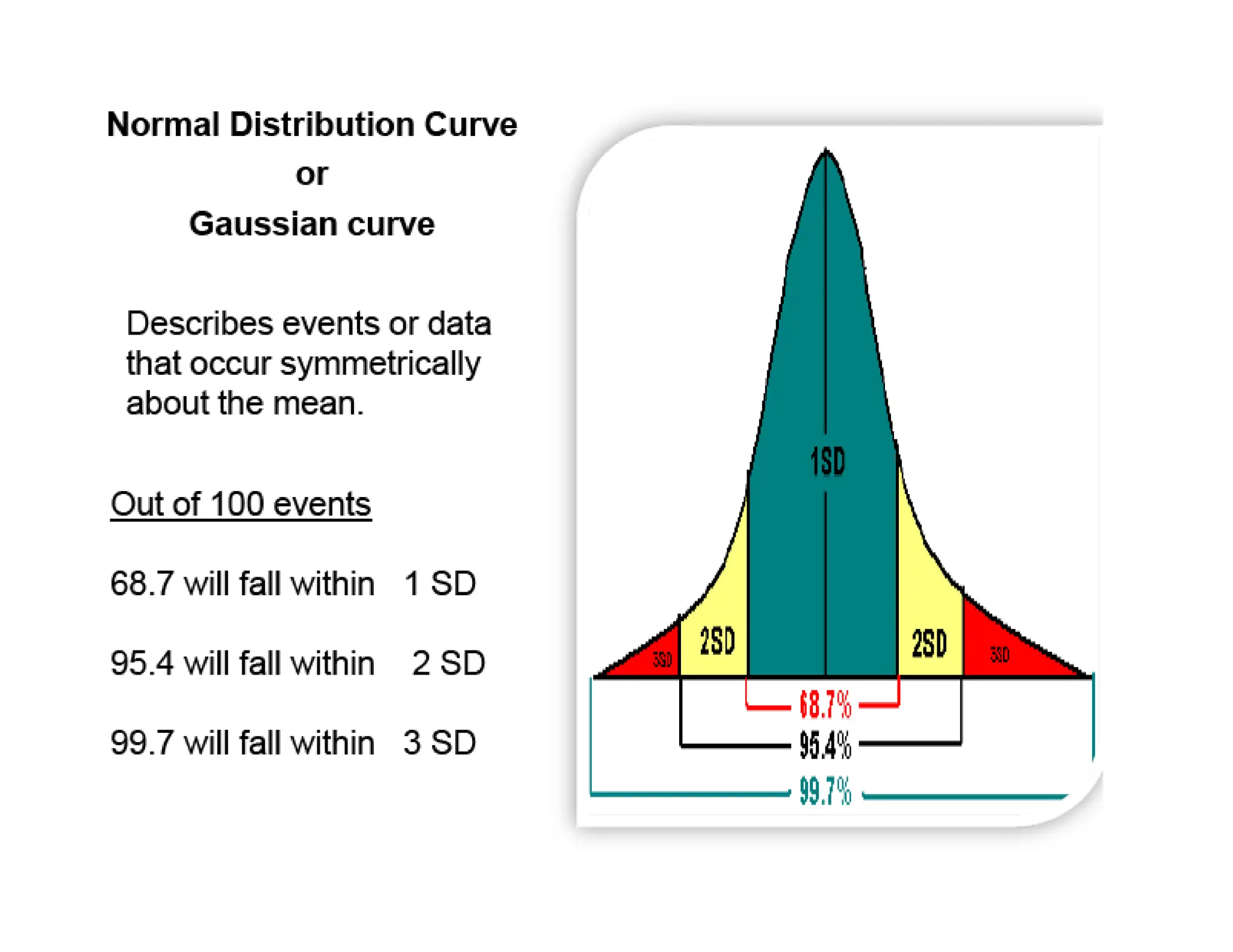
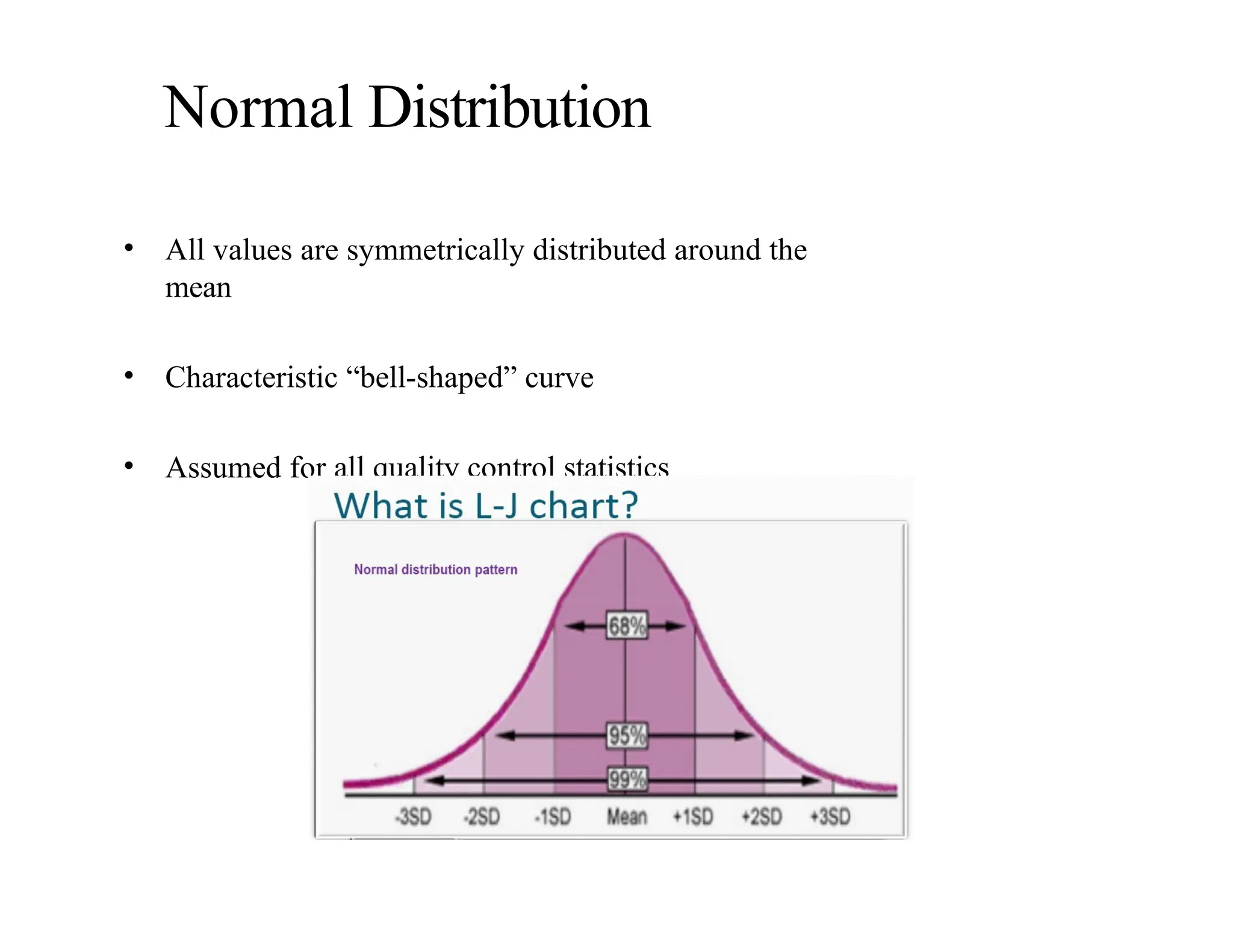
Normal Distribution
• All values are symmetrically distributed around the
mean
• Characteristic “bell-shaped” curve
• Assumed for all quality control statistics
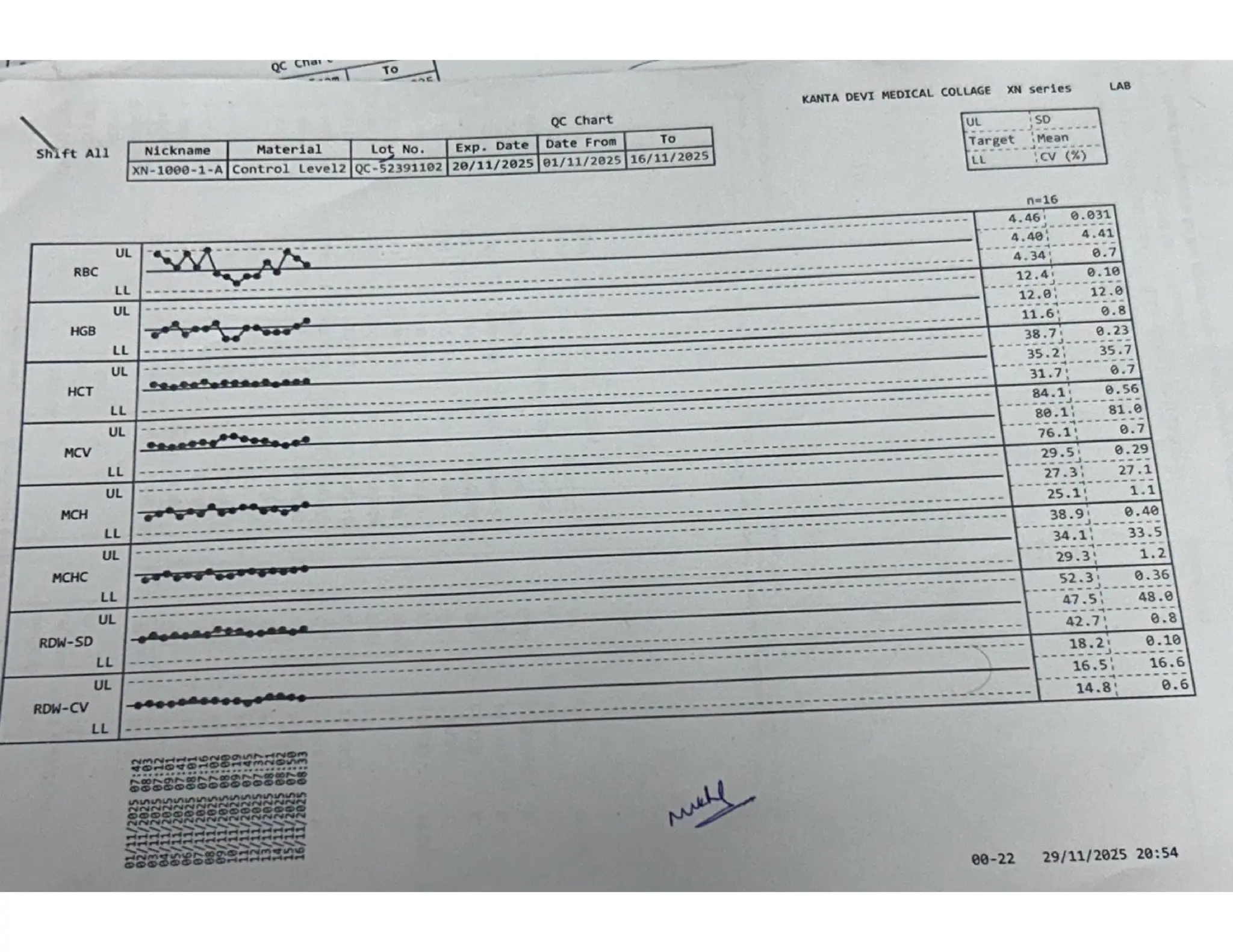
Levey-Jennings CHART
• A graphical method for displaying control results
and evaluating whether a procedure is in-control
or out-of-control
• It is named after S.LEVEY & E.R.JENNINGS
in 1950.
• Control values are plotted versus time
• Lines are drawn from point to point accent, any
trends, shifts or random excursions
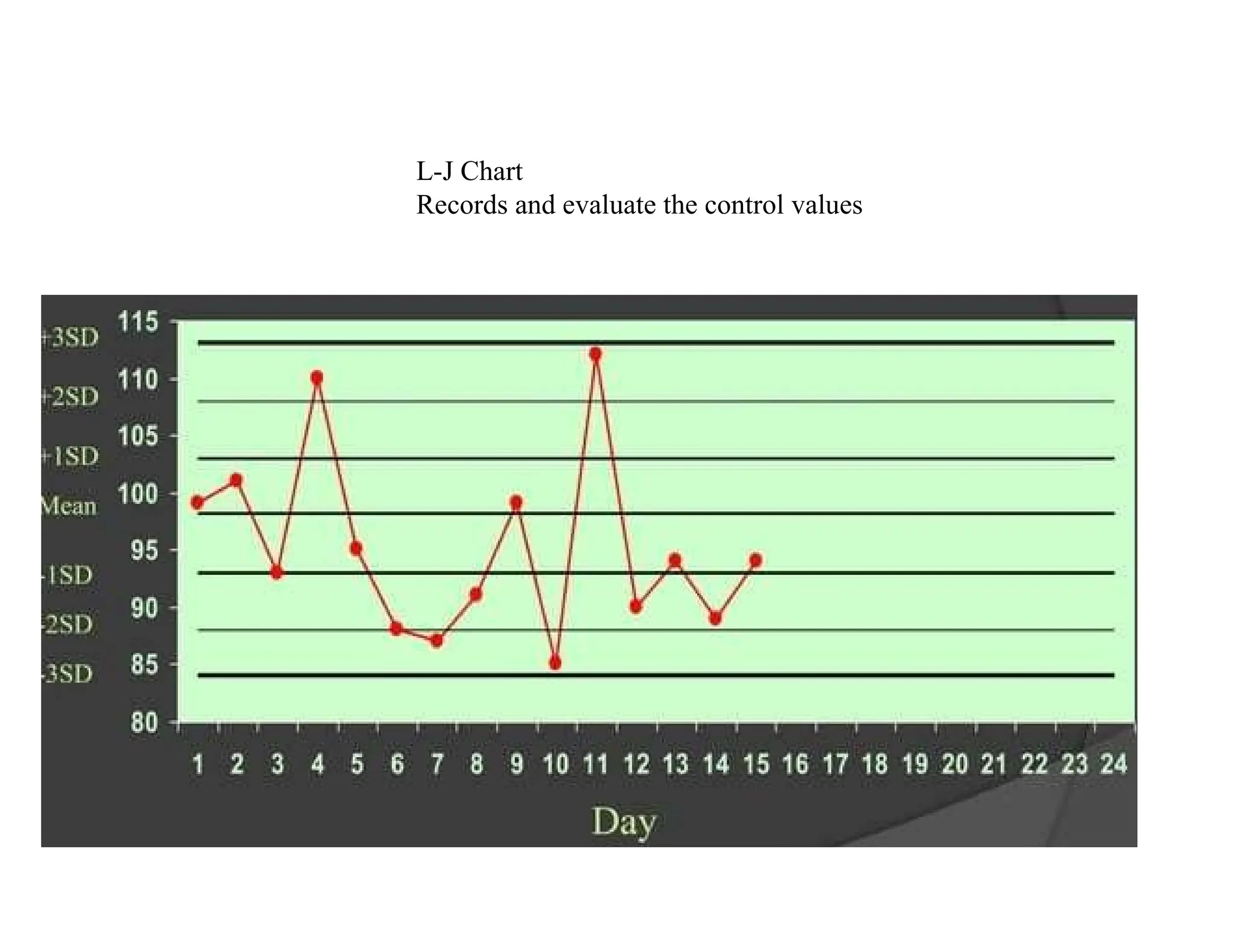
L-J Chart
Records and evaluate the control values
Monitoring QC data
• Use Levey-Jennings Chart
• Plot control values each run, make decision
regarding acceptability of run
• Monitor overtime to evaluate the precision and
accuracy of repeated measurements
• Review charts at defined intervals, take
necessary action, and document
INTERNAL QUALITY CONTROL
• Use of standard reagents & known control
sample
• Well trained staff
• The batch result are accepted if the values
of control sera are within 2 SD.
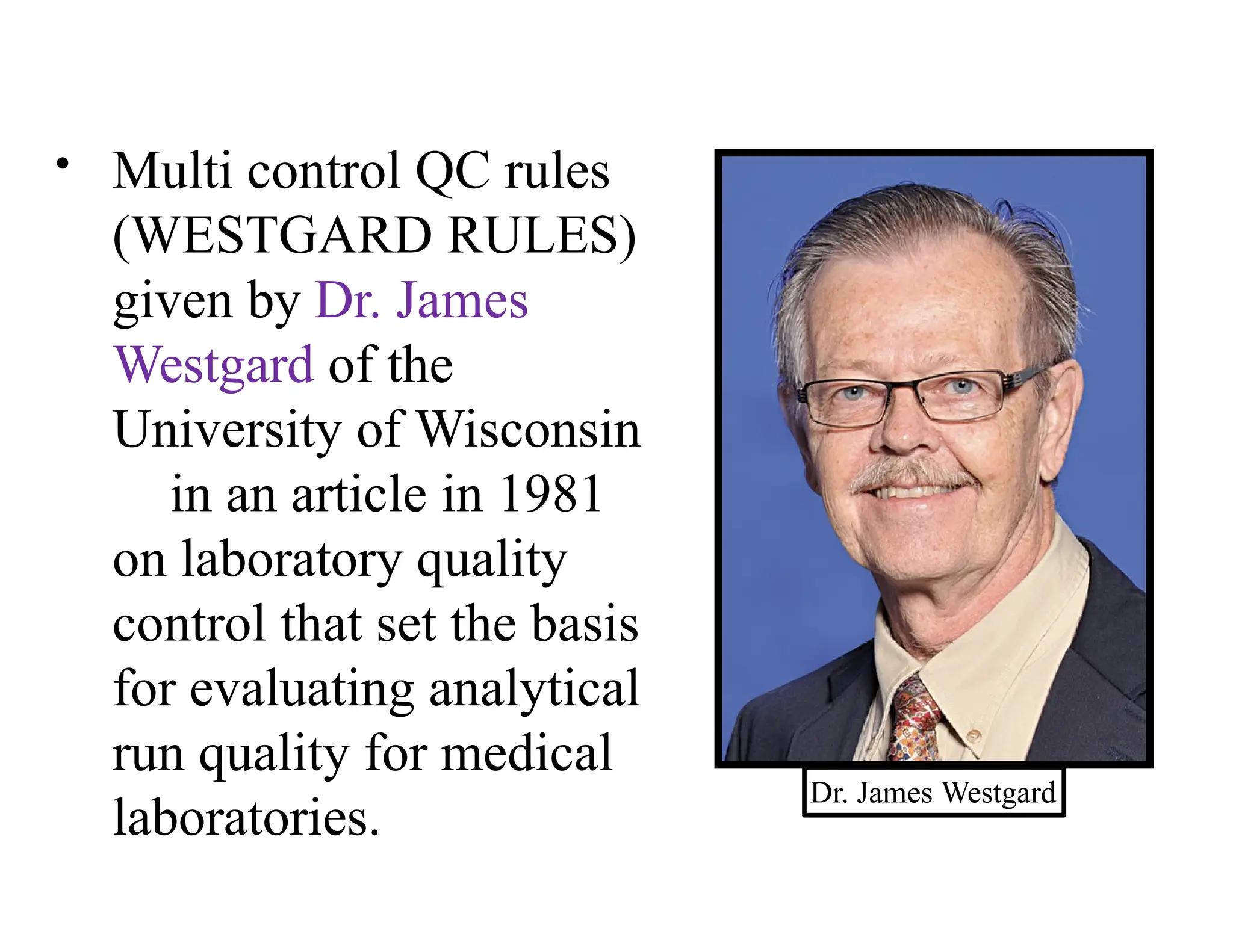
• Multi control QC rules
(WESTGARD RULES)
given by Dr. James
Westgard of the
University of Wisconsin
in an article in 1981
on laboratory quality
control that set the basis
for evaluating analytical
run quality for medical
laboratories.
Dr. James Westgard
• The Westgard system -based on the principles
of statistical process control used in
manufacturing nationwide since the 1950s
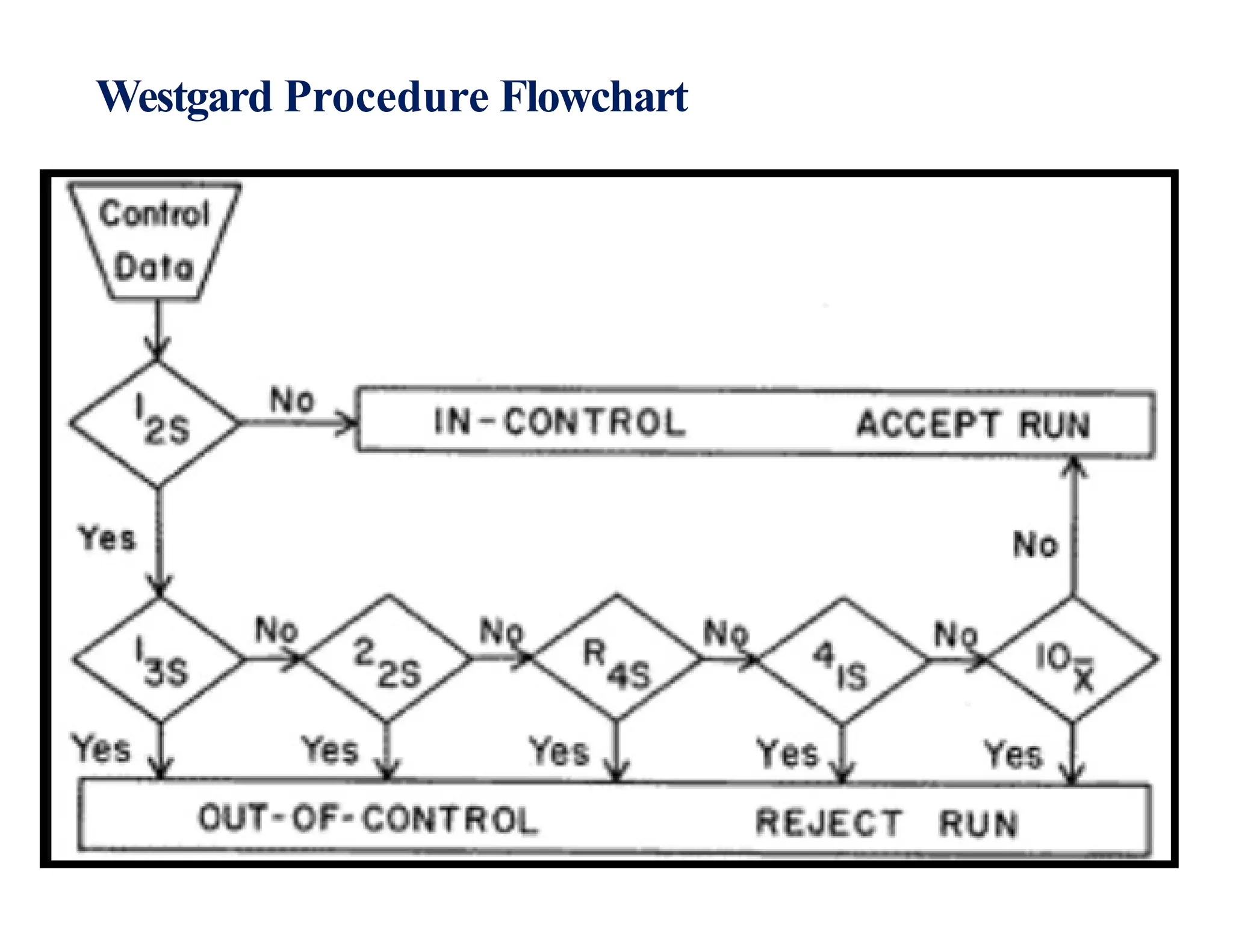
• Six basic rules in the Westgard scheme: 1-3s,
2- 2s, R-4s, 1-2s, 4-1s, and 10x. These rules
are used individually or in combination (multi-
rule) to evaluate the quality of analytical runs.
• Detect random or systematic errors
WESTGARD RULES
• 1-2S Rule
• 1-3S Rule
• 2-2S Rule
• R-4S Rule
• 4-1S Rule
• 10X Rule
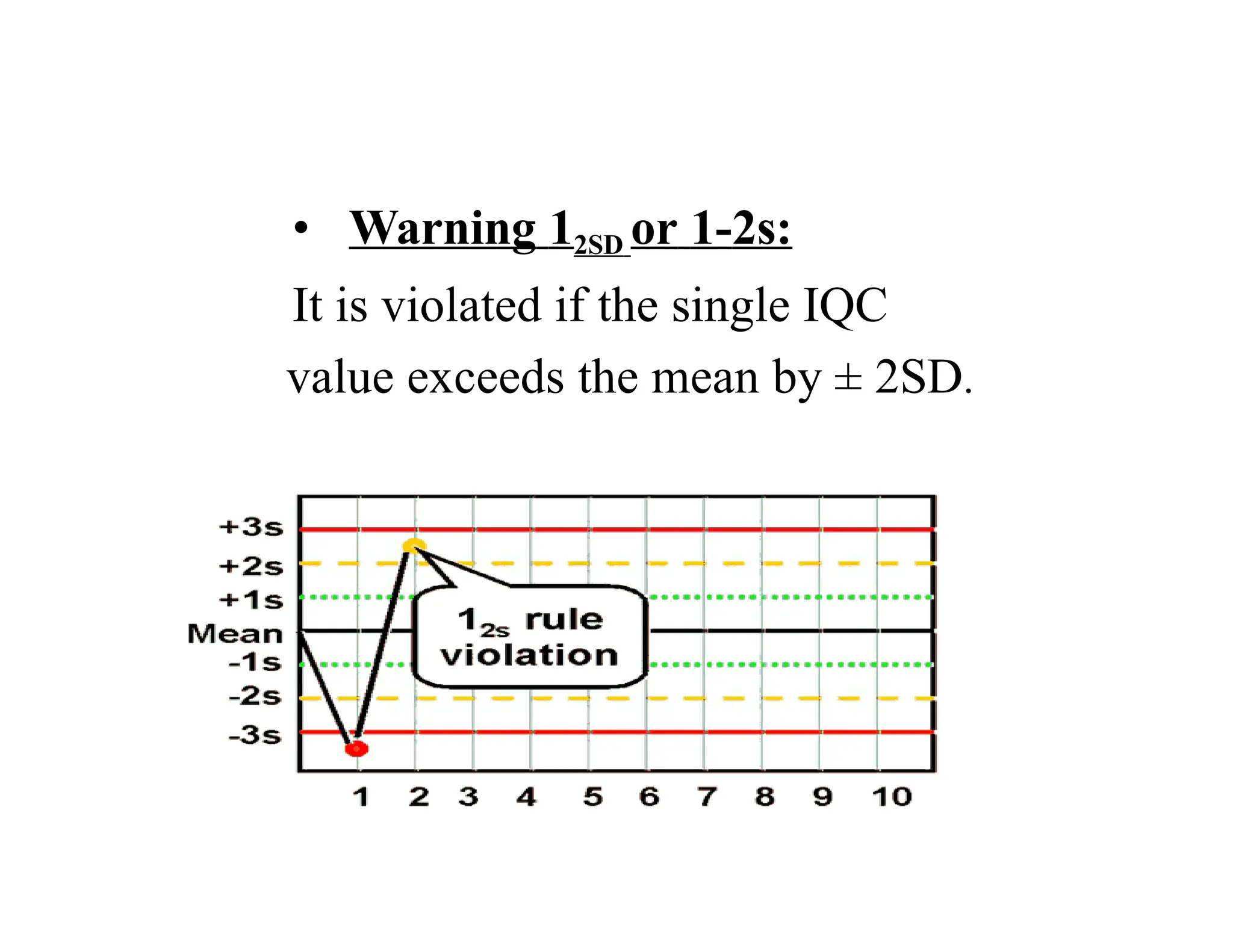
• Warning 12SD or 1-2s:
It is violated if the single IQC
value exceeds the mean by ± 2SD.
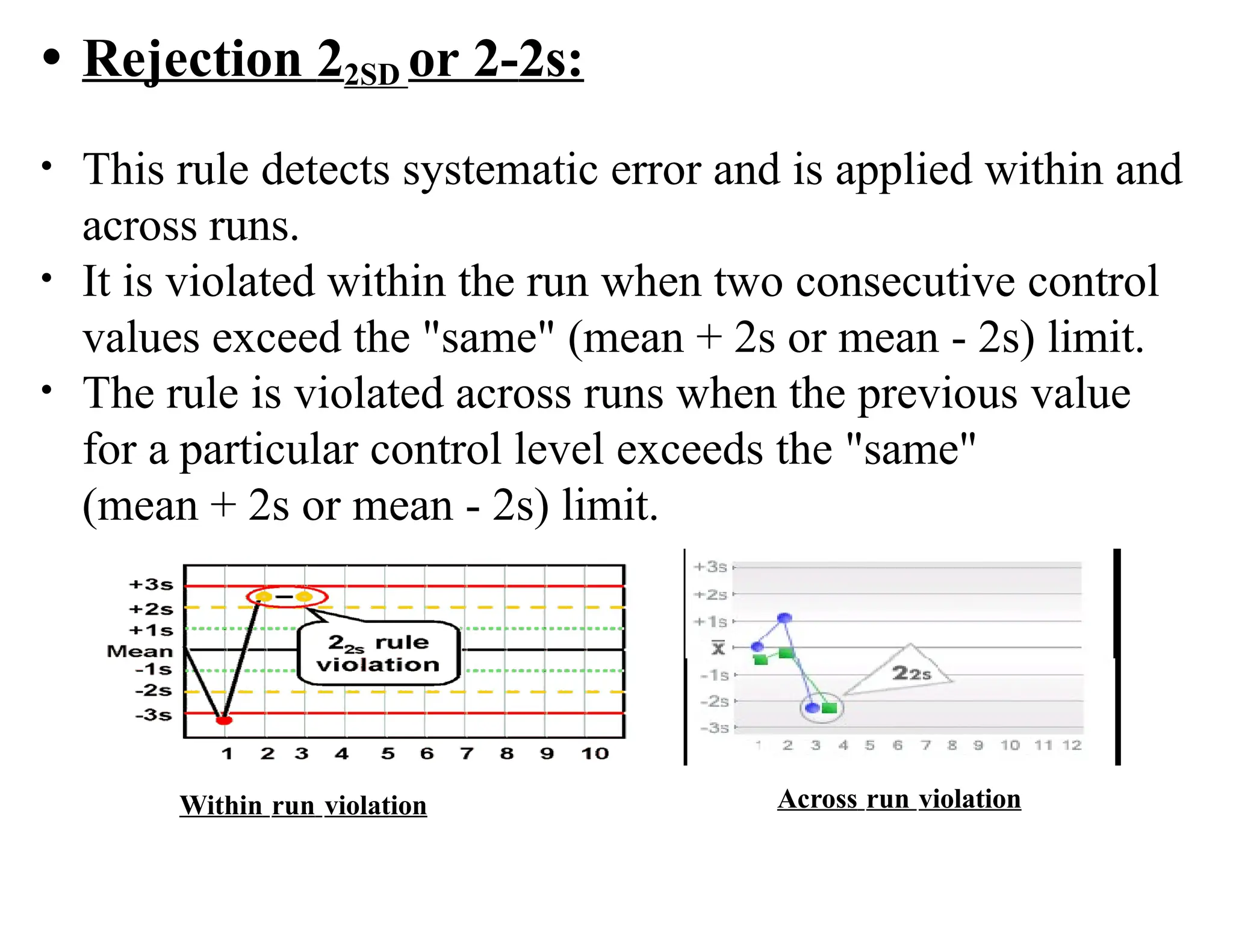
• Rejection 22SD or 2-2s:
• This rule detects systematic error and is applied within and
across runs.
• It is violated within the run when two consecutive control
values exceed the "same" (mean + 2s or mean - 2s) limit.
• The rule is violated across runs when the previous value
for a particular control level exceeds the "same"
(mean + 2s or mean - 2s) limit.
Within run violation Across run violation
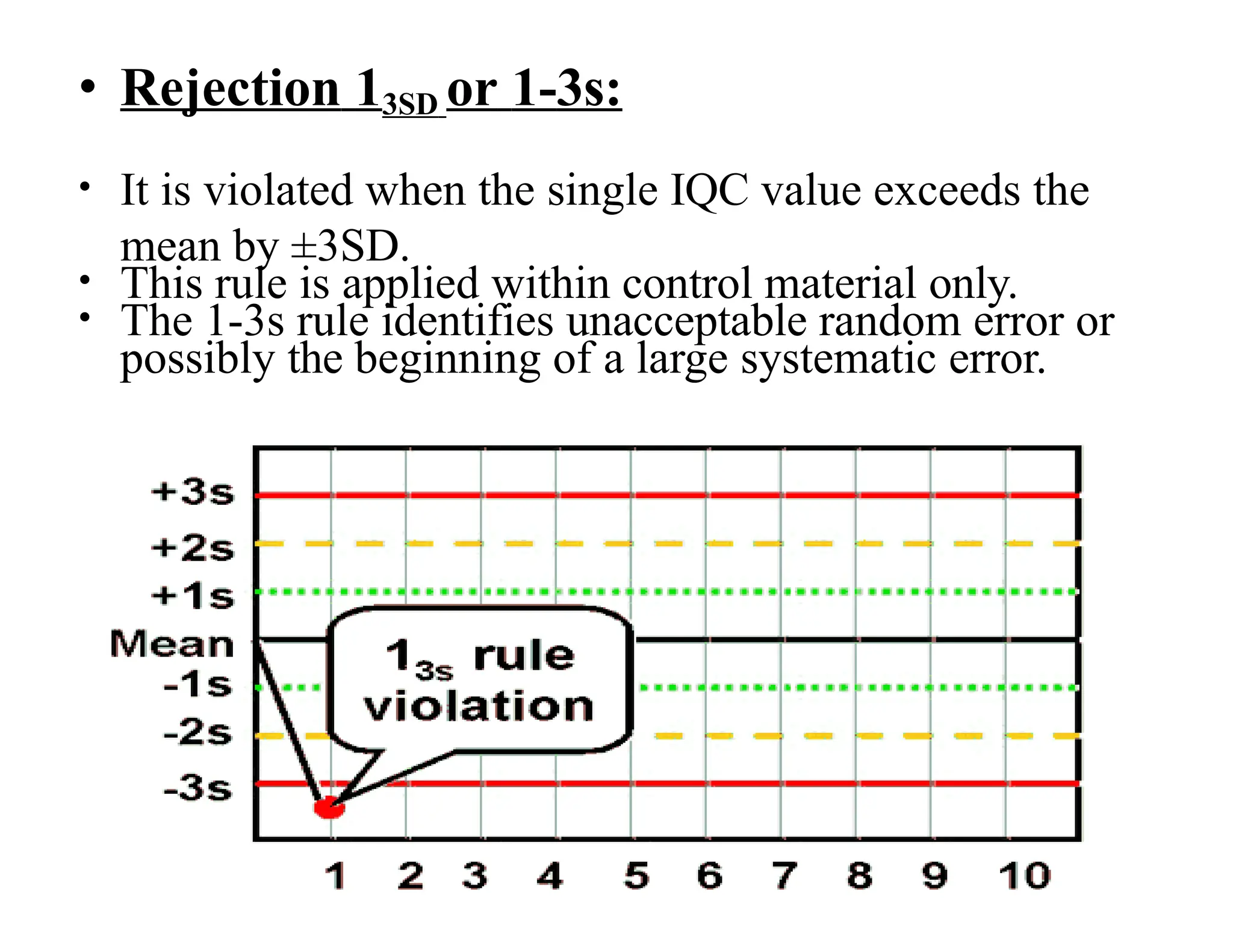
• Rejection 13SD or 1-3s:
• It is violated when the single IQC value exceeds the
mean by ±3SD.
• This rule is applied within control material only.
• The 1-3s rule identifies unacceptable random error or
possibly the beginning of a large systematic error.
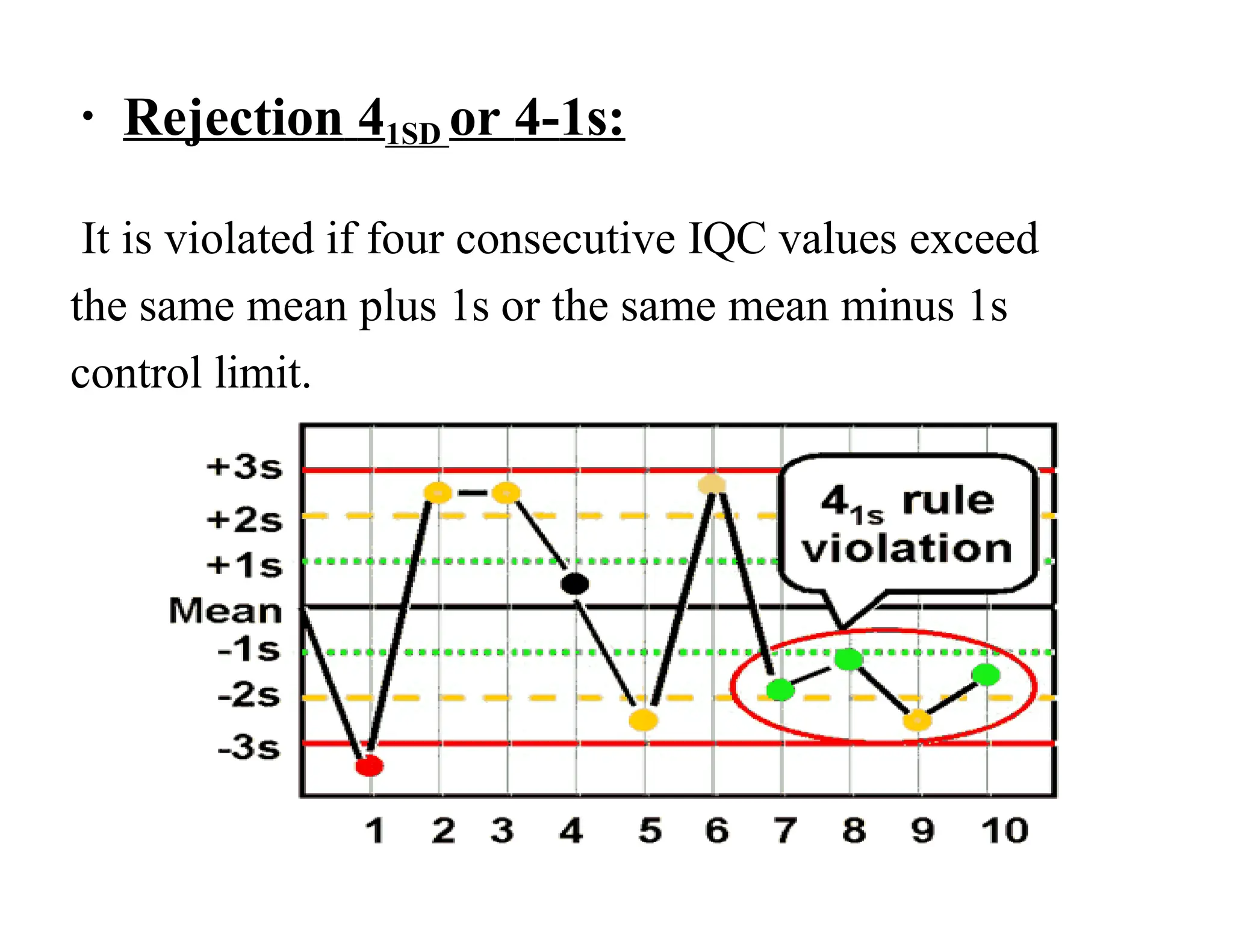
• Rejection 41SD or 4-1s:
It is violated if four consecutive IQC values exceed
the same mean plus 1s or the same mean minus 1s
control limit.
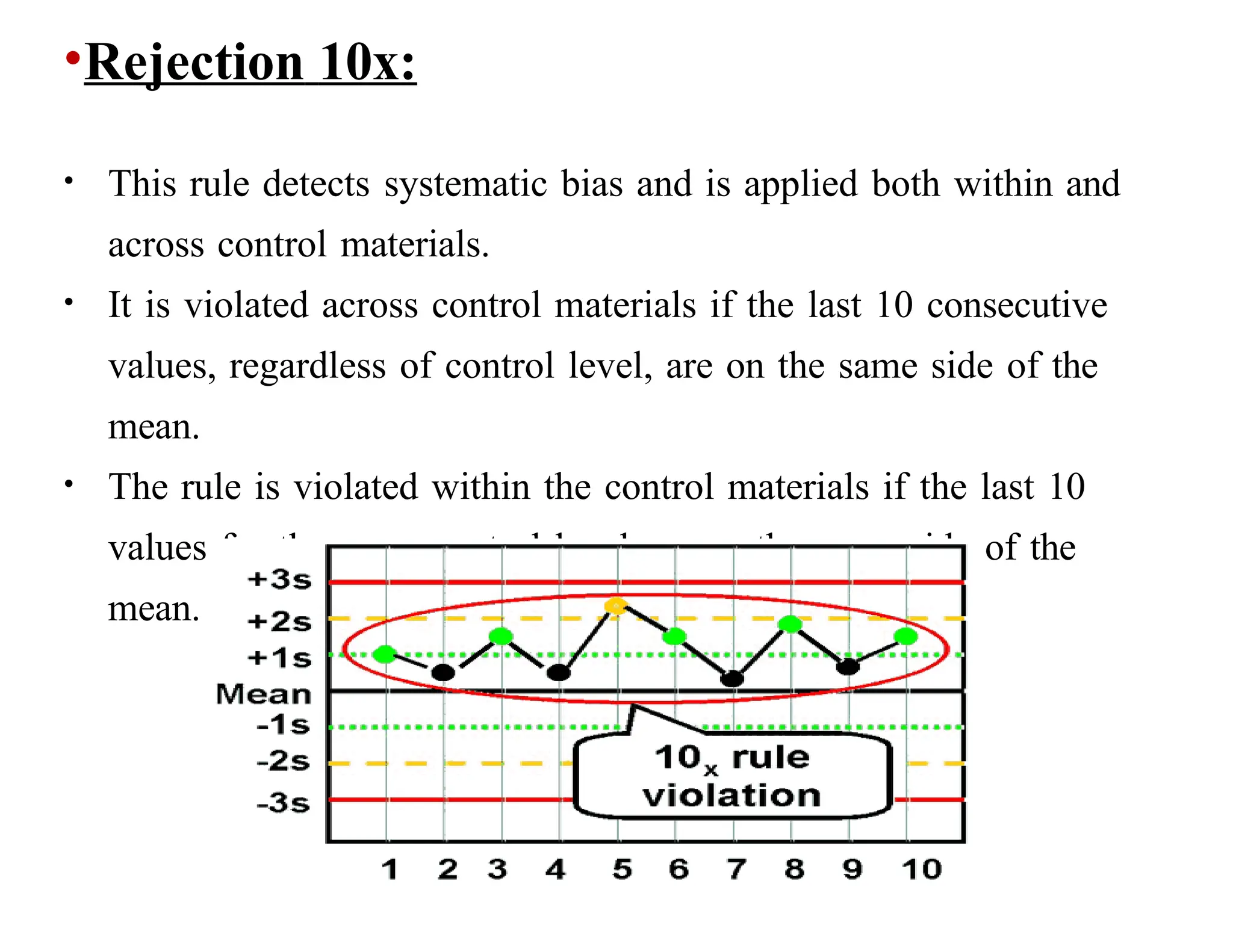
•Rejection 10x:
• This rule detects systematic bias and is applied both within and
across control materials.
• It is violated across control materials if the last 10 consecutive
values, regardless of control level, are on the same side of the
mean.
• The rule is violated within the control materials if the last 10
values for the same control level are on the same side of the
mean.
Westgard Procedure Flowchart
Why use Westgard rules?
We use it to help us reduce costs while
maintaining a high level of certainty that
are analytical process is functioning
properly
In other words to diminish, the false
rejection rate without compromising
quality
EXTERNAL QUALITY
CONTROL
• All the participating laboratories daily
analyze the same lot of control material
• The results are tabulated monthly & sent
the sponsoring groups for the data
analysis
• Summary reports are prepared by the
program sponsor & are distributed to all
participating laboratories
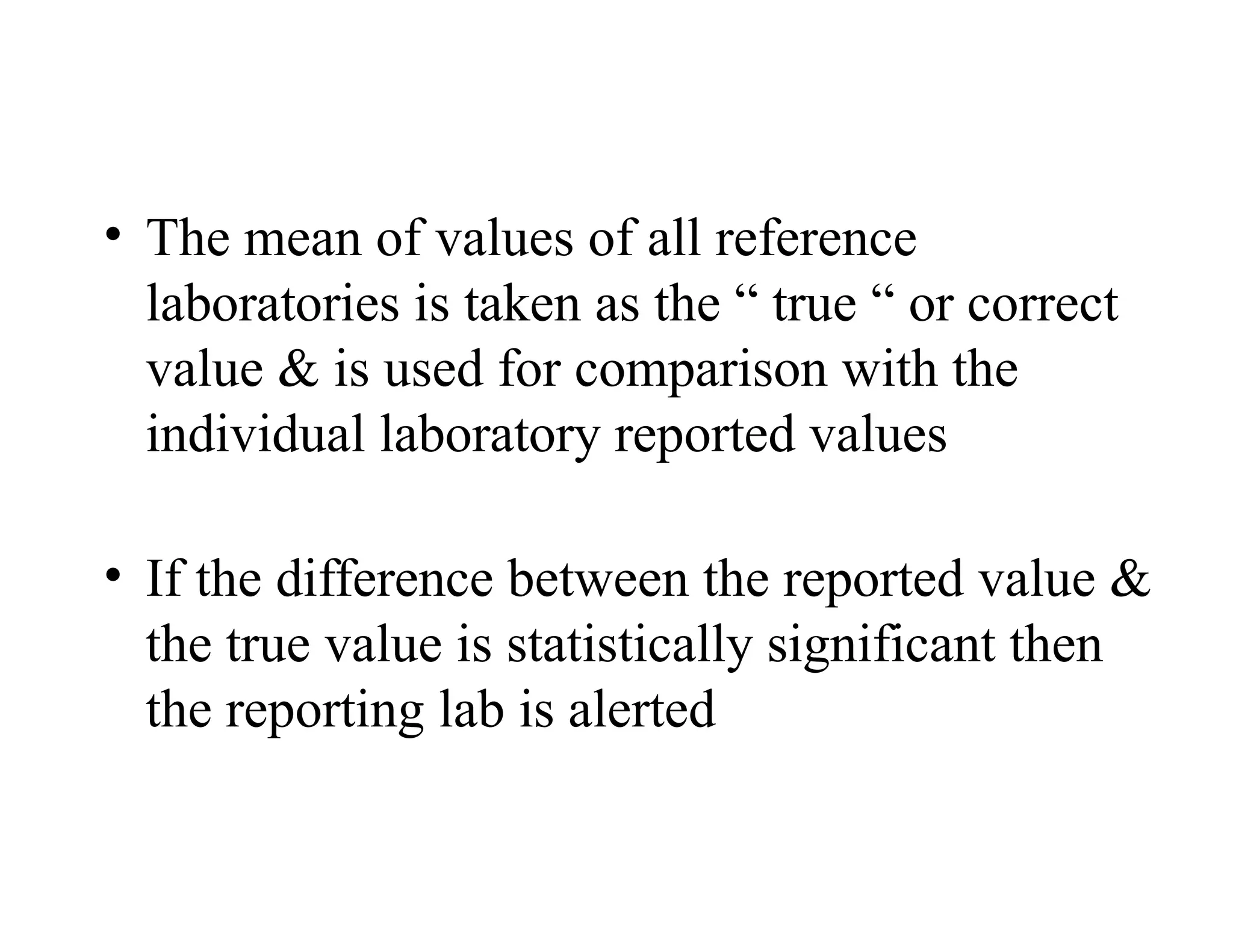
• The mean of values of all reference
laboratories is taken as the “ true “ or correct
value & is used for comparison with the
individual laboratory reported values
• If the difference between the reported value &
the true value is statistically significant then
the reporting lab is alerted
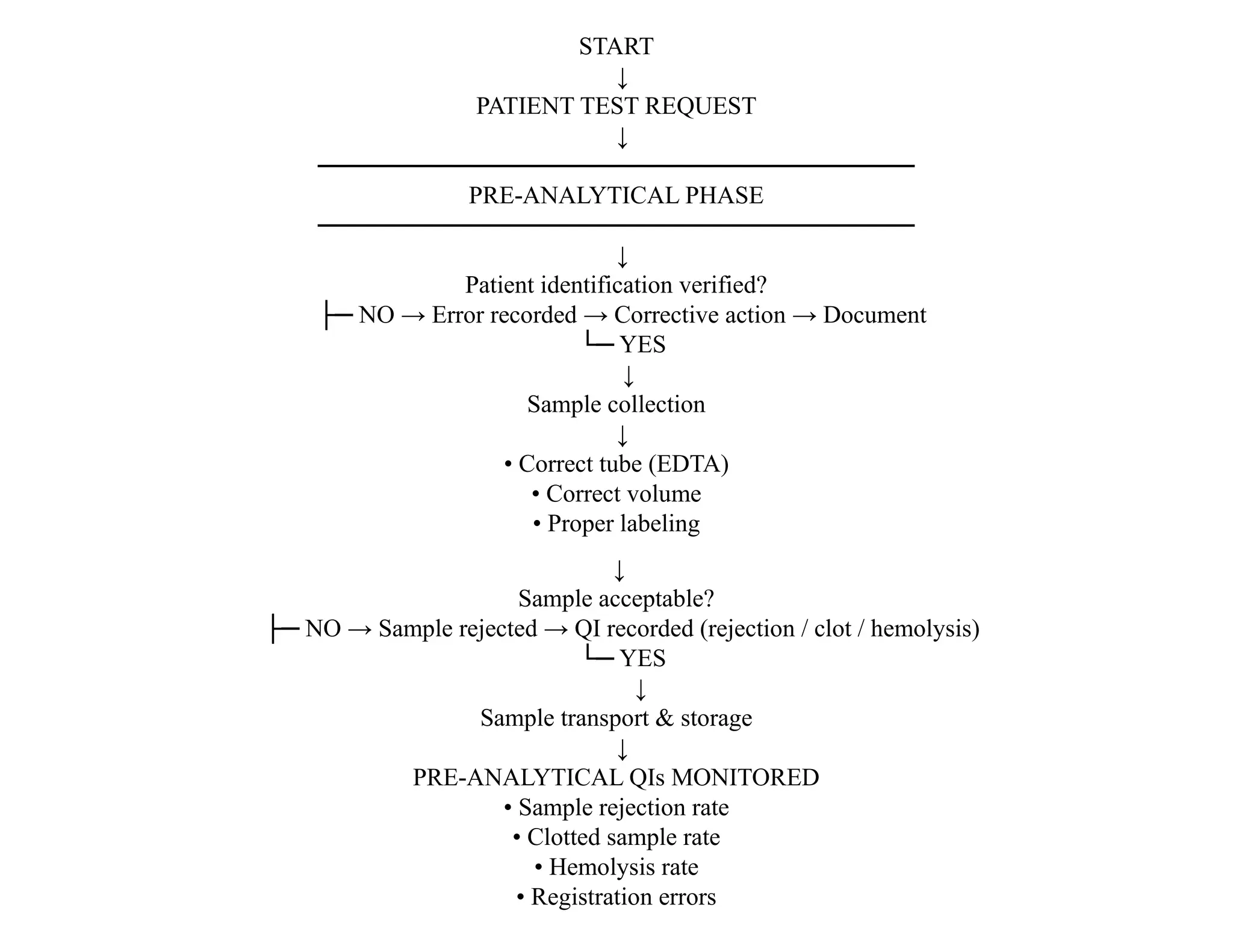
START
↓
PATIENT TEST REQUEST
↓
──────────────────────────────────
PRE ANALYTICAL PHASE
‑
──────────────────────────────────
↓
Patient identification verified?
├─ NO → Error recorded → Corrective action → Document
└─ YES
↓
Sample collection
↓
• Correct tube (EDTA)
• Correct volume
• Proper labeling
↓
Sample acceptable?
├─ NO → Sample rejected → QI recorded (rejection / clot / hemolysis)
└─ YES
↓
Sample transport & storage
↓
PRE ANALYTICAL QIs MONITORED
‑
• Sample rejection rate
• Clotted sample rate
• Hemolysis rate
• Registration errors
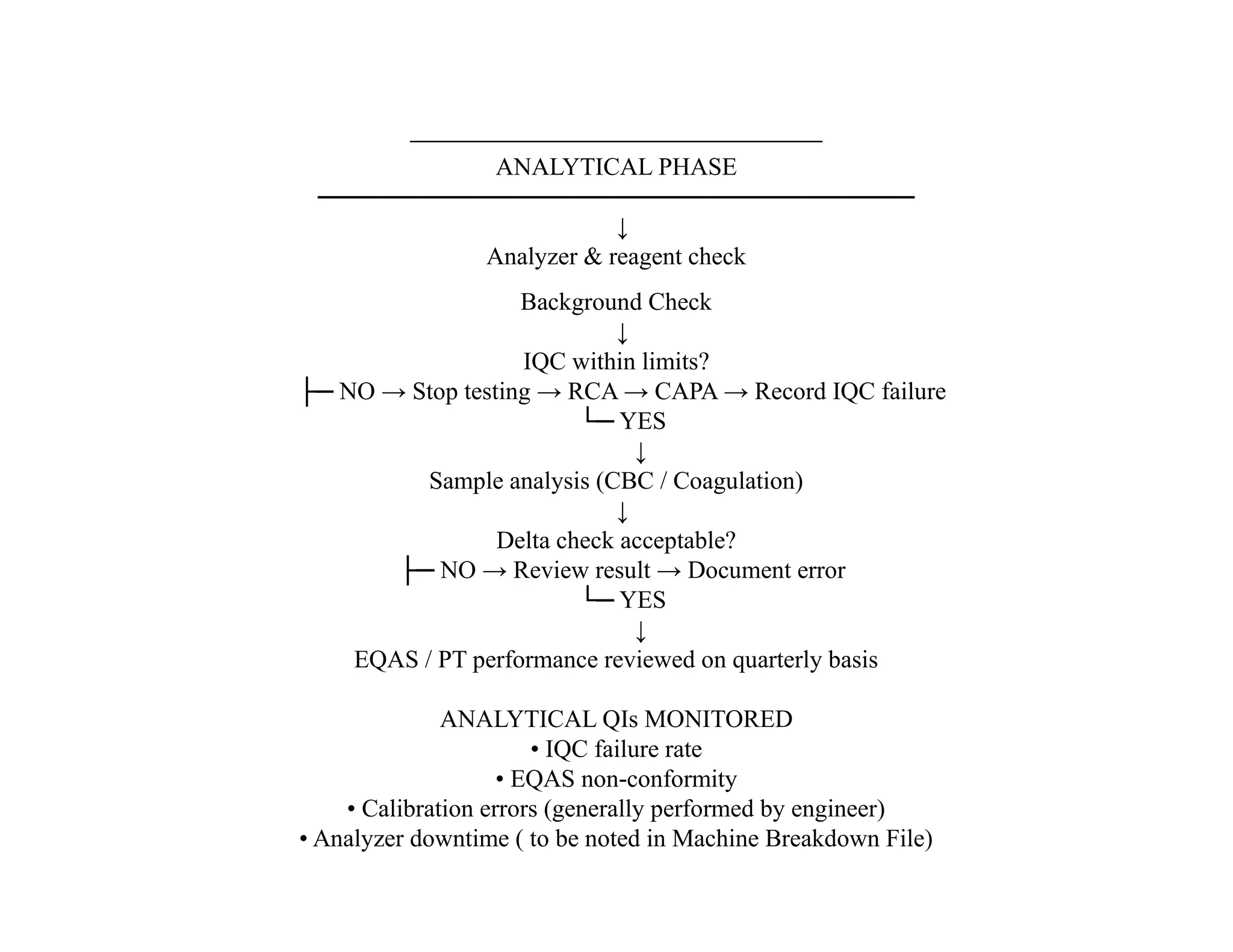
──────────────────────────────────
ANALYTICAL PHASE
──────────────────────────────────
↓
Analyzer & reagent check
Background Check
↓
IQC within limits?
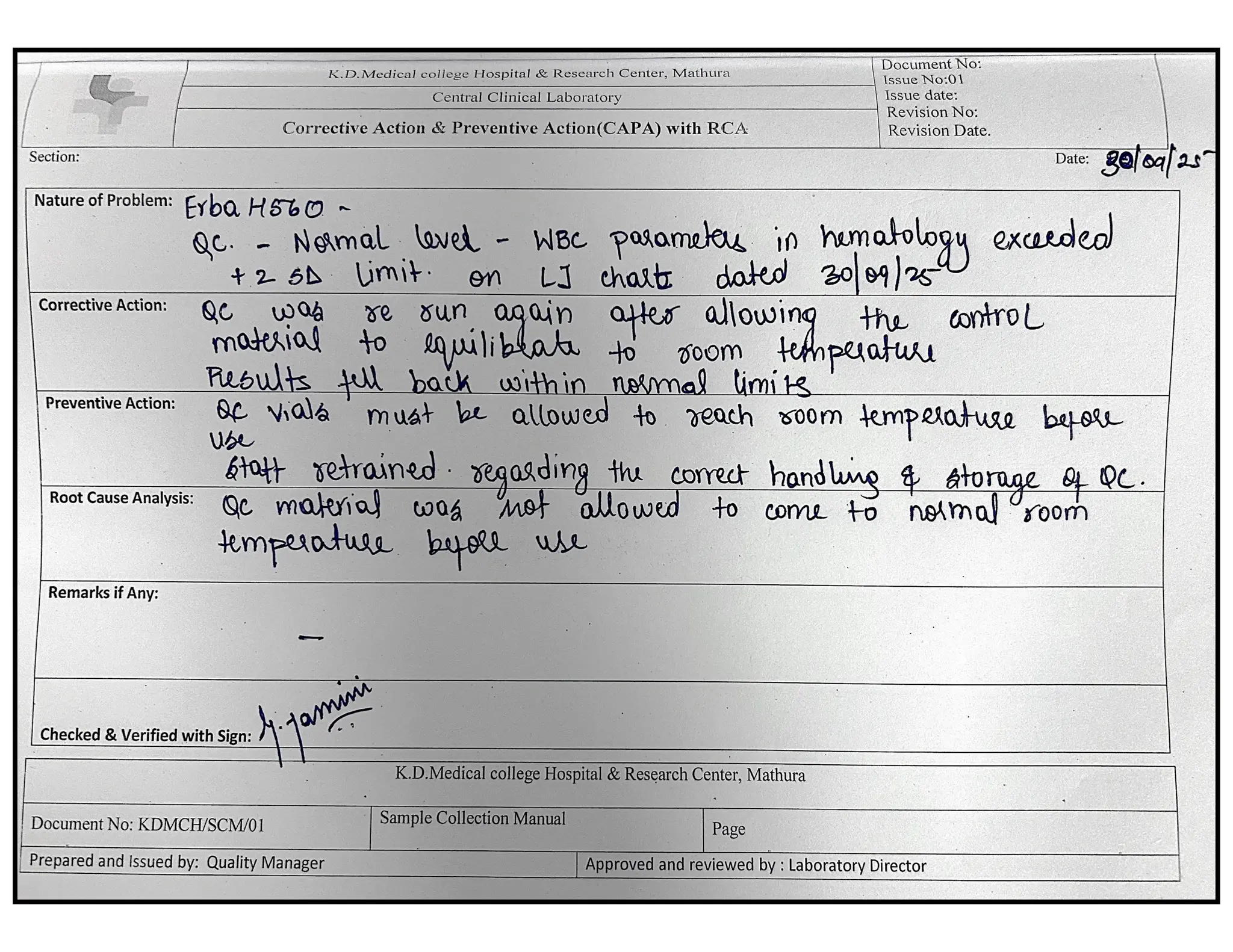
├─ NO → Stop testing → RCA → CAPA → Record IQC failure
└─ YES
↓
Sample analysis (CBC / Coagulation)
↓
Delta check acceptable?
├─ NO → Review result → Document error
└─ YES
↓
EQAS / PT performance reviewed on quarterly basis
ANALYTICAL QIs MONITORED
• IQC failure rate
• EQAS non conformity
‑
• Calibration errors (generally performed by engineer)
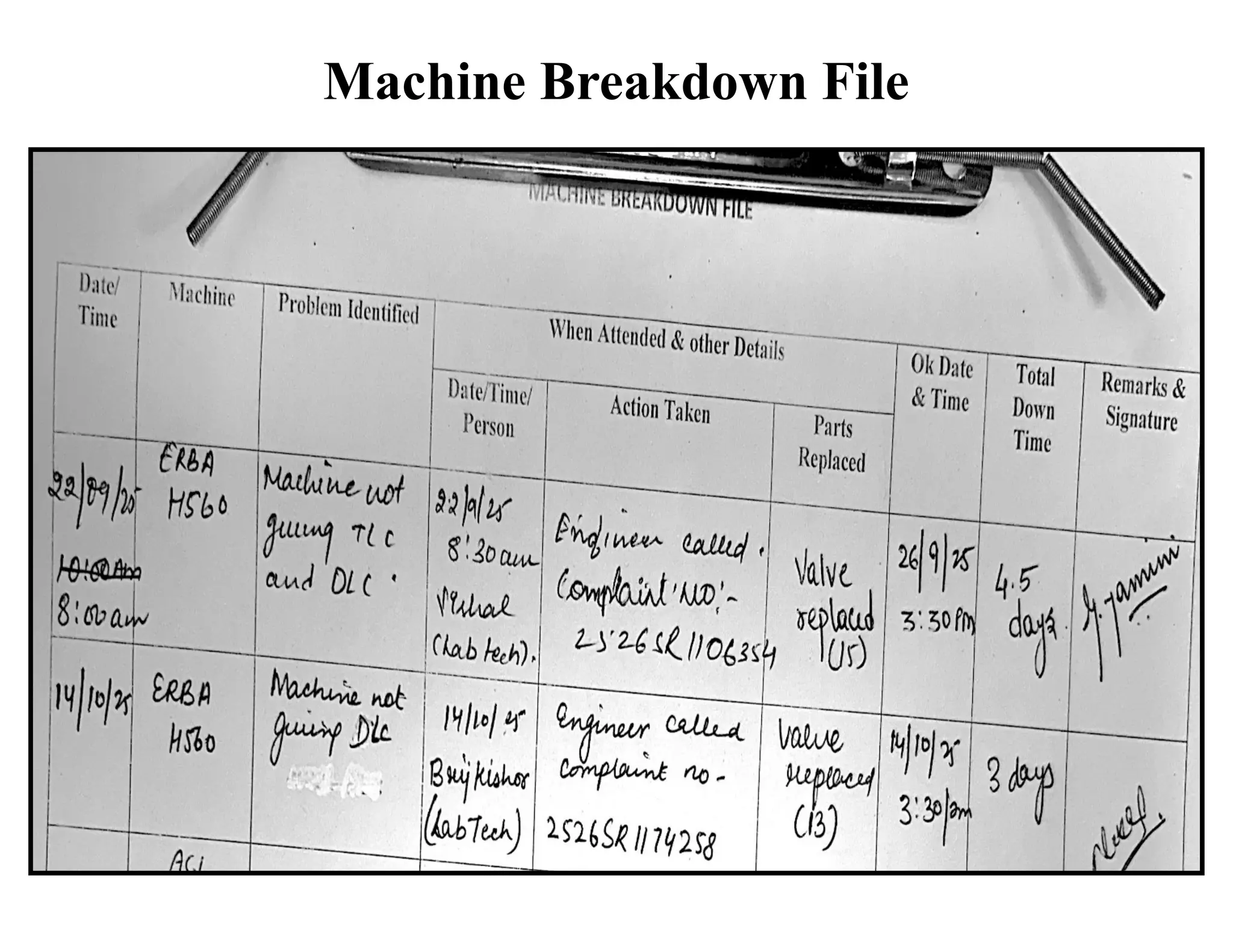
• Analyzer downtime ( to be noted in Machine Breakdown File)
────
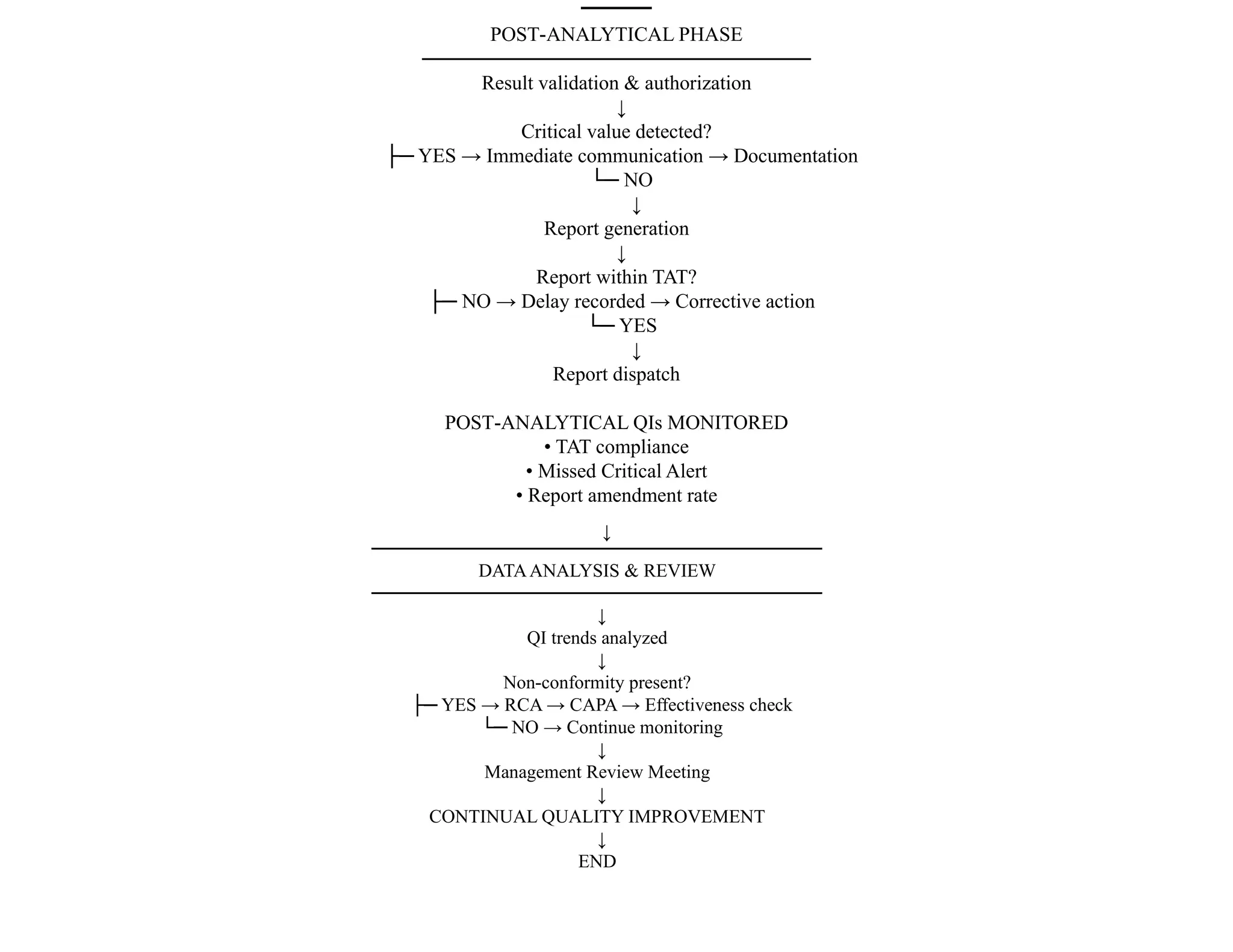
POST ANALYTICAL PHASE
‑
───────────────────────────
Result validation & authorization
↓
Critical value detected?
├─ YES → Immediate communication → Documentation
└─ NO
↓
Report generation
↓
Report within TAT?
├─ NO → Delay recorded → Corrective action
└─ YES
↓
Report dispatch
POST ANALYTICAL QIs MONITORED
‑
• TAT compliance
• Missed Critical Alert
• Report amendment rate
──────────────────────────────────
DATAANALYSIS & REVIEW
──────────────────────────────────
↓
QI trends analyzed
↓
Non conformity present?
‑
├─ YES → RCA → CAPA → Effectiveness check
└─ NO → Continue monitoring
↓
Management Review Meeting
↓
CONTINUAL QUALITY IMPROVEMENT
↓
END
↓
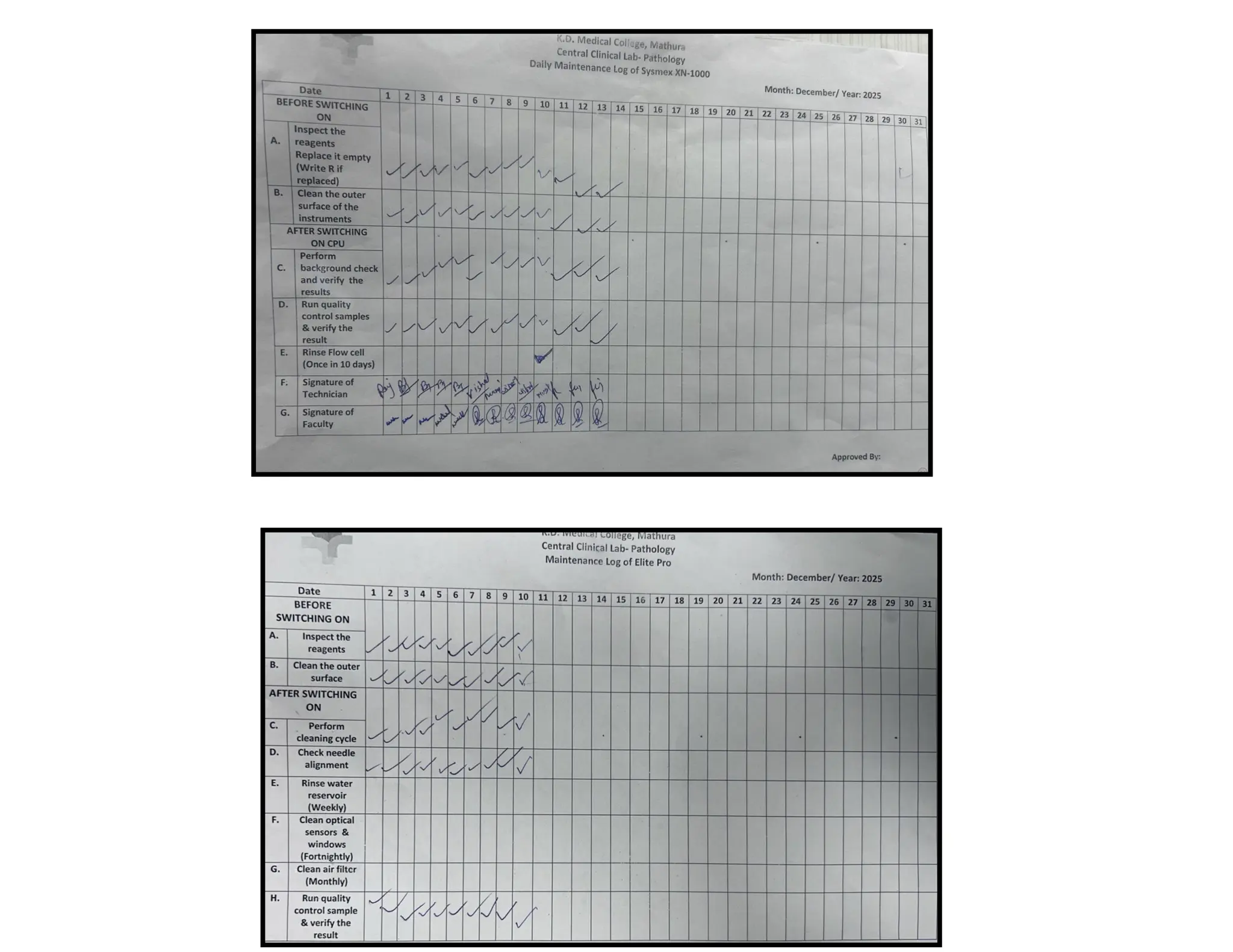
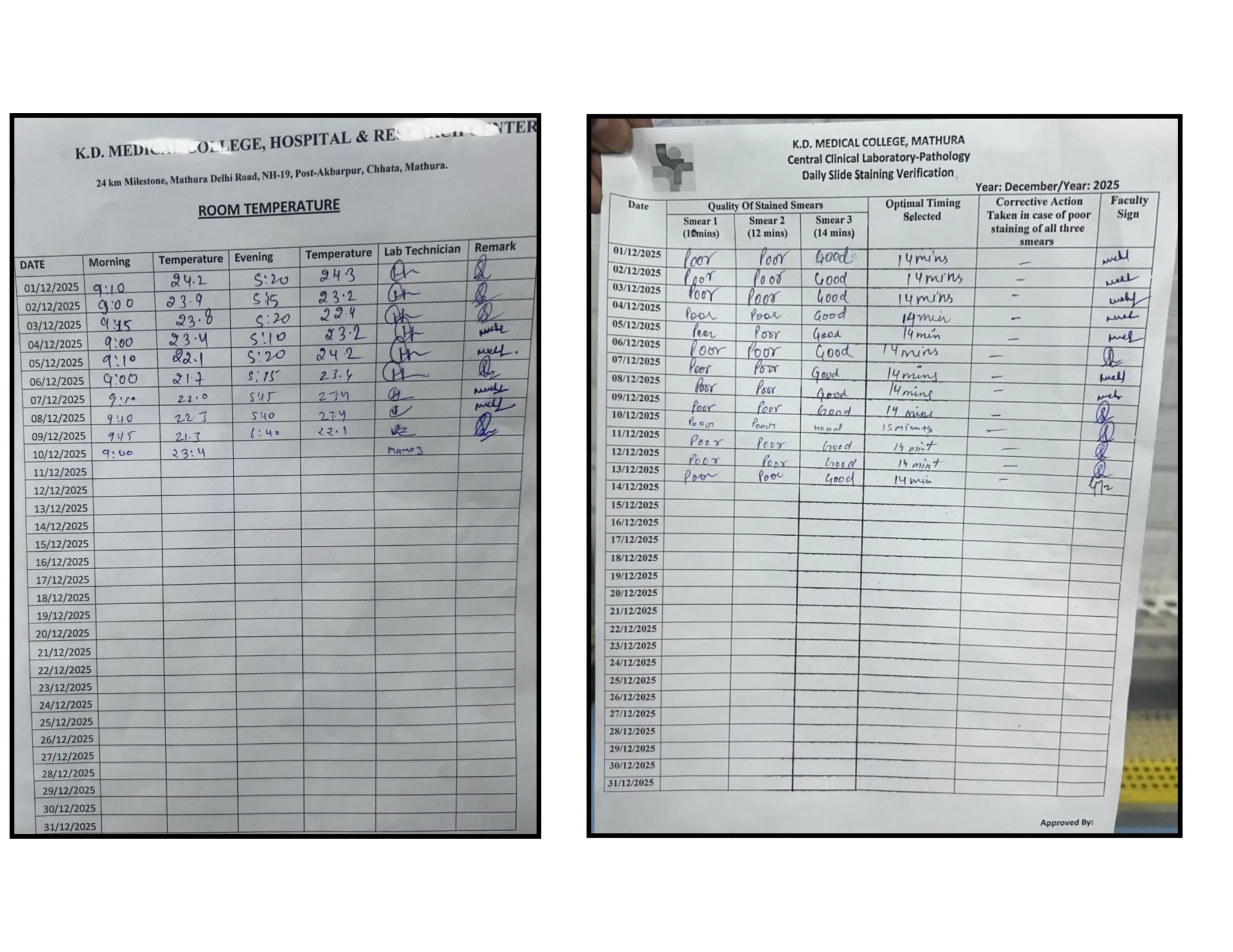
Machine Breakdown File
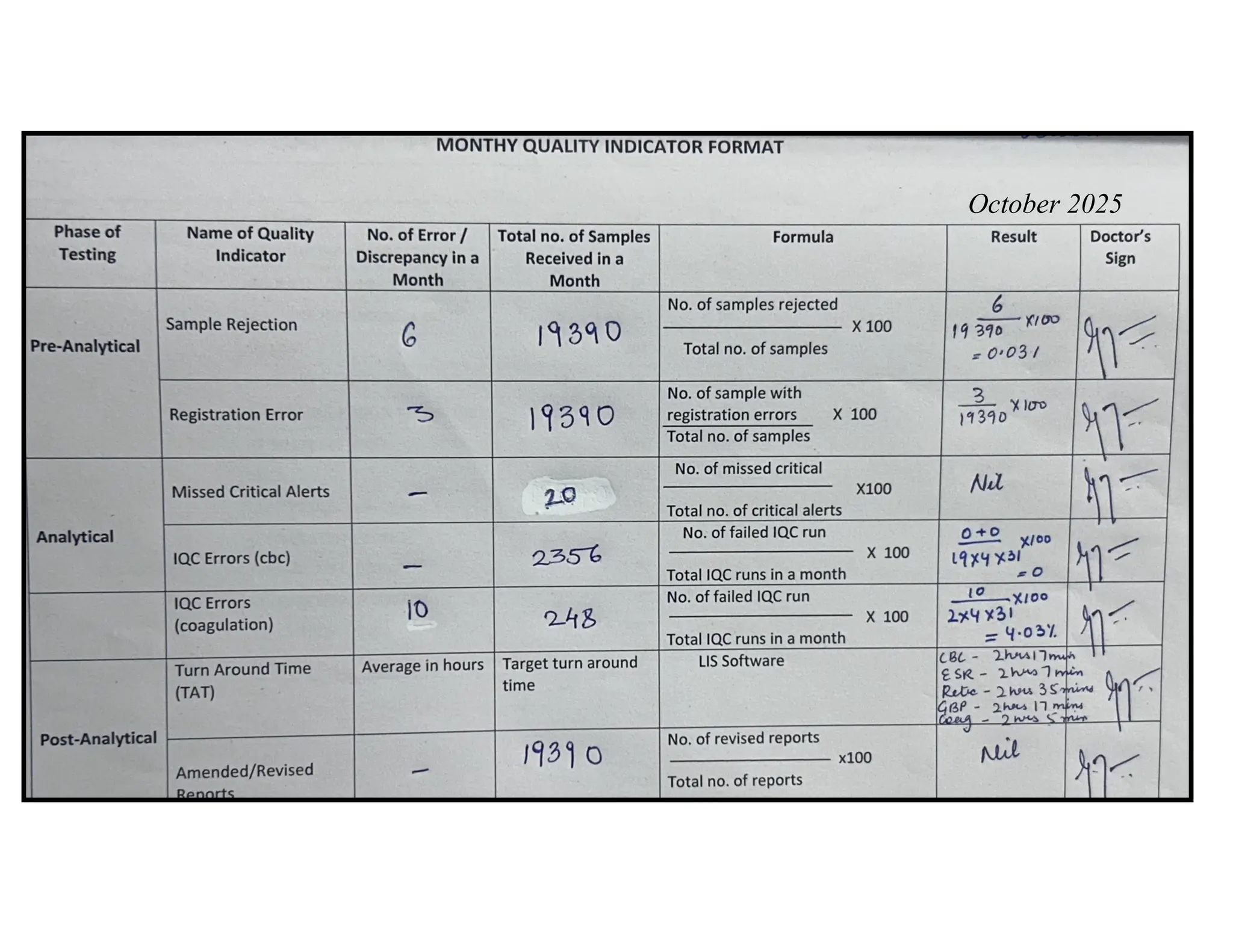
October 2025
Why go through all of this?
Accreditation-
• It is a process of inspection
of laboratories and their
licensing by a third-party
to ensure conformity to
predefined criteria
• Very very long task (it
may take around 2 to 3
years to follow the random
map)
LJ chart.pptx important topic for pathology pgs

LJ chart.pptx important topic for pathology pgs

  • 1.
    QUALITY MANAGEMENT IN LABORATORY Presented By- Dr.Ayushi Agarwal Guided By- Dr. Yamini Guttikonda (18.12.2025)
  • 2.
    QUALITY IS…….. A measureof excellence, or State of being free from defects, deficiencies, and significant variations Invisible when GOOD Impossible to ignore when BAD
  • 3.
    • Quality Assurance An overallmanagement plan to guarantee the integrity of data (THE SYSTEM) • Quality Control A series of analytical measurements used to assess the quality of the analytical data (THE TOOLS)
  • 5.
    Three Phases : Pre-AnalyticalPhase • Procedures occuring before actual testing of specimen • 62% of errors • Patient identification • Patient preparation • Specimen collection • Transport & handling Analytical Phase • 15% of errors • Actual testing • Instrument calibration • Quality control • Result calculation Post-analytical Phase • 23% of errors • Result recording • Timely reporting • Clinical notification • Documentation
  • 6.
    Quality Assessment?? Also knownas proficiency testing It is to determine the quality of results generated by the laboratory It is a challenge to the QA and QC programs It can be external or internal
  • 7.
  • 8.
    Documentation It ensures processesand outcomes are traceable Tool for training Reminds you what to do next “If you have not documented it, you have NOT done it.”
  • 9.
    It is acomprehensively written document that describes the laboratory procedures and all other related issues Essential for ensuring uniformity in laboratory procedures Standard Operating Procedures (SOP)
  • 10.
    TERMINOLOGY • PRECISION: Thisindicates how close test measurements to each other when the same test is run on the same sample repeatedly. • ACCURACY: How close to the true value a measurement is. Hence, the closer to the actual value, the more accurate.
  • 11.
  • 12.
    Systematic vs. RandomErrors Systematic Error Avoidable error due to controllable variables in a measurement. Random Errors Unavoidable errors that are always present in any measurement. Impossible to eliminate
  • 15.
    Statistical Quality ControlExercise •Standard Control values (3 levels of control) •Calculation of mean •Calculation of standard deviation •Creation of Levey-Jennings chart
  • 16.
    • CONTROL: Thisis a sample i.e. chemically & physically similar to the unknown specimen. • STANDARD DEVIATION: This is a statistical expression of scatter or dispersion of values around a central average value.
  • 17.
    CALCULATION OF MEAN Dataset (30.0, 32.0, 31.5, 33.5, 32.0, 33.0, 29.0,29.5, 31.0, 32.5, 34.5, 33.5, 31.5, 30.5, 30.0, 34.0,32.0, 32.0, 35.0, 32.5.) mg/dL The sum of the values (X1 + X2 + X3 … X20) divided by the number (n) of observations The mean of these 20 observations is (639.5 ÷ 20) = 32.0 mg/dL
  • 19.
    Normal Distribution • Allvalues are symmetrically distributed around the mean • Characteristic “bell-shaped” curve • Assumed for all quality control statistics
  • 20.
    Levey-Jennings CHART • Agraphical method for displaying control results and evaluating whether a procedure is in-control or out-of-control • It is named after S.LEVEY & E.R.JENNINGS in 1950.
  • 22.
    • Control valuesare plotted versus time • Lines are drawn from point to point accent, any trends, shifts or random excursions
  • 23.
    L-J Chart Records andevaluate the control values
  • 25.
    Monitoring QC data •Use Levey-Jennings Chart • Plot control values each run, make decision regarding acceptability of run • Monitor overtime to evaluate the precision and accuracy of repeated measurements • Review charts at defined intervals, take necessary action, and document
  • 26.
    INTERNAL QUALITY CONTROL •Use of standard reagents & known control sample • Well trained staff • The batch result are accepted if the values of control sera are within 2 SD.
  • 27.
    • Multi controlQC rules (WESTGARD RULES) given by Dr. James Westgard of the University of Wisconsin in an article in 1981 on laboratory quality control that set the basis for evaluating analytical run quality for medical laboratories. Dr. James Westgard
  • 28.
    • The Westgardsystem -based on the principles of statistical process control used in manufacturing nationwide since the 1950s • Six basic rules in the Westgard scheme: 1-3s, 2- 2s, R-4s, 1-2s, 4-1s, and 10x. These rules are used individually or in combination (multi- rule) to evaluate the quality of analytical runs. • Detect random or systematic errors
  • 29.
    WESTGARD RULES • 1-2SRule • 1-3S Rule • 2-2S Rule • R-4S Rule • 4-1S Rule • 10X Rule
  • 30.
    • Warning 12SDor 1-2s: It is violated if the single IQC value exceeds the mean by ± 2SD.
  • 31.
    • Rejection 22SDor 2-2s: • This rule detects systematic error and is applied within and across runs. • It is violated within the run when two consecutive control values exceed the "same" (mean + 2s or mean - 2s) limit. • The rule is violated across runs when the previous value for a particular control level exceeds the "same" (mean + 2s or mean - 2s) limit. Within run violation Across run violation
  • 32.
    • Rejection 13SDor 1-3s: • It is violated when the single IQC value exceeds the mean by ±3SD. • This rule is applied within control material only. • The 1-3s rule identifies unacceptable random error or possibly the beginning of a large systematic error.
  • 33.
    • Rejection 41SDor 4-1s: It is violated if four consecutive IQC values exceed the same mean plus 1s or the same mean minus 1s control limit.
  • 34.
    •Rejection 10x: • Thisrule detects systematic bias and is applied both within and across control materials. • It is violated across control materials if the last 10 consecutive values, regardless of control level, are on the same side of the mean. • The rule is violated within the control materials if the last 10 values for the same control level are on the same side of the mean.
  • 35.
  • 36.
    Why use Westgardrules? We use it to help us reduce costs while maintaining a high level of certainty that are analytical process is functioning properly In other words to diminish, the false rejection rate without compromising quality
  • 39.
    EXTERNAL QUALITY CONTROL • Allthe participating laboratories daily analyze the same lot of control material • The results are tabulated monthly & sent the sponsoring groups for the data analysis • Summary reports are prepared by the program sponsor & are distributed to all participating laboratories
  • 40.
    • The meanof values of all reference laboratories is taken as the “ true “ or correct value & is used for comparison with the individual laboratory reported values • If the difference between the reported value & the true value is statistically significant then the reporting lab is alerted
  • 41.
    START ↓ PATIENT TEST REQUEST ↓ ────────────────────────────────── PREANALYTICAL PHASE ‑ ────────────────────────────────── ↓ Patient identification verified? ├─ NO → Error recorded → Corrective action → Document └─ YES ↓ Sample collection ↓ • Correct tube (EDTA) • Correct volume • Proper labeling ↓ Sample acceptable? ├─ NO → Sample rejected → QI recorded (rejection / clot / hemolysis) └─ YES ↓ Sample transport & storage ↓ PRE ANALYTICAL QIs MONITORED ‑ • Sample rejection rate • Clotted sample rate • Hemolysis rate • Registration errors
  • 42.
    ────────────────────────────────── ANALYTICAL PHASE ────────────────────────────────── ↓ Analyzer &reagent check Background Check ↓ IQC within limits? ├─ NO → Stop testing → RCA → CAPA → Record IQC failure └─ YES ↓ Sample analysis (CBC / Coagulation) ↓ Delta check acceptable? ├─ NO → Review result → Document error └─ YES ↓ EQAS / PT performance reviewed on quarterly basis ANALYTICAL QIs MONITORED • IQC failure rate • EQAS non conformity ‑ • Calibration errors (generally performed by engineer) • Analyzer downtime ( to be noted in Machine Breakdown File)
  • 43.
    ──── POST ANALYTICAL PHASE ‑ ─────────────────────────── Resultvalidation & authorization ↓ Critical value detected? ├─ YES → Immediate communication → Documentation └─ NO ↓ Report generation ↓ Report within TAT? ├─ NO → Delay recorded → Corrective action └─ YES ↓ Report dispatch POST ANALYTICAL QIs MONITORED ‑ • TAT compliance • Missed Critical Alert • Report amendment rate ────────────────────────────────── DATAANALYSIS & REVIEW ────────────────────────────────── ↓ QI trends analyzed ↓ Non conformity present? ‑ ├─ YES → RCA → CAPA → Effectiveness check └─ NO → Continue monitoring ↓ Management Review Meeting ↓ CONTINUAL QUALITY IMPROVEMENT ↓ END ↓
  • 45.
  • 46.
  • 47.
    Why go throughall of this?
  • 48.
    Accreditation- • It isa process of inspection of laboratories and their licensing by a third-party to ensure conformity to predefined criteria • Very very long task (it may take around 2 to 3 years to follow the random map)