DEFINITION:
Neuralgia
(Greek neuron, "nerve" + algos, "pain")
is pain in the distribution of a nerve
or nerves, as in intercoastal
neuralgia, trigeminal neuralgia,
and glossopharyngeal neuralgia
CAUSES:
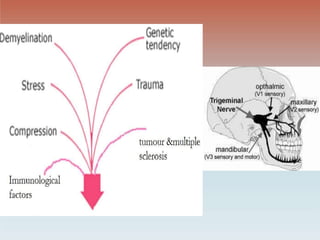
Main cause is damage to nerve leading to
demyelination of nerve and finally leading to
stabbing, severe, shock like pain resulting in
neuralgia.
FACTORS CAUSING DAMAGE ARE-
 Old age
 Infection( postherpetic neuralgia)
 Multiple sclerosis
 Pressure on nerves
 Diabetes
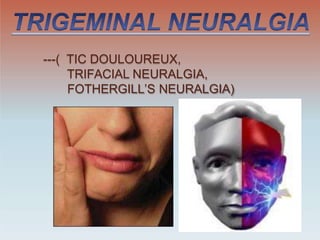
---( TIC DOULOUREUX,
TRIFACIAL NEURALGIA,
FOTHERGILL’S NEURALGIA)
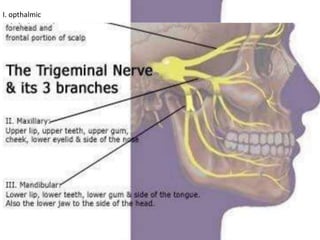
I. opthalmic
INTRODUCTION:
 It is the most debilitating form of
neuralgia that affects the sensory
branches of the Vth cranial nerve.
 It is a disorder of the peripheral or
central fibres of the trigeminal nerve in
which the dominant symptom is pain
in the anterior half of the head.
DEFINITION:
face, originating from t
 It is defined as sudden, usually unilateral,
severe, brief, stabbing, lancinating, recurring
pain in the distribution of one or more
branches of the Vth cranial nerve
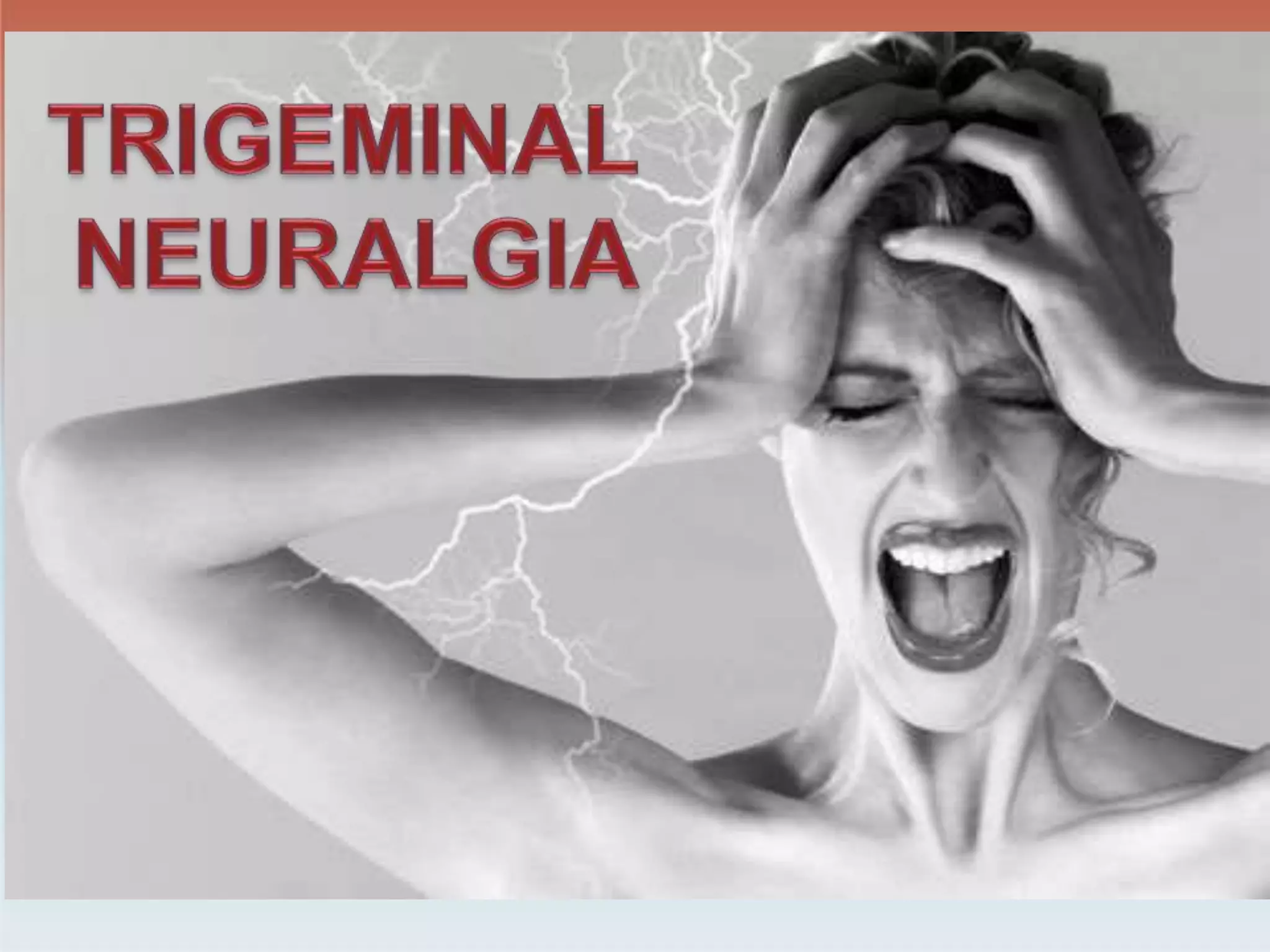
 Trigeminal neuralgia also known as prosopalgia
or fothergill’s disease is aneuropathic disorder
characterized by episodes of intense pain in
the rigeminal nerve
TIC DOULOUREUX:
painful
 TiC DOULOUREUX
jerking.
 It is a truly agonizing condition, in
which the patient may clunch the
hand over the face & experience
severe, lancinating pain associated
with spasmodic contractions of the
facial muscles during attacks .
-a feature that led to use of this term
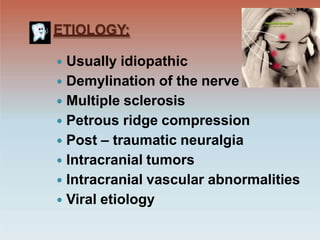
ETIOLOGY:
 Usually idiopathic
 Demylination of the nerve
 Multiple sclerosis
 Petrous ridge compression
 Post – traumatic neuralgia
 Intracranial tumors
 Intracranial vascular abnormalities
 Viral etiology
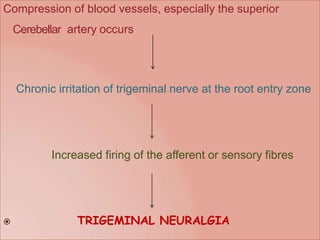
Compression of blood vessels, especially the superior
Cerebellar artery occurs
Chronic irritation of trigeminal nerve at the root entry zone
Increased firing of the afferent or sensory fibres
 TRIGEMINAL NEURALGIA
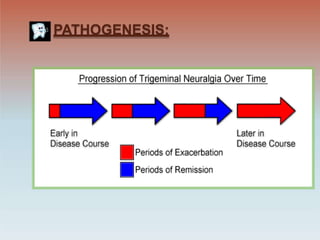
PATHOGENESIS:
TYPES OF TRIGEMINAL NEURALGIA
:
 TYPICAL TRIGEMINALNEURALGIA
 ATYPICAL TRIGEMINALNEURALGIA
 PRE- TRIGEMINAL NEURALGIA
 MULTIPLE SCLEROSIS RELATED TRIGEMINAL
NEURALGIA
 SECONDARY OR TUMOR RELATED
TRIGEMINAL NEURALGIA
 TRIGEMINAL NEUROPATHY OR POST-
TRAUMATIC TRIGEMINAL NEURALGIA
 FAILED TRIGEMINAL NEURALGIA
1. TYPICAL TRIGEMINAL NEURALGIA:
• Most common form, previously termed CLASSICAL,
IDIOPATHIC and ESSENTIAL TRIGEMINALNEURALGIA.
•Nearly all cases of typical trigeminal neuralgia are caused by
blood vessel compressing the trigeminal nerve root.
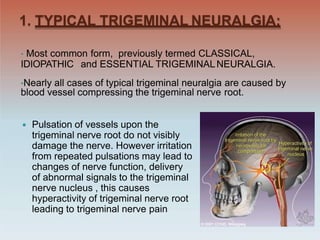
 Pulsation of vessels upon the
trigeminal nerve root do not visibly
damage the nerve. However irritation
from repeated pulsations may lead to
changes of nerve function, delivery
of abnormal signals to the trigeminal
nerve nucleus , this causes
hyperactivity of trigeminal nerve root
leading to trigeminal nerve pain
2. ATYPICAL TRIGEMINAL
NEURALGIA:
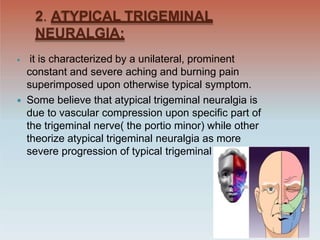
 it is characterized by a unilateral, prominent
constant and severe aching and burning pain
superimposed upon otherwise typical symptom.
 Some believe that atypical trigeminal neuralgia is
due to vascular compression upon specific part of
the trigeminal nerve( the portio minor) while other
theorize atypical trigeminal neuralgia as more
severe progression of typical trigeminal neuralgia.
3. PRE- TRIGEMINAL NEURALGIA:
- Days to years before the first attack of Trigeminal pain,
some sufferers experience odd sensations of pain,( such
as toothache) or discomfort( parasthesia).
4. MULTIPLE SCLEROSIS RELATED
TRIGEMINAL NEURALGIA:
- Symptoms of MS related trigeminal neuralgia
are identical to typical trigeminal neuralgia. Bilateral
trigeminal neuralgia is more commonly seen in
people with MS. MS involves formation of
demyelinating plaques within the brain.
GENERAL CHARACTERISTICS
 INCIDENCE-
 AGE-
 SEX-
 AFFLICTION FOR SIDE-
8: 100000
5th-6th decade of life
female> male
right> left
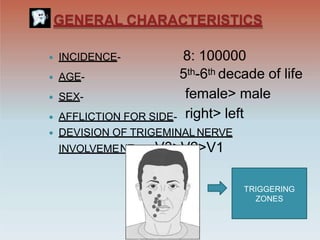
 DEVISION OF TRIGEMINAL NERVE
NT- V3>V2>V1
INVOLVEME
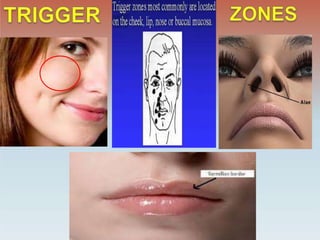
TRIGGERING
ZONES
5. SECONDARY OR TUMOR
RELATED TRIGEMINAL NEURALGIA:
Trigeminal pain caused by a lesion, such as a
tumor.
Tumor that severely compresses or distorts the
trigeminal nerve may cause numbness, weakness of
chewing muscles or constant aching pain
6. FAILED TRIGEMINAL NEURALGIA:
In a very small proportion of suferrers, all medications,
surgical procedures prove ineffective in controlling the
pain.
Such individuals also suffer from additional trigeminal
neuropathy as a result of destructive intervention they
underwent.
CLINICAL CHARACTERISTICS
 Manifests as a sudden, unilateral, intermittent paroxysmal,
sharp, shooting, lancinating , shock like pain, elicited by slight
touching superficial ‘trigger points’ which radiates from that
point, across the distribution of one or more branches of the
trigeminal nerve
 Pain is usually confined to one part of one division of trigeminal
nerve
 Pain rarely crosses the midline
 Attacks do not occur during sleep
 Pain is of short duration, but may recur with variable frequency.
 In extreme cases, the patient will have a motionless face – the
‘frozen or mask like face’.
 Common trigger zone include- cutaneous( corner of the lips,
cheek, ala of the nose, lateral brow); intraoral( teeth, gingivae,
tongue). Trigger area on the face are so sensitive thattouching
or even air currents can trigger an episode.
 10-12% of cases are bilateral, or occurring on both sides. This
mainly seen in cases with systemic involvement include multiple
sclerosis or expanding cranial tumor
DIAGNOSIS
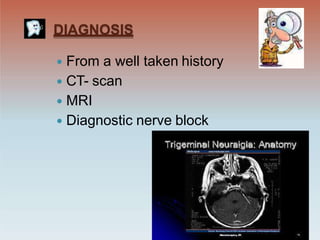
 From a well taken history
 CT- scan
 MRI
 Diagnostic nerve block
TREATMENT
1. MEDICAL
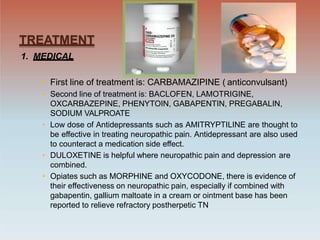
• First line of treatment is: CARBAMAZIPINE ( anticonvulsant)
• Second line of treatment is: BACLOFEN, LAMOTRIGINE,
OXCARBAZEPINE, PHENYTOIN, GABAPENTIN, PREGABALIN,
SODIUM VALPROATE
• Low dose of Antidepressants such as AMITRYPTILINE are thought to
be effective in treating neuropathic pain. Antidepressant are also used
to counteract a medication side effect.
• DULOXETINE is helpful where neuropathic pain and depression are
combined.
• Opiates such as MORPHINE and OXYCODONE, there is evidence of
their effectiveness on neuropathic pain, especially if combined with
gabapentin, gallium maltoate in a cream or ointment base has been
reported to relieve refractory postherpetic TN
2.SURGICAL METHOD:
ION)
INJECTION OF NERVE WITH ANESTHETIC A
•
G
E
LN
oT
ngacting anesthetic agents
• Alcohol injection
 PERIPHERAL GLYCEROL INJECTION
 PERIPHERAL NEURECTOMY( NERVE AVULS
 OPEN PROCEDURES ( INTRACRANIAL PROCEDURES)
- MICROVASCULAR DECOMPRESSION
- PERCUTANEOUS RHIZOTOMIES
- GAMMA KNIFE RADIOSURGERY
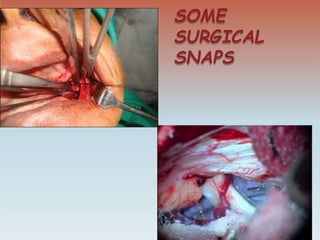
SOME
SURGICAL
SNAPS
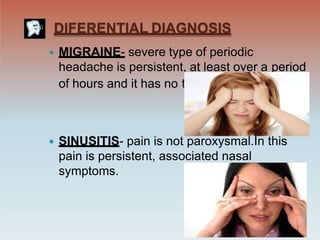
DIFERENTIAL DIAGNOSIS
 MIGRAINE- severe type of periodic
headache is persistent, at least over a period
of hours and it has no trigger zone.
 SINUSITIS- pain is not paroxysmal.In this
pain is persistent, associated nasal
symptoms.
 DENTAL PAIN- localized, related to biting or hot
or cold foods, visible abnormalities on oral
examination.
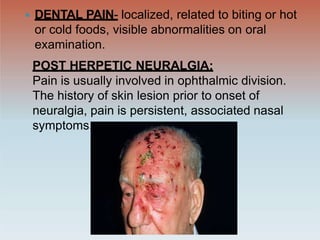
POST HERPETIC NEURALGIA:
Pain is usually involved in ophthalmic division.
The history of skin lesion prior to onset of
neuralgia, pain is persistent, associated nasal
symptoms.
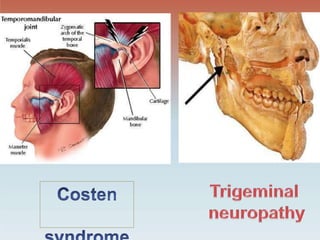
ar nerve in the
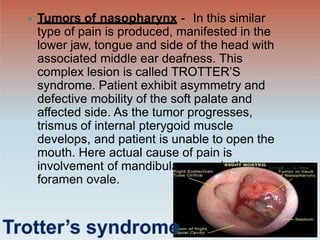
 Tumors of nasopharynx - In this similar
type of pain is produced, manifested in the
lower jaw, tongue and side of the head with
associated middle ear deafness. This
complex lesion is called TROTTER’S
syndrome. Patient exhibit asymmetry and
defective mobility of the soft palate and
affected side. As the tumor progresses,
trismus of internal pterygoid muscle
develops, and patient is unable to open the
mouth. Here actual cause of pain is
involvement of mandibul
foramen ovale.
FINAL WORDS:
 Patients with trigeminal neuralgia
deserve an accurate and
dispassionate explanation of merits
and drawbacks of all methods of
treatment from the outset.
 Surgical approaches are performed
when medication cannot control
pain,patient cannot tolerate the
adverse effects of the medication or in
particular medically compromised
patients contraindicated for the
required medication.
Trigeminal_neuralgia_.pptx

Trigeminal_neuralgia_.pptx

  • 3.
    DEFINITION: Neuralgia (Greek neuron, "nerve"+ algos, "pain") is pain in the distribution of a nerve or nerves, as in intercoastal neuralgia, trigeminal neuralgia, and glossopharyngeal neuralgia
  • 4.
    CAUSES: Main cause isdamage to nerve leading to demyelination of nerve and finally leading to stabbing, severe, shock like pain resulting in neuralgia. FACTORS CAUSING DAMAGE ARE-  Old age  Infection( postherpetic neuralgia)  Multiple sclerosis  Pressure on nerves  Diabetes
  • 5.
    ---( TIC DOULOUREUX, TRIFACIALNEURALGIA, FOTHERGILL’S NEURALGIA)
  • 6.
  • 8.
    INTRODUCTION:  It isthe most debilitating form of neuralgia that affects the sensory branches of the Vth cranial nerve.  It is a disorder of the peripheral or central fibres of the trigeminal nerve in which the dominant symptom is pain in the anterior half of the head.
  • 9.
    DEFINITION: face, originating fromt  It is defined as sudden, usually unilateral, severe, brief, stabbing, lancinating, recurring pain in the distribution of one or more branches of the Vth cranial nerve  Trigeminal neuralgia also known as prosopalgia or fothergill’s disease is aneuropathic disorder characterized by episodes of intense pain in the rigeminal nerve
  • 10.
    TIC DOULOUREUX: painful  TiCDOULOUREUX jerking.  It is a truly agonizing condition, in which the patient may clunch the hand over the face & experience severe, lancinating pain associated with spasmodic contractions of the facial muscles during attacks . -a feature that led to use of this term
  • 11.
    ETIOLOGY:  Usually idiopathic Demylination of the nerve  Multiple sclerosis  Petrous ridge compression  Post – traumatic neuralgia  Intracranial tumors  Intracranial vascular abnormalities  Viral etiology
  • 12.
    Compression of bloodvessels, especially the superior Cerebellar artery occurs Chronic irritation of trigeminal nerve at the root entry zone Increased firing of the afferent or sensory fibres  TRIGEMINAL NEURALGIA
  • 14.
  • 16.
    TYPES OF TRIGEMINALNEURALGIA :  TYPICAL TRIGEMINALNEURALGIA  ATYPICAL TRIGEMINALNEURALGIA  PRE- TRIGEMINAL NEURALGIA  MULTIPLE SCLEROSIS RELATED TRIGEMINAL NEURALGIA  SECONDARY OR TUMOR RELATED TRIGEMINAL NEURALGIA  TRIGEMINAL NEUROPATHY OR POST- TRAUMATIC TRIGEMINAL NEURALGIA  FAILED TRIGEMINAL NEURALGIA
  • 17.
    1. TYPICAL TRIGEMINALNEURALGIA: • Most common form, previously termed CLASSICAL, IDIOPATHIC and ESSENTIAL TRIGEMINALNEURALGIA. •Nearly all cases of typical trigeminal neuralgia are caused by blood vessel compressing the trigeminal nerve root.  Pulsation of vessels upon the trigeminal nerve root do not visibly damage the nerve. However irritation from repeated pulsations may lead to changes of nerve function, delivery of abnormal signals to the trigeminal nerve nucleus , this causes hyperactivity of trigeminal nerve root leading to trigeminal nerve pain
  • 18.
    2. ATYPICAL TRIGEMINAL NEURALGIA: it is characterized by a unilateral, prominent constant and severe aching and burning pain superimposed upon otherwise typical symptom.  Some believe that atypical trigeminal neuralgia is due to vascular compression upon specific part of the trigeminal nerve( the portio minor) while other theorize atypical trigeminal neuralgia as more severe progression of typical trigeminal neuralgia.
  • 19.
    3. PRE- TRIGEMINALNEURALGIA: - Days to years before the first attack of Trigeminal pain, some sufferers experience odd sensations of pain,( such as toothache) or discomfort( parasthesia). 4. MULTIPLE SCLEROSIS RELATED TRIGEMINAL NEURALGIA: - Symptoms of MS related trigeminal neuralgia are identical to typical trigeminal neuralgia. Bilateral trigeminal neuralgia is more commonly seen in people with MS. MS involves formation of demyelinating plaques within the brain.
  • 20.
    GENERAL CHARACTERISTICS  INCIDENCE- AGE-  SEX-  AFFLICTION FOR SIDE- 8: 100000 5th-6th decade of life female> male right> left  DEVISION OF TRIGEMINAL NERVE NT- V3>V2>V1 INVOLVEME TRIGGERING ZONES
  • 21.
    5. SECONDARY ORTUMOR RELATED TRIGEMINAL NEURALGIA: Trigeminal pain caused by a lesion, such as a tumor. Tumor that severely compresses or distorts the trigeminal nerve may cause numbness, weakness of chewing muscles or constant aching pain 6. FAILED TRIGEMINAL NEURALGIA: In a very small proportion of suferrers, all medications, surgical procedures prove ineffective in controlling the pain. Such individuals also suffer from additional trigeminal neuropathy as a result of destructive intervention they underwent.
  • 22.
    CLINICAL CHARACTERISTICS  Manifestsas a sudden, unilateral, intermittent paroxysmal, sharp, shooting, lancinating , shock like pain, elicited by slight touching superficial ‘trigger points’ which radiates from that point, across the distribution of one or more branches of the trigeminal nerve  Pain is usually confined to one part of one division of trigeminal nerve  Pain rarely crosses the midline  Attacks do not occur during sleep  Pain is of short duration, but may recur with variable frequency.  In extreme cases, the patient will have a motionless face – the ‘frozen or mask like face’.  Common trigger zone include- cutaneous( corner of the lips, cheek, ala of the nose, lateral brow); intraoral( teeth, gingivae, tongue). Trigger area on the face are so sensitive thattouching or even air currents can trigger an episode.  10-12% of cases are bilateral, or occurring on both sides. This mainly seen in cases with systemic involvement include multiple sclerosis or expanding cranial tumor
  • 23.
    DIAGNOSIS  From awell taken history  CT- scan  MRI  Diagnostic nerve block
  • 24.
    TREATMENT 1. MEDICAL • Firstline of treatment is: CARBAMAZIPINE ( anticonvulsant) • Second line of treatment is: BACLOFEN, LAMOTRIGINE, OXCARBAZEPINE, PHENYTOIN, GABAPENTIN, PREGABALIN, SODIUM VALPROATE • Low dose of Antidepressants such as AMITRYPTILINE are thought to be effective in treating neuropathic pain. Antidepressant are also used to counteract a medication side effect. • DULOXETINE is helpful where neuropathic pain and depression are combined. • Opiates such as MORPHINE and OXYCODONE, there is evidence of their effectiveness on neuropathic pain, especially if combined with gabapentin, gallium maltoate in a cream or ointment base has been reported to relieve refractory postherpetic TN
  • 25.
    2.SURGICAL METHOD: ION) INJECTION OFNERVE WITH ANESTHETIC A • G E LN oT ngacting anesthetic agents • Alcohol injection  PERIPHERAL GLYCEROL INJECTION  PERIPHERAL NEURECTOMY( NERVE AVULS  OPEN PROCEDURES ( INTRACRANIAL PROCEDURES) - MICROVASCULAR DECOMPRESSION - PERCUTANEOUS RHIZOTOMIES - GAMMA KNIFE RADIOSURGERY
  • 26.
  • 27.
    DIFERENTIAL DIAGNOSIS  MIGRAINE-severe type of periodic headache is persistent, at least over a period of hours and it has no trigger zone.  SINUSITIS- pain is not paroxysmal.In this pain is persistent, associated nasal symptoms.
  • 28.
     DENTAL PAIN-localized, related to biting or hot or cold foods, visible abnormalities on oral examination. POST HERPETIC NEURALGIA: Pain is usually involved in ophthalmic division. The history of skin lesion prior to onset of neuralgia, pain is persistent, associated nasal symptoms.
  • 29.
    ar nerve inthe  Tumors of nasopharynx - In this similar type of pain is produced, manifested in the lower jaw, tongue and side of the head with associated middle ear deafness. This complex lesion is called TROTTER’S syndrome. Patient exhibit asymmetry and defective mobility of the soft palate and affected side. As the tumor progresses, trismus of internal pterygoid muscle develops, and patient is unable to open the mouth. Here actual cause of pain is involvement of mandibul foramen ovale.
  • 32.
    FINAL WORDS:  Patientswith trigeminal neuralgia deserve an accurate and dispassionate explanation of merits and drawbacks of all methods of treatment from the outset.  Surgical approaches are performed when medication cannot control pain,patient cannot tolerate the adverse effects of the medication or in particular medically compromised patients contraindicated for the required medication.