Trigeminal neuralgia
Prepared by
Wria S. rasheed
contents:
Anatomy of trigeminal nerve
Definition
Clinical characteristics
Causes
Etiology
Pathogenesis
Types
Diagnosis
Differential
Diagnosis
Treatment
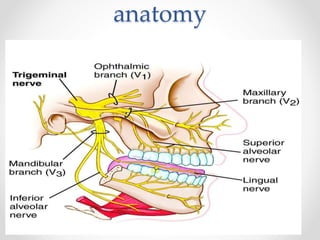
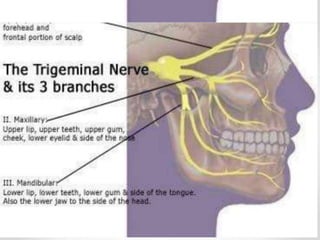
anatomy
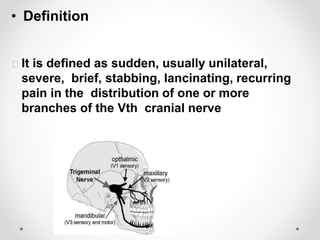
• Definition
It is defined as sudden, usually unilateral,
severe, brief, stabbing, lancinating, recurring
pain in the distribution of one or more
branches of the Vth cranial nerve
Clinical presentation
In the early stages, the pain of trigeminal
neuralgia may be rather mild and is often
described by the patient as a twinge, dull ache,
or burning sensation. This clinical presentation
may be erroneously attributed to disorders of
the teeth, jaws, and paranasal sinuses and lead
to escalation of treatment and a variety of
therapeutic misadventures.
trigger zones Some patients are sensitive in
certain areas of the face, which when touched
cause an attack of pain .
Causes
Main cause is damage to nerve leading to
demyelination of nerve and finally leading to
stabbing, severe, shock like pain resulting in
neuralgia.
Factors causing damage are-
Old age
Infection
Multiple sclerosis
Pressure on nerves
Diabetes
Etiology
Usually idiopathic
Demylination of the nerve
Multiple sclerosis
Petrous ridge compression
Post – traumatic neuralgia
Intracranial tumors
Intracranial vascular abnormalities
Viral etiology
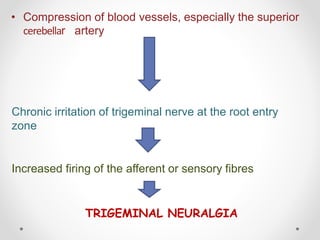
• Compression of blood vessels, especially the superior
cerebellar artery
Chronic irritation of trigeminal nerve at the root entry
zone
Increased firing of the afferent or sensory fibres
TRIGEMINAL NEURALGIA
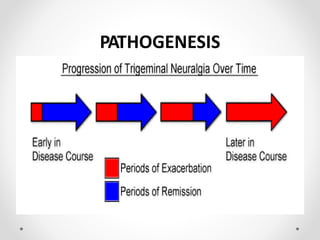
PATHOGENESIS
types
Typical trigeminal neuralgia:
Most common form, previously termed
IDIOPATHIC.
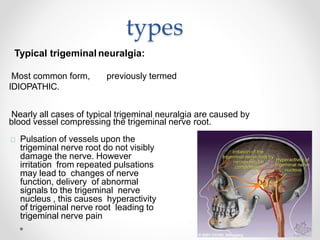
Nearly all cases of typical trigeminal neuralgia are caused by
blood vessel compressing the trigeminal nerve root.
Pulsation of vessels upon the
trigeminal nerve root do not visibly
damage the nerve. However
irritation from repeated pulsations
may lead to changes of nerve
function, delivery of abnormal
signals to the trigeminal nerve
nucleus , this causes hyperactivity
of trigeminal nerve root leading to
trigeminal nerve pain
Atypical trigeminal neuralgia:
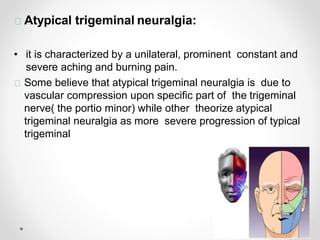
• it is characterized by a unilateral, prominent constant and
severe aching and burning pain.
Some believe that atypical trigeminal neuralgia is due to
vascular compression upon specific part of the trigeminal
nerve( the portio minor) while other theorize atypical
trigeminal neuralgia as more severe progression of typical
trigeminal
Pre- trigeminal neuralgia:
Days to years before the first attach of trigeminal pain some sufferers
experience odd sensations of pain,( such
As toothache) or discomfort( parasthesia).
Multiple sclerosis related trigeminal Neuralgia:
Symptoms of MS related trigeminal neuralgia are identical to
typical trigeminal neuralgia. Bilateral trigeminal neuralgia
is more commonly seen in people with MS. MS involves
formation of demyelinating plaques within the brain.
Secondary or tumor related trigeminal
neuralgia:
Trigeminal pain caused by a lesion, such as a tumor.
Tumor that severely compresses or distorts the trigeminal
nerve may cause numbness, weakness of chewing muscles
or constant aching pain
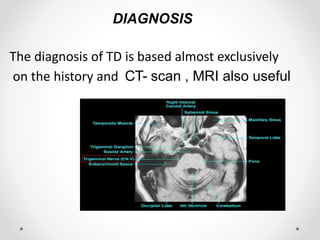
DIAGNOSIS
The diagnosis of TD is based almost exclusively
on the history and CT- scan , MRI also useful
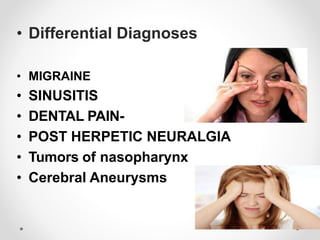
• Differential Diagnoses
• MIGRAINE
• SINUSITIS
• DENTAL PAIN-
• POST HERPETIC NEURALGIA
• Tumors of nasopharynx
• Cerebral Aneurysms
TREATMENT
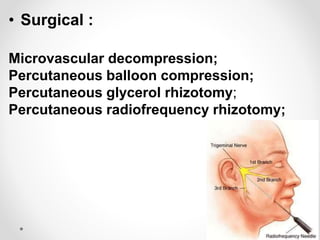
• Medical
• first line of treatment is: carbamazipine
( anticonvulsant)
• second line of treatment is: baclofen,
oxcarbazepine, phenytoin,, pregabalin,
• low dose of antidepressants such as
amitryptiline are thought to be effective in
treating neuropathic pain.
• morphine and oxycodone, there is evidence of
their effectiveness on neuropathic pain,
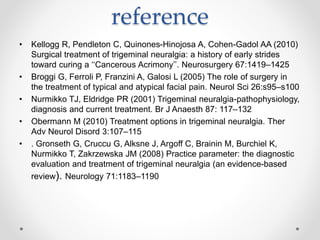
• Surgical :
Microvascular decompression;
Percutaneous balloon compression;
Percutaneous glycerol rhizotomy;
Percutaneous radiofrequency rhizotomy;
reference
• Kellogg R, Pendleton C, Quinones-Hinojosa A, Cohen-Gadol AA (2010)
Surgical treatment of trigeminal neuralgia: a history of early strides
toward curing a ‘‘Cancerous Acrimony’’. Neurosurgery 67:1419–1425
• Broggi G, Ferroli P, Franzini A, Galosi L (2005) The role of surgery in
the treatment of typical and atypical facial pain. Neurol Sci 26:s95–s100
• Nurmikko TJ, Eldridge PR (2001) Trigeminal neuralgia-pathophysiology,
diagnosis and current treatment. Br J Anaesth 87: 117–132
• Obermann M (2010) Treatment options in trigeminal neuralgia. Ther
Adv Neurol Disord 3:107–115
• . Gronseth G, Cruccu G, Alksne J, Argoff C, Brainin M, Burchiel K,
Nurmikko T, Zakrzewska JM (2008) Practice parameter: the diagnostic
evaluation and treatment of trigeminal neuralgia (an evidence-based
review). Neurology 71:1183–1190
• Mallin AW (1961) Trigeminal neuralgia in multiple sclerosis:
report of two cases and review of literature. J Natl Med
Assoc 53:18–23
• Pawl RP (1997) Trigeminal neuralgia and atypical facial
pain. Curr Pain Headache Rep 1:175–181
• Freemont AJ, Millac P (1981) The place of peripheral
neurectomy in the management of trigeminal neuralgia.
Postgrad Med J 57:75–76
Trigeminal neuralgia

Trigeminal neuralgia

  • 1.
  • 2.
    contents: Anatomy of trigeminalnerve Definition Clinical characteristics Causes Etiology Pathogenesis Types Diagnosis Differential Diagnosis Treatment
  • 3.
  • 5.
    • Definition It isdefined as sudden, usually unilateral, severe, brief, stabbing, lancinating, recurring pain in the distribution of one or more branches of the Vth cranial nerve
  • 6.
    Clinical presentation In theearly stages, the pain of trigeminal neuralgia may be rather mild and is often described by the patient as a twinge, dull ache, or burning sensation. This clinical presentation may be erroneously attributed to disorders of the teeth, jaws, and paranasal sinuses and lead to escalation of treatment and a variety of therapeutic misadventures. trigger zones Some patients are sensitive in certain areas of the face, which when touched cause an attack of pain .
  • 7.
    Causes Main cause isdamage to nerve leading to demyelination of nerve and finally leading to stabbing, severe, shock like pain resulting in neuralgia. Factors causing damage are- Old age Infection Multiple sclerosis Pressure on nerves Diabetes
  • 8.
    Etiology Usually idiopathic Demylination ofthe nerve Multiple sclerosis Petrous ridge compression Post – traumatic neuralgia Intracranial tumors Intracranial vascular abnormalities Viral etiology
  • 9.
    • Compression ofblood vessels, especially the superior cerebellar artery Chronic irritation of trigeminal nerve at the root entry zone Increased firing of the afferent or sensory fibres TRIGEMINAL NEURALGIA
  • 10.
  • 11.
    types Typical trigeminal neuralgia: Mostcommon form, previously termed IDIOPATHIC. Nearly all cases of typical trigeminal neuralgia are caused by blood vessel compressing the trigeminal nerve root. Pulsation of vessels upon the trigeminal nerve root do not visibly damage the nerve. However irritation from repeated pulsations may lead to changes of nerve function, delivery of abnormal signals to the trigeminal nerve nucleus , this causes hyperactivity of trigeminal nerve root leading to trigeminal nerve pain
  • 12.
    Atypical trigeminal neuralgia: •it is characterized by a unilateral, prominent constant and severe aching and burning pain. Some believe that atypical trigeminal neuralgia is due to vascular compression upon specific part of the trigeminal nerve( the portio minor) while other theorize atypical trigeminal neuralgia as more severe progression of typical trigeminal
  • 13.
    Pre- trigeminal neuralgia: Daysto years before the first attach of trigeminal pain some sufferers experience odd sensations of pain,( such As toothache) or discomfort( parasthesia). Multiple sclerosis related trigeminal Neuralgia: Symptoms of MS related trigeminal neuralgia are identical to typical trigeminal neuralgia. Bilateral trigeminal neuralgia is more commonly seen in people with MS. MS involves formation of demyelinating plaques within the brain.
  • 14.
    Secondary or tumorrelated trigeminal neuralgia: Trigeminal pain caused by a lesion, such as a tumor. Tumor that severely compresses or distorts the trigeminal nerve may cause numbness, weakness of chewing muscles or constant aching pain
  • 15.
    DIAGNOSIS The diagnosis ofTD is based almost exclusively on the history and CT- scan , MRI also useful
  • 16.
    • Differential Diagnoses •MIGRAINE • SINUSITIS • DENTAL PAIN- • POST HERPETIC NEURALGIA • Tumors of nasopharynx • Cerebral Aneurysms
  • 17.
    TREATMENT • Medical • firstline of treatment is: carbamazipine ( anticonvulsant) • second line of treatment is: baclofen, oxcarbazepine, phenytoin,, pregabalin, • low dose of antidepressants such as amitryptiline are thought to be effective in treating neuropathic pain. • morphine and oxycodone, there is evidence of their effectiveness on neuropathic pain,
  • 18.
    • Surgical : Microvasculardecompression; Percutaneous balloon compression; Percutaneous glycerol rhizotomy; Percutaneous radiofrequency rhizotomy;
  • 19.
    reference • Kellogg R,Pendleton C, Quinones-Hinojosa A, Cohen-Gadol AA (2010) Surgical treatment of trigeminal neuralgia: a history of early strides toward curing a ‘‘Cancerous Acrimony’’. Neurosurgery 67:1419–1425 • Broggi G, Ferroli P, Franzini A, Galosi L (2005) The role of surgery in the treatment of typical and atypical facial pain. Neurol Sci 26:s95–s100 • Nurmikko TJ, Eldridge PR (2001) Trigeminal neuralgia-pathophysiology, diagnosis and current treatment. Br J Anaesth 87: 117–132 • Obermann M (2010) Treatment options in trigeminal neuralgia. Ther Adv Neurol Disord 3:107–115 • . Gronseth G, Cruccu G, Alksne J, Argoff C, Brainin M, Burchiel K, Nurmikko T, Zakrzewska JM (2008) Practice parameter: the diagnostic evaluation and treatment of trigeminal neuralgia (an evidence-based review). Neurology 71:1183–1190
  • 20.
    • Mallin AW(1961) Trigeminal neuralgia in multiple sclerosis: report of two cases and review of literature. J Natl Med Assoc 53:18–23 • Pawl RP (1997) Trigeminal neuralgia and atypical facial pain. Curr Pain Headache Rep 1:175–181 • Freemont AJ, Millac P (1981) The place of peripheral neurectomy in the management of trigeminal neuralgia. Postgrad Med J 57:75–76