Dr. Subhash R. Yende
Asst. Professor,
Gurunanak College of Pharmacy, Nagpur
General anaesthetics (GAs) are drugs which produce reversible loss of all
sensation and consciousness
 The cardinal features of general anaesthesia are:
◦ Loss of all sensation, especially pain
◦ Sleep (unconsciousness) and amnesia
◦ Immobility and muscle relaxation
◦ Abolition of somatic and autonomic reflexes
2
Dr. Subhash R. Yende
3
Dr. Subhash R. Yende
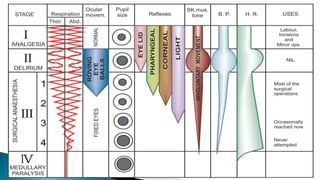
 GAs cause an irregularly descending depression of the CNS
 Guedel (1920) described four stages with ether anaesthesia
I. Stage of analgesia-
 Starts from beginning of anaesthetic inhalation and lasts upto the loss of
consciousness.
 Some minor operations can be carried out during this stage
II. Stage of delirium –
 From loss of consciousness to beginning of regular respiration.
 No operative procedure carried out during this stage
4
Dr. Subhash R. Yende
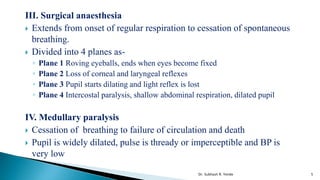
III. Surgical anaesthesia
 Extends from onset of regular respiration to cessation of spontaneous
breathing.
 Divided into 4 planes as-
◦ Plane 1 Roving eyeballs, ends when eyes become fixed
◦ Plane 2 Loss of corneal and laryngeal reflexes
◦ Plane 3 Pupil starts dilating and light reflex is lost
◦ Plane 4 Intercostal paralysis, shallow abdominal respiration, dilated pupil
IV. Medullary paralysis
 Cessation of breathing to failure of circulation and death
 Pupil is widely dilated, pulse is thready or imperceptible and BP is
very low
Dr. Subhash R. Yende 5
Dr. Subhash R. Yende 6
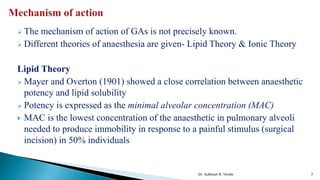
 The mechanism of action of GAs is not precisely known.
 Different theories of anaesthesia are given- Lipid Theory & Ionic Theory
Lipid Theory
 Mayer and Overton (1901) showed a close correlation between anaesthetic
potency and lipid solubility
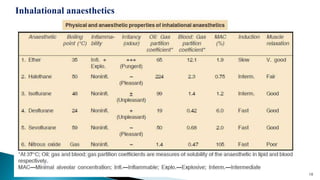
 Potency is expressed as the minimal alveolar concentration (MAC)
 MAC is the lowest concentration of the anaesthetic in pulmonary alveoli
needed to produce immobility in response to a painful stimulus (surgical
incision) in 50% individuals
7
Dr. Subhash R. Yende
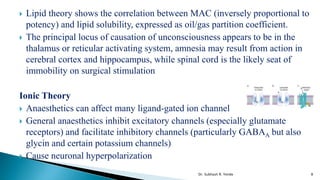
 Lipid theory shows the correlation between MAC (inversely proportional to
potency) and lipid solubility, expressed as oil/gas partition coefficient.
 The principal locus of causation of unconsciousness appears to be in the
thalamus or reticular activating system, amnesia may result from action in
cerebral cortex and hippocampus, while spinal cord is the likely seat of
immobility on surgical stimulation
Ionic Theory
 Anaesthetics can affect many ligand-gated ion channel
 General anaesthetics inhibit excitatory channels (especially glutamate
receptors) and facilitate inhibitory channels (particularly GABAA but also
glycin and certain potassium channels)
 Cause neuronal hyperpolarization
8
Dr. Subhash R. Yende
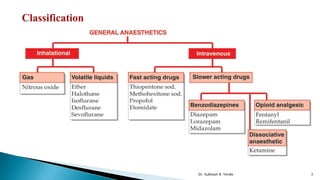
 Inhalational anaesthetics are gases or vapours that diffuse rapidly across
pulmonary alveoli and tissue barriers. The depth of anaesthesia depends on
the potency of the agent (MAC) and its partial pressure (PP) in the brain,
while induction and recovery depend on the rate of change of PP in the
brain.
 During elimination, when N2O is discontinued after prolonged anaesthesia;
N2O having low blood solubility rapidly diffuses into alveoli and dilutes the
alveolar air, and PP of oxygen in alveoli is reduced. The resulting hypoxia,
called diffusion hypoxia.
9
Dr. Subhash R. Yende
Inhalational anaesthetics
10
Dr. Subhash R. Yende
Intravenous anaesthetics
Fast acting drugs-
 These are drugs which on i.v. injection produce loss of consciousness in one
arm-brain circulation time (~11 sec)
 used for induction because of rapidity of onset of action
 Eg. Thiopentone sodium, Propofol
Slower acting drugs-
1. Benzodiazepines (BZDs)
 Relatively large doses (diazepam 0.2–0.3 mg/kg or equivalent) injected i.v.
produce sedation, amnesia and then unconsciousness in 5–10 min.
 Poor analgesic, not provoke postoperative nausea and vomiting
11
Dr. Subhash R. Yende
2. Ketamine
 Pharmacologically related to the hallucinogen phencyclidine.
 It induces a so called ‘dissociative anaesthesia’ characterized by profound
analgesia, immobility, amnesia with light sleep, the patient appears to be
dissociated from his body and surroundings
 Shows activity in cortex and limbic system
 Non-competitive blocker of NMDA receptor
 Adverse effect- cardiac stimulation
3. Fentanyl
 highly lipophilic, short acting (30–50 min) potent opioid analgesic
 generally given i.v. at the beginning of painful surgical procedures
12
Dr. Subhash R. Yende
 Preanaesthetic medication refers to the use of drugs before anaesthesia to make it
more pleasant and safe.
The aims are:
◦ Relief of anxiety and apprehension preoperatively and to facilitate smooth
induction.
◦ Amnesia for pre- and postoperative events.
◦ Supplement analgesic action of anaesthetics and potentiate them so that less
anaesthetic is needed
◦ Decrease secretions and vagal stimulation that may be caused by the anaesthetic
◦ Antiemetic effect extending to the postoperative period
◦ Decrease acidity and volume of gastric juice so that it is less damaging if
aspirated.
Dr. Subhash R. Yende 13
Different drugs used are-
 Sedative-antianxiety drugs –Benzodiazepines like diazepam, lorazepam,
medazolam, Promethazine
 Opioids – Morphine, pethidine
 Anticholinergics –Atropine, hyoscine
 Neuroleptics –Chlorpromazine, triflupromazine, haloperidol
 H2 blockers/proton pump inhibitors-Ranitidine, famotidine, omeprazole,
pantoprazole
 Antiemetics - Metoclopramide, Domperidone, Ondansetron
Dr. Subhash R. Yende 14
KD Tripathi. Essentials of Medical Pharmacology, 8th edition, 2019,
Jaypee Brothers Medical Publishers (P) Ltd. New Delhi.
10-Jul-21 15
Dr. Subhash R. Yende

General Anesthetics

  • 1.
    Dr. Subhash R.Yende Asst. Professor, Gurunanak College of Pharmacy, Nagpur
  • 2.
    General anaesthetics (GAs)are drugs which produce reversible loss of all sensation and consciousness  The cardinal features of general anaesthesia are: ◦ Loss of all sensation, especially pain ◦ Sleep (unconsciousness) and amnesia ◦ Immobility and muscle relaxation ◦ Abolition of somatic and autonomic reflexes 2 Dr. Subhash R. Yende
  • 3.
  • 4.
     GAs causean irregularly descending depression of the CNS  Guedel (1920) described four stages with ether anaesthesia I. Stage of analgesia-  Starts from beginning of anaesthetic inhalation and lasts upto the loss of consciousness.  Some minor operations can be carried out during this stage II. Stage of delirium –  From loss of consciousness to beginning of regular respiration.  No operative procedure carried out during this stage 4 Dr. Subhash R. Yende
  • 5.
    III. Surgical anaesthesia Extends from onset of regular respiration to cessation of spontaneous breathing.  Divided into 4 planes as- ◦ Plane 1 Roving eyeballs, ends when eyes become fixed ◦ Plane 2 Loss of corneal and laryngeal reflexes ◦ Plane 3 Pupil starts dilating and light reflex is lost ◦ Plane 4 Intercostal paralysis, shallow abdominal respiration, dilated pupil IV. Medullary paralysis  Cessation of breathing to failure of circulation and death  Pupil is widely dilated, pulse is thready or imperceptible and BP is very low Dr. Subhash R. Yende 5
  • 6.
  • 7.
     The mechanismof action of GAs is not precisely known.  Different theories of anaesthesia are given- Lipid Theory & Ionic Theory Lipid Theory  Mayer and Overton (1901) showed a close correlation between anaesthetic potency and lipid solubility  Potency is expressed as the minimal alveolar concentration (MAC)  MAC is the lowest concentration of the anaesthetic in pulmonary alveoli needed to produce immobility in response to a painful stimulus (surgical incision) in 50% individuals 7 Dr. Subhash R. Yende
  • 8.
     Lipid theoryshows the correlation between MAC (inversely proportional to potency) and lipid solubility, expressed as oil/gas partition coefficient.  The principal locus of causation of unconsciousness appears to be in the thalamus or reticular activating system, amnesia may result from action in cerebral cortex and hippocampus, while spinal cord is the likely seat of immobility on surgical stimulation Ionic Theory  Anaesthetics can affect many ligand-gated ion channel  General anaesthetics inhibit excitatory channels (especially glutamate receptors) and facilitate inhibitory channels (particularly GABAA but also glycin and certain potassium channels)  Cause neuronal hyperpolarization 8 Dr. Subhash R. Yende
  • 9.
     Inhalational anaestheticsare gases or vapours that diffuse rapidly across pulmonary alveoli and tissue barriers. The depth of anaesthesia depends on the potency of the agent (MAC) and its partial pressure (PP) in the brain, while induction and recovery depend on the rate of change of PP in the brain.  During elimination, when N2O is discontinued after prolonged anaesthesia; N2O having low blood solubility rapidly diffuses into alveoli and dilutes the alveolar air, and PP of oxygen in alveoli is reduced. The resulting hypoxia, called diffusion hypoxia. 9 Dr. Subhash R. Yende
  • 10.
  • 11.
    Intravenous anaesthetics Fast actingdrugs-  These are drugs which on i.v. injection produce loss of consciousness in one arm-brain circulation time (~11 sec)  used for induction because of rapidity of onset of action  Eg. Thiopentone sodium, Propofol Slower acting drugs- 1. Benzodiazepines (BZDs)  Relatively large doses (diazepam 0.2–0.3 mg/kg or equivalent) injected i.v. produce sedation, amnesia and then unconsciousness in 5–10 min.  Poor analgesic, not provoke postoperative nausea and vomiting 11 Dr. Subhash R. Yende
  • 12.
    2. Ketamine  Pharmacologicallyrelated to the hallucinogen phencyclidine.  It induces a so called ‘dissociative anaesthesia’ characterized by profound analgesia, immobility, amnesia with light sleep, the patient appears to be dissociated from his body and surroundings  Shows activity in cortex and limbic system  Non-competitive blocker of NMDA receptor  Adverse effect- cardiac stimulation 3. Fentanyl  highly lipophilic, short acting (30–50 min) potent opioid analgesic  generally given i.v. at the beginning of painful surgical procedures 12 Dr. Subhash R. Yende
  • 13.
     Preanaesthetic medicationrefers to the use of drugs before anaesthesia to make it more pleasant and safe. The aims are: ◦ Relief of anxiety and apprehension preoperatively and to facilitate smooth induction. ◦ Amnesia for pre- and postoperative events. ◦ Supplement analgesic action of anaesthetics and potentiate them so that less anaesthetic is needed ◦ Decrease secretions and vagal stimulation that may be caused by the anaesthetic ◦ Antiemetic effect extending to the postoperative period ◦ Decrease acidity and volume of gastric juice so that it is less damaging if aspirated. Dr. Subhash R. Yende 13
  • 14.
    Different drugs usedare-  Sedative-antianxiety drugs –Benzodiazepines like diazepam, lorazepam, medazolam, Promethazine  Opioids – Morphine, pethidine  Anticholinergics –Atropine, hyoscine  Neuroleptics –Chlorpromazine, triflupromazine, haloperidol  H2 blockers/proton pump inhibitors-Ranitidine, famotidine, omeprazole, pantoprazole  Antiemetics - Metoclopramide, Domperidone, Ondansetron Dr. Subhash R. Yende 14
  • 15.
    KD Tripathi. Essentialsof Medical Pharmacology, 8th edition, 2019, Jaypee Brothers Medical Publishers (P) Ltd. New Delhi. 10-Jul-21 15 Dr. Subhash R. Yende