
TRIGEMINAL
NEURALGIA
Presented by:
Mr. DANIEL VENKATESH .A
ASSOCIATE PROFESSOR IN NURSING
VHCASCON, HYDERBAD
NEURALGIA
Neuralgia (Greek neuron,
"nerve" + algos, "pain") is pain in
the distribution of a nerve or
nerves.
Pain of severe throbbing or
stabbing character in the course of
distribution of a nerve.
CLASSIFICATION OF NEURALGIA:
• Trigeminal neuralgia
• Occipital neuralgia
• Glossopharyngeal neuralgia
• Postherpetic neuralgia
• Intercostal neuralgia
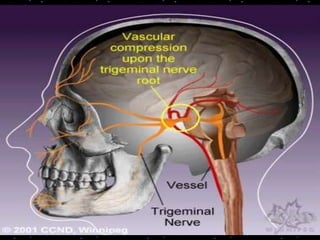
TRIGEMINAL NEURALGIA:
is the most debilitating form
of neuralgia affecting the
sensory branches of 5th
Craniel Nerve
It leads Sudden, recurrent,
severe pain in the distribution
of one or more branches of
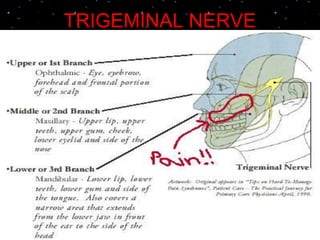
TRIGEMINAL NERVE
SYNONYMS
•Trifacial neuralgia
•Fothergill’s disease
•Tic-doloureux (painful
jerking)
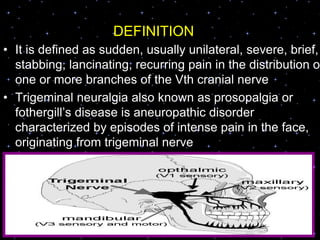
DEFINITION
• It is defined as sudden, usually unilateral, severe, brief,
stabbing, lancinating, recurring pain in the distribution of
one or more branches of the Vth cranial nerve
• Trigeminal neuralgia also known as prosopalgia or
fothergill’s disease is aneuropathic disorder
characterized by episodes of intense pain in the face,
originating from trigeminal nerve
ETOIOLOGY
• Usually idiopathic
• Demylination of the nerve
• Multiple sclerosis
• Petrous ridge compression
• Post – traumatic neuralgia
• Intracranial tumors
• Intracranial vascular abnormalities
• Viral etiology
ETOIOLOGY
• INTRACRANIAL CAUSES
1. Petrous ridge compression-internal
carotid artey pulsations
2. Multiple sclerosis
3. Intracranial tumors- at the
cerebellopontine angle
4. Intracranial vascular abnormalities-
basilar artery aneurysm, superior
cerebellar artery abnormality
•Neuralgias and neuritis
•Syphilis
•Tuberculosis
•Tumor of the brain
•Basilar meningitis
•Pontine diseases .
• Skull fracture
• Aneurysm of the carotid artery or circle
of willis
• Psychoneuroses,and
• Cavernous sinus thrombosis
Other disorders that may affect the trigeminal nerve include :
origin of the…..pain....nerve
.
Print master
Your Text here
TYPES OF TRIGEMINAL
NEURALGIA
• Pre Trigeminal
neuralgia
• Idiopathic Trigeminal
neuralgia
• Symptomatic neuralgia
• Pre trigeminal neuralgia: dull
aching pain usually observed
before appearance of trigeminal
neuralgia
• Idopathic neuralgia: where the
etiology remains unknown
• Symptomatic neuralgia: the
type in which the etiology is
known
CLINICAL FEATURES
• Manifests as sudden, unilateral,
intermittent, paroxysmal, sharp,
shooting, lancinating pain, elicited
by slight touch.
• Patient usually complains of
electric shock/lightening like pain
• Usually confined to one part.
• Lasts for few seconds to minutes.
• Motionless or mask like face
• Rarely crosses the midline.
• Trigger points - Spontaneous attack
or triggered by trigger zone or
movement of the face as in chewing
talking, brushing or yawning
• This leads patient frequently go
unshaven or unwashed
• Paroxysms occur in cycles.
• Depression and weight loss
DIAGNOSIS
• History/physical Exam
• Trigeminal nerve
examination
• Diagnostic nerve
blocking
• MRI (brain)
• EEG
MANAGEMENT
•PHARMACOLOGICAL
•SURGICAL
•OTHERS
PHARMACOLOGICAL
• FIRST LINE OF APPROACH
Carbamazepine 100, 200mg..
• SECOND LINE OF APPROACH
Phenytoin 100mg
Baclofen 5-80 mg/day
Lamotrigine 25 mg/day
• THIRD LINE OF APPROACH
Clonazepam 4-8 mg
Valproic acid 250-500 mg
Oxcarbazepine 1200mg/day
Other methods used are
• Trichloro ethylene inhalation
• Topical capsaicin cream application
• Proparacaine 0.5% anaesthetic drops
in eye
• Anti inflammatory drug-Indomethacin
& short courses of steroids are found
useful in some cases
INJECTION OF NERVE WITH
ANESTHETIC AGENT
• Long acting anesthetic agents
• Alcohol injection
This older treatment is not used
often. It involves the injection of
small amounts of alcohol into the
nerve endings.
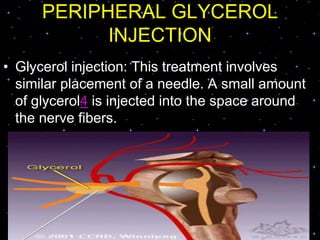
PERIPHERAL GLYCEROL
INJECTION
• Glycerol injection: This treatment involves
similar placement of a needle. A small amount
of glycerol4 is injected into the space around
the nerve fibers.
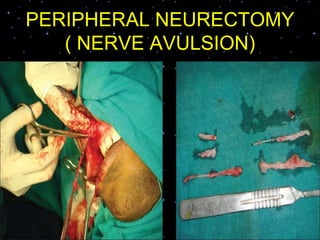
PERIPHERAL NEURECTOMY
( NERVE AVULSION)
OPEN PROCEDURES
( INTRACRANIAL PROCEDURES)
 1. MICROVASCULAR
DECOMPRESSION
2. PERCUTANEOUS
RHIZOTOMIES (Surgical division
of nerve roots)
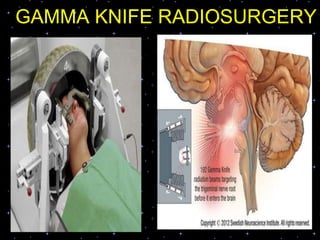
3. GAMMA KNIFE
RADIOSURGERY
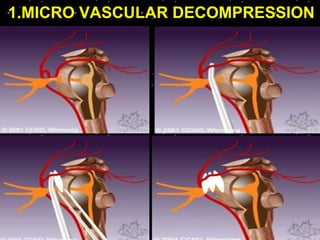
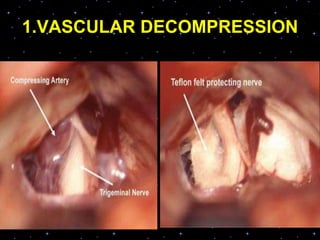
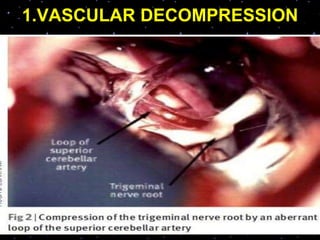
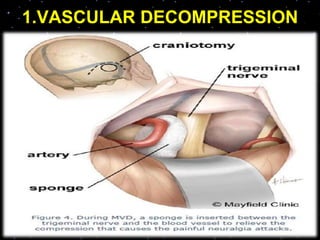
MICROVASCULAR DECOMPRESSION
This surgery is performed by
going into the skull and moving the
blood vessel away from the
trigeminal nerve. A small pad is
then placed between the vessel
and the nerve to keep them apart
1.MICRO VASCULAR DECOMPRESSION
1.VASCULAR DECOMPRESSION
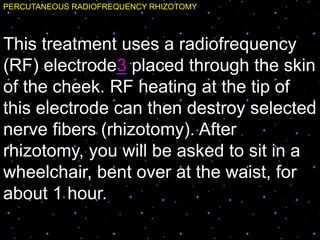
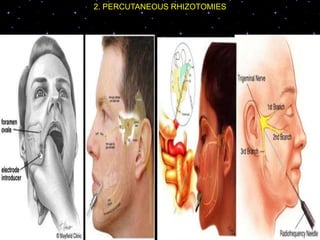
PERCUTANEOUS RADIOFREQUENCY RHIZOTOMY
This treatment uses a radiofrequency
(RF) electrode3 placed through the skin
of the cheek. RF heating at the tip of
this electrode can then destroy selected
nerve fibers (rhizotomy). After
rhizotomy, you will be asked to sit in a
wheelchair, bent over at the waist, for
about 1 hour.
2. PERCUTANEOUS RHIZOTOMIES
GAMMA KNIFE RADIOSURGERY
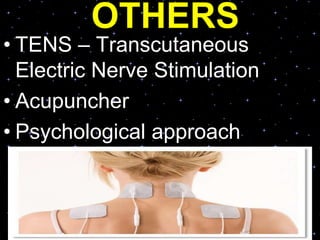
OTHERS
• TENS – Transcutaneous
Electric Nerve Stimulation
• Acupuncher
• Psychological approach
NURSING MANGEMENT
• Preventing pain-Recognize the
factors that alleviate the pain such
as food that is too hot or too cold
and washing the face, and brushing
the teeth etc., nurse should assist
the patient by providing education.
• Provide cotton pads and room
temperature water to wash the face.
• Instruct patient to use mouth wash
to cleanse the mouth after taking
food if tooth brush causes pain.,
• The patient is instructed to eat the
food at room temperature and to
chew the food in the unaffected
site, and to ingest soft foods.
• Provide psychological support.
THANK YOU

Trigeminal neuralgia

  • 1.
    TRIGEMINAL NEURALGIA Presented by: Mr. DANIELVENKATESH .A ASSOCIATE PROFESSOR IN NURSING VHCASCON, HYDERBAD
  • 3.
    NEURALGIA Neuralgia (Greek neuron, "nerve"+ algos, "pain") is pain in the distribution of a nerve or nerves. Pain of severe throbbing or stabbing character in the course of distribution of a nerve.
  • 4.
    CLASSIFICATION OF NEURALGIA: •Trigeminal neuralgia • Occipital neuralgia • Glossopharyngeal neuralgia • Postherpetic neuralgia • Intercostal neuralgia
  • 5.
    TRIGEMINAL NEURALGIA: is themost debilitating form of neuralgia affecting the sensory branches of 5th Craniel Nerve It leads Sudden, recurrent, severe pain in the distribution of one or more branches of
  • 6.
  • 7.
  • 8.
    DEFINITION • It isdefined as sudden, usually unilateral, severe, brief, stabbing, lancinating, recurring pain in the distribution of one or more branches of the Vth cranial nerve • Trigeminal neuralgia also known as prosopalgia or fothergill’s disease is aneuropathic disorder characterized by episodes of intense pain in the face, originating from trigeminal nerve
  • 9.
    ETOIOLOGY • Usually idiopathic •Demylination of the nerve • Multiple sclerosis • Petrous ridge compression • Post – traumatic neuralgia • Intracranial tumors • Intracranial vascular abnormalities • Viral etiology
  • 10.
    ETOIOLOGY • INTRACRANIAL CAUSES 1.Petrous ridge compression-internal carotid artey pulsations 2. Multiple sclerosis 3. Intracranial tumors- at the cerebellopontine angle 4. Intracranial vascular abnormalities- basilar artery aneurysm, superior cerebellar artery abnormality
  • 11.
    •Neuralgias and neuritis •Syphilis •Tuberculosis •Tumorof the brain •Basilar meningitis •Pontine diseases . • Skull fracture • Aneurysm of the carotid artery or circle of willis • Psychoneuroses,and • Cavernous sinus thrombosis Other disorders that may affect the trigeminal nerve include :
  • 12.
  • 13.
  • 14.
    TYPES OF TRIGEMINAL NEURALGIA •Pre Trigeminal neuralgia • Idiopathic Trigeminal neuralgia • Symptomatic neuralgia
  • 15.
    • Pre trigeminalneuralgia: dull aching pain usually observed before appearance of trigeminal neuralgia • Idopathic neuralgia: where the etiology remains unknown • Symptomatic neuralgia: the type in which the etiology is known
  • 16.
    CLINICAL FEATURES • Manifestsas sudden, unilateral, intermittent, paroxysmal, sharp, shooting, lancinating pain, elicited by slight touch. • Patient usually complains of electric shock/lightening like pain • Usually confined to one part. • Lasts for few seconds to minutes. • Motionless or mask like face
  • 17.
    • Rarely crossesthe midline. • Trigger points - Spontaneous attack or triggered by trigger zone or movement of the face as in chewing talking, brushing or yawning • This leads patient frequently go unshaven or unwashed • Paroxysms occur in cycles. • Depression and weight loss
  • 18.
    DIAGNOSIS • History/physical Exam •Trigeminal nerve examination • Diagnostic nerve blocking • MRI (brain) • EEG
  • 19.
  • 20.
    PHARMACOLOGICAL • FIRST LINEOF APPROACH Carbamazepine 100, 200mg.. • SECOND LINE OF APPROACH Phenytoin 100mg Baclofen 5-80 mg/day Lamotrigine 25 mg/day • THIRD LINE OF APPROACH Clonazepam 4-8 mg Valproic acid 250-500 mg Oxcarbazepine 1200mg/day
  • 21.
    Other methods usedare • Trichloro ethylene inhalation • Topical capsaicin cream application • Proparacaine 0.5% anaesthetic drops in eye • Anti inflammatory drug-Indomethacin & short courses of steroids are found useful in some cases
  • 22.
    INJECTION OF NERVEWITH ANESTHETIC AGENT • Long acting anesthetic agents • Alcohol injection This older treatment is not used often. It involves the injection of small amounts of alcohol into the nerve endings.
  • 23.
    PERIPHERAL GLYCEROL INJECTION • Glycerolinjection: This treatment involves similar placement of a needle. A small amount of glycerol4 is injected into the space around the nerve fibers.
  • 24.
  • 25.
    OPEN PROCEDURES ( INTRACRANIALPROCEDURES)  1. MICROVASCULAR DECOMPRESSION 2. PERCUTANEOUS RHIZOTOMIES (Surgical division of nerve roots) 3. GAMMA KNIFE RADIOSURGERY
  • 26.
    MICROVASCULAR DECOMPRESSION This surgeryis performed by going into the skull and moving the blood vessel away from the trigeminal nerve. A small pad is then placed between the vessel and the nerve to keep them apart
  • 27.
  • 28.
  • 29.
  • 30.
  • 31.
    PERCUTANEOUS RADIOFREQUENCY RHIZOTOMY Thistreatment uses a radiofrequency (RF) electrode3 placed through the skin of the cheek. RF heating at the tip of this electrode can then destroy selected nerve fibers (rhizotomy). After rhizotomy, you will be asked to sit in a wheelchair, bent over at the waist, for about 1 hour.
  • 32.
  • 33.
  • 34.
    OTHERS • TENS –Transcutaneous Electric Nerve Stimulation • Acupuncher • Psychological approach
  • 35.
    NURSING MANGEMENT • Preventingpain-Recognize the factors that alleviate the pain such as food that is too hot or too cold and washing the face, and brushing the teeth etc., nurse should assist the patient by providing education. • Provide cotton pads and room temperature water to wash the face.
  • 36.
    • Instruct patientto use mouth wash to cleanse the mouth after taking food if tooth brush causes pain., • The patient is instructed to eat the food at room temperature and to chew the food in the unaffected site, and to ingest soft foods. • Provide psychological support.
  • 37.