LIPID METABOLISM
LIPID METABOLISM
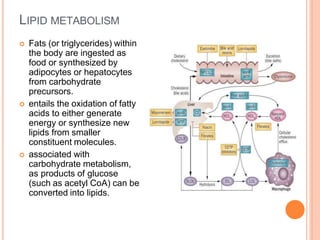
 Fats (or triglycerides) within
the body are ingested as
food or synthesized by
adipocytes or hepatocytes
from carbohydrate
precursors.
 entails the oxidation of fatty
acids to either generate
energy or synthesize new
lipids from smaller
constituent molecules.
 associated with
carbohydrate metabolism,
as products of glucose
(such as acetyl CoA) can be
converted into lipids.
WHAT IS THE DEFINITION OF LIPID
METABOLISM?
Lipid metabolism is the synthesis and
degradation of lipids in cells, involving
the break down or storage of fats for
energy. These fats are obtained from
consuming food and absorbing them
or they are synthesized by an animal's
liver.
WHAT IS THE END PRODUCT OF LIPID
METABOLISM?
Just like glucose, the end-products of
fatty acid metabolism are carbon
dioxide, water and ATP.
WHERE DOES LIPID METABOLISM OCCUR IN
THE BODY?
Triglycerides and lipids, high-energy
molecules, are stored in adipose
tissue until they are needed.
WHAT IS A LIPID METABOLISM DISORDER?
Lipid metabolism disorders, such as
Gaucher disease and Tay-Sachs
disease, involve lipids.
Lipids are fats or fat-like substances.
They include oils, fatty acids, waxes,
and cholesterol. ... Or the enzymes
may not work properly and your body
can't convert the fats into energy.
WHERE ARE LIPIDS STORED IN THE BODY?
Lipids such as cholesterol, cholesteryl
esters and triglycerides are stored in
your body primarily in specialized fat
cells called adipocytes, which
comprise a specialized fatty tissue
called adipose tissue.
Stored lipids can be derived from the
lipids in your diet or from lipids that
your body synthesizes.
WHAT IS THE ROLE OF THE LIVER IN THE USE
OF LIPIDS?
With the help of vitamin K, the liver
produces proteins that are important in
blood clotting.
In fat metabolism the liver cells break
down fats and produce energy.
HOW ARE LIPIDS USED IN THE BODY?
Lipids, also known as fats, play many
important roles in your body, from
providing energy to producing
hormones. You wouldn't be able to
digest and absorb food properly
without lipids. Of course, eating more
fat than you need can lead to weight
gain, but in proper amounts lipids are
a healthy part of your diet.
HOW DO WE METABOLIZE FAT?
Fat Metabolism. Almost all fat in your
diet comes in the form of triglycerides.
These compounds contain three fatty
acids held together by a molecule
called glycerol. In order to store or use
fats for energy, this bond must be
broken by pancreatic enzymes
released into your stomach acid.
WHAT HAPPENS TO FATTY ACIDS IN THE
LIVER?
The liver is the major site for
converting excess carbohydrates and
proteins into fatty acids and
triglyceride, which are then exported
and stored in adipose tissue. The liver
synthesizes large quantities of
cholesterol and phospholipids.
WHERE ARE LIPIDS ABSORBED IN THE BODY?
Most lipids that you consume in your
diet are fats. Some digestion occurs in
your mouth and the stomach, but most
takes place in the small intestine.
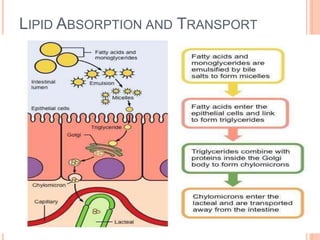
LIPID ABSORPTION AND TRANSPORT
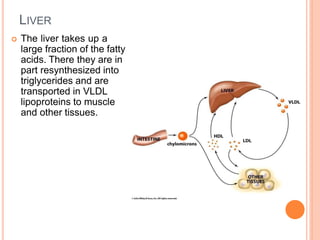
LIVER
 The liver takes up a
large fraction of the fatty
acids. There they are in
part resynthesized into
triglycerides and are
transported in VLDL
lipoproteins to muscle
and other tissues.
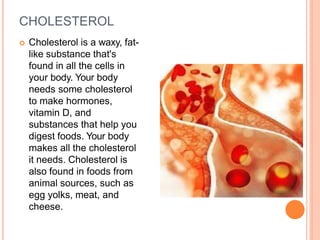
CHOLESTEROL
 Cholesterol is a waxy, fat-
like substance that's
found in all the cells in
your body. Your body
needs some cholesterol
to make hormones,
vitamin D, and
substances that help you
digest foods. Your body
makes all the cholesterol
it needs. Cholesterol is
also found in foods from
animal sources, such as
egg yolks, meat, and
cheese.
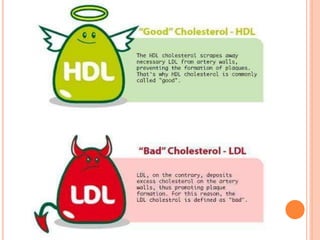
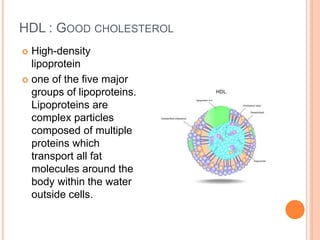
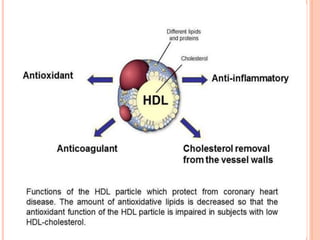
HDL : GOOD CHOLESTEROL
 High-density
lipoprotein
 one of the five major
groups of lipoproteins.
Lipoproteins are
complex particles
composed of multiple
proteins which
transport all fat
molecules around the
body within the water
outside cells.
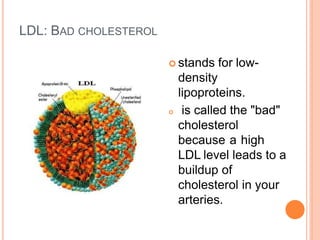
LDL: BAD CHOLESTEROL
 stands for low-
density
lipoproteins.
 is called the "bad"
cholesterol
because a high
LDL level leads to a
buildup of
cholesterol in your
arteries.
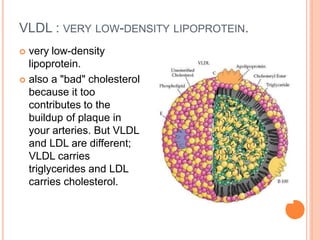
VLDL : VERY LOW-DENSITY LIPOPROTEIN.
 very low-density
lipoprotein.
 also a "bad" cholesterol
because it too
contributes to the
buildup of plaque in
your arteries. But VLDL
and LDL are different;
VLDL carries
triglycerides and LDL
carries cholesterol.
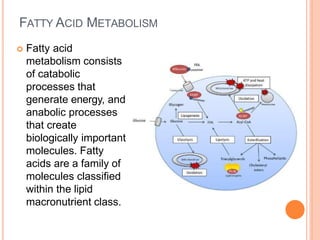
FATTY ACID METABOLISM
 Fatty acid
metabolism consists
of catabolic
processes that
generate energy, and
anabolic processes
that create
biologically important
molecules. Fatty
acids are a family of
molecules classified
within the lipid
macronutrient class.
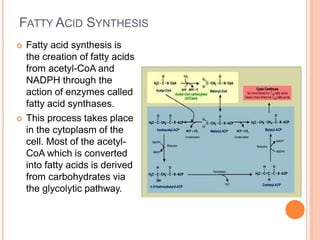
FATTY ACID SYNTHESIS
 Fatty acid synthesis is
the creation of fatty acids
from acetyl-CoA and
NADPH through the
action of enzymes called
fatty acid synthases.
 This process takes place
in the cytoplasm of the
cell. Most of the acetyl-
CoA which is converted
into fatty acids is derived
from carbohydrates via
the glycolytic pathway.
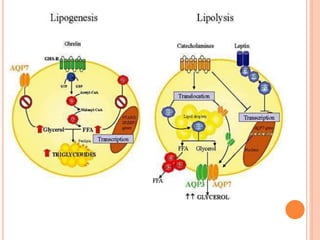
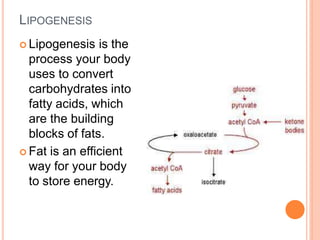
LIPOGENESIS
 Lipogenesis is the
process your body
uses to convert
carbohydrates into
fatty acids, which
are the building
blocks of fats.
 Fat is an efficient
way for your body
to store energy.
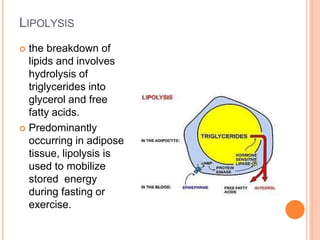
LIPOLYSIS
 the breakdown of
lipids and involves
hydrolysis of
triglycerides into
glycerol and free
fatty acids.
 Predominantly
occurring in adipose
tissue, lipolysis is
used to mobilize
stored energy
during fasting or
exercise.
PUTTING LIPIDS TO USE
 essential to good health, not only for humans but also
for other animals and even plants.
 a poor conductor of heat, lipids also can function as
effective insulators
 Act as chemical messengers in the body, while others
serve as storage areas for chemical energy. There is a
good reason why babies are born with "baby fat" and
why children entering puberty often tend to become
chubby: in both cases, they are building up energy
reserves for the great metabolic hurdles that lie ahead,
and within a few years, they will have used up those
excessive fat stores
REFERENCES
 https://opentextbc.ca/anatomyandphysiology/chapter/24-4-lipid-
metabolism/
 https://www.biologyexams4u.com/2013/02/difference-between-fatty-
acid-synthesis.html#.W3PiEsIRXIU
 http://lipidlibrary.aocs.org/Biochemistry/content.cfm?ItemNumber=3918
7
 https://www.britannica.com/science/lipid/Mobilization-of-fatty-acids
 https://www.researchgate.net/figure/Schematic-diagram-of-the-putative-
roles-of-the-placental-plasma-membrane-associated-
and_fig1_12249750
 https://www.ccrc.uga.edu/~rcarlson/bcmb3100/Chap28.pdf
 https://www.researchgate.net/figure/Proposed-role-of-ghrelin-and-
leptin-in-lipogenesis-and-lipolysis-respectively-
ACC_fig3_261254994
 https://medlineplus.gov/cholesterol.html
 https://medlineplus.gov/ldlthebadcholesterol.html

LIPID METABOLISM.pptx

  • 1.
  • 2.
    LIPID METABOLISM  Fats(or triglycerides) within the body are ingested as food or synthesized by adipocytes or hepatocytes from carbohydrate precursors.  entails the oxidation of fatty acids to either generate energy or synthesize new lipids from smaller constituent molecules.  associated with carbohydrate metabolism, as products of glucose (such as acetyl CoA) can be converted into lipids.
  • 3.
    WHAT IS THEDEFINITION OF LIPID METABOLISM? Lipid metabolism is the synthesis and degradation of lipids in cells, involving the break down or storage of fats for energy. These fats are obtained from consuming food and absorbing them or they are synthesized by an animal's liver.
  • 4.
    WHAT IS THEEND PRODUCT OF LIPID METABOLISM? Just like glucose, the end-products of fatty acid metabolism are carbon dioxide, water and ATP.
  • 5.
    WHERE DOES LIPIDMETABOLISM OCCUR IN THE BODY? Triglycerides and lipids, high-energy molecules, are stored in adipose tissue until they are needed.
  • 6.
    WHAT IS ALIPID METABOLISM DISORDER? Lipid metabolism disorders, such as Gaucher disease and Tay-Sachs disease, involve lipids. Lipids are fats or fat-like substances. They include oils, fatty acids, waxes, and cholesterol. ... Or the enzymes may not work properly and your body can't convert the fats into energy.
  • 7.
    WHERE ARE LIPIDSSTORED IN THE BODY? Lipids such as cholesterol, cholesteryl esters and triglycerides are stored in your body primarily in specialized fat cells called adipocytes, which comprise a specialized fatty tissue called adipose tissue. Stored lipids can be derived from the lipids in your diet or from lipids that your body synthesizes.
  • 8.
    WHAT IS THEROLE OF THE LIVER IN THE USE OF LIPIDS? With the help of vitamin K, the liver produces proteins that are important in blood clotting. In fat metabolism the liver cells break down fats and produce energy.
  • 9.
    HOW ARE LIPIDSUSED IN THE BODY? Lipids, also known as fats, play many important roles in your body, from providing energy to producing hormones. You wouldn't be able to digest and absorb food properly without lipids. Of course, eating more fat than you need can lead to weight gain, but in proper amounts lipids are a healthy part of your diet.
  • 10.
    HOW DO WEMETABOLIZE FAT? Fat Metabolism. Almost all fat in your diet comes in the form of triglycerides. These compounds contain three fatty acids held together by a molecule called glycerol. In order to store or use fats for energy, this bond must be broken by pancreatic enzymes released into your stomach acid.
  • 11.
    WHAT HAPPENS TOFATTY ACIDS IN THE LIVER? The liver is the major site for converting excess carbohydrates and proteins into fatty acids and triglyceride, which are then exported and stored in adipose tissue. The liver synthesizes large quantities of cholesterol and phospholipids.
  • 12.
    WHERE ARE LIPIDSABSORBED IN THE BODY? Most lipids that you consume in your diet are fats. Some digestion occurs in your mouth and the stomach, but most takes place in the small intestine.
  • 13.
  • 15.
    LIVER  The livertakes up a large fraction of the fatty acids. There they are in part resynthesized into triglycerides and are transported in VLDL lipoproteins to muscle and other tissues.
  • 16.
    CHOLESTEROL  Cholesterol isa waxy, fat- like substance that's found in all the cells in your body. Your body needs some cholesterol to make hormones, vitamin D, and substances that help you digest foods. Your body makes all the cholesterol it needs. Cholesterol is also found in foods from animal sources, such as egg yolks, meat, and cheese.
  • 18.
    HDL : GOODCHOLESTEROL  High-density lipoprotein  one of the five major groups of lipoproteins. Lipoproteins are complex particles composed of multiple proteins which transport all fat molecules around the body within the water outside cells.
  • 20.
    LDL: BAD CHOLESTEROL stands for low- density lipoproteins.  is called the "bad" cholesterol because a high LDL level leads to a buildup of cholesterol in your arteries.
  • 21.
    VLDL : VERYLOW-DENSITY LIPOPROTEIN.  very low-density lipoprotein.  also a "bad" cholesterol because it too contributes to the buildup of plaque in your arteries. But VLDL and LDL are different; VLDL carries triglycerides and LDL carries cholesterol.
  • 22.
    FATTY ACID METABOLISM Fatty acid metabolism consists of catabolic processes that generate energy, and anabolic processes that create biologically important molecules. Fatty acids are a family of molecules classified within the lipid macronutrient class.
  • 23.
    FATTY ACID SYNTHESIS Fatty acid synthesis is the creation of fatty acids from acetyl-CoA and NADPH through the action of enzymes called fatty acid synthases.  This process takes place in the cytoplasm of the cell. Most of the acetyl- CoA which is converted into fatty acids is derived from carbohydrates via the glycolytic pathway.
  • 25.
    LIPOGENESIS  Lipogenesis isthe process your body uses to convert carbohydrates into fatty acids, which are the building blocks of fats.  Fat is an efficient way for your body to store energy.
  • 26.
    LIPOLYSIS  the breakdownof lipids and involves hydrolysis of triglycerides into glycerol and free fatty acids.  Predominantly occurring in adipose tissue, lipolysis is used to mobilize stored energy during fasting or exercise.
  • 27.
    PUTTING LIPIDS TOUSE  essential to good health, not only for humans but also for other animals and even plants.  a poor conductor of heat, lipids also can function as effective insulators  Act as chemical messengers in the body, while others serve as storage areas for chemical energy. There is a good reason why babies are born with "baby fat" and why children entering puberty often tend to become chubby: in both cases, they are building up energy reserves for the great metabolic hurdles that lie ahead, and within a few years, they will have used up those excessive fat stores
  • 28.
    REFERENCES  https://opentextbc.ca/anatomyandphysiology/chapter/24-4-lipid- metabolism/  https://www.biologyexams4u.com/2013/02/difference-between-fatty- acid-synthesis.html#.W3PiEsIRXIU http://lipidlibrary.aocs.org/Biochemistry/content.cfm?ItemNumber=3918 7  https://www.britannica.com/science/lipid/Mobilization-of-fatty-acids  https://www.researchgate.net/figure/Schematic-diagram-of-the-putative- roles-of-the-placental-plasma-membrane-associated- and_fig1_12249750  https://www.ccrc.uga.edu/~rcarlson/bcmb3100/Chap28.pdf  https://www.researchgate.net/figure/Proposed-role-of-ghrelin-and- leptin-in-lipogenesis-and-lipolysis-respectively- ACC_fig3_261254994  https://medlineplus.gov/cholesterol.html  https://medlineplus.gov/ldlthebadcholesterol.html