Trichomonas vaginalis
General description
Trichomonas vaginalis is an anaerobic, flagellated protozoan parasite and
the causative agent of trichomoniasis. It is the most common pathogenic
protozoan infection of humans in industrialized countries. Infection rates
between men and women are similar with women being symptomatic,
while infections in men are usually asymptomatic. Transmission usually
occurs via direct, skin-to-skin contact with an infected individual, most
often through vaginal intercourse. The WHO has estimated that 160
million cases of infection are acquired annually worldwide. The
estimates for North America alone are between 5 and 8 million new
infections each year, with an estimated rate of asymptomatic cases as
high as 50%. Usually treatment consists of metronidazole and tinidazole.
History
Alfred Francois Donné (1801–1878) was the first to describe a
procedure to diagnose trichomoniasis through "the
microscopic observation of motile protozoa in vaginal or
cervical secretions" in 1836. He published this in the article
entitled, "Animalcules observés dans les matières purulentes et
le produit des sécrétions des organes génitaux de l'homme et
de la femme" in the journal, Comptes rendus de l'Académie
des sciences. As a result, the official binomial name of the
parasite is Trichomonas vaginalis DONNÉ.
Mechanism of infection
Trichomonas vaginalis, a parasitic protozoan, is the etiologic agent of trichomoniasis, and is a
sexually transmitted infection. More than 160 million people worldwide are annually infected
by this protozoan.
Symptoms
Trichomoniasis, a sexually transmitted infection of the urogenital tract, is a common cause of
vaginitis in women, while men with this infection can display symptoms of urethritis. 'Frothy',
greenish vaginal discharge with a 'musty' malodorous smell is characteristic.
Signs
Only 2% of women with the infection will have a "strawberry" cervix (colpitis macularis, an
erythematous cervix with pinpoint areas of exudation) or vagina on examination.[8][9][10] This
is due to capillary dilation as a result of the inflammatory response.
Diagnosis
Classically, with a cervical smear, infected women have a transparent
"halo" around their superficial cell nucleus. It is unreliably detected by
studying a genital discharge or with a cervical smear because of their low
sensitivity. T. vaginalis was traditionally diagnosed via a wet mount, in
which "corkscrew" motility was observed. Currently, the most common
method of diagnosis is via overnight culture, with a sensitivity range of
75–95%. Newer methods, such as rapid antigen testing and
transcriptionmediated amplification, have even greater sensitivity, but are
not in widespread use. The presence of T. vaginalis can also be diagnosed
by PCR, using primers specific for GENBANK/L23861.
Treatment
Infection is treated and cured with metronidazole or
tinidazole. The CDC recommends a one time dose of 2 grams
of either metronidazole or tinidazole as the first-line
treatment; the alternative treatment recommended is 500
milligrams of metronidazole, twice daily, for seven days if
there is failure of the single-dose regimen. Medication should
be prescribed to any sexual partner(s) as well because they
may be asymptomatic carriers .
Morphology
Unlike other parasitic protozoa (Giardia lamblia, Entamoeba histolytica
etc.), Trichomonas vaginalis exists in only one morphological stage, a
trophozoite, and cannot encyst. The T. vaginalis trophozoite is oval as
well as flagellated, or "pear" shaped as seen on a wet-mount. It is slightly
larger than a white blood cell, measuring 9 × 7 μm. Five flagella arise
near the cytostome; four of these immediately extend outside the cell
together, while the fifth flagellum wraps backwards along the surface of
the organism. The functionality of the fifth flagellum is not known. In
addition, a conspicuous barb-like axostyle projects opposite the four-
flagella bundle. The axostyle may be used for attachment to surfaces and
may also cause the tissue damage seen in trichomoniasis infections.
While T. vaginalis does not have a cyst form, organisms can survive for
up to 24 hours in urine, semen, or even water samples.
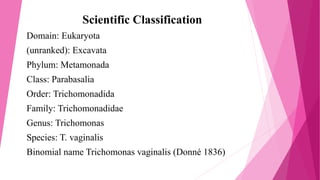
Scientific Classification
Domain: Eukaryota
(unranked): Excavata
Phylum: Metamonada
Class: Parabasalia
Order: Trichomonadida
Family: Trichomonadidae
Genus: Trichomonas
Species: T. vaginalis
Binomial name Trichomonas vaginalis (Donné 1836)

Trichomonas vaginalis

  • 1.
    Trichomonas vaginalis General description Trichomonasvaginalis is an anaerobic, flagellated protozoan parasite and the causative agent of trichomoniasis. It is the most common pathogenic protozoan infection of humans in industrialized countries. Infection rates between men and women are similar with women being symptomatic, while infections in men are usually asymptomatic. Transmission usually occurs via direct, skin-to-skin contact with an infected individual, most often through vaginal intercourse. The WHO has estimated that 160 million cases of infection are acquired annually worldwide. The estimates for North America alone are between 5 and 8 million new infections each year, with an estimated rate of asymptomatic cases as high as 50%. Usually treatment consists of metronidazole and tinidazole.
  • 2.
    History Alfred Francois Donné(1801–1878) was the first to describe a procedure to diagnose trichomoniasis through "the microscopic observation of motile protozoa in vaginal or cervical secretions" in 1836. He published this in the article entitled, "Animalcules observés dans les matières purulentes et le produit des sécrétions des organes génitaux de l'homme et de la femme" in the journal, Comptes rendus de l'Académie des sciences. As a result, the official binomial name of the parasite is Trichomonas vaginalis DONNÉ.
  • 3.
    Mechanism of infection Trichomonasvaginalis, a parasitic protozoan, is the etiologic agent of trichomoniasis, and is a sexually transmitted infection. More than 160 million people worldwide are annually infected by this protozoan. Symptoms Trichomoniasis, a sexually transmitted infection of the urogenital tract, is a common cause of vaginitis in women, while men with this infection can display symptoms of urethritis. 'Frothy', greenish vaginal discharge with a 'musty' malodorous smell is characteristic. Signs Only 2% of women with the infection will have a "strawberry" cervix (colpitis macularis, an erythematous cervix with pinpoint areas of exudation) or vagina on examination.[8][9][10] This is due to capillary dilation as a result of the inflammatory response.
  • 4.
    Diagnosis Classically, with acervical smear, infected women have a transparent "halo" around their superficial cell nucleus. It is unreliably detected by studying a genital discharge or with a cervical smear because of their low sensitivity. T. vaginalis was traditionally diagnosed via a wet mount, in which "corkscrew" motility was observed. Currently, the most common method of diagnosis is via overnight culture, with a sensitivity range of 75–95%. Newer methods, such as rapid antigen testing and transcriptionmediated amplification, have even greater sensitivity, but are not in widespread use. The presence of T. vaginalis can also be diagnosed by PCR, using primers specific for GENBANK/L23861.
  • 5.
    Treatment Infection is treatedand cured with metronidazole or tinidazole. The CDC recommends a one time dose of 2 grams of either metronidazole or tinidazole as the first-line treatment; the alternative treatment recommended is 500 milligrams of metronidazole, twice daily, for seven days if there is failure of the single-dose regimen. Medication should be prescribed to any sexual partner(s) as well because they may be asymptomatic carriers .
  • 6.
    Morphology Unlike other parasiticprotozoa (Giardia lamblia, Entamoeba histolytica etc.), Trichomonas vaginalis exists in only one morphological stage, a trophozoite, and cannot encyst. The T. vaginalis trophozoite is oval as well as flagellated, or "pear" shaped as seen on a wet-mount. It is slightly larger than a white blood cell, measuring 9 × 7 μm. Five flagella arise near the cytostome; four of these immediately extend outside the cell together, while the fifth flagellum wraps backwards along the surface of the organism. The functionality of the fifth flagellum is not known. In addition, a conspicuous barb-like axostyle projects opposite the four- flagella bundle. The axostyle may be used for attachment to surfaces and may also cause the tissue damage seen in trichomoniasis infections. While T. vaginalis does not have a cyst form, organisms can survive for up to 24 hours in urine, semen, or even water samples.
  • 7.
    Scientific Classification Domain: Eukaryota (unranked):Excavata Phylum: Metamonada Class: Parabasalia Order: Trichomonadida Family: Trichomonadidae Genus: Trichomonas Species: T. vaginalis Binomial name Trichomonas vaginalis (Donné 1836)