Behavioral immunology
 Behavioral immunology” refers to the branch of behavioral medicine concerned with
bidirectional interactions between behavior and the immune system.
Immune system
the organs and processes of the body that provide resistance to
infection and toxins. For example Organ like thymus
 The thymus is a specialized primary lymphoid organ of the immune system. Within the
thymus, T cells or T lymphocytes mature. T cells are critical , where the body adapts
specifically to foreign invaders. The thymus is composed of two identical lobes and is
located anatomically in front of the heart . Histologically, each lobe of the thymus can
be
divided into a central medulla and a peripheral cortex which is surrounded by an outer
capsule. The cortex and medulla play different roles in the development of T-cells.
 The thymus provides an inductive environment for development of T cell. Each T cell
attacks a specific foreign substance which it identifies with its receptor.
Here are some examples in which we are better able to understand behavioral immunology
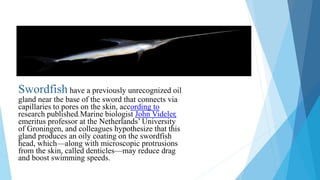
Swordfish have a previously unrecognized oil
gland near the base of the sword that connects via
capillaries to pores on the skin, according to
research published.Marine biologist John Videler,
emeritus professor at the Netherlands’ University
of Groningen, and colleagues hypothesize that this
gland produces an oily coating on the swordfish
head, which—along with microscopic protrusions
from the skin, called denticles—may reduce drag
and boost swimming speeds.
Electric eel
A researcher documents electric eels jumping out of the water to shock potential
threats, confirming a centuries-old report of the defensive behavior.
 The electric eel has three pairs of abdominal organs that produce electricity: the
main organ, the Hunter's organ, and the Sach's organ. These organs make up four-
fifths of its body, and give the electric eel the ability to generate two types of
electric organ discharges: low voltage and high voltage. These organs are made of
electrocytes, lined up so a current of ions can flow through them and stacked so
each one adds to a potential difference.[citation needed]
 When the eel finds its prey, the brain sends a signal through the nervous
system to the electrocytes.[citation needed] This opens the ion channels, allowing
sodium to flow through, reversing the polarity momentarily. By causing a
sudden difference in electric potential, it generates an electric current in a
manner similar to a battery, in which stacked plates each produce an electric
potential difference.
 In the electric eel, some 5,000 to 6,000 stacked electroplaques are can make
a shock up to 860 volts and 1 ampere of current (860 watts) for two
milliseconds. Such a shock is extremely unlikely to be deadly for an adult
human, due to the very short duration of the discharge.
Sex Differences in Immune Response
“A healthy immune system must be in balance,” study researcher Linde Meyaard
of the UMC Utrecht said while presenting the results at the meeting. Too little
response leads to infections; too much results in inflammatory disease, she said.
 In a 2012 study, Meyaard and colleagues conducted several experiments with
knockout mice that lacked the CD200 receptor, which acts as an inhibitory
immunological “checkpoint.” Mice that lacked this receptor had a strong type
I interferon (IFN) response. When the researchers infected these mice with
murine hepatitis corona virus (MHV), which is normally highly fatal, the
animals rapidly cleared the virus—particularly the females. But the mice also
experienced more symptoms of autoimmune disease, the researchers found.
 Fighting MHV is known to depend on Toll like receptor 7 (TLR7) signaling, and
previous studies have shown sex differences in the TLR7 response in men and
women. In another experiment, Meyaard and colleagues gave female CD200
knockout mice a ligand to suppress TLR7 activity, and infected the
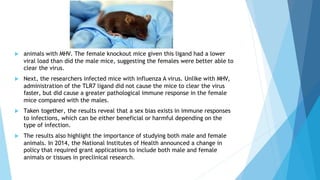
 animals with MHV. The female knockout mice given this ligand had a lower
viral load than did the male mice, suggesting the females were better able to
clear the virus.
 Next, the researchers infected mice with influenza A virus. Unlike with MHV,
administration of the TLR7 ligand did not cause the mice to clear the virus
faster, but did cause a greater pathological immune response in the female
mice compared with the males.
 Taken together, the results reveal that a sex bias exists in immune responses
to infections, which can be either beneficial or harmful depending on the
type of infection.
 The results also highlight the importance of studying both male and female
animals. In 2014, the National Institutes of Health announced a change in
policy that required grant applications to include both male and female
animals or tissues in preclinical research.
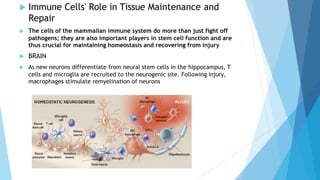
 Immune Cells' Role in Tissue Maintenance and
Repair
 The cells of the mammalian immune system do more than just fight off
pathogens; they are also important players in stem cell function and are
thus crucial for maintaining homeostasis and recovering from injury
 BRAIN
 As new neurons differentiate from neural stem cells in the hippocampus, T
cells and microglia are recruited to the neurogenic site. Following injury,
macrophages stimulate remyelination of neurons
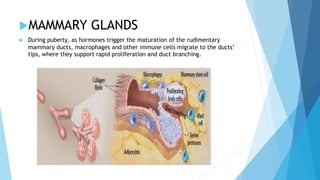
MAMMARY GLANDS
 During puberty, as hormones trigger the maturation of the rudimentary
mammary ducts, macrophages and other immune cells migrate to the ducts’
tips, where they support rapid proliferation and duct branching.
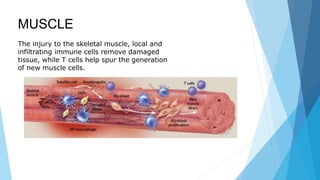
MUSCLE
The injury to the skeletal muscle, local and
infiltrating immune cells remove damaged
tissue, while T cells help spur the generation
of new muscle cells.
Implications for human behavior
 Within the psychological sciences, there is extensive
research linking the behavioral immune system to a variety
of prejudices—including prejudices against people who aren't
actually diseased but are simply characterized by some sort
of visual characteristics that deviate from those of a
subjectively prototypical human being. The disease–avoidant
processes that characterize the behavioral immune system
have been shown to contribute to prejudices
against obese individuals, elderly individuals, and people
with physical disfigurements or disabilities
Disease transmission
Additional lines of research on the behavioral immune
system have shown that people engage in more reticent and
conservative forms of behavior under conditions in which
they feel more vulnerable to disease transmission. For
instance, when the potential threat of disease is made
salient, people tend to be less extraverted or
sociable. Evidence suggests that the behavioral immune
system also incorporates mechanisms designed to search out
and process (heuristic) signs of disease at the level of basic
visual attention
 References;
 Kohl JV, Atzmueller M, Fink B, Grammer K; Human pheromones: integrating
neuroendocrinology and ethology. Neuroendocrinology Letters, 2001.
 Krebs, J. R., and N. B. Davies. 1993. An Introduction to Behavioural Ecology,
3rd ed. Blackwell Science, Oxford, U.K.
 Becker, J., Breedlove, S. M., and Crews, D. 1992. Behavioral Endocrinology.
Cambridge, MA, Bradford Books, MIT Press.
Behavioral immunology

Behavioral immunology

  • 2.
    Behavioral immunology  Behavioralimmunology” refers to the branch of behavioral medicine concerned with bidirectional interactions between behavior and the immune system. Immune system the organs and processes of the body that provide resistance to infection and toxins. For example Organ like thymus
  • 3.
     The thymusis a specialized primary lymphoid organ of the immune system. Within the thymus, T cells or T lymphocytes mature. T cells are critical , where the body adapts specifically to foreign invaders. The thymus is composed of two identical lobes and is located anatomically in front of the heart . Histologically, each lobe of the thymus can be divided into a central medulla and a peripheral cortex which is surrounded by an outer capsule. The cortex and medulla play different roles in the development of T-cells.  The thymus provides an inductive environment for development of T cell. Each T cell attacks a specific foreign substance which it identifies with its receptor. Here are some examples in which we are better able to understand behavioral immunology
  • 4.
    Swordfish have apreviously unrecognized oil gland near the base of the sword that connects via capillaries to pores on the skin, according to research published.Marine biologist John Videler, emeritus professor at the Netherlands’ University of Groningen, and colleagues hypothesize that this gland produces an oily coating on the swordfish head, which—along with microscopic protrusions from the skin, called denticles—may reduce drag and boost swimming speeds.
  • 5.
    Electric eel A researcherdocuments electric eels jumping out of the water to shock potential threats, confirming a centuries-old report of the defensive behavior.  The electric eel has three pairs of abdominal organs that produce electricity: the main organ, the Hunter's organ, and the Sach's organ. These organs make up four- fifths of its body, and give the electric eel the ability to generate two types of electric organ discharges: low voltage and high voltage. These organs are made of electrocytes, lined up so a current of ions can flow through them and stacked so each one adds to a potential difference.[citation needed]
  • 6.
     When theeel finds its prey, the brain sends a signal through the nervous system to the electrocytes.[citation needed] This opens the ion channels, allowing sodium to flow through, reversing the polarity momentarily. By causing a sudden difference in electric potential, it generates an electric current in a manner similar to a battery, in which stacked plates each produce an electric potential difference.  In the electric eel, some 5,000 to 6,000 stacked electroplaques are can make a shock up to 860 volts and 1 ampere of current (860 watts) for two milliseconds. Such a shock is extremely unlikely to be deadly for an adult human, due to the very short duration of the discharge.
  • 7.
    Sex Differences inImmune Response “A healthy immune system must be in balance,” study researcher Linde Meyaard of the UMC Utrecht said while presenting the results at the meeting. Too little response leads to infections; too much results in inflammatory disease, she said.  In a 2012 study, Meyaard and colleagues conducted several experiments with knockout mice that lacked the CD200 receptor, which acts as an inhibitory immunological “checkpoint.” Mice that lacked this receptor had a strong type I interferon (IFN) response. When the researchers infected these mice with murine hepatitis corona virus (MHV), which is normally highly fatal, the animals rapidly cleared the virus—particularly the females. But the mice also experienced more symptoms of autoimmune disease, the researchers found.  Fighting MHV is known to depend on Toll like receptor 7 (TLR7) signaling, and previous studies have shown sex differences in the TLR7 response in men and women. In another experiment, Meyaard and colleagues gave female CD200 knockout mice a ligand to suppress TLR7 activity, and infected the
  • 8.
     animals withMHV. The female knockout mice given this ligand had a lower viral load than did the male mice, suggesting the females were better able to clear the virus.  Next, the researchers infected mice with influenza A virus. Unlike with MHV, administration of the TLR7 ligand did not cause the mice to clear the virus faster, but did cause a greater pathological immune response in the female mice compared with the males.  Taken together, the results reveal that a sex bias exists in immune responses to infections, which can be either beneficial or harmful depending on the type of infection.  The results also highlight the importance of studying both male and female animals. In 2014, the National Institutes of Health announced a change in policy that required grant applications to include both male and female animals or tissues in preclinical research.
  • 9.
     Immune Cells'Role in Tissue Maintenance and Repair  The cells of the mammalian immune system do more than just fight off pathogens; they are also important players in stem cell function and are thus crucial for maintaining homeostasis and recovering from injury  BRAIN  As new neurons differentiate from neural stem cells in the hippocampus, T cells and microglia are recruited to the neurogenic site. Following injury, macrophages stimulate remyelination of neurons
  • 10.
    MAMMARY GLANDS  Duringpuberty, as hormones trigger the maturation of the rudimentary mammary ducts, macrophages and other immune cells migrate to the ducts’ tips, where they support rapid proliferation and duct branching.
  • 11.
    MUSCLE The injury tothe skeletal muscle, local and infiltrating immune cells remove damaged tissue, while T cells help spur the generation of new muscle cells.
  • 12.
    Implications for humanbehavior  Within the psychological sciences, there is extensive research linking the behavioral immune system to a variety of prejudices—including prejudices against people who aren't actually diseased but are simply characterized by some sort of visual characteristics that deviate from those of a subjectively prototypical human being. The disease–avoidant processes that characterize the behavioral immune system have been shown to contribute to prejudices against obese individuals, elderly individuals, and people with physical disfigurements or disabilities
  • 13.
    Disease transmission Additional linesof research on the behavioral immune system have shown that people engage in more reticent and conservative forms of behavior under conditions in which they feel more vulnerable to disease transmission. For instance, when the potential threat of disease is made salient, people tend to be less extraverted or sociable. Evidence suggests that the behavioral immune system also incorporates mechanisms designed to search out and process (heuristic) signs of disease at the level of basic visual attention
  • 14.
     References;  KohlJV, Atzmueller M, Fink B, Grammer K; Human pheromones: integrating neuroendocrinology and ethology. Neuroendocrinology Letters, 2001.  Krebs, J. R., and N. B. Davies. 1993. An Introduction to Behavioural Ecology, 3rd ed. Blackwell Science, Oxford, U.K.  Becker, J., Breedlove, S. M., and Crews, D. 1992. Behavioral Endocrinology. Cambridge, MA, Bradford Books, MIT Press.