Trichomonas vaginalis
Trichomoniasis is a sexually transmitted infection caused
by the protozoa Trichomonas vaginalis.
Women with trichomoniasis may experience various
symptoms, including a yellow-green vaginal discharge
and vulvar irritation, or they may be asymptomatic.
Men with trichomoniasis are frequently asymptomatic.
Trichomoniasis
The high incidence of trichomoniasis worldwide, its contribution to
poor health outcomes, and its co-infection with other sexually
transmitted infections make trichomoniasis a compelling public
health concern.
Notably, T vaginalis infection is believed to increase the risk of HIV
transmission.
Trichomoniasis is also associated with adverse pregnancy
outcomes, infertility, post-operative infections, and cervical
neoplasia.
Trichomoniasis
Worldwide, the annual incidence of trichomoniasis is about
170 million cases. The incidence of trichomoniasis in
Europe is similar to that in the United States. In Africa,
the prevalence of trichomoniasis may be much higher.
Epidemiology
The infection is highly associated with the presence
of other sexually transmitted infections, including
gonorrhea, chlamydia, and HIV.
In men, complications of untreated trichomoniasis
include prostatitis, epididymitis, urethral stricture
disease, and infertility. Infertility may result from a
decreased sperm motility and viability.
Epidemiology
T vaginalis is approximately the size of a white blood cell
(about 10 μm in diameter), although its size may vary
with physical conditions. Its flagellum allows it to move
around vaginal and urethral tissues.
T vaginalis directly damages the epithelium, leading to
micro-ulcerations of inhabited tissues, increasing the risk
of HIV transmission.
Pathophysiology
Symptoms of trichomoniasis typically occur after an
incubation period of 4-28 days.
In women, T vaginalis is isolated from the vagina,
cervix, urethra and bladder.
In men, the organism is found in the anterior urethra,
external genitalia, prostate, epididymis, and semen.
Pathophysiology
Women
Women with trichomoniasis frequently report a frothy yellowish-green
vaginal discharge, abnormal vaginal odor, vulvovaginal itching and
soreness, dyspareunia (pain during sexual intercourse), and
dysuria (pain during urination). Cervicitis due to
trichomoniasis is characterized by 2 major signs—purulent
discharge in the endocervical canal and easily induced
endocervical bleeding.
T vaginalis infection is one of the top 3 causes of vaginitis. Vaginitis
is usually characterized by vaginal discharge, which may be
Clinical Symptoms
Men
Trichomoniasis symptoms in men range from none to
urethritis complicated by prostatitis. Nongonococcal
nonchlamydial urethritis is the most common symptom
reported by men with trichomoniasis.
Symptoms of urethritis include discharge, dysuria, and
urethral pruritus. The discharge may be purulent to
mucoid in character.
Clinical Symptoms
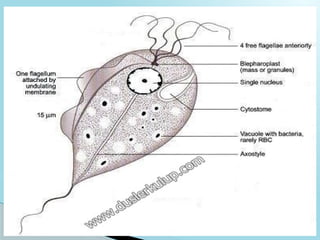
All the trichomonads are morphologically similar, having
a pear-shaped body 7- 23 μm long, a single anterior
nucleus, three to five forward-directed flagella, and a
single posteriorly directed flagellum that forms the
outer border of an undulating membrane.
Structure
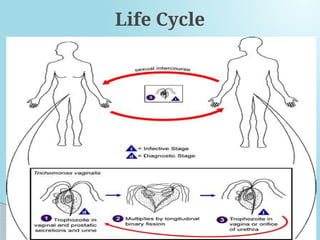
Trichomonads have the simplest kind of
protozoan life cycle, in which the organism
occurs only as a trophozoite. Division is by
binary fission. Because there is no resistant
cyst, transmission from host to host must be
relatively direct.
Life Cycle
Life Cycle
A wet mount preparation of discharge from the patient should be
examined microscopically as a first step in diagnosing T vaginalis
infection. The presence of typical pear-shaped trophozoites,
usually 7 to 23 μm in length, with "bobbling“ motility and, on
careful examination, the wavelike movement of the undulating
membrane, are usually sufficient to identify T vaginalis.
Material that is negative by wet mount examination should be cultured
because culturing is a considerably more sensitive, although time-
consuming, method of diagnosis.
Diagnosis
Metronidazole is effective in both males and females.
Vinegar douche may be useful.
Personal hygiene and the use of condoms are helpful.
Treatment & Control
Summary

Trichomonas vaginalis.pptx power point presentation

  • 1.
  • 2.
    Trichomoniasis is asexually transmitted infection caused by the protozoa Trichomonas vaginalis. Women with trichomoniasis may experience various symptoms, including a yellow-green vaginal discharge and vulvar irritation, or they may be asymptomatic. Men with trichomoniasis are frequently asymptomatic. Trichomoniasis
  • 3.
    The high incidenceof trichomoniasis worldwide, its contribution to poor health outcomes, and its co-infection with other sexually transmitted infections make trichomoniasis a compelling public health concern. Notably, T vaginalis infection is believed to increase the risk of HIV transmission. Trichomoniasis is also associated with adverse pregnancy outcomes, infertility, post-operative infections, and cervical neoplasia. Trichomoniasis
  • 4.
    Worldwide, the annualincidence of trichomoniasis is about 170 million cases. The incidence of trichomoniasis in Europe is similar to that in the United States. In Africa, the prevalence of trichomoniasis may be much higher. Epidemiology
  • 5.
    The infection ishighly associated with the presence of other sexually transmitted infections, including gonorrhea, chlamydia, and HIV. In men, complications of untreated trichomoniasis include prostatitis, epididymitis, urethral stricture disease, and infertility. Infertility may result from a decreased sperm motility and viability. Epidemiology
  • 6.
    T vaginalis isapproximately the size of a white blood cell (about 10 μm in diameter), although its size may vary with physical conditions. Its flagellum allows it to move around vaginal and urethral tissues. T vaginalis directly damages the epithelium, leading to micro-ulcerations of inhabited tissues, increasing the risk of HIV transmission. Pathophysiology
  • 7.
    Symptoms of trichomoniasistypically occur after an incubation period of 4-28 days. In women, T vaginalis is isolated from the vagina, cervix, urethra and bladder. In men, the organism is found in the anterior urethra, external genitalia, prostate, epididymis, and semen. Pathophysiology
  • 8.
    Women Women with trichomoniasisfrequently report a frothy yellowish-green vaginal discharge, abnormal vaginal odor, vulvovaginal itching and soreness, dyspareunia (pain during sexual intercourse), and dysuria (pain during urination). Cervicitis due to trichomoniasis is characterized by 2 major signs—purulent discharge in the endocervical canal and easily induced endocervical bleeding. T vaginalis infection is one of the top 3 causes of vaginitis. Vaginitis is usually characterized by vaginal discharge, which may be Clinical Symptoms
  • 9.
    Men Trichomoniasis symptoms inmen range from none to urethritis complicated by prostatitis. Nongonococcal nonchlamydial urethritis is the most common symptom reported by men with trichomoniasis. Symptoms of urethritis include discharge, dysuria, and urethral pruritus. The discharge may be purulent to mucoid in character. Clinical Symptoms
  • 11.
    All the trichomonadsare morphologically similar, having a pear-shaped body 7- 23 μm long, a single anterior nucleus, three to five forward-directed flagella, and a single posteriorly directed flagellum that forms the outer border of an undulating membrane. Structure
  • 12.
    Trichomonads have thesimplest kind of protozoan life cycle, in which the organism occurs only as a trophozoite. Division is by binary fission. Because there is no resistant cyst, transmission from host to host must be relatively direct. Life Cycle
  • 13.
  • 14.
    A wet mountpreparation of discharge from the patient should be examined microscopically as a first step in diagnosing T vaginalis infection. The presence of typical pear-shaped trophozoites, usually 7 to 23 μm in length, with "bobbling“ motility and, on careful examination, the wavelike movement of the undulating membrane, are usually sufficient to identify T vaginalis. Material that is negative by wet mount examination should be cultured because culturing is a considerably more sensitive, although time- consuming, method of diagnosis. Diagnosis
  • 15.
    Metronidazole is effectivein both males and females. Vinegar douche may be useful. Personal hygiene and the use of condoms are helpful. Treatment & Control
  • 16.