SUBMITTED TO:
DR IJAZ AHMAD TATLAH
PRESENTERS: ASMA HANIF 152233
ABID ALI 152202
Trends in Curriculum
Development
Essential Question
What are the things
that you would like to
Change and Transform
in your life?
I seek changes
You seek changes
We seek changes
Man seek changes
DEVELOPMENT
“INNOVATIONS are INEVITABLE”
Changing Trends
With the demand brought about by the
fast changing society, it is most likely that
changes will occur.
In curriculum, changes and modifications
are being introduced to keep pace with the
changing world.
There is no stopping to innovations. In
local or national setting, there are
innovations that have been introduced.
C U R R I C U L U M D E V E L O P M E N T
L O C A L A N D G L O B A L T R E N D S
Future:
Curriculum
Innovations
What is “Innovation”?
According to The Merriam-Webster
Thesaurus:
Importance of Curriculum
 Curriculum plays very important
role in the field of education. For
every course curriculum is a
backbone which reflects the
structure of the course and clears
all the dimensions, aims and
objectives instructional strategies
and so on.
Role of Curriculum
 Curriculum should be relevant to the
changing time, if there is a lag between
the requirements and components in
the curriculum then all task of
teaching-learning becomes futile.
Up to Date Curriculum
 Curriculum should be update. In the
modern scenario many changes are
taken every day.
 Not only information but building of
knowledge is equally important .
Effective Implementation
In this regard all these changes
should be reflected in the
curriculum then and then only
application of earning is
possible.
Modern trends in Curriculum
Development:
 1) Digital Diversity
 Present age is an age of ICT technology has touched
to all the wakes of human life. Technology has made
various tasks easy, convenient and of quality.
 To survive in the concern field, it is necessary for
everyone to have a knowledge and skill of
technology.
 Education makes man enable to contribute, it
strengthens the capabilities.
2) Need based Curriculums
 Researches in all the fields resulted in to
specialization.
 Need based curriculum is the foremost need of the
present education system. Many universities are
developing need based short term programs for this
purpose.
 Mumbai University has introduced courses like –
certificate course in Power Point, certificate course in
tally, certificate courses
3) Modular Curriculum with credit base
system
 Modular curriculum gives real freedom of
learning especially in the open
learning system his approach has been
adopted at first
 But now majority of traditional universities
also accepting his system; this is a real
emerging trend in the modern curriculum.
4) Online Courses
 Need based and choice based curriculums are
available online also. E.g. course era .com has
introduced many useful need based courses for
free of cost.
 Government also takes initiative for this e.g. Right
to Information certificate course has been
introduced by Government of India to the Indian
people. This course is free and online.
5) 21st century skills
 All the curriculums of various courses
should focus on 21st century skills.
Skills like
 Collaboration, critical thinking,
effective communication, multitasking
stress management, empathy are must
for all the personals.
6) International Understanding
 Globalization has made converted the
world in to global village.
 We should consider world as a one
family and for this international
understanding must be inculcate
through curriculum.
7) Constructivism
 Constructivist approach believes that learner
should be given freedom to construct his/her
knowledge. Spoon feeding must be avoided.
 If a learner is fully active in construction of
knowledge then learning process will be highly
effective.
 In all the curriculums constructivist strategies
must be given important place.
Curriculum Reforms in Pakistan
 Curriculum Reforms have been underway
since 2001 in Pakistan after a long period of
neglect and stagnation.
 From 2001-2003 curriculum ‘revision’ was
undertaken in measured and tempered
phases to keep the influential religious lobby
in government at bay.
Continue….
 In 2005 -06, curriculum of all grades and subjects
(grades I-XII ) underwent a comprehensive reform
in response to critiques
 The persistent charges against the curriculum in
use have been that it is: exclusionary, ideologically
driven, bigoted, generating negative stereotypes
with outmoded content and resistance to change;
 All of which, leads to irrelevance and poor learning
levels as corroborated by the latest National
Education Assessment System reports (NEAS 2006
and 2008)
Continue…..
 The comprehensive national curriculum reforms
began in 2005 embedded in three mega concurrent
initiatives of the Ministry of Education
 i) The National Education Policy Reform Process
(NEPR)
 ii) the National Curriculum Reforms, and the
undertaking of the first ever National Education
Census (NEC) of all service delivery units in
Education (www.moe.gov.pk)
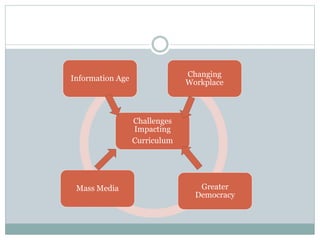
HOW THE INFORMATION AGE,
WORKPLACE, MEDIA AND GREATER
DEMOCRACY IMPACT CURRICULUM
DEVELOPEMENT
Four main challenges face the
education system
Challenges
Impacting
Curriculum
Changing
Workplace
Greater
Democracy
Mass Media
Information Age
Information Age
 More information has been produced
 Information are made available to anybody,
anywhere and anytime.
 Has the present curriculum in educational
institutions taken into consideration these
developments?
Changing Workplace
 Automation and computerization is another
development that is rapidly changing the workplace
and type of job performed.
 The workforce of the future will need to acquire skills
in shorter periods of time and at faster rate to keep
pace with knowledge that is fast competitive and
relevant.
Influence of The Media
 The onslaught of the media 24 hours a day and 7
days a week have brought with it both positive and
negative content.
 A plethora of forces are competing for the attention
of children, adolescents and adults.
 Are schools adequately preparing children with the
skills and knowledge to make wise dicision?
Modern Trends
Constructivism, modular
curriculum, credit system,
Information technology these all
are the emerging trends in
curriculum development.
Conclusion
 Constructivism, modular curriculum, credit
system, Information technology these all are the
emerging trends in curriculum development.
 These trends should be given proper justice while
developing curriculum.
 Educators should learn to work together with their
students, and with other experts in creating
content, and are able to tailor it to exactly what
they need.
Trends in curri presentation

Trends in curri presentation

  • 2.
    SUBMITTED TO: DR IJAZAHMAD TATLAH PRESENTERS: ASMA HANIF 152233 ABID ALI 152202 Trends in Curriculum Development
  • 3.
    Essential Question What arethe things that you would like to Change and Transform in your life?
  • 4.
    I seek changes Youseek changes We seek changes Man seek changes DEVELOPMENT “INNOVATIONS are INEVITABLE”
  • 5.
    Changing Trends With thedemand brought about by the fast changing society, it is most likely that changes will occur. In curriculum, changes and modifications are being introduced to keep pace with the changing world. There is no stopping to innovations. In local or national setting, there are innovations that have been introduced.
  • 6.
    C U RR I C U L U M D E V E L O P M E N T L O C A L A N D G L O B A L T R E N D S Future: Curriculum Innovations
  • 7.
    What is “Innovation”? Accordingto The Merriam-Webster Thesaurus:
  • 8.
    Importance of Curriculum Curriculum plays very important role in the field of education. For every course curriculum is a backbone which reflects the structure of the course and clears all the dimensions, aims and objectives instructional strategies and so on.
  • 9.
    Role of Curriculum Curriculum should be relevant to the changing time, if there is a lag between the requirements and components in the curriculum then all task of teaching-learning becomes futile.
  • 10.
    Up to DateCurriculum  Curriculum should be update. In the modern scenario many changes are taken every day.  Not only information but building of knowledge is equally important .
  • 11.
    Effective Implementation In thisregard all these changes should be reflected in the curriculum then and then only application of earning is possible.
  • 12.
    Modern trends inCurriculum Development:  1) Digital Diversity  Present age is an age of ICT technology has touched to all the wakes of human life. Technology has made various tasks easy, convenient and of quality.  To survive in the concern field, it is necessary for everyone to have a knowledge and skill of technology.  Education makes man enable to contribute, it strengthens the capabilities.
  • 13.
    2) Need basedCurriculums  Researches in all the fields resulted in to specialization.  Need based curriculum is the foremost need of the present education system. Many universities are developing need based short term programs for this purpose.  Mumbai University has introduced courses like – certificate course in Power Point, certificate course in tally, certificate courses
  • 14.
    3) Modular Curriculumwith credit base system  Modular curriculum gives real freedom of learning especially in the open learning system his approach has been adopted at first  But now majority of traditional universities also accepting his system; this is a real emerging trend in the modern curriculum.
  • 15.
    4) Online Courses Need based and choice based curriculums are available online also. E.g. course era .com has introduced many useful need based courses for free of cost.  Government also takes initiative for this e.g. Right to Information certificate course has been introduced by Government of India to the Indian people. This course is free and online.
  • 16.
    5) 21st centuryskills  All the curriculums of various courses should focus on 21st century skills. Skills like  Collaboration, critical thinking, effective communication, multitasking stress management, empathy are must for all the personals.
  • 17.
    6) International Understanding Globalization has made converted the world in to global village.  We should consider world as a one family and for this international understanding must be inculcate through curriculum.
  • 18.
    7) Constructivism  Constructivistapproach believes that learner should be given freedom to construct his/her knowledge. Spoon feeding must be avoided.  If a learner is fully active in construction of knowledge then learning process will be highly effective.  In all the curriculums constructivist strategies must be given important place.
  • 19.
    Curriculum Reforms inPakistan  Curriculum Reforms have been underway since 2001 in Pakistan after a long period of neglect and stagnation.  From 2001-2003 curriculum ‘revision’ was undertaken in measured and tempered phases to keep the influential religious lobby in government at bay.
  • 20.
    Continue….  In 2005-06, curriculum of all grades and subjects (grades I-XII ) underwent a comprehensive reform in response to critiques  The persistent charges against the curriculum in use have been that it is: exclusionary, ideologically driven, bigoted, generating negative stereotypes with outmoded content and resistance to change;  All of which, leads to irrelevance and poor learning levels as corroborated by the latest National Education Assessment System reports (NEAS 2006 and 2008)
  • 21.
    Continue…..  The comprehensivenational curriculum reforms began in 2005 embedded in three mega concurrent initiatives of the Ministry of Education  i) The National Education Policy Reform Process (NEPR)  ii) the National Curriculum Reforms, and the undertaking of the first ever National Education Census (NEC) of all service delivery units in Education (www.moe.gov.pk)
  • 22.
    HOW THE INFORMATIONAGE, WORKPLACE, MEDIA AND GREATER DEMOCRACY IMPACT CURRICULUM DEVELOPEMENT Four main challenges face the education system
  • 23.
  • 24.
    Information Age  Moreinformation has been produced  Information are made available to anybody, anywhere and anytime.  Has the present curriculum in educational institutions taken into consideration these developments?
  • 25.
    Changing Workplace  Automationand computerization is another development that is rapidly changing the workplace and type of job performed.  The workforce of the future will need to acquire skills in shorter periods of time and at faster rate to keep pace with knowledge that is fast competitive and relevant.
  • 26.
    Influence of TheMedia  The onslaught of the media 24 hours a day and 7 days a week have brought with it both positive and negative content.  A plethora of forces are competing for the attention of children, adolescents and adults.  Are schools adequately preparing children with the skills and knowledge to make wise dicision?
  • 27.
    Modern Trends Constructivism, modular curriculum,credit system, Information technology these all are the emerging trends in curriculum development.
  • 28.
    Conclusion  Constructivism, modularcurriculum, credit system, Information technology these all are the emerging trends in curriculum development.  These trends should be given proper justice while developing curriculum.  Educators should learn to work together with their students, and with other experts in creating content, and are able to tailor it to exactly what they need.