M.Ed
Dept.of.education
Periyar university
Salem-11
P. MERCY RANI
TYPES
OF
URRICULUM
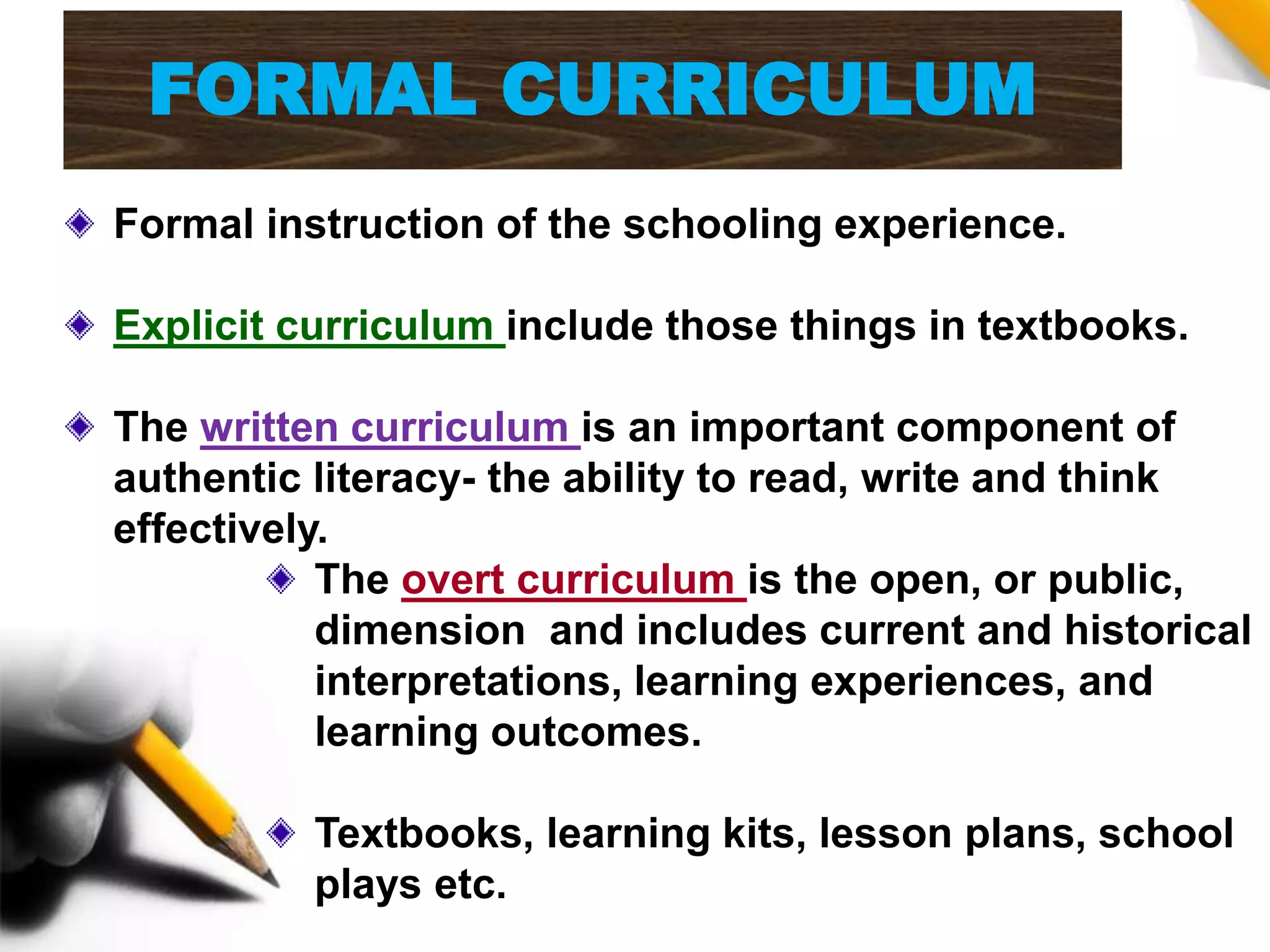
FORMAL CURRICULUM
Formal instruction of the schooling experience.
Explicit curriculum include those things in textbooks.
The written curriculum is an important component of
authentic literacy- the ability to read, write and think
effectively.
The overt curriculum is the open, or public,
dimension and includes current and historical
interpretations, learning experiences, and
learning outcomes.
Textbooks, learning kits, lesson plans, school
plays etc.
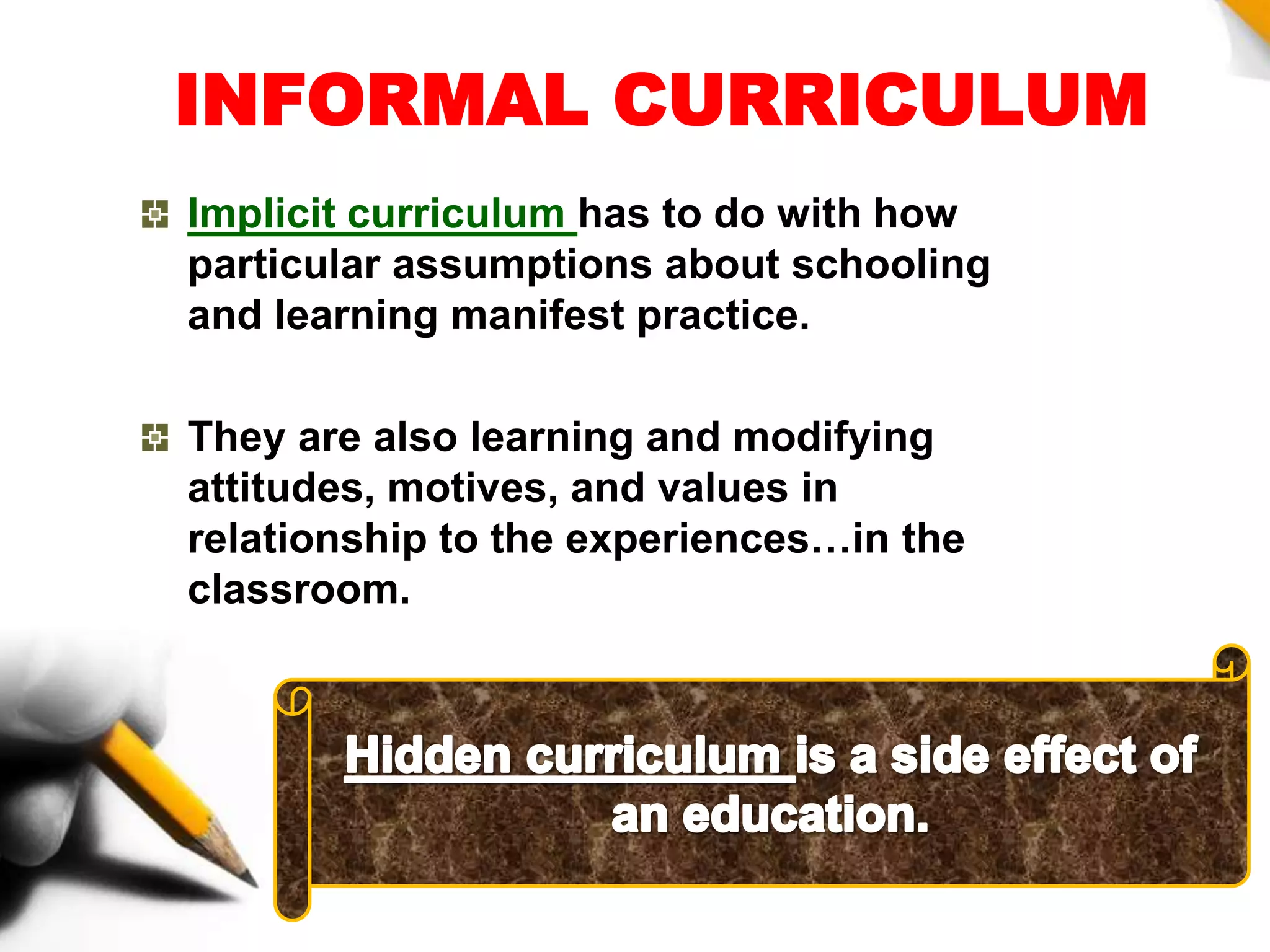
INFORMAL CURRICULUM
Implicit curriculum has to do with how
particular assumptions about schooling
and learning manifest practice.
They are also learning and modifying
attitudes, motives, and values in
relationship to the experiences…in the
classroom.
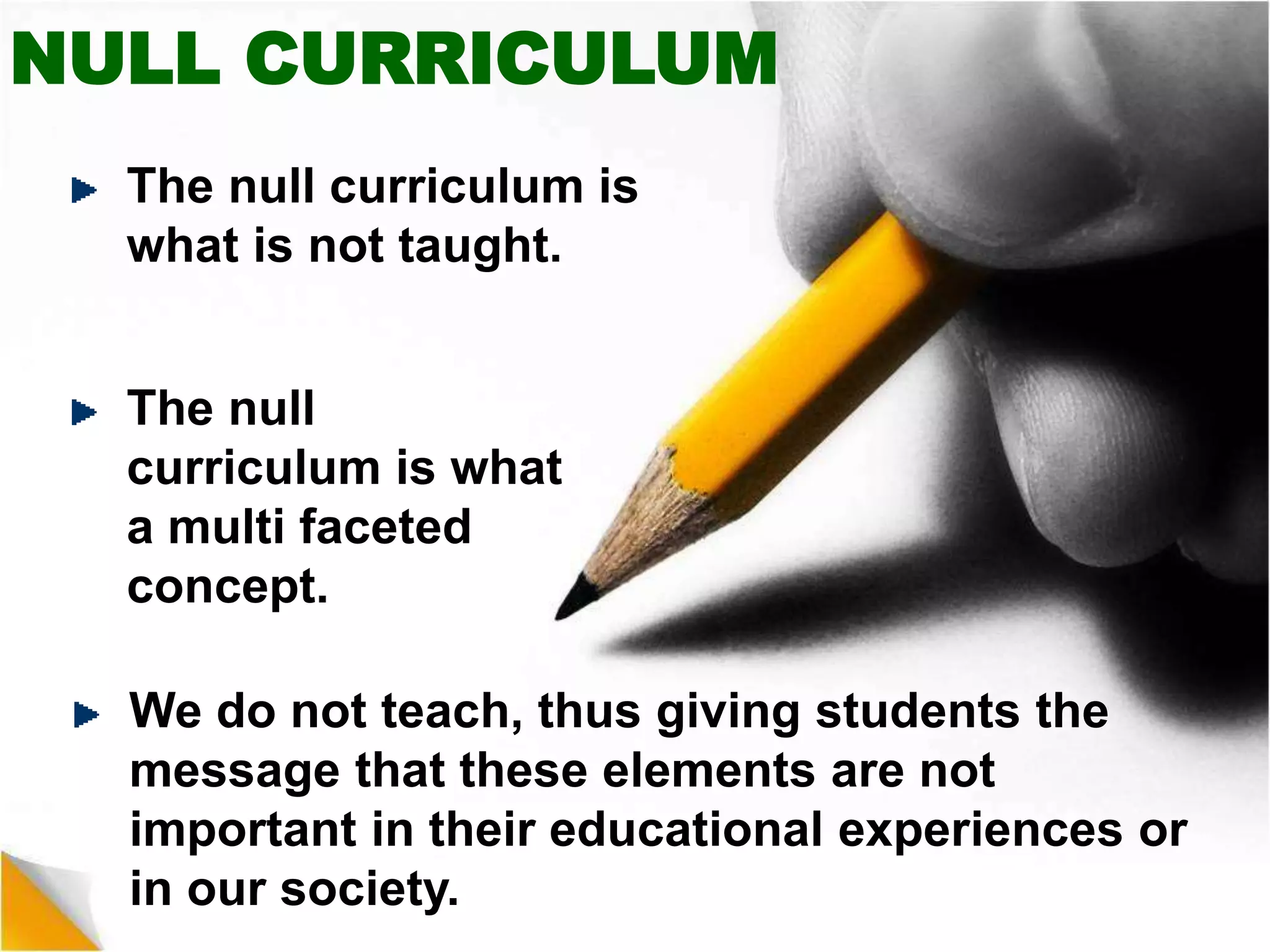
NULL CURRICULUM
We do not teach, thus giving students the
message that these elements are not
important in their educational experiences or
in our society.
The null curriculum is
what is not taught.
The null
curriculum is what
a multi faceted
concept.
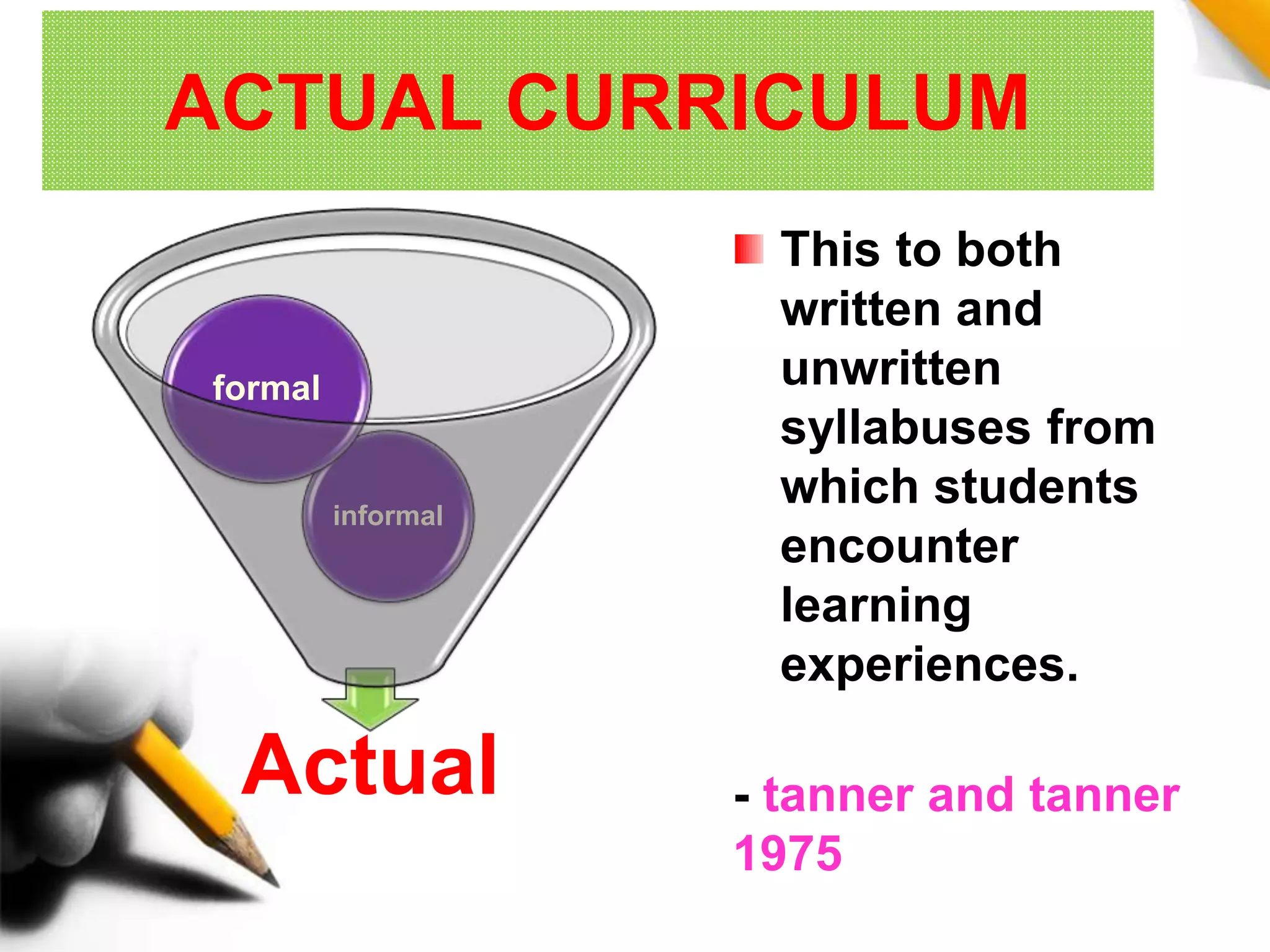
ACTUAL CURRICULUM
This to both
written and
unwritten
syllabuses from
which students
encounter
learning
experiences.
- tanner and tanner
1975
Actual
informal
formal
SUBJECT CURRICULUM
Traditional curriculum
Curriculum is organized according to
how essential knowledge has been
developed in the various subject areas.
LIMITATIONS:
 Learner interest & needs have no place.
 More stress is given to content.
 No place for personal experience.
 Memorization is mostly encouraged.
CHILD CURRICULUM
Experience curriculum
establishes the relationship
between school and society.
Activity curriculum empowers
students through ownership of
knowledge.
LIMITATIONS:
 Content not specific.
 No common curriculum is possible.
 Transforming the experiences into organized
knowledge is difficult-no proper guidance is
provided.
CORE CURRICULUM
This not an independent type of
curriculum.
Compulsory course of study
It relationship between life and
learning.
History, political structure,
democracy, cultural, family,
science.
BROAD FIELD CURRICULUM
Fused curriculum is combining
several specific areas into large
fields/areas.
Integrated curriculum – several
courses have been merged into one.
“Environmental pollution”-chemistry,
physics, biology, geography.
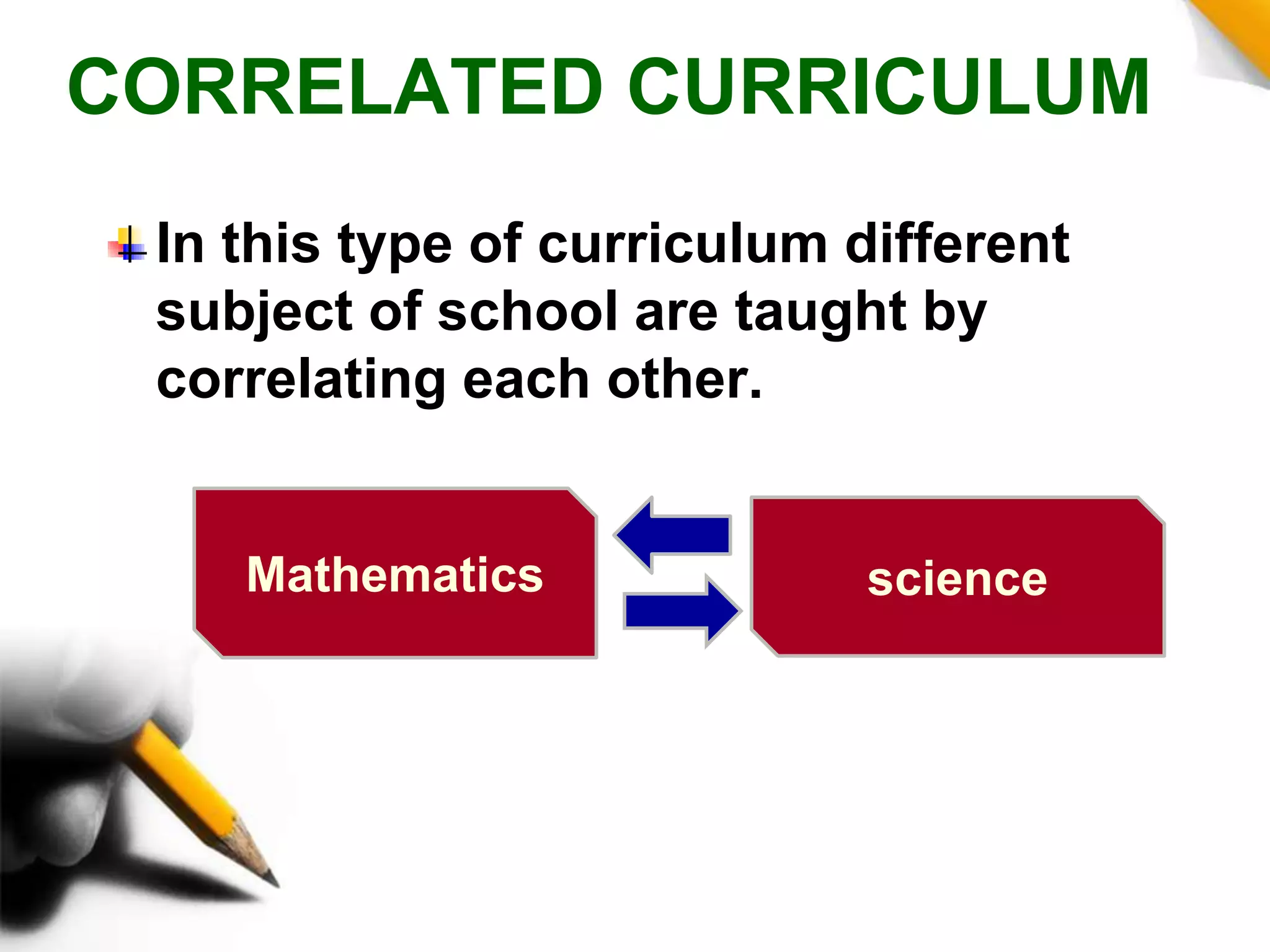
CORRELATED CURRICULUM
In this type of curriculum different
subject of school are taught by
correlating each other.
Mathematics science
TASK CURRICULUM
John Dewey has suggested this type of
curriculum.
kelpertrik has given project-method
teaching for this curriculum.
Mahatma Gandhi emphasized on basic
education.(i.e) 3H-education Hand, Head
and Heart.
INTENDED CURRICULUM
It serves as a documented map of
theories, beliefs and intentions about
schooling, teaching and knowledge
evidence in the development of teacher
proof curriculum.
Processes, content, knowledge
combined with the experiences and
realities of the learner to create new
knowledge.
EXTRA-MURAL CURRICULUM
It refers to those learning activities or
experiences students are exposed to
by their teachers but which are not
stipulated in the formal or official
curriculum.
OBJECTIVE CURRICULUM
B.S BlOOM has suggested this
tri polar process educational
objectives-learning experience-
change behaviour
RHETORICAL CURRICULUM
Elements from the rhetorical
curriculum are comprised from ideas
offered by policymakers, school
official, administrators or politicians.
The rhetorical curriculum may also
come from the publicized works
offering updates in pedagogical
knowledge.
PHANTOM CURRICULUM
The message prevalent in
and through exposure to
media.
CONCOMITANT CURRICULUM
This type of curriculum may be received
at church, in the content of religious
expression, lessons on values, ethics or
morals, moulded behaviours, or social
experiences based on a family's
preferences.
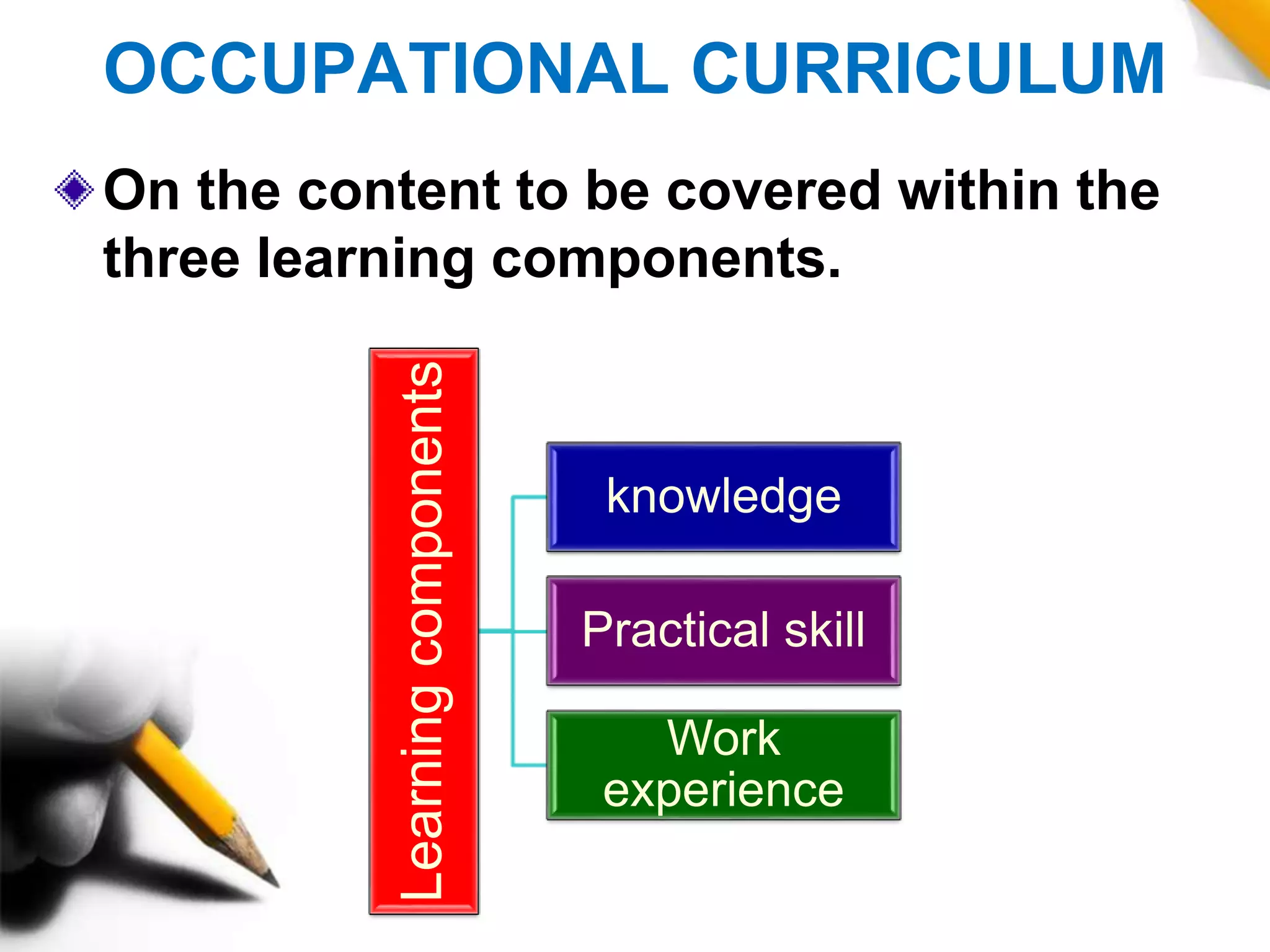
OCCUPATIONAL CURRICULUM
On the content to be covered within the
three learning components.
Learningcomponents
knowledge
Practical skill
Work
experience
TESTED CURRICULUM
What is tested is a limited part of what is
intended by policy makers, taught by
teachers and learned by students.
The test curriculum is that set of learning's
that is assessed in teacher-made
classroom tests; in district-developed,
curriculum-referenced tests and in
standardized test.
E-CURRICULUM
Those lessons learned through
searching the internet for information
or through using e-forms of
communication.
CD-ROM, network, internet, intranet,
video, audio, animation, e-mails, FB,
YouTube.
E-Electronic
Types of curriculum

Types of curriculum

  • 1.
  • 2.
    FORMAL CURRICULUM Formal instructionof the schooling experience. Explicit curriculum include those things in textbooks. The written curriculum is an important component of authentic literacy- the ability to read, write and think effectively. The overt curriculum is the open, or public, dimension and includes current and historical interpretations, learning experiences, and learning outcomes. Textbooks, learning kits, lesson plans, school plays etc.
  • 3.
    INFORMAL CURRICULUM Implicit curriculumhas to do with how particular assumptions about schooling and learning manifest practice. They are also learning and modifying attitudes, motives, and values in relationship to the experiences…in the classroom.
  • 4.
    NULL CURRICULUM We donot teach, thus giving students the message that these elements are not important in their educational experiences or in our society. The null curriculum is what is not taught. The null curriculum is what a multi faceted concept.
  • 5.
    ACTUAL CURRICULUM This toboth written and unwritten syllabuses from which students encounter learning experiences. - tanner and tanner 1975 Actual informal formal
  • 6.
    SUBJECT CURRICULUM Traditional curriculum Curriculumis organized according to how essential knowledge has been developed in the various subject areas. LIMITATIONS:  Learner interest & needs have no place.  More stress is given to content.  No place for personal experience.  Memorization is mostly encouraged.
  • 7.
    CHILD CURRICULUM Experience curriculum establishesthe relationship between school and society. Activity curriculum empowers students through ownership of knowledge. LIMITATIONS:  Content not specific.  No common curriculum is possible.  Transforming the experiences into organized knowledge is difficult-no proper guidance is provided.
  • 8.
    CORE CURRICULUM This notan independent type of curriculum. Compulsory course of study It relationship between life and learning. History, political structure, democracy, cultural, family, science.
  • 9.
    BROAD FIELD CURRICULUM Fusedcurriculum is combining several specific areas into large fields/areas. Integrated curriculum – several courses have been merged into one. “Environmental pollution”-chemistry, physics, biology, geography.
  • 10.
    CORRELATED CURRICULUM In thistype of curriculum different subject of school are taught by correlating each other. Mathematics science
  • 11.
    TASK CURRICULUM John Deweyhas suggested this type of curriculum. kelpertrik has given project-method teaching for this curriculum. Mahatma Gandhi emphasized on basic education.(i.e) 3H-education Hand, Head and Heart.
  • 12.
    INTENDED CURRICULUM It servesas a documented map of theories, beliefs and intentions about schooling, teaching and knowledge evidence in the development of teacher proof curriculum. Processes, content, knowledge combined with the experiences and realities of the learner to create new knowledge.
  • 13.
    EXTRA-MURAL CURRICULUM It refersto those learning activities or experiences students are exposed to by their teachers but which are not stipulated in the formal or official curriculum. OBJECTIVE CURRICULUM B.S BlOOM has suggested this tri polar process educational objectives-learning experience- change behaviour
  • 14.
    RHETORICAL CURRICULUM Elements fromthe rhetorical curriculum are comprised from ideas offered by policymakers, school official, administrators or politicians. The rhetorical curriculum may also come from the publicized works offering updates in pedagogical knowledge.
  • 15.
    PHANTOM CURRICULUM The messageprevalent in and through exposure to media. CONCOMITANT CURRICULUM This type of curriculum may be received at church, in the content of religious expression, lessons on values, ethics or morals, moulded behaviours, or social experiences based on a family's preferences.
  • 16.
    OCCUPATIONAL CURRICULUM On thecontent to be covered within the three learning components. Learningcomponents knowledge Practical skill Work experience
  • 17.
    TESTED CURRICULUM What istested is a limited part of what is intended by policy makers, taught by teachers and learned by students. The test curriculum is that set of learning's that is assessed in teacher-made classroom tests; in district-developed, curriculum-referenced tests and in standardized test.
  • 18.
    E-CURRICULUM Those lessons learnedthrough searching the internet for information or through using e-forms of communication. CD-ROM, network, internet, intranet, video, audio, animation, e-mails, FB, YouTube. E-Electronic