Appraisal Types
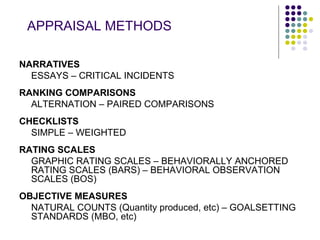
APPRAISAL METHODS
NARRATIVES
ESSAYS – CRITICAL INCIDENTS
RANKING COMPARISONS
ALTERNATION – PAIRED COMPARISONS
CHECKLISTS
SIMPLE – WEIGHTED
RATING SCALES
GRAPHIC RATING SCALES – BEHAVIORALLY ANCHORED
RATING SCALES (BARS) – BEHAVIORAL OBSERVATION
SCALES (BOS)
OBJECTIVE MEASURES
NATURAL COUNTS (Quantity produced, etc) – GOALSETTING
STANDARDS (MBO, etc)
Performance appraisal attempts to:
 Give feedback to improve subsequent performance
 Identify training needs
 Document criteria used to allocate rewards
 Form a basis for personnel decisions
 Provide the opportunity for development
 Facilitate communication
 Validate selection techniques and human resource
policies to meet federal EEO requirements.
Appraisal Formats
 Many different formats and procedures have
been tried to meet these multiple objectives.
 There are relatively few special rules or
special principles applicable only to the
specific purposes.
 There are common formats.
Issues with standard practice
 Despite its standard practice in most public and private
organizations for more than 50 years, performance appraisal still
has many problems.
 Raters show resistance to criticizing subordinates, and the
judgmental aspect of evaluating human performance is subject to
both covert (subjective and individual) and overt (prejudice and
bias) errors.
 Another consideration is that federal legislation, court decisions,
and guidelines of several federal agencies have targeted
performance appraisal as a validation procedure for employee
selection techniques and preventing discrimination in the
workplace. The courts have found organizations in violation of
civil rights laws in failing to validate performance appraisal
criteria and methods.
Performance Appraisal Methods
 Performance appraisals take many forms.
 Written essays, the simplest essay method, is a
written narrative assessing an employee's strengths,
weaknesses, past performance, potential, and
provides recommendations for improvement.
 Types of performance appraisal methods include
comparative standards (such as, simple ranking,
paired comparison, forced distribution) and absolute
standards (such as, critical incidents, BARS, MBO).
Comparative Standards or Multi-person Comparison
 This relative, as opposed to absolute method, compares one
employee's performance with that of one or more others.
 In group rank ordering the supervisor places employees into a
particular classification such as "top one-fifth" and "second one-
fifth". If a supervisor has ten employees, only two could be in the
top fifth, and two must be assigned to the bottom fifth.
 In individual ranking the supervisor lists employees from
highest to lowest. The difference between the top two employees
is assumed equivalent to the difference between the bottom two
employees.
 In paired comparison the supervisor compares each employee
with every other employee in the group and rates each as either
superior or weaker of the pair. After all comparisons are made,
each employee is assigned a summary or ranking based on the
number of superior scores received.
Formats
 Critical Incidents. The supervisor's attention is
focused on specific or critical behaviors that separate
effective from ineffective performance.
 Graphic Rating Scale. This method lists a set of
performance factors such as job knowledge, work
quality, cooperation that the supervisor uses to rate
employee performance using an incremental scale.
 Behaviorally Anchored Rating Scales (BARS).
BARS combine elements from critical incident and
graphic rating scale approaches. The supervisor rates
employees according to items on a numerical scale.
Formats
 Management by Objectives. MBO evaluates how well an
employee has accomplished objectives determined to be
critical in job performance.
 This method aligns objectives with quantitative measures
such as sales, profits, zero-defect units produced.
 360 Degree Feedback. This multi-source feedback method
provides a comprehensive perspective of employee
performance by utilizing feedback from the full circle of
people with whom the employee interacts: supervisors,
subordinates and co-workers. It is effective for career
coaching and identifying strengths and weaknesses. See
360 Degree examples
http://www.bmpcoe.org/bestpractices/external/mash/mash_18.html and
http://www.bmpcoe.org/bestpractices/external/ccad/ccad_23.html
Which format?
 Which one works?
 What have you seen in action?
 Is it the format or the underlying concept that
is problematic?
SUMMARY GUIDELINES FOR APPRAISALS
1. Appraisal standards are job related
2. Standards are clearly communicated to employees in advance
3. Standards are responsive to actual worker behavior or effort
4. Activities performed and results achieved are both appraised
5. Acceptable vs. unacceptable results can clearly be discerned
6. Appraisal criteria are consistently applied
7. Raters are able to consistently observe work performance
8. Raters are trained in appraisal and how to feedback results
9. Developmental feedback is separated from judgmental appraisal
10. An appeal process exists to resolve (judgmental) rating disputes

Appraisal types

  • 1.
  • 2.
    APPRAISAL METHODS NARRATIVES ESSAYS –CRITICAL INCIDENTS RANKING COMPARISONS ALTERNATION – PAIRED COMPARISONS CHECKLISTS SIMPLE – WEIGHTED RATING SCALES GRAPHIC RATING SCALES – BEHAVIORALLY ANCHORED RATING SCALES (BARS) – BEHAVIORAL OBSERVATION SCALES (BOS) OBJECTIVE MEASURES NATURAL COUNTS (Quantity produced, etc) – GOALSETTING STANDARDS (MBO, etc)
  • 3.
    Performance appraisal attemptsto:  Give feedback to improve subsequent performance  Identify training needs  Document criteria used to allocate rewards  Form a basis for personnel decisions  Provide the opportunity for development  Facilitate communication  Validate selection techniques and human resource policies to meet federal EEO requirements.
  • 4.
    Appraisal Formats  Manydifferent formats and procedures have been tried to meet these multiple objectives.  There are relatively few special rules or special principles applicable only to the specific purposes.  There are common formats.
  • 5.
    Issues with standardpractice  Despite its standard practice in most public and private organizations for more than 50 years, performance appraisal still has many problems.  Raters show resistance to criticizing subordinates, and the judgmental aspect of evaluating human performance is subject to both covert (subjective and individual) and overt (prejudice and bias) errors.  Another consideration is that federal legislation, court decisions, and guidelines of several federal agencies have targeted performance appraisal as a validation procedure for employee selection techniques and preventing discrimination in the workplace. The courts have found organizations in violation of civil rights laws in failing to validate performance appraisal criteria and methods.
  • 6.
    Performance Appraisal Methods Performance appraisals take many forms.  Written essays, the simplest essay method, is a written narrative assessing an employee's strengths, weaknesses, past performance, potential, and provides recommendations for improvement.  Types of performance appraisal methods include comparative standards (such as, simple ranking, paired comparison, forced distribution) and absolute standards (such as, critical incidents, BARS, MBO).
  • 7.
    Comparative Standards orMulti-person Comparison  This relative, as opposed to absolute method, compares one employee's performance with that of one or more others.  In group rank ordering the supervisor places employees into a particular classification such as "top one-fifth" and "second one- fifth". If a supervisor has ten employees, only two could be in the top fifth, and two must be assigned to the bottom fifth.  In individual ranking the supervisor lists employees from highest to lowest. The difference between the top two employees is assumed equivalent to the difference between the bottom two employees.  In paired comparison the supervisor compares each employee with every other employee in the group and rates each as either superior or weaker of the pair. After all comparisons are made, each employee is assigned a summary or ranking based on the number of superior scores received.
  • 8.
    Formats  Critical Incidents.The supervisor's attention is focused on specific or critical behaviors that separate effective from ineffective performance.  Graphic Rating Scale. This method lists a set of performance factors such as job knowledge, work quality, cooperation that the supervisor uses to rate employee performance using an incremental scale.  Behaviorally Anchored Rating Scales (BARS). BARS combine elements from critical incident and graphic rating scale approaches. The supervisor rates employees according to items on a numerical scale.
  • 9.
    Formats  Management byObjectives. MBO evaluates how well an employee has accomplished objectives determined to be critical in job performance.  This method aligns objectives with quantitative measures such as sales, profits, zero-defect units produced.  360 Degree Feedback. This multi-source feedback method provides a comprehensive perspective of employee performance by utilizing feedback from the full circle of people with whom the employee interacts: supervisors, subordinates and co-workers. It is effective for career coaching and identifying strengths and weaknesses. See 360 Degree examples http://www.bmpcoe.org/bestpractices/external/mash/mash_18.html and http://www.bmpcoe.org/bestpractices/external/ccad/ccad_23.html
  • 10.
    Which format?  Whichone works?  What have you seen in action?  Is it the format or the underlying concept that is problematic?
  • 11.
    SUMMARY GUIDELINES FORAPPRAISALS 1. Appraisal standards are job related 2. Standards are clearly communicated to employees in advance 3. Standards are responsive to actual worker behavior or effort 4. Activities performed and results achieved are both appraised 5. Acceptable vs. unacceptable results can clearly be discerned 6. Appraisal criteria are consistently applied 7. Raters are able to consistently observe work performance 8. Raters are trained in appraisal and how to feedback results 9. Developmental feedback is separated from judgmental appraisal 10. An appeal process exists to resolve (judgmental) rating disputes