The Story of Carol
I arrived from Jamaica when I was 7 years old and my
mother enrolled me in first grade. Though the work wasn't
hard, I had a difficult time adjusting. Even though I spoke
English, there were many ways of saying and doing things.
One time we had a writing assignment and I make a
mistake and wanted to use an eraser to correct it. Not
knowing the word for eraser, I used the Jamaican term and
asked for a rubber . No one responded to me so I asked
for a rubber again, and again until I was finally ignored.
Finally I took an eraser (rubber) from a student’s desk and
he got upset and my teacher scolded me. I learned the
word when the teacher asked me to erased the board. As
a result, she thought I was slow and she started to treat me
differently.
Components of a Curriculum

 What is to be done?
 What subject matter is to be included?
 What instructional strategies, resources and
  activities will be employed?
 What methods and instruments will be used to
  assess the results of the curriculum?
Components of a Curriculum
 Curriculum Aims, Goals and Objectives
  - Philippine Constitution of 1987 ( school aims)
  - Education Act of 1982 (elementary, secondary &
  tertiary)
  -Ex. Of school’s vision:
        Commits to the Exemplary Christian Education
  for Life and responsive to the needs of the total
  person and the world.
  - Ex. Of school’s mission:
        To produce globally competitive lifelong
  learners.
  Ex. Of school goals
        Build a strong foundation of skills and concepts.
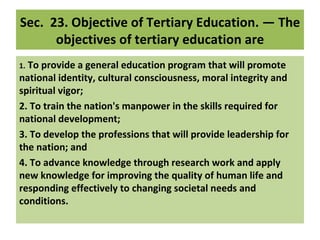
Sec.  23. Objective of Tertiary Education. — The 
       objectives of tertiary education are
1. To provide a general education program that will promote 
national identity, cultural consciousness, moral integrity and 
spiritual vigor;
2. To train the nation's manpower in the skills required for 
national development;
3. To develop the professions that will provide leadership for 
the nation; and
4. To advance knowledge through research work and apply 
new knowledge for improving the quality of human life and 
responding effectively to changing societal needs and 
conditions.
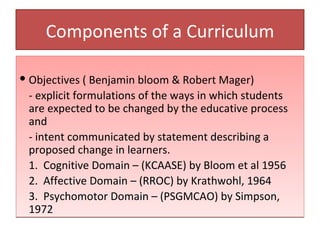
Components of a Curriculum

 Objectives ( Benjamin bloom & Robert Mager)
  - explicit formulations of the ways in which students
  are expected to be changed by the educative process
  and
  - intent communicated by statement describing a
  proposed change in learners.
  1. Cognitive Domain – (KCAASE) by Bloom et al 1956
  2. Affective Domain – (RROC) by Krathwohl, 1964
  3. Psychomotor Domain – (PSGMCAO) by Simpson,
  1972
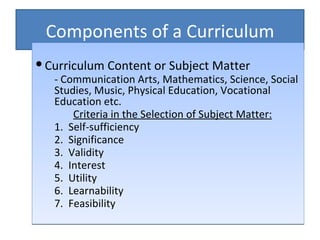
Components of a Curriculum
 Curriculum Content or Subject Matter
   - Communication Arts, Mathematics, Science, Social
   Studies, Music, Physical Education, Vocational
   Education etc.
       Criteria in the Selection of Subject Matter:
   1. Self-sufficiency
   2. Significance
   3. Validity
   4. Interest
   5. Utility
   6. Learnability
   7. Feasibility
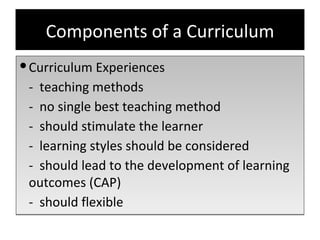
Components of a Curriculum
 Curriculum Experiences
  - teaching methods
  - no single best teaching method
  - should stimulate the learner
  - learning styles should be considered
  - should lead to the development of learning
  outcomes (CAP)
  - should flexible
Components of a Curriculum
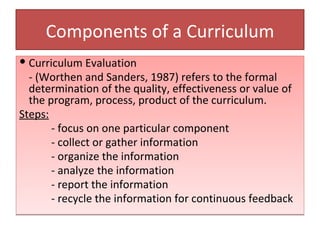
 Curriculum Evaluation
  - (Worthen and Sanders, 1987) refers to the formal
  determination of the quality, effectiveness or value of
  the program, process, product of the curriculum.
Steps:
       - focus on one particular component
       - collect or gather information
       - organize the information
       - analyze the information
       - report the information
       - recycle the information for continuous feedback
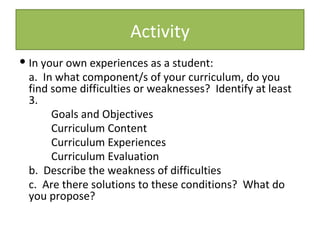
Activity
 In your own experiences as a student:
  a. In what component/s of your curriculum, do you
  find some difficulties or weaknesses? Identify at least
  3.
       Goals and Objectives
       Curriculum Content
       Curriculum Experiences
       Curriculum Evaluation
  b. Describe the weakness of difficulties
  c. Are there solutions to these conditions? What do
  you propose?

Components of a curriculum

  • 1.
    The Story ofCarol I arrived from Jamaica when I was 7 years old and my mother enrolled me in first grade. Though the work wasn't hard, I had a difficult time adjusting. Even though I spoke English, there were many ways of saying and doing things. One time we had a writing assignment and I make a mistake and wanted to use an eraser to correct it. Not knowing the word for eraser, I used the Jamaican term and asked for a rubber . No one responded to me so I asked for a rubber again, and again until I was finally ignored. Finally I took an eraser (rubber) from a student’s desk and he got upset and my teacher scolded me. I learned the word when the teacher asked me to erased the board. As a result, she thought I was slow and she started to treat me differently.
  • 2.
    Components of aCurriculum  What is to be done?  What subject matter is to be included?  What instructional strategies, resources and activities will be employed?  What methods and instruments will be used to assess the results of the curriculum?
  • 3.
    Components of aCurriculum  Curriculum Aims, Goals and Objectives - Philippine Constitution of 1987 ( school aims) - Education Act of 1982 (elementary, secondary & tertiary) -Ex. Of school’s vision: Commits to the Exemplary Christian Education for Life and responsive to the needs of the total person and the world. - Ex. Of school’s mission: To produce globally competitive lifelong learners. Ex. Of school goals Build a strong foundation of skills and concepts.
  • 4.
    Sec.  23. Objective of Tertiary Education. — The  objectives of tertiary education are 1. To provide a general education program that will promote  national identity, cultural consciousness, moral integrity and  spiritual vigor; 2. To train the nation's manpower in the skills required for  national development; 3. To develop the professions that will provide leadership for  the nation; and 4. To advance knowledge through research work and apply  new knowledge for improving the quality of human life and  responding effectively to changing societal needs and  conditions.
  • 5.
    Components of aCurriculum  Objectives ( Benjamin bloom & Robert Mager) - explicit formulations of the ways in which students are expected to be changed by the educative process and - intent communicated by statement describing a proposed change in learners. 1. Cognitive Domain – (KCAASE) by Bloom et al 1956 2. Affective Domain – (RROC) by Krathwohl, 1964 3. Psychomotor Domain – (PSGMCAO) by Simpson, 1972
  • 6.
    Components of aCurriculum  Curriculum Content or Subject Matter - Communication Arts, Mathematics, Science, Social Studies, Music, Physical Education, Vocational Education etc. Criteria in the Selection of Subject Matter: 1. Self-sufficiency 2. Significance 3. Validity 4. Interest 5. Utility 6. Learnability 7. Feasibility
  • 7.
    Components of aCurriculum  Curriculum Experiences - teaching methods - no single best teaching method - should stimulate the learner - learning styles should be considered - should lead to the development of learning outcomes (CAP) - should flexible
  • 8.
    Components of aCurriculum  Curriculum Evaluation - (Worthen and Sanders, 1987) refers to the formal determination of the quality, effectiveness or value of the program, process, product of the curriculum. Steps: - focus on one particular component - collect or gather information - organize the information - analyze the information - report the information - recycle the information for continuous feedback
  • 9.
    Activity  In yourown experiences as a student: a. In what component/s of your curriculum, do you find some difficulties or weaknesses? Identify at least 3. Goals and Objectives Curriculum Content Curriculum Experiences Curriculum Evaluation b. Describe the weakness of difficulties c. Are there solutions to these conditions? What do you propose?