

 Education is for the child. The child is the center of
the educational process.
 Through education, efforts are made for bringing
desirable changes in the behavior of the
learners.
 Psychology as a science of behavior is linked with
the process of imparting education.
 It helps curriculum developers in deciding what
content and learning experiences can be
included in the curriculum.
 It provides bases for curriculum development in
such a way that curriculum could be developed
according to the children in a particular grade
and their needs.
 The psychology of individual differences among
children influences the plan and development of
the curriculum.
 Basic Questions: How do people learn?; How does
psychology help the curriculum? How does
psychology become a basis for curriculum
development?
 Does the physiological development of learner
influence the curriculum?
There are two areas of interest. First, there is a
relationship between the physical condition of the
body and learning. Second, the nervous system is
involved in the physiological makeup of the
body. Yet, the motor and sensory nerves are the
vehicles used in regard to the psychological and
physiological makeup of the learners.
 Does the age of the leaner influence the
curriculum?
Understandings regarding the psychological and
educational competencies of the learners in
particular age groups have led to structuring of
the curriculum on an age grade basis.
 Does the mental development of the learner
affect the curriculum?
There is evidence available to indicate that the
mental development of the learner occurs in what
could be characterized as stages in the same sense
that the physical development of the learner
occurs in stage.
 Do problems of the learner influence the
curriculum?
The development of guidance programmes
in schools in probably a result of a realization
that problems of learners do influence the
curriculum.
 Do the interests of the learner influence the
curriculum?
The findings in psychology indicate that the
interests of the learners are crucial in determining
the effectiveness of learning . Further, studies have
shown that children are more prone to be
interested in certain types of activities at certain
age levels than they are at others.
 Do the needs of the learner influence the
curriculum?
Knowledge in the filed of psychology indicates
that there are needs that all youngsters have in
common, though they may not have these to the
same degree.
 Should the curriculum be analyzed to
determine the extent to which it provides
for rewards or punishments for the
learners?
Generally, the learner responds better when
rewards are emphasized than when
punishment.
 Should there be concern for the extent to
which a group of learners can learn and use
symbols and concepts in developing
curriculum?
Attempts have been made by researchers to
ascertain the age and developmental level at
which a youngster can perform certain kinds
of tasks or mater generalizations or
concepts.
 Behaviorist or association theories
 Cognitive or information processing theories.
 Phenomenological or humanistic theories.
 The first theory which studied how learning occurs was
named as behaviourism. Behaviorism claimed and proved
that behaviour can be modified by changing the
environment, In other words, a learner responds differently
to different stimulus. Accordingly, it suggested to
intentionally provide a stimulus to create desirable response.
It says that:
 Behavior is result of conditions in which learning takes place.
 If proper stimuli are provided, behaviour can be moulded.
 It is possible to control learning experiences to create
desired learning outcomes.
 It is important to reinforce positive behaviour to ensure its
repetition.
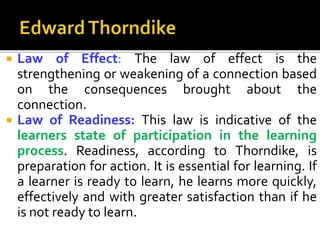
 Law of Effect: The law of effect is the
strengthening or weakening of a connection based
on the consequences brought about the
connection.
 Law of Readiness: This law is indicative of the
learners state of participation in the learning
process. Readiness, according to Thorndike, is
preparation for action. It is essential for learning. If
a learner is ready to learn, he learns more quickly,
effectively and with greater satisfaction than if he
is not ready to learn.
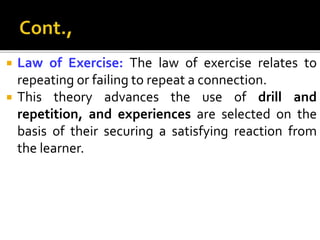
 Law of Exercise: The law of exercise relates to
repeating or failing to repeat a connection.
 This theory advances the use of drill and
repetition, and experiences are selected on the
basis of their securing a satisfying reaction from
the learner.
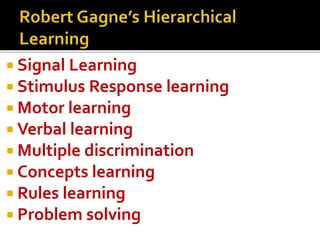
 Signal Learning
 Stimulus Response learning
 Motor learning
 Verbal learning
 Multiple discrimination
 Concepts learning
 Rules learning
 Problem solving
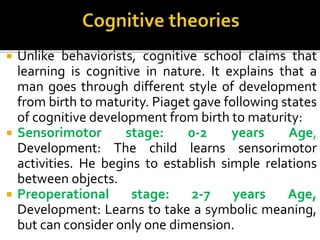
 Unlike behaviorists, cognitive school claims that
learning is cognitive in nature. It explains that a
man goes through different style of development
from birth to maturity. Piaget gave following states
of cognitive development from birth to maturity:
 Sensorimotor stage: 0-2 years Age,
Development: The child learns sensorimotor
activities. He begins to establish simple relations
between objects.
 Preoperational stage: 2-7 years Age,
Development: Learns to take a symbolic meaning,
but can consider only one dimension.
 Concrete operational stage: 7-11 years Age,
Development: Learns to organize data into logical
relationships and can learn concepts in problem
solving situations.
 Formal operational stage: 11 on-wards Age,
Development: Can think about abstract ideas,
formulate hypotheses and deduce possible
conclusions from them.
These stages follow a hierarchical order. Age limit is
flexible for each stage depending on hereditary and
environmental factors. Tyler, Taba and Bruner based
their curriculum principles on Piaget’s theory.
 Physiological Needs: These are basic needs
without which a person,can’t survive and maintain
life like food, water and, oxygen etc.
 Safety Needs: These are the needs which are
meant to protect our-self like a house to save
oneself from many problems, security etc.
 Love and Belonging Needs: These are needs to
have a loving and understanding relationship with
people and to have a social circle.
 Esteem Need: These are needs to be identified as
a respectable person.
 Setf-actuaziliation Needs: These needs demand
the development of best within a person.
 Knowing and Understanding: These needs are for
a desire to learn and know the deepest of truth.
 Maslow claimed, that these needs emerge in
hierarchical order unless and until one set of needs
are fulfilled, next don’t emerge. This theory has
implication for teaching-learning. Maslow
considered the experience of child as:
 Fundamental to learning.
 Emphasizing human qualities like creativity,
values, love etc.,
 Giving importance to the dignity and work of the
individual and focus on the psychological
development and human potential of the learners.
 It is expected that whatever a child learns in the
school will get transferred to a child’s life and there
from to the society at large. Therefore, a
curriculum must be based on such syllabus or
subject-matter which is most useful and desirable
for the child and society and which promises
maximum transfer of knowledge and matters.
 The Gestalt or field psychology is primarily
concerned with the analysis of perceptual fields
which are considered to the primary whole.
Harold Johnson (1968) states that according to
this perceives the problem as he focuses his
experiential background upon the problem
situation. In viewing the learning situation, the
learner perceives a likely solution and tries that
solution. Through such experiences the learners
develop insight.
 Psychology plays a vital role in curriculum
development. The psychological concepts and
theories influence in the curriculum. we can
conclude that curriculum development is guided by
the ideas put forward by psychologists (Watson,
Skinner, Pavlov’s, Piaget, Gagne’s, Bruner, etc.)
from time to time. Hence curriculum development
has sufficient psychological bases.
 Retrieved from
https://physicscatalyst.com/graduation/bases-of-
curriculum/
 Retrieved from https://www.owlgen.in/discuss-
about-psychological-foundations-of-curriculum-
development/