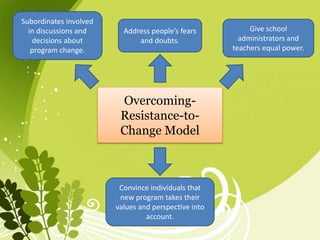
Overcoming-
Resistance-to-
Change Model
Address people’s fears
and doubts.
Give school
administrators and
teachers equal power.
Subordinates involved
in discussions and
decisions about
program change.
Convince individuals that
new program takes their
values and perspective into
account.
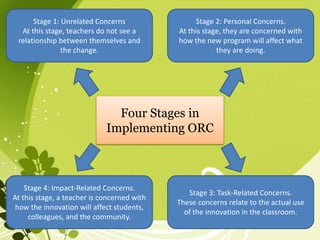
Four Stages in
Implementing ORC
Stage 1: Unrelated Concerns
At this stage, teachers do not see a
relationship between themselves and
the change.
Stage 2: Personal Concerns.
At this stage, they are concerned with
how the new program will affect what
they are doing.
Stage 3: Task-Related Concerns.
These concerns relate to the actual use
of the innovation in the classroom.
Stage 4: Impact-Related Concerns.
At this stage, a teacher is concerned with
how the innovation will affect students,
colleagues, and the community.
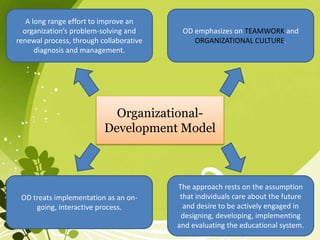
Organizational-
Development Model
A long range effort to improve an
organization’s problem-solving and
renewal process, through collaborative
diagnosis and management.
OD emphasizes on TEAMWORK and
ORGANIZATIONAL CULTURE.
The approach rests on the assumption
that individuals care about the future
and desire to be actively engaged in
designing, developing, implementing
and evaluating the educational system.
OD treats implementation as an on-
going, interactive process.
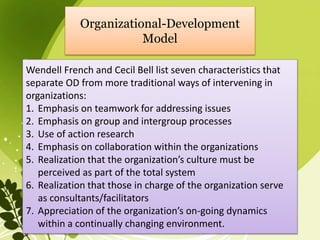
Organizational-Development
Model
Wendell French and Cecil Bell list seven characteristics that
separate OD from more traditional ways of intervening in
organizations:
1. Emphasis on teamwork for addressing issues
2. Emphasis on group and intergroup processes
3. Use of action research
4. Emphasis on collaboration within the organizations
5. Realization that the organization’s culture must be
perceived as part of the total system
6. Realization that those in charge of the organization serve
as consultants/facilitators
7. Appreciation of the organization’s on-going dynamics
within a continually changing environment.
Concerns-Based Adoption
Model
• CBA implementers believe that all change originates with
individuals.
• Individuals change Institutions change.
• Change occurs when individuals’ concerns are made
known.
• Because the change process involves many individuals, it
needs time to take shape.
• Individuals need time to learn new skills and formulate
new attitudes.
Concern Stages
Relating to
Implementing an
Innovation
1. Awareness of
innovation
2. Awareness of
information level
5. Concern for
students
3. Concern for self
4. Concern for
teaching
Systems Model
• The OD and CBA models draw on systems thinking.
• Both consider people’s actions as performed within an
organization defined by a system of relations among
people and structures.
• The work of higher-level administrative or curricular teams
affects that of lower-level professional teams.
• If people responsible for a major portion of an innovation
respect, support, and trust one another, they are also likely
to interact in a positive way with others throughout the
organization.
Systems Model
• To implement a change in curricular module time, energy
and patience are required in order to achieve the goals.
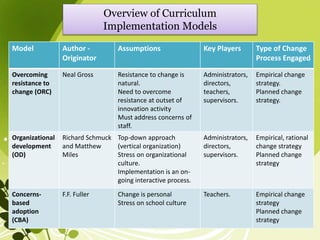
Model Author -
Originator
Assumptions Key Players Type of Change
Process Engaged
Overcoming
resistance to
change (ORC)
Neal Gross Resistance to change is
natural.
Need to overcome
resistance at outset of
innovation activity
Must address concerns of
staff.
Administrators,
directors,
teachers,
supervisors.
Empirical change
strategy.
Planned change
strategy.
Organizational
development
(OD)
Richard Schmuck
and Matthew
Miles
Top-down approach
(vertical organization)
Stress on organizational
culture.
Implementation is an on-
going interactive process.
Administrators,
directors,
supervisors.
Empirical, rational
change strategy
Planned change
strategy
Concerns-
based
adoption
(CBA)
F.F. Fuller Change is personal
Stress on school culture
Teachers. Empirical change
strategy
Planned change
strategy
Overview of Curriculum
Implementation Models
Model Author -
Originator
Assumptions Key Players Type of Change
Process Engaged
Systems
model
Rensis Likert
and Chris
Argyris
The organization is composed
of parts, units, and
departments.
Linkages between people and
groups.
Implementations consist of
corrective actions.
Administrators,
directors,
teachers,
supervisors.
Normative,
rational change
strategies
Planned change
strategy
Educational
change
Michael
Fullan
Successful change involves,
need, clarity, some
complexity, and quality of
programs.
Administrators,
teachers,
students, school
board,
community
members, and
government.
Rational change
strategy
Overview of Curriculum
Implementation Models

-ORC-Model(online material).pptx

  • 1.
    Overcoming- Resistance-to- Change Model Address people’sfears and doubts. Give school administrators and teachers equal power. Subordinates involved in discussions and decisions about program change. Convince individuals that new program takes their values and perspective into account.
  • 2.
    Four Stages in ImplementingORC Stage 1: Unrelated Concerns At this stage, teachers do not see a relationship between themselves and the change. Stage 2: Personal Concerns. At this stage, they are concerned with how the new program will affect what they are doing. Stage 3: Task-Related Concerns. These concerns relate to the actual use of the innovation in the classroom. Stage 4: Impact-Related Concerns. At this stage, a teacher is concerned with how the innovation will affect students, colleagues, and the community.
  • 3.
    Organizational- Development Model A longrange effort to improve an organization’s problem-solving and renewal process, through collaborative diagnosis and management. OD emphasizes on TEAMWORK and ORGANIZATIONAL CULTURE. The approach rests on the assumption that individuals care about the future and desire to be actively engaged in designing, developing, implementing and evaluating the educational system. OD treats implementation as an on- going, interactive process.
  • 4.
    Organizational-Development Model Wendell French andCecil Bell list seven characteristics that separate OD from more traditional ways of intervening in organizations: 1. Emphasis on teamwork for addressing issues 2. Emphasis on group and intergroup processes 3. Use of action research 4. Emphasis on collaboration within the organizations 5. Realization that the organization’s culture must be perceived as part of the total system 6. Realization that those in charge of the organization serve as consultants/facilitators 7. Appreciation of the organization’s on-going dynamics within a continually changing environment.
  • 5.
    Concerns-Based Adoption Model • CBAimplementers believe that all change originates with individuals. • Individuals change Institutions change. • Change occurs when individuals’ concerns are made known. • Because the change process involves many individuals, it needs time to take shape. • Individuals need time to learn new skills and formulate new attitudes.
  • 6.
    Concern Stages Relating to Implementingan Innovation 1. Awareness of innovation 2. Awareness of information level 5. Concern for students 3. Concern for self 4. Concern for teaching
  • 7.
    Systems Model • TheOD and CBA models draw on systems thinking. • Both consider people’s actions as performed within an organization defined by a system of relations among people and structures. • The work of higher-level administrative or curricular teams affects that of lower-level professional teams. • If people responsible for a major portion of an innovation respect, support, and trust one another, they are also likely to interact in a positive way with others throughout the organization.
  • 8.
    Systems Model • Toimplement a change in curricular module time, energy and patience are required in order to achieve the goals.
  • 9.
    Model Author - Originator AssumptionsKey Players Type of Change Process Engaged Overcoming resistance to change (ORC) Neal Gross Resistance to change is natural. Need to overcome resistance at outset of innovation activity Must address concerns of staff. Administrators, directors, teachers, supervisors. Empirical change strategy. Planned change strategy. Organizational development (OD) Richard Schmuck and Matthew Miles Top-down approach (vertical organization) Stress on organizational culture. Implementation is an on- going interactive process. Administrators, directors, supervisors. Empirical, rational change strategy Planned change strategy Concerns- based adoption (CBA) F.F. Fuller Change is personal Stress on school culture Teachers. Empirical change strategy Planned change strategy Overview of Curriculum Implementation Models
  • 10.
    Model Author - Originator AssumptionsKey Players Type of Change Process Engaged Systems model Rensis Likert and Chris Argyris The organization is composed of parts, units, and departments. Linkages between people and groups. Implementations consist of corrective actions. Administrators, directors, teachers, supervisors. Normative, rational change strategies Planned change strategy Educational change Michael Fullan Successful change involves, need, clarity, some complexity, and quality of programs. Administrators, teachers, students, school board, community members, and government. Rational change strategy Overview of Curriculum Implementation Models