Movement Disorders
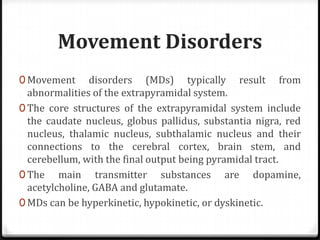
0 Movement      disorders (MDs) typically result from
  abnormalities of the extrapyramidal system.
0 The core structures of the extrapyramidal system include
  the caudate nucleus, globus pallidus, substantia nigra, red
  nucleus, thalamic nucleus, subthalamic nucleus and their
  connections to the cerebral cortex, brain stem, and
  cerebellum, with the final output being pyramidal tract.
0 The main transmitter substances are dopamine,
  acetylcholine, GABA and glutamate.
0 MDs can be hyperkinetic, hypokinetic, or dyskinetic.
Pattern Recognition

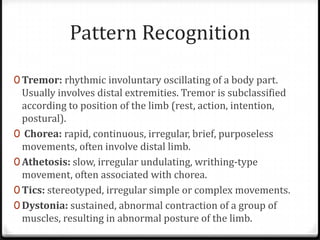
0 Tremor: rhythmic involuntary oscillating of a body part.
  Usually involves distal extremities. Tremor is subclassified
  according to position of the limb (rest, action, intention,
  postural).
0 Chorea: rapid, continuous, irregular, brief, purposeless
  movements, often involve distal limb.
0 Athetosis: slow, irregular undulating, writhing-type
  movement, often associated with chorea.
0 Tics: stereotyped, irregular simple or complex movements.
0 Dystonia: sustained, abnormal contraction of a group of
  muscles, resulting in abnormal posture of the limb.
0 • Ballismus: violent, flinging movements often involving
  proximal limb, usually unilateral (hemiballismus), but can be
  bilateral lower or upper extremities because of contralateral
  subthalamic nucleus lesion.
0 • Myoclonus: sudden, irregular shock-like contraction of the
  muscle or group of muscles.
0 • Tardive dyskinesia: stereotyped movements often involving
  the facial and oral muscles, manifesting as tongue protrusion,
  chewing, lip smacking, and facial grimacing. The trunk and
  extremities are often also involved. This condition is seen after
  chronic use of dopamine-blocking antipsychotic or antiemetic
  drugs.
0 • Rigidity: increased muscle tone throughout the passive range
  of motion of the limb. When there is coexistence of tremor, the
  examiner detects a ratchet like resistance, referred to as
  “cogwheel rigidity.”
Tremor
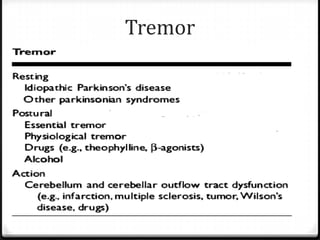
1. Rest tremor.
0 Tremor that occurs in a body part that is not voluntarily activated
 and is completely supported against gravity.
0 Rest tremor increases with mental stress (counting backwards),
 or when movements of another body part are performed
 (especially walking). It is mostly found in Parkinson's disease, but
 also in other parkinsonian syndromes, including drug-induced
 parkinsonism.
0 Its presence indicates dysfunction of the nigrostriatal dopamine
 pathway or its efferent projections to basal ganglia
 thalamocortical circuits.
2. Action tremor.
0 Postural tremor. Tremor present while voluntarily maintaining a
  position against gravity. This tremor is usually documented by
  having the patient outstretch the arms.
0 Simple-kinetic tremor. Tremor that occurs during voluntary action
  that is not target-directed.
0 Intention tremor. Action tremor in which amplitude increases
  substantially during the pursuit of a target or goal. Its presence
  suggests a disturbance of the cerebellum or its afferent/efferent
  pathways.
0 Task-specific kinetic tremor. Tremor occurring during specific
  activities, such as the primary writing tremor and occupational
  tremors. These tremors are often associated with dystonia.
Etiological classification of
         tremors
Treatment (ET)
a) β-Blockers: propranolol (Inderal) studied most extensively
i) Inderal LA (long-acting) may be started at 40 mg daily, and increased in small increments to
optimal doses 240-320 mg/day, as tolerated and if needed
ii) Tremor reduction up to 60%
iii) Contraindicated if asthma, diabetes mellitus, marked bradycardia, second- or third-degree
atrioventricular block, heart failure

b) Primidone (Mysoline)
i) As effective as propranolol but more adverse effects
ii) Converted to phenylethylmalonamide and phenobarbital, the latter with longer half-life
iii) To minimize the adverse effects, start with small doses of 50 mg/day and with subsequent
titration, may be divided as 3-times-daily regimen
iv) May be titrated up to maximum of 750 mg/day (250 mg 3 times daily)

c) Second-line agents: carbonic anhydrase inhibitors
(e.g., methazolamide), gabapentin, benzodiazepines
d) Surgical treatment
i) Thalamotomy
ii) Thalamic stimulation: high success rate (tremor reduced in up to 90% and abolished in 50%
of cases); bilateral procedures have lower complication rates than thalamotomy
Chorea
Chorea
0 a. Unsustained, nonstereotypic movements with variable
  speed and direction, may be rapid or brief, may flow from
  one extremity to the next.
0 b. Choreoathetosis: chorea occurring concurrently with
  athetosis or dystonic movements
0 c. Ballismus (ballism): large-amplitude random movements,
  most prominent at the proximal limbs
0 d. Hemichorea or hemiballismus: refers to hemi body
  distribution of the movement disorder
Clinical features
a. Mild chorea may appear as restlessness or uneasy
movements
b. Parakinesia: chorea that may seem semipurposeful and
may “blend into” purposeful movements
c. Inability to maintain tone: maintaining handgrip
(“milkmaid’s grip”) or maintaining protrusion of tongue
(“flycatcher’s tongue”)
Treatment and management
a) Dopamine receptor blockers and dopamine-depleting agents for
chorea, psychosis, and behavioral symptoms
i) Typical antipsychotics are not well tolerated and can induce tardive dyskinesias
ii) Atypical antipsychotics better tolerated and do not induce tardive dyskinesias
iii) Atypical antipsychotic—clozapine: effective for psychosis but not for chorea;
disadvantage is high cost and risk of agranulocytosis
iv) Atypical antipsychotic—olanzapine: effective for both chorea and psychiatric
symptoms (may increase stroke risk in elderly)
b) Riluzole: corticostriatal glutamate release inhibitor; may potentially improve
chorea
c) Remacemide: glutamate/NMDA receptor antagonist, may marginally improve
chorea .
d) Coenzyme Q10: mitochondrial complex I enhancer, possible decline in
measure of disability (not statistically significant), possible benefit on behavioral
symptoms
e) Anticonvulsants (e.g., valproate): may be helpful for chorea and psychiatric
and behavioral symptoms, including aggression and irritability
Dystonia
Dystonia
0 syndrome of sustained muscle contractions producing
 abnormal postures or repetitive movements involving
 different distributions
0Classification according to distribution:
1) Focal: one body region
2) Multifocal: at least two noncontiguous body regions
3) Hemidystonia: at least two ipsilateral body regions
4) Segmental: adjacent body regions
5) Generalized: involvement of both lower extremities or one
lower extremity and trunk and another body region
0 A characteristic feature of dystonic movements is that they
  may be diminished by sensory tricks such as gently
  touching the affected body part (geste antagoniste).
0 Dystonic movements tend to be exacerbated by
  fatigue, stress, and emotional states and may be suppressed
  by relaxation and sleep.
0 Dystonia typically worsens during voluntary movement. At
  the time of onset, dystonia may only be present during a
  specific movement (action dystonia).
0 With progression, however, the dystonia may emerge with
  other movements and eventually may be present at rest.
Causes
1) Idiopathic torsion dystonia is a primary dystonia and may
occur as a familial condition. The spectrum of the disorder is
broad and includes focal (blepharospasm, torticollis,
spasmodic dysphonia, writer's cramp), segmental, and
generalized forms. The gene for the autosomal dominant
familial form has been located on chromosome 9q,
2) Secondary causes of dystonia include metabolic disorders
(e.g., Wilson's disease) degenerative diseases (parkinson's
disease, progressive supranuclear palsy, corticobasal
ganglionic degeneration, Huntington's disease, multiple
system atrophy), and nondegenerative central nervous
system disorders (anoxia, head or peripheral trauma, prior
stroke, multiple sclerosis, or drug-induced)
Treatment
1)Botulinum toxin A (BTX)
2) Medical treatment
0 a) Dopaminergic (Sinemet)
0 b) Dopaminergic antagonists
0 c) Dopamine-depleting agents
0 d) Anticholinergic (e.g., trihexyphenidyl, benztropine): may be effective in up to 40% of
  patients
0 e) Baclofen: may be effective in up to 20%
0 f) Clonazepam: may be effective in up to 15%
0 g) Anticonvulsants (e.g., carbamazepine, gabapentin)
3) Surgical treatment
0 a) Peripheral denervation procedures: bilateral anterior cervical rhizotomy,
  microvascular decompression, ramisectomy, peripheral nerve lysis, myectomy
0 b) Deep brain stimulation
0 c) Unilateral thalamotomy
ACUTE DRUG-INDUCED
        DYSTONIA
Acute drug-induced dystonia presents with abnormal
tongue or jaw postures and neck dystonia, occurring
within the first 3 days of starting a neuroleptic.

The treatment is benzotropin (Cogentin), 2 mg
intravenously or intramuscularly, or 50 mg
diphentrydramine (Benadryl) intravenously.
Myoclonus
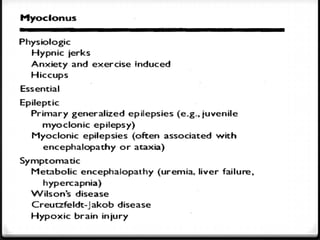
0 Myoclonus is a sudden Iightning-like movement produced by
  abrupt and brief muscle contraction.
0 The four etiologic categories are essential, physiological,
  epileptic, and symptomatic.
0 Essential myoclonus is a non physiological variety that occurs
  in isolation without evidence of other neurologic symptoms or
  signs. It may occur in familial and sporadic forms. Some
  patients may note a striking improvement with small
  quantities of alcohol.
Treatment:
0 clonazepam and other benzodiazepines, valproate, 5-
 hydroxytryptophan, piracetam
Tics
0 Tics are abrupt, stereotyped, coordinated movements or
  vocalizations. They may vary in intensity and be repeated at
  irregular intervals. Tics may be exacerbated by stress and
  relieved by distraction.
0 Tics may be motor or vocal and are classified as being either
  simple or complex. Examples of simple motor tics include eye
  blinking, shoulder shrugging, and toe curling. Spitting and finger
  cracking are examples of complex motor tics. Simple vocal tics
  may take the form of sniffing, throat clearing, snorting, or
  coughing.
0 Complex phonic tics are meaningful syllables, words, or phrases
  (“okay,” “shut up”), and include palilalia (repeating the last
  syllables of one's words), echolalia (repeating someone else's
  words
0 Sensory tics are uncomfortable sensations
  (pressure, cold, warmth, or paresthesias) localized to certain
  body parts that are relieved by the performance of an intentional
  act in the affected area.
0 Tics may also be classified as idiopathic (the majority) or
  secondary. Secondary causes include head
  trauma, encephalitis, stroke, and various drugs.
0 For treatment of tics, dopamine antagonists (haloperidol or
  the atypical antipsychotics) are most effective;
  however, because of the adverse effect profile of these
  agents, less potent drugs such as clonazepam and clonidine
  should be tried first
Q.1. A 45-year-old man with frequent but vague
gastrointestinal complaints has been doing well on a
combination of added fiber, ranitidine, and metoclopramide.
He has no new complaints. He appears to be chewing
gum, but examination reveals nothing in his mouth, and he
does not appear to be able to suppress the movements. He
is unaware of the movements, but his spouse noted their
progressive appearance during the past six months. The
most likely cause of his problem is
A. Whipple’s disease
B. Chronic oral tic disorder
C. Drug-induced tardive dyskinesia
D. Normal aging
Q.2. An 86-year-old woman with Alzheimer’s disease has been
using donepezil for her ailing memory. Risperidone was added
recently for progressively agitated behaviors. Several months
later, she appears slow and has had several falls.
Examination reveals a shuffling gait, stooped posture, and slowed
movements. Otherwise, her examination is unchanged.
Appropriate management includes
A. Starting levodopa/carbidopa for possible Parkinson’s disease
B. Starting an antidepressant for suspected depression
C. Discontinuing risperidone
D. Discontinuing donepezil
 movement disorders

movement disorders

  • 2.
    Movement Disorders 0 Movement disorders (MDs) typically result from abnormalities of the extrapyramidal system. 0 The core structures of the extrapyramidal system include the caudate nucleus, globus pallidus, substantia nigra, red nucleus, thalamic nucleus, subthalamic nucleus and their connections to the cerebral cortex, brain stem, and cerebellum, with the final output being pyramidal tract. 0 The main transmitter substances are dopamine, acetylcholine, GABA and glutamate. 0 MDs can be hyperkinetic, hypokinetic, or dyskinetic.
  • 3.
    Pattern Recognition 0 Tremor:rhythmic involuntary oscillating of a body part. Usually involves distal extremities. Tremor is subclassified according to position of the limb (rest, action, intention, postural). 0 Chorea: rapid, continuous, irregular, brief, purposeless movements, often involve distal limb. 0 Athetosis: slow, irregular undulating, writhing-type movement, often associated with chorea. 0 Tics: stereotyped, irregular simple or complex movements. 0 Dystonia: sustained, abnormal contraction of a group of muscles, resulting in abnormal posture of the limb.
  • 4.
    0 • Ballismus:violent, flinging movements often involving proximal limb, usually unilateral (hemiballismus), but can be bilateral lower or upper extremities because of contralateral subthalamic nucleus lesion. 0 • Myoclonus: sudden, irregular shock-like contraction of the muscle or group of muscles. 0 • Tardive dyskinesia: stereotyped movements often involving the facial and oral muscles, manifesting as tongue protrusion, chewing, lip smacking, and facial grimacing. The trunk and extremities are often also involved. This condition is seen after chronic use of dopamine-blocking antipsychotic or antiemetic drugs. 0 • Rigidity: increased muscle tone throughout the passive range of motion of the limb. When there is coexistence of tremor, the examiner detects a ratchet like resistance, referred to as “cogwheel rigidity.”
  • 5.
  • 6.
    1. Rest tremor. 0Tremor that occurs in a body part that is not voluntarily activated and is completely supported against gravity. 0 Rest tremor increases with mental stress (counting backwards), or when movements of another body part are performed (especially walking). It is mostly found in Parkinson's disease, but also in other parkinsonian syndromes, including drug-induced parkinsonism. 0 Its presence indicates dysfunction of the nigrostriatal dopamine pathway or its efferent projections to basal ganglia thalamocortical circuits.
  • 7.
    2. Action tremor. 0Postural tremor. Tremor present while voluntarily maintaining a position against gravity. This tremor is usually documented by having the patient outstretch the arms. 0 Simple-kinetic tremor. Tremor that occurs during voluntary action that is not target-directed. 0 Intention tremor. Action tremor in which amplitude increases substantially during the pursuit of a target or goal. Its presence suggests a disturbance of the cerebellum or its afferent/efferent pathways. 0 Task-specific kinetic tremor. Tremor occurring during specific activities, such as the primary writing tremor and occupational tremors. These tremors are often associated with dystonia.
  • 8.
  • 12.
    Treatment (ET) a) β-Blockers:propranolol (Inderal) studied most extensively i) Inderal LA (long-acting) may be started at 40 mg daily, and increased in small increments to optimal doses 240-320 mg/day, as tolerated and if needed ii) Tremor reduction up to 60% iii) Contraindicated if asthma, diabetes mellitus, marked bradycardia, second- or third-degree atrioventricular block, heart failure b) Primidone (Mysoline) i) As effective as propranolol but more adverse effects ii) Converted to phenylethylmalonamide and phenobarbital, the latter with longer half-life iii) To minimize the adverse effects, start with small doses of 50 mg/day and with subsequent titration, may be divided as 3-times-daily regimen iv) May be titrated up to maximum of 750 mg/day (250 mg 3 times daily) c) Second-line agents: carbonic anhydrase inhibitors (e.g., methazolamide), gabapentin, benzodiazepines d) Surgical treatment i) Thalamotomy ii) Thalamic stimulation: high success rate (tremor reduced in up to 90% and abolished in 50% of cases); bilateral procedures have lower complication rates than thalamotomy
  • 13.
  • 14.
    Chorea 0 a. Unsustained,nonstereotypic movements with variable speed and direction, may be rapid or brief, may flow from one extremity to the next. 0 b. Choreoathetosis: chorea occurring concurrently with athetosis or dystonic movements 0 c. Ballismus (ballism): large-amplitude random movements, most prominent at the proximal limbs 0 d. Hemichorea or hemiballismus: refers to hemi body distribution of the movement disorder
  • 15.
    Clinical features a. Mildchorea may appear as restlessness or uneasy movements b. Parakinesia: chorea that may seem semipurposeful and may “blend into” purposeful movements c. Inability to maintain tone: maintaining handgrip (“milkmaid’s grip”) or maintaining protrusion of tongue (“flycatcher’s tongue”)
  • 17.
    Treatment and management a)Dopamine receptor blockers and dopamine-depleting agents for chorea, psychosis, and behavioral symptoms i) Typical antipsychotics are not well tolerated and can induce tardive dyskinesias ii) Atypical antipsychotics better tolerated and do not induce tardive dyskinesias iii) Atypical antipsychotic—clozapine: effective for psychosis but not for chorea; disadvantage is high cost and risk of agranulocytosis iv) Atypical antipsychotic—olanzapine: effective for both chorea and psychiatric symptoms (may increase stroke risk in elderly) b) Riluzole: corticostriatal glutamate release inhibitor; may potentially improve chorea c) Remacemide: glutamate/NMDA receptor antagonist, may marginally improve chorea . d) Coenzyme Q10: mitochondrial complex I enhancer, possible decline in measure of disability (not statistically significant), possible benefit on behavioral symptoms e) Anticonvulsants (e.g., valproate): may be helpful for chorea and psychiatric and behavioral symptoms, including aggression and irritability
  • 18.
  • 19.
    Dystonia 0 syndrome ofsustained muscle contractions producing abnormal postures or repetitive movements involving different distributions 0Classification according to distribution: 1) Focal: one body region 2) Multifocal: at least two noncontiguous body regions 3) Hemidystonia: at least two ipsilateral body regions 4) Segmental: adjacent body regions 5) Generalized: involvement of both lower extremities or one lower extremity and trunk and another body region
  • 20.
    0 A characteristicfeature of dystonic movements is that they may be diminished by sensory tricks such as gently touching the affected body part (geste antagoniste). 0 Dystonic movements tend to be exacerbated by fatigue, stress, and emotional states and may be suppressed by relaxation and sleep. 0 Dystonia typically worsens during voluntary movement. At the time of onset, dystonia may only be present during a specific movement (action dystonia). 0 With progression, however, the dystonia may emerge with other movements and eventually may be present at rest.
  • 21.
    Causes 1) Idiopathic torsiondystonia is a primary dystonia and may occur as a familial condition. The spectrum of the disorder is broad and includes focal (blepharospasm, torticollis, spasmodic dysphonia, writer's cramp), segmental, and generalized forms. The gene for the autosomal dominant familial form has been located on chromosome 9q, 2) Secondary causes of dystonia include metabolic disorders (e.g., Wilson's disease) degenerative diseases (parkinson's disease, progressive supranuclear palsy, corticobasal ganglionic degeneration, Huntington's disease, multiple system atrophy), and nondegenerative central nervous system disorders (anoxia, head or peripheral trauma, prior stroke, multiple sclerosis, or drug-induced)
  • 22.
    Treatment 1)Botulinum toxin A(BTX) 2) Medical treatment 0 a) Dopaminergic (Sinemet) 0 b) Dopaminergic antagonists 0 c) Dopamine-depleting agents 0 d) Anticholinergic (e.g., trihexyphenidyl, benztropine): may be effective in up to 40% of patients 0 e) Baclofen: may be effective in up to 20% 0 f) Clonazepam: may be effective in up to 15% 0 g) Anticonvulsants (e.g., carbamazepine, gabapentin) 3) Surgical treatment 0 a) Peripheral denervation procedures: bilateral anterior cervical rhizotomy, microvascular decompression, ramisectomy, peripheral nerve lysis, myectomy 0 b) Deep brain stimulation 0 c) Unilateral thalamotomy
  • 23.
    ACUTE DRUG-INDUCED DYSTONIA Acute drug-induced dystonia presents with abnormal tongue or jaw postures and neck dystonia, occurring within the first 3 days of starting a neuroleptic. The treatment is benzotropin (Cogentin), 2 mg intravenously or intramuscularly, or 50 mg diphentrydramine (Benadryl) intravenously.
  • 24.
  • 25.
    0 Myoclonus isa sudden Iightning-like movement produced by abrupt and brief muscle contraction. 0 The four etiologic categories are essential, physiological, epileptic, and symptomatic. 0 Essential myoclonus is a non physiological variety that occurs in isolation without evidence of other neurologic symptoms or signs. It may occur in familial and sporadic forms. Some patients may note a striking improvement with small quantities of alcohol.
  • 27.
    Treatment: 0 clonazepam andother benzodiazepines, valproate, 5- hydroxytryptophan, piracetam
  • 28.
  • 29.
    0 Tics areabrupt, stereotyped, coordinated movements or vocalizations. They may vary in intensity and be repeated at irregular intervals. Tics may be exacerbated by stress and relieved by distraction. 0 Tics may be motor or vocal and are classified as being either simple or complex. Examples of simple motor tics include eye blinking, shoulder shrugging, and toe curling. Spitting and finger cracking are examples of complex motor tics. Simple vocal tics may take the form of sniffing, throat clearing, snorting, or coughing. 0 Complex phonic tics are meaningful syllables, words, or phrases (“okay,” “shut up”), and include palilalia (repeating the last syllables of one's words), echolalia (repeating someone else's words 0 Sensory tics are uncomfortable sensations (pressure, cold, warmth, or paresthesias) localized to certain body parts that are relieved by the performance of an intentional act in the affected area.
  • 30.
    0 Tics mayalso be classified as idiopathic (the majority) or secondary. Secondary causes include head trauma, encephalitis, stroke, and various drugs. 0 For treatment of tics, dopamine antagonists (haloperidol or the atypical antipsychotics) are most effective; however, because of the adverse effect profile of these agents, less potent drugs such as clonazepam and clonidine should be tried first
  • 31.
    Q.1. A 45-year-oldman with frequent but vague gastrointestinal complaints has been doing well on a combination of added fiber, ranitidine, and metoclopramide. He has no new complaints. He appears to be chewing gum, but examination reveals nothing in his mouth, and he does not appear to be able to suppress the movements. He is unaware of the movements, but his spouse noted their progressive appearance during the past six months. The most likely cause of his problem is A. Whipple’s disease B. Chronic oral tic disorder C. Drug-induced tardive dyskinesia D. Normal aging
  • 32.
    Q.2. An 86-year-oldwoman with Alzheimer’s disease has been using donepezil for her ailing memory. Risperidone was added recently for progressively agitated behaviors. Several months later, she appears slow and has had several falls. Examination reveals a shuffling gait, stooped posture, and slowed movements. Otherwise, her examination is unchanged. Appropriate management includes A. Starting levodopa/carbidopa for possible Parkinson’s disease B. Starting an antidepressant for suspected depression C. Discontinuing risperidone D. Discontinuing donepezil