JOURNAL PRESENTATION ON
ESSENTIAL TREMOR
Presented By-
Dr. Ejaj Uddin Ahmed
MD Resident (Phase A)- Critical Care Medicine
BIRDEM
The NEW ENGLAND JOURNAL Of
MEDICINE
Introduction
Tremor
Tremor may be defined as involuntary rhythmic oscillatory
movement produced by alternating contractions of
reciprocally innervated muscle.
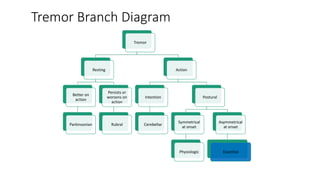
Classification can be broadly based on whether it occurs during rest
or during action.
Tremor Branch Diagram
Tremor
Resting
Better on
action
Parkinsonian
Persists or
worsens on
action
Rubral
Action
Intention
Cerebellar
Postural
Symmetrical
at onset
Physiologic
Asymmetrical
at onset
Essential
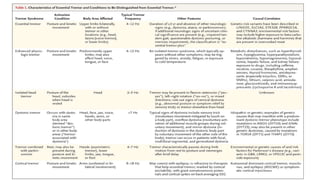
Essential Tremor
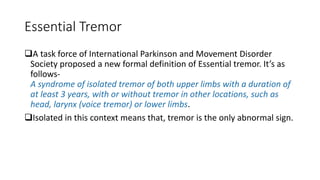
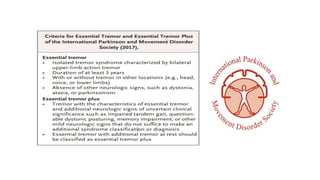
A task force of International Parkinson and Movement Disorder
Society proposed a new formal definition of Essential tremor. It’s as
follows-
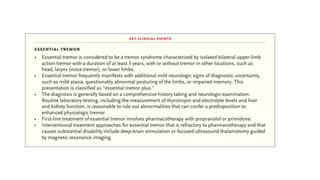
A syndrome of isolated tremor of both upper limbs with a duration of
at least 3 years, with or without tremor in other locations, such as
head, larynx (voice tremor) or lower limbs.
Isolated in this context means that, tremor is the only abnormal sign.
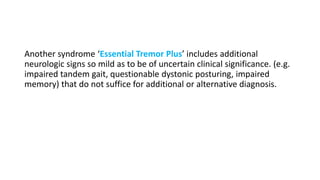
Another syndrome ‘Essential Tremor Plus’ includes additional
neurologic signs so mild as to be of uncertain clinical significance. (e.g.
impaired tandem gait, questionable dystonic posturing, impaired
memory) that do not suffice for additional or alternative diagnosis.
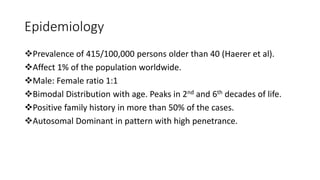
Epidemiology
Prevalence of 415/100,000 persons older than 40 (Haerer et al).
Affect 1% of the population worldwide.
Male: Female ratio 1:1
Bimodal Distribution with age. Peaks in 2nd and 6th decades of life.
Positive family history in more than 50% of the cases.
Autosomal Dominant in pattern with high penetrance.
Co relates
• Environmental risk factor includes higher exposure to beta-carboline
alkaloids. These are present in overcooked meats.
• Genetic risk Variants have been described in LING01, SLC1A2, STK32B,
PPARGC1A and CTNNA3
• Worsened by- Emotion, Exercise, fatigue
Pathophysiology
Several lines of evidence suggests towards cerebellar dysfunction. In
case of essential tremor--
i. Decreased amount of N-acetylaspartate in the cerebellum,
indicating loss or dysfunction of neurons.
ii. Loss of purkinje’s cell in the cerebellum.
iii. Increased number of torpedoes( swollen axons of purkinje’s cell)
and loss of dendritic arborization.
• iv. Increased LING01 level and GABA dysfunction in cerebellum.
• v. Cerebellar metabolism is high at rest, increases with arm extension
and decreases by taking ethanol( ethanol suppresses ET)
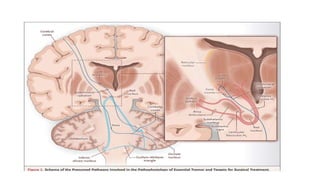
• vi. Cellular burst in the cerebellar receiving zone of the
thalamus(Ventral Intermediate Nucleus) correlates with the tremor
itself.
• vii. Pathophysiology of tremor certainly involves cortico-ponto-
cerebello-thalamo-cortical loop. Source of oscillation is unknown
though.
Assessment
Full assessment should include history taking, neurological
examinations and laboratory testing.
 History should include particularly duration of illness, age of onset,
family history and drug history.
 Drugs known to potentiate tremor includes- Valproate, SSRI,
Sympathomimetic drugs, Lithium
 Complete neurological examination with visual estimation of tremor
and assessing signs to find other systemic illness is mandatory.
Laboratory testing
• Routine lab tests are done to exclude any metabolic or hormonal
illness which may cause enhanced physiological tremor.
• Complete History and examination are often sufficient to make a
diagnosis.
• Early Parkinson’s disease can reliably be distinguished from ET by
single photon-emission computed tomography using tracer 123I-
Ioflupane.
• Surface electromyography and accelerometry can be done to evaluate
muscle activation characteristic and differentiate ET from Enhanced
Physiological Tremor.
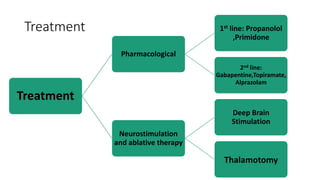
Treatment
Treatment
Pharmacological
1st line: Propanolol
,Primidone
2nd line:
Gabapentine,Topiramate,
Alprazolam
Neurostimulation
and ablative therapy
Deep Brain
Stimulation
Thalamotomy
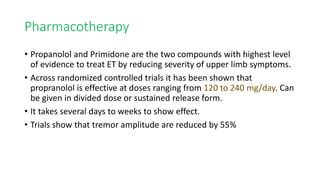
Pharmacotherapy
• Propanolol and Primidone are the two compounds with highest level
of evidence to treat ET by reducing severity of upper limb symptoms.
• Across randomized controlled trials it has been shown that
propranolol is effective at doses ranging from 120 to 240 mg/day. Can
be given in divided dose or sustained release form.
• It takes several days to weeks to show effect.
• Trials show that tremor amplitude are reduced by 55%
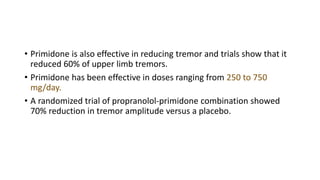
• Primidone is also effective in reducing tremor and trials show that it
reduced 60% of upper limb tremors.
• Primidone has been effective in doses ranging from 250 to 750
mg/day.
• A randomized trial of propranolol-primidone combination showed
70% reduction in tremor amplitude versus a placebo.
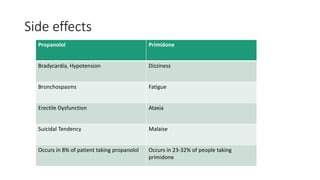
Side effects
Propanolol Primidone
Bradycardia, Hypotension Dizziness
Bronchospasms Fatigue
Erectile Dysfunction Ataxia
Suicidal Tendency Malaise
Occurs in 8% of patient taking propanolol Occurs in 23-32% of people taking
primidone
RCT shows NO clinical benefits in case of following drugs
Flunarizine
Acetazolamide
Mirtazapine
Nifedipine
Pindolol
Trazodone
Verapamil
Amiframpidine
Levetiracetam
Surgical Approach
Thalamotomy (Unilateral)
Targets thalamic nucleus ventralis intermedius. Used in case of
medically intractable upper limb tremor in ET
Its use is limited to unilateral approach as bilateral thalamotomy
causes high risk of irreversible dysarthria or ataxia,sensory
disturbance.
Randomized trials shows less effectiveness of thalamotomy
compared to deep brain stimulation.
Deep Brain Stimulation(DBS)
It causes greater functional improvement and less side effects.
But unfortunately, at a 5 year follow up it was seen that half the
patient receiving DBS having a diminished effect. It has been reported
as a result of disease progression or tolerance to stimulation.
Adverse effects include- ataxia, dysarthria, paresthesias, muscle
contraction and impaired balance.
Focused Ultrasound
In 2016, the Food and Drug Administration approved a focused
ultrasound device to treat essential tremor that is refractory to medical
therapy. The approval was based on the results of a randomized,
controlled trial involving 76 participants with essential tremor, in which
unilateral thalamic thermoablation using focused ultrasound with
magnetic resonance imaging guidance resulted in a significantly greater
reduction in hand tremor and better quality of life over a period of 12
months.
The most common adverse events with focused ultrasound
thalamotomy were intra-procedural discomfort, as well as
postoperative paresthesia or numbness (in 38% of participants) and
gait disturbance (in 36%). At 12 months after the intervention, the rate
of paresthesia or numbness was 14%, and the rate of gait disturbance
was 9% .
Areas of Potentials
Essential tremor requires further study. The extent of degenerative
processes in the cerebellum in affected patients and their relevance to
the broad spectrum of essential tremor remain unclear. More data are
needed from randomized trials to provide information regarding the
effectiveness and risks of treatments for essential tremor. Clinical rating
scales and transducer-based methods to objectively quantify tremor
have been developed for use in clinical trials as well as in routine
practice.However, the clinical meaningfulness of observed changes in
these instruments is uncertain, and data are needed on patient-
reported outcomes and quality of life.
Development in Pharmacological Sector
Potential molecular targets for treatment of essential tremor include
the T-type calcium channel and GABA type A receptors. On the
basis of the tremor-suppressing effect of ethanol and its presumed
molecular action on these targets, the long-chain alcohol 1-octanol and
its metabolite octanoic acid have been proposed for treatment of
essential tremor; preliminary data have suggested benefit,although
further study is needed.
Development in interventional sector
Although the ventral intermedius nucleus of the thalamus has been the
primary target for surgical treatment of tremor, two regions below
the thalamus — the zona incerta and the white matter tract of
cerebellothalamic fibers (the prelemniscal radiation) — have been
proposed as alternative targets, with uncontrolled
studies suggesting a potentially greater effect than with the
conventional target.However, controlled trials are needed to confirm
efficacy.
Gadgets
New developments in stimulation therapies for essential tremor
include closed-loop stimulation using sensors to monitor tremor
activity to trigger and adjust stimulation in real time and
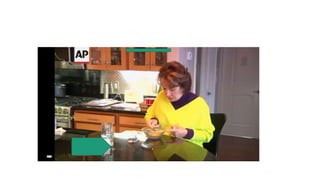
“on demand.” A tremor-cancelling spoon, which uses tremor sensors
that drive micro-motors to counteract the tremor and stabilize the
utensil, has been developed.
Journal presentation on essential tremor

Journal presentation on essential tremor

  • 1.
    JOURNAL PRESENTATION ON ESSENTIALTREMOR Presented By- Dr. Ejaj Uddin Ahmed MD Resident (Phase A)- Critical Care Medicine BIRDEM The NEW ENGLAND JOURNAL Of MEDICINE
  • 3.
    Introduction Tremor Tremor may bedefined as involuntary rhythmic oscillatory movement produced by alternating contractions of reciprocally innervated muscle. Classification can be broadly based on whether it occurs during rest or during action.
  • 4.
    Tremor Branch Diagram Tremor Resting Betteron action Parkinsonian Persists or worsens on action Rubral Action Intention Cerebellar Postural Symmetrical at onset Physiologic Asymmetrical at onset Essential
  • 5.
    Essential Tremor A taskforce of International Parkinson and Movement Disorder Society proposed a new formal definition of Essential tremor. It’s as follows- A syndrome of isolated tremor of both upper limbs with a duration of at least 3 years, with or without tremor in other locations, such as head, larynx (voice tremor) or lower limbs. Isolated in this context means that, tremor is the only abnormal sign.
  • 6.
    Another syndrome ‘EssentialTremor Plus’ includes additional neurologic signs so mild as to be of uncertain clinical significance. (e.g. impaired tandem gait, questionable dystonic posturing, impaired memory) that do not suffice for additional or alternative diagnosis.
  • 9.
    Epidemiology Prevalence of 415/100,000persons older than 40 (Haerer et al). Affect 1% of the population worldwide. Male: Female ratio 1:1 Bimodal Distribution with age. Peaks in 2nd and 6th decades of life. Positive family history in more than 50% of the cases. Autosomal Dominant in pattern with high penetrance.
  • 10.
    Co relates • Environmentalrisk factor includes higher exposure to beta-carboline alkaloids. These are present in overcooked meats. • Genetic risk Variants have been described in LING01, SLC1A2, STK32B, PPARGC1A and CTNNA3 • Worsened by- Emotion, Exercise, fatigue
  • 11.
    Pathophysiology Several lines ofevidence suggests towards cerebellar dysfunction. In case of essential tremor-- i. Decreased amount of N-acetylaspartate in the cerebellum, indicating loss or dysfunction of neurons. ii. Loss of purkinje’s cell in the cerebellum. iii. Increased number of torpedoes( swollen axons of purkinje’s cell) and loss of dendritic arborization.
  • 12.
    • iv. IncreasedLING01 level and GABA dysfunction in cerebellum. • v. Cerebellar metabolism is high at rest, increases with arm extension and decreases by taking ethanol( ethanol suppresses ET) • vi. Cellular burst in the cerebellar receiving zone of the thalamus(Ventral Intermediate Nucleus) correlates with the tremor itself. • vii. Pathophysiology of tremor certainly involves cortico-ponto- cerebello-thalamo-cortical loop. Source of oscillation is unknown though.
  • 14.
    Assessment Full assessment shouldinclude history taking, neurological examinations and laboratory testing.  History should include particularly duration of illness, age of onset, family history and drug history.  Drugs known to potentiate tremor includes- Valproate, SSRI, Sympathomimetic drugs, Lithium  Complete neurological examination with visual estimation of tremor and assessing signs to find other systemic illness is mandatory.
  • 15.
    Laboratory testing • Routinelab tests are done to exclude any metabolic or hormonal illness which may cause enhanced physiological tremor. • Complete History and examination are often sufficient to make a diagnosis. • Early Parkinson’s disease can reliably be distinguished from ET by single photon-emission computed tomography using tracer 123I- Ioflupane. • Surface electromyography and accelerometry can be done to evaluate muscle activation characteristic and differentiate ET from Enhanced Physiological Tremor.
  • 16.
    Treatment Treatment Pharmacological 1st line: Propanolol ,Primidone 2ndline: Gabapentine,Topiramate, Alprazolam Neurostimulation and ablative therapy Deep Brain Stimulation Thalamotomy
  • 17.
    Pharmacotherapy • Propanolol andPrimidone are the two compounds with highest level of evidence to treat ET by reducing severity of upper limb symptoms. • Across randomized controlled trials it has been shown that propranolol is effective at doses ranging from 120 to 240 mg/day. Can be given in divided dose or sustained release form. • It takes several days to weeks to show effect. • Trials show that tremor amplitude are reduced by 55%
  • 18.
    • Primidone isalso effective in reducing tremor and trials show that it reduced 60% of upper limb tremors. • Primidone has been effective in doses ranging from 250 to 750 mg/day. • A randomized trial of propranolol-primidone combination showed 70% reduction in tremor amplitude versus a placebo.
  • 19.
    Side effects Propanolol Primidone Bradycardia,Hypotension Dizziness Bronchospasms Fatigue Erectile Dysfunction Ataxia Suicidal Tendency Malaise Occurs in 8% of patient taking propanolol Occurs in 23-32% of people taking primidone
  • 20.
    RCT shows NOclinical benefits in case of following drugs Flunarizine Acetazolamide Mirtazapine Nifedipine Pindolol Trazodone Verapamil Amiframpidine Levetiracetam
  • 21.
    Surgical Approach Thalamotomy (Unilateral) Targetsthalamic nucleus ventralis intermedius. Used in case of medically intractable upper limb tremor in ET Its use is limited to unilateral approach as bilateral thalamotomy causes high risk of irreversible dysarthria or ataxia,sensory disturbance. Randomized trials shows less effectiveness of thalamotomy compared to deep brain stimulation.
  • 22.
    Deep Brain Stimulation(DBS) Itcauses greater functional improvement and less side effects. But unfortunately, at a 5 year follow up it was seen that half the patient receiving DBS having a diminished effect. It has been reported as a result of disease progression or tolerance to stimulation. Adverse effects include- ataxia, dysarthria, paresthesias, muscle contraction and impaired balance.
  • 23.
    Focused Ultrasound In 2016,the Food and Drug Administration approved a focused ultrasound device to treat essential tremor that is refractory to medical therapy. The approval was based on the results of a randomized, controlled trial involving 76 participants with essential tremor, in which unilateral thalamic thermoablation using focused ultrasound with magnetic resonance imaging guidance resulted in a significantly greater reduction in hand tremor and better quality of life over a period of 12 months.
  • 24.
    The most commonadverse events with focused ultrasound thalamotomy were intra-procedural discomfort, as well as postoperative paresthesia or numbness (in 38% of participants) and gait disturbance (in 36%). At 12 months after the intervention, the rate of paresthesia or numbness was 14%, and the rate of gait disturbance was 9% .
  • 25.
    Areas of Potentials Essentialtremor requires further study. The extent of degenerative processes in the cerebellum in affected patients and their relevance to the broad spectrum of essential tremor remain unclear. More data are needed from randomized trials to provide information regarding the effectiveness and risks of treatments for essential tremor. Clinical rating scales and transducer-based methods to objectively quantify tremor have been developed for use in clinical trials as well as in routine practice.However, the clinical meaningfulness of observed changes in these instruments is uncertain, and data are needed on patient- reported outcomes and quality of life.
  • 26.
    Development in PharmacologicalSector Potential molecular targets for treatment of essential tremor include the T-type calcium channel and GABA type A receptors. On the basis of the tremor-suppressing effect of ethanol and its presumed molecular action on these targets, the long-chain alcohol 1-octanol and its metabolite octanoic acid have been proposed for treatment of essential tremor; preliminary data have suggested benefit,although further study is needed.
  • 27.
    Development in interventionalsector Although the ventral intermedius nucleus of the thalamus has been the primary target for surgical treatment of tremor, two regions below the thalamus — the zona incerta and the white matter tract of cerebellothalamic fibers (the prelemniscal radiation) — have been proposed as alternative targets, with uncontrolled studies suggesting a potentially greater effect than with the conventional target.However, controlled trials are needed to confirm efficacy.
  • 28.
    Gadgets New developments instimulation therapies for essential tremor include closed-loop stimulation using sensors to monitor tremor activity to trigger and adjust stimulation in real time and “on demand.” A tremor-cancelling spoon, which uses tremor sensors that drive micro-motors to counteract the tremor and stabilize the utensil, has been developed.