Approach to tremors
PRESENTER- DR.PALLAV JAIN
DM RESIDENT(NEUROLOGY)
GMC,KOTA
DEFINITION
• Defined “as a more or less involuntary and rhythmic
oscillatory movement produced by alternating or
irregularly synchronous contractions of reciprocally
innervated muscles.”
• The amplitude of tremor is not critical for the definition.
• Vary in frequency and amplitude and are influenced by
physiologic and psychological factors and drugs.
• Categorization is based on position, posture, and the
movement necessary to elicit the tremor.
Tremors can be classified according to their
• Frequency
• Phenomenology
• Distribution
• Etiology
Frequency
• Most of the tremors have frequencies between 4 and 12 Hz.
low <4 HZ –eg. Cerebellar tremors-- 2-3 hz
medium 4-7 Hz –eg. parkinson tremor– 4-6 hz
High >7 Hz- eg.-Orthostatic tremors-- 12-18 hz
• The frequencies overlap considerably ,thus the exact determination of tremor
frequency is difficult.
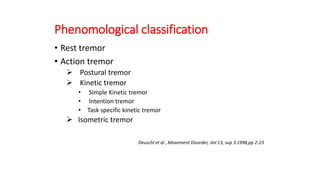
Phenomological classification
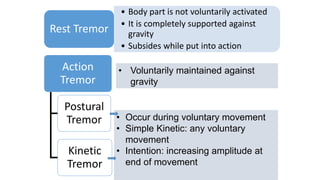
• Rest tremor
• Action tremor
 Postural tremor
 Kinetic tremor
• Simple Kinetic tremor
• Intention tremor
• Task specific kinetic tremor
 Isometric tremor
Deuschl et al , Movement Disorder, Vol 13, sup 3.1998,pp 2-23
• Body part is not voluntarily activated
• It is completely supported against
gravity
• Subsides while put into action
Rest Tremor
Action
Tremor
Postural
Tremor
Kinetic
Tremor
• Voluntarily maintained against
gravity
• Occur during voluntary movement
• Simple Kinetic: any voluntary
movement
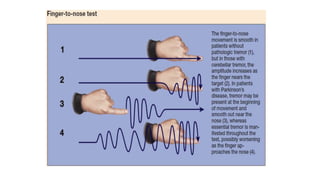
• Intention: increasing amplitude at
end of movement
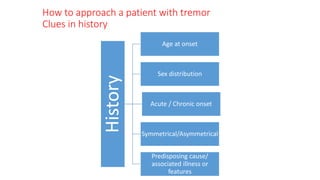
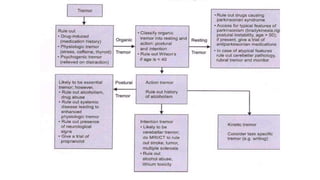
How to approach a patient with tremor
Clues in history
History
Age at onset
Sex distribution
Acute / Chronic onset
Symmetrical/Asymmetrical
Predisposing cause/
associated illness or
features
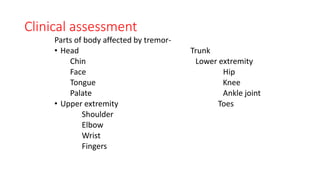
Clinical assessment
Parts of body affected by tremor-
• Head Trunk
Chin Lower extremity
Face Hip
Tongue Knee
Palate Ankle joint
• Upper extremity Toes
Shoulder
Elbow
Wrist
Fingers
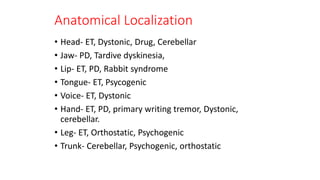
Anatomical Localization
• Head- ET, Dystonic, Drug, Cerebellar
• Jaw- PD, Tardive dyskinesia,
• Lip- ET, PD, Rabbit syndrome
• Tongue- ET, Psycogenic
• Voice- ET, Dystonic
• Hand- ET, PD, primary writing tremor, Dystonic,
cerebellar.
• Leg- ET, Orthostatic, Psychogenic
• Trunk- Cerebellar, Psychogenic, orthostatic
Examination Of Tremor
• Identify tremor component
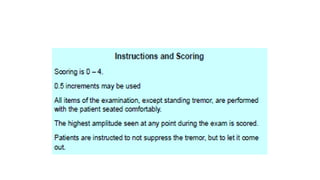
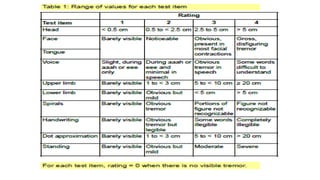
• Document severity
• Other neurological and physical sign
• Psychological and psychiatric state
• Examination in different posture
Physiological tremor
• Action tremor
• Low Amplitude,Frequency- 8-12 Hz
• Drugs, Anxiety, excitement, fright, muscle fatigue, hypoglycemia, alcohol and
opioid withdrawal, thyrotoxicosis, fever, and pheochromocytoma
• Enhancement of physiologic tremor is the most common cause of action tremor.
• Medical rather than primary neurologic cause for action tremor.
Rest Tremor
• Evident with the affected body part fully supported against gravity,
completely at rest
• Temporarily dampened or abolished during voluntary activity.
• May quickly reappear as soon as the body part assumes a new resting
or antigravity posture (re-emergent tremor)
• In PD- pill-rolling tremor, with a frequency of 4 to 6 Hertz .
Rest tremor
• Parkinson disease (PD)
• Other parkinsonian syndromes
• a. MSA, PSP,CBD
• b. Secondary parkinsonism- Toxin, Drugs , Vascular, Tumor , Infectious
• Heredodegenerative disorders: HD,WD,NBIA
• Severe essential tremor
• Midbrain(rubral tremor)
Essential Tremor
• Most common form of pathologic tremor.
• Begins at any age, but its prevalence increases with age.
• No gender difference.
• Approx 5% of people over the age of 65 are believed to have
essential tremor.
• It affects the hands in nearly all cases.
Cerebellar Tremor
• Used to describe tremors that are caused by known
cerebellar pathology.
• They can be postural, simple kinetic, or intention
• Tremor frequency is typically low 3 to 4 Hz
• Can be associated with ataxia and dysmetria.
Titubation of the head and neck
Holmes (Rubral) Tremor
• It may produce a combination of rest, postural, simple
kinetic, and intention tremors
• Tends to have a slower frequency (3 to 5 Hz) than
typical Parkinson tremor (5 to 7 Hz).
• It also persists unchanged or increases with postural
changes or goal-directed activity.
• The tremor is often not rhythmic .
• Combined lesions that interrupt the outflow pathway
from the cerebellum to the motor thalamus, often
involving the superior cerebellar peduncle, substantia
nigra, or red nucleus.
Dystonic Tremor
• Tremor in an extremity or body part that is affected by dystonia.
• Focal tremors, usually with irregular amplitudes and variable frequency (<7
Hz).
• Mainly postural/kinetic tremors and usually not seen during complete rest
• The use of an alleviating maneuver (geste antagoniste, sensory trick) can
be helpful in distinguishing dystonic tremor from other tremor syndromes,
such as ET.
Dystonic tremor syndrome
• Tremor associated with dystonia: tremor occurs in a body part not
affected by dystonia, but the patient has dystonia elsewhere.
• Dystonia gene associated tremor: tremor as an isolated finding in
patients with a dystonic pedigree.
Primary Orthostatic Tremor
• Rhythmic 13- to 18-Hz postural tremor .
• Patients feel unsteady when they attempt to stand
still.
• Affects the lower limbs, torso, upper limbs, neck, and
cranium.
• Best detected with surface EMG electrodes.
Bain PG, J Neurol Neurosurg psychiatry , 2002, 72,sup I , 3-9
Neuropathic tremor
• More frequently in demyelinating than axonal
neuropathies.
• Acute and chronic inflammatory demyelinating
polyneuropathies, hereditary motor, sensory, and IgM
paraproteinaemic neuropathies.
• 3- 10 HZ, postural /kinetic tremor.
• Probably due to abnormal reflex mechanisim.
• NCV/EMG - e/o peripheral neuropathy
Task Specific Tremor
• Primary writing tremor is present when tremor occurs
only (or predominantly) during writing.
• 5-7 Hz
• Isolated voice tremor is present if vocalization is
tremulous but no other parts of the body show
tremor
Drug Induced Tremor
Was the tremor pre-existing?
• Enhanced physiological tremor is the most common
drug-induced tremor and many patients have
previously unnoticed, undiagnosed tremors
Have other medical causes of tremor been ruled out?
• Hyperthyroidism, hypoglycemia, essential tremor,
Parkinson’s disease etc
Is there a temporal relation to the start of drug
therapy or misuse?
• Drug-induced tremors are temporally linked to the
start or escalation of therapy
Has the tremor worsened with dose escalation?
• Drug-induced tremors typically worsen with dose
escalation
In periods of drug abstinence or non-compliance has
the tremor abated?
• Helps determine whether there is a relation to drug
ingestion
Is the tremor worsening over time?
• Parkinsonian tremor and essential tremor are usually
progressive in nature, and drug induced tremor is
typically not progressive
Psychogenic Tremor
• Sudden onset of tremor, remission or both
• Unusual clinical combinations of rest and
postural/intention tremors
• Decrease in tremor amplitude on distraction or
changes in tremor frequency during voluntary
movements of the contralateral hand.
• Presence of the co-activation sign of psychogenic
tremor.
• Past medical history of a somatisation disorder
• Appearance of additional and unrelated neurological
signs with tremor
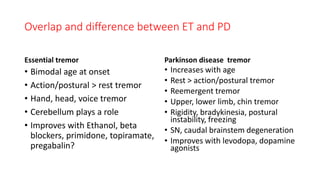
Overlap and difference between ET and PD
Essential tremor Parkinson disease tremor
• Bimodal age at onset
• Action/postural > rest tremor
• Hand, head, voice tremor
• Cerebellum plays a role
• Improves with Ethanol, beta
blockers, primidone, topiramate,
pregabalin?
• Increases with age
• Rest > action/postural tremor
• Reemergent tremor
• Upper, lower limb, chin tremor
• Rigidity, bradykinesia, postural
instability, freezing
• SN, caudal brainstem degeneration
• Improves with levodopa, dopamine
agonists
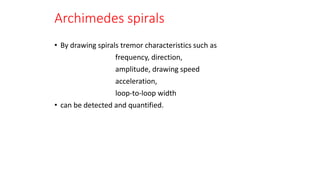
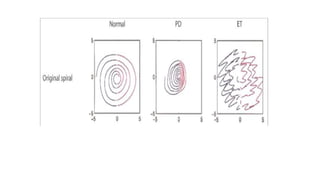
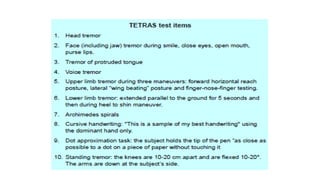
Archimedes spirals
• By drawing spirals tremor characteristics such as
frequency, direction,
amplitude, drawing speed
acceleration,
loop-to-loop width
• can be detected and quantified.
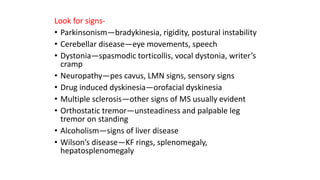
Look for signs-
• Parkinsonism—bradykinesia, rigidity, postural instability
• Cerebellar disease—eye movements, speech
• Dystonia—spasmodic torticollis, vocal dystonia, writer’s
cramp
• Neuropathy—pes cavus, LMN signs, sensory signs
• Drug induced dyskinesia—orofacial dyskinesia
• Multiple sclerosis—other signs of MS usually evident
• Orthostatic tremor—unsteadiness and palpable leg
tremor on standing
• Alcoholism—signs of liver disease
• Wilson’s disease—KF rings, splenomegaly,
hepatosplenomegaly
Lab Investigations
• Thyroid function tests
• S. ceruloplasmin, S. Cu &24-h urine copper
• Toxic sceen
Imaging
• MRI brain
• TRODAT SPECT
• [18F]-labeled L-3,4-dihydroxiphenylalanine PET is
the best diagnostic modality differentiate it from
other Parkinsonian syndromes as well as ET
Question
And
Answer
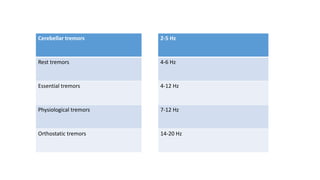
2-5 Hz
4-6 Hz
4-12 Hz
7-12 Hz
14-20 Hz
Cerebellar tremors
Rest tremors
Essential tremors
Physiological tremors
Orthostatic tremors
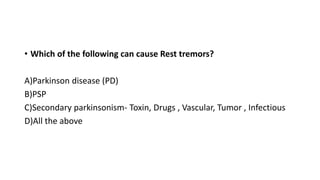
• Which of the following can cause Rest tremors?
A)Parkinson disease (PD)
B)PSP
C)Secondary parkinsonism- Toxin, Drugs , Vascular, Tumor , Infectious
D)All the above
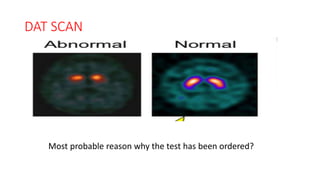
DAT SCAN
Most probable reason why the test has been ordered?
• dopamine transporter single photon emission CT (DaT-SPECT) with
(123I) ioflupane in
• Diagnosis of parkinsonian syndromes from other causes of tremors
Like essential tremors
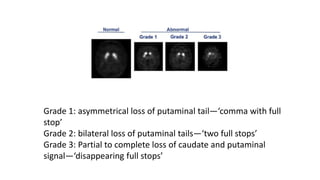
Grade 1: asymmetrical loss of putaminal tail—‘comma with full
stop’
Grade 2: bilateral loss of putaminal tails—‘two full stops’
Grade 3: Partial to complete loss of caudate and putaminal
signal—‘disappearing full stops’
• A 33-year-old overweight woman with asthma presents to the clinic
complaining of tremor. She reports she had a tremor since her teenage
years but it had not really bothered her until the prior year. Her
handwriting was starting to be “shaky” and she was not able to eat soup
without spilling. She worked in construction and often operated heavy
machinery, and was concerned that her tremor was putting herself and
others in danger. Her father and paternal grandfather had a similar tremor.
On examination, there was no tremor at rest. With outstretched arms, or
while pouring water from one cup to another, a prominent bilateral high-
frequency tremor was observed. What is the most likely diagnosis in this
patient?
a. Enhanced physiologic tremor
b. Essential tremor
c. Dystonic tremor
d. Task-specific tremor
e. Rubral tremor
• Which of the following doesn’t persist in sleep
• A- Palatal myoclonus
• B- Tremors
• C-Epilepsia partialis continua
• D- Severe tics
Q-1- What one thing would you like to look in physical examination?
• DBS of which part is done for intractable essential tremors?
• Ventral intermediate nucleus of thalmus
• Which of the following drugs not responsible for tremors?
• Terbutaline
• SSRI
• Lithium
• Topiramate
THANK YOU
Approach to tremors
Approach to tremors
Approach to tremors

Approach to tremors

  • 1.
    Approach to tremors PRESENTER-DR.PALLAV JAIN DM RESIDENT(NEUROLOGY) GMC,KOTA
  • 2.
    DEFINITION • Defined “asa more or less involuntary and rhythmic oscillatory movement produced by alternating or irregularly synchronous contractions of reciprocally innervated muscles.” • The amplitude of tremor is not critical for the definition. • Vary in frequency and amplitude and are influenced by physiologic and psychological factors and drugs. • Categorization is based on position, posture, and the movement necessary to elicit the tremor.
  • 3.
    Tremors can beclassified according to their • Frequency • Phenomenology • Distribution • Etiology
  • 4.
    Frequency • Most ofthe tremors have frequencies between 4 and 12 Hz. low <4 HZ –eg. Cerebellar tremors-- 2-3 hz medium 4-7 Hz –eg. parkinson tremor– 4-6 hz High >7 Hz- eg.-Orthostatic tremors-- 12-18 hz • The frequencies overlap considerably ,thus the exact determination of tremor frequency is difficult.
  • 5.
    Phenomological classification • Resttremor • Action tremor  Postural tremor  Kinetic tremor • Simple Kinetic tremor • Intention tremor • Task specific kinetic tremor  Isometric tremor Deuschl et al , Movement Disorder, Vol 13, sup 3.1998,pp 2-23
  • 6.
    • Body partis not voluntarily activated • It is completely supported against gravity • Subsides while put into action Rest Tremor Action Tremor Postural Tremor Kinetic Tremor • Voluntarily maintained against gravity • Occur during voluntary movement • Simple Kinetic: any voluntary movement • Intention: increasing amplitude at end of movement
  • 8.
    How to approacha patient with tremor Clues in history History Age at onset Sex distribution Acute / Chronic onset Symmetrical/Asymmetrical Predisposing cause/ associated illness or features
  • 9.
    Clinical assessment Parts ofbody affected by tremor- • Head Trunk Chin Lower extremity Face Hip Tongue Knee Palate Ankle joint • Upper extremity Toes Shoulder Elbow Wrist Fingers
  • 10.
    Anatomical Localization • Head-ET, Dystonic, Drug, Cerebellar • Jaw- PD, Tardive dyskinesia, • Lip- ET, PD, Rabbit syndrome • Tongue- ET, Psycogenic • Voice- ET, Dystonic • Hand- ET, PD, primary writing tremor, Dystonic, cerebellar. • Leg- ET, Orthostatic, Psychogenic • Trunk- Cerebellar, Psychogenic, orthostatic
  • 11.
    Examination Of Tremor •Identify tremor component • Document severity • Other neurological and physical sign • Psychological and psychiatric state • Examination in different posture
  • 12.
    Physiological tremor • Actiontremor • Low Amplitude,Frequency- 8-12 Hz • Drugs, Anxiety, excitement, fright, muscle fatigue, hypoglycemia, alcohol and opioid withdrawal, thyrotoxicosis, fever, and pheochromocytoma • Enhancement of physiologic tremor is the most common cause of action tremor. • Medical rather than primary neurologic cause for action tremor.
  • 13.
    Rest Tremor • Evidentwith the affected body part fully supported against gravity, completely at rest • Temporarily dampened or abolished during voluntary activity. • May quickly reappear as soon as the body part assumes a new resting or antigravity posture (re-emergent tremor) • In PD- pill-rolling tremor, with a frequency of 4 to 6 Hertz .
  • 14.
    Rest tremor • Parkinsondisease (PD) • Other parkinsonian syndromes • a. MSA, PSP,CBD • b. Secondary parkinsonism- Toxin, Drugs , Vascular, Tumor , Infectious • Heredodegenerative disorders: HD,WD,NBIA • Severe essential tremor • Midbrain(rubral tremor)
  • 15.
    Essential Tremor • Mostcommon form of pathologic tremor. • Begins at any age, but its prevalence increases with age. • No gender difference. • Approx 5% of people over the age of 65 are believed to have essential tremor. • It affects the hands in nearly all cases.
  • 16.
    Cerebellar Tremor • Usedto describe tremors that are caused by known cerebellar pathology. • They can be postural, simple kinetic, or intention • Tremor frequency is typically low 3 to 4 Hz • Can be associated with ataxia and dysmetria. Titubation of the head and neck
  • 17.
    Holmes (Rubral) Tremor •It may produce a combination of rest, postural, simple kinetic, and intention tremors • Tends to have a slower frequency (3 to 5 Hz) than typical Parkinson tremor (5 to 7 Hz). • It also persists unchanged or increases with postural changes or goal-directed activity. • The tremor is often not rhythmic . • Combined lesions that interrupt the outflow pathway from the cerebellum to the motor thalamus, often involving the superior cerebellar peduncle, substantia nigra, or red nucleus.
  • 18.
    Dystonic Tremor • Tremorin an extremity or body part that is affected by dystonia. • Focal tremors, usually with irregular amplitudes and variable frequency (<7 Hz). • Mainly postural/kinetic tremors and usually not seen during complete rest • The use of an alleviating maneuver (geste antagoniste, sensory trick) can be helpful in distinguishing dystonic tremor from other tremor syndromes, such as ET.
  • 19.
    Dystonic tremor syndrome •Tremor associated with dystonia: tremor occurs in a body part not affected by dystonia, but the patient has dystonia elsewhere. • Dystonia gene associated tremor: tremor as an isolated finding in patients with a dystonic pedigree.
  • 20.
    Primary Orthostatic Tremor •Rhythmic 13- to 18-Hz postural tremor . • Patients feel unsteady when they attempt to stand still. • Affects the lower limbs, torso, upper limbs, neck, and cranium. • Best detected with surface EMG electrodes. Bain PG, J Neurol Neurosurg psychiatry , 2002, 72,sup I , 3-9
  • 21.
    Neuropathic tremor • Morefrequently in demyelinating than axonal neuropathies. • Acute and chronic inflammatory demyelinating polyneuropathies, hereditary motor, sensory, and IgM paraproteinaemic neuropathies. • 3- 10 HZ, postural /kinetic tremor. • Probably due to abnormal reflex mechanisim. • NCV/EMG - e/o peripheral neuropathy
  • 22.
    Task Specific Tremor •Primary writing tremor is present when tremor occurs only (or predominantly) during writing. • 5-7 Hz • Isolated voice tremor is present if vocalization is tremulous but no other parts of the body show tremor
  • 23.
    Drug Induced Tremor Wasthe tremor pre-existing? • Enhanced physiological tremor is the most common drug-induced tremor and many patients have previously unnoticed, undiagnosed tremors Have other medical causes of tremor been ruled out? • Hyperthyroidism, hypoglycemia, essential tremor, Parkinson’s disease etc Is there a temporal relation to the start of drug therapy or misuse? • Drug-induced tremors are temporally linked to the start or escalation of therapy
  • 24.
    Has the tremorworsened with dose escalation? • Drug-induced tremors typically worsen with dose escalation In periods of drug abstinence or non-compliance has the tremor abated? • Helps determine whether there is a relation to drug ingestion Is the tremor worsening over time? • Parkinsonian tremor and essential tremor are usually progressive in nature, and drug induced tremor is typically not progressive
  • 25.
    Psychogenic Tremor • Suddenonset of tremor, remission or both • Unusual clinical combinations of rest and postural/intention tremors • Decrease in tremor amplitude on distraction or changes in tremor frequency during voluntary movements of the contralateral hand. • Presence of the co-activation sign of psychogenic tremor. • Past medical history of a somatisation disorder • Appearance of additional and unrelated neurological signs with tremor
  • 26.
    Overlap and differencebetween ET and PD Essential tremor Parkinson disease tremor • Bimodal age at onset • Action/postural > rest tremor • Hand, head, voice tremor • Cerebellum plays a role • Improves with Ethanol, beta blockers, primidone, topiramate, pregabalin? • Increases with age • Rest > action/postural tremor • Reemergent tremor • Upper, lower limb, chin tremor • Rigidity, bradykinesia, postural instability, freezing • SN, caudal brainstem degeneration • Improves with levodopa, dopamine agonists
  • 27.
    Archimedes spirals • Bydrawing spirals tremor characteristics such as frequency, direction, amplitude, drawing speed acceleration, loop-to-loop width • can be detected and quantified.
  • 29.
    Look for signs- •Parkinsonism—bradykinesia, rigidity, postural instability • Cerebellar disease—eye movements, speech • Dystonia—spasmodic torticollis, vocal dystonia, writer’s cramp • Neuropathy—pes cavus, LMN signs, sensory signs • Drug induced dyskinesia—orofacial dyskinesia • Multiple sclerosis—other signs of MS usually evident • Orthostatic tremor—unsteadiness and palpable leg tremor on standing • Alcoholism—signs of liver disease • Wilson’s disease—KF rings, splenomegaly, hepatosplenomegaly
  • 30.
    Lab Investigations • Thyroidfunction tests • S. ceruloplasmin, S. Cu &24-h urine copper • Toxic sceen Imaging • MRI brain • TRODAT SPECT • [18F]-labeled L-3,4-dihydroxiphenylalanine PET is the best diagnostic modality differentiate it from other Parkinsonian syndromes as well as ET
  • 32.
  • 33.
    2-5 Hz 4-6 Hz 4-12Hz 7-12 Hz 14-20 Hz Cerebellar tremors Rest tremors Essential tremors Physiological tremors Orthostatic tremors
  • 34.
    • Which ofthe following can cause Rest tremors? A)Parkinson disease (PD) B)PSP C)Secondary parkinsonism- Toxin, Drugs , Vascular, Tumor , Infectious D)All the above
  • 35.
    DAT SCAN Most probablereason why the test has been ordered?
  • 36.
    • dopamine transportersingle photon emission CT (DaT-SPECT) with (123I) ioflupane in • Diagnosis of parkinsonian syndromes from other causes of tremors Like essential tremors
  • 37.
    Grade 1: asymmetricalloss of putaminal tail—‘comma with full stop’ Grade 2: bilateral loss of putaminal tails—‘two full stops’ Grade 3: Partial to complete loss of caudate and putaminal signal—‘disappearing full stops’
  • 38.
    • A 33-year-oldoverweight woman with asthma presents to the clinic complaining of tremor. She reports she had a tremor since her teenage years but it had not really bothered her until the prior year. Her handwriting was starting to be “shaky” and she was not able to eat soup without spilling. She worked in construction and often operated heavy machinery, and was concerned that her tremor was putting herself and others in danger. Her father and paternal grandfather had a similar tremor. On examination, there was no tremor at rest. With outstretched arms, or while pouring water from one cup to another, a prominent bilateral high- frequency tremor was observed. What is the most likely diagnosis in this patient? a. Enhanced physiologic tremor b. Essential tremor c. Dystonic tremor d. Task-specific tremor e. Rubral tremor
  • 39.
    • Which ofthe following doesn’t persist in sleep • A- Palatal myoclonus • B- Tremors • C-Epilepsia partialis continua • D- Severe tics
  • 40.
    Q-1- What onething would you like to look in physical examination?
  • 41.
    • DBS ofwhich part is done for intractable essential tremors? • Ventral intermediate nucleus of thalmus
  • 42.
    • Which ofthe following drugs not responsible for tremors? • Terbutaline • SSRI • Lithium • Topiramate
  • 43.

Editor's Notes

  • #7 Kinetic tremor can further be task induced and Intention tremor
  • #9 Age: ET has a bimodal peak, whereas orthostatic tremor and PD occur in older age group, wilsons in younger age group(<40) Acute onset : a vascular event, tumor, cerebellitis, demyelinating lesion, toxin, or psychogenic origin