See discussions, stats, and author profiles for this publication at: https://www.researchgate.net/publication/340247805
Computer Networks Chapter (5) Transmission Media
Presentation · March2020
DOI:10.13140/RG.2.2.16768.99848
CITATIONS
0
READS
15,405
Some ofthe authors ofthis publication are also working on these relatedprojects:
Inverse kinematics solution for robotic manipulatorsbased on fuzzy logic and PDcontrol View project
control Viewproject
1author:
Abbas Miry
Al-Mustansiriya University
58 PUBLICATIONS102CITATIONS
SEEPROFILE
All content following this pagewasuploaded by Abbas Miryon 28March2020.
Theuser hasrequestedenhancementof the downloaded file.
5.1
Chapter 5
Transmission Media
 Computer Networks
 Al-Mustansiryah University
 Elec. Eng. Department College of Engineering
Fourth Year Class
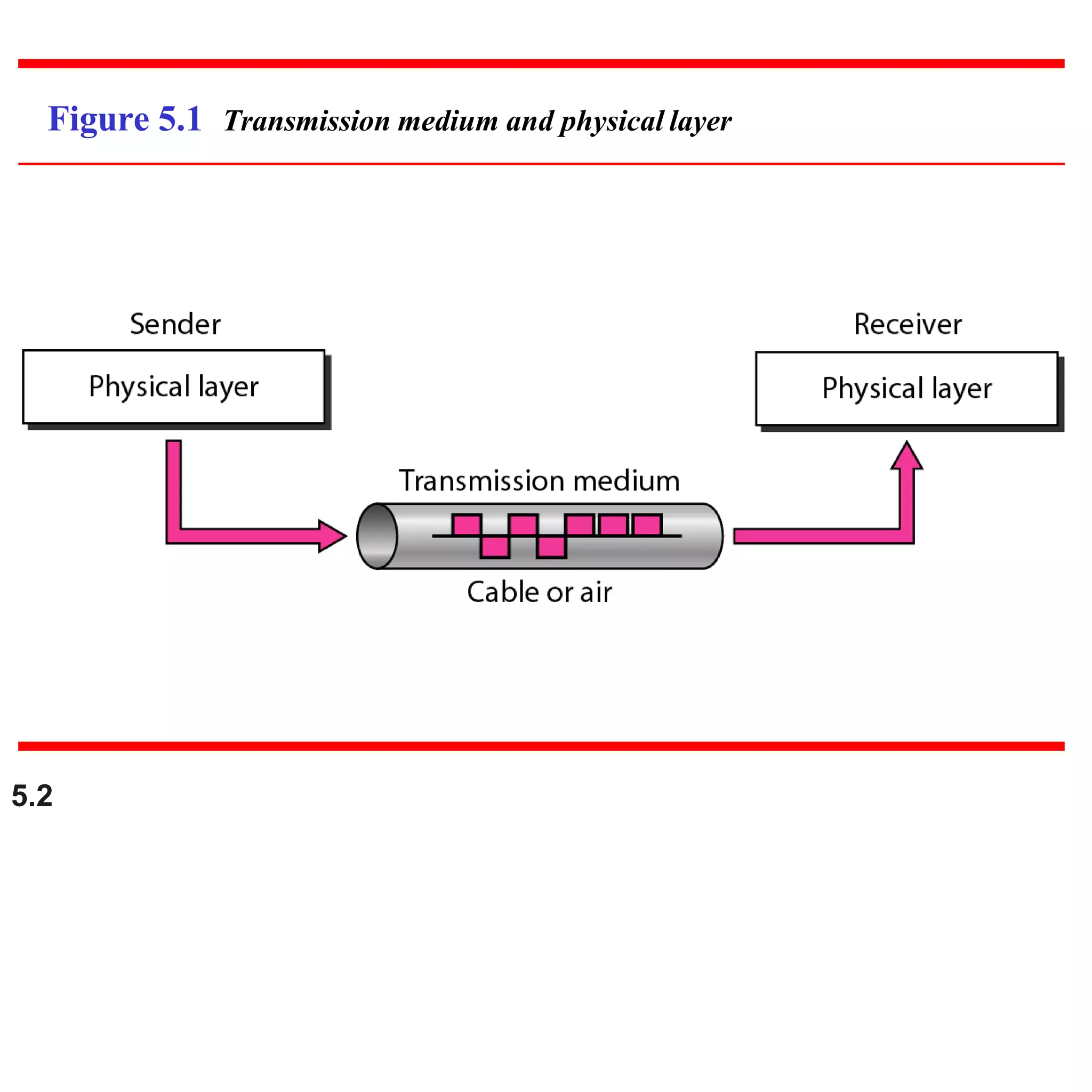
Figure 5.1 Transmission medium and physical layer
5.2
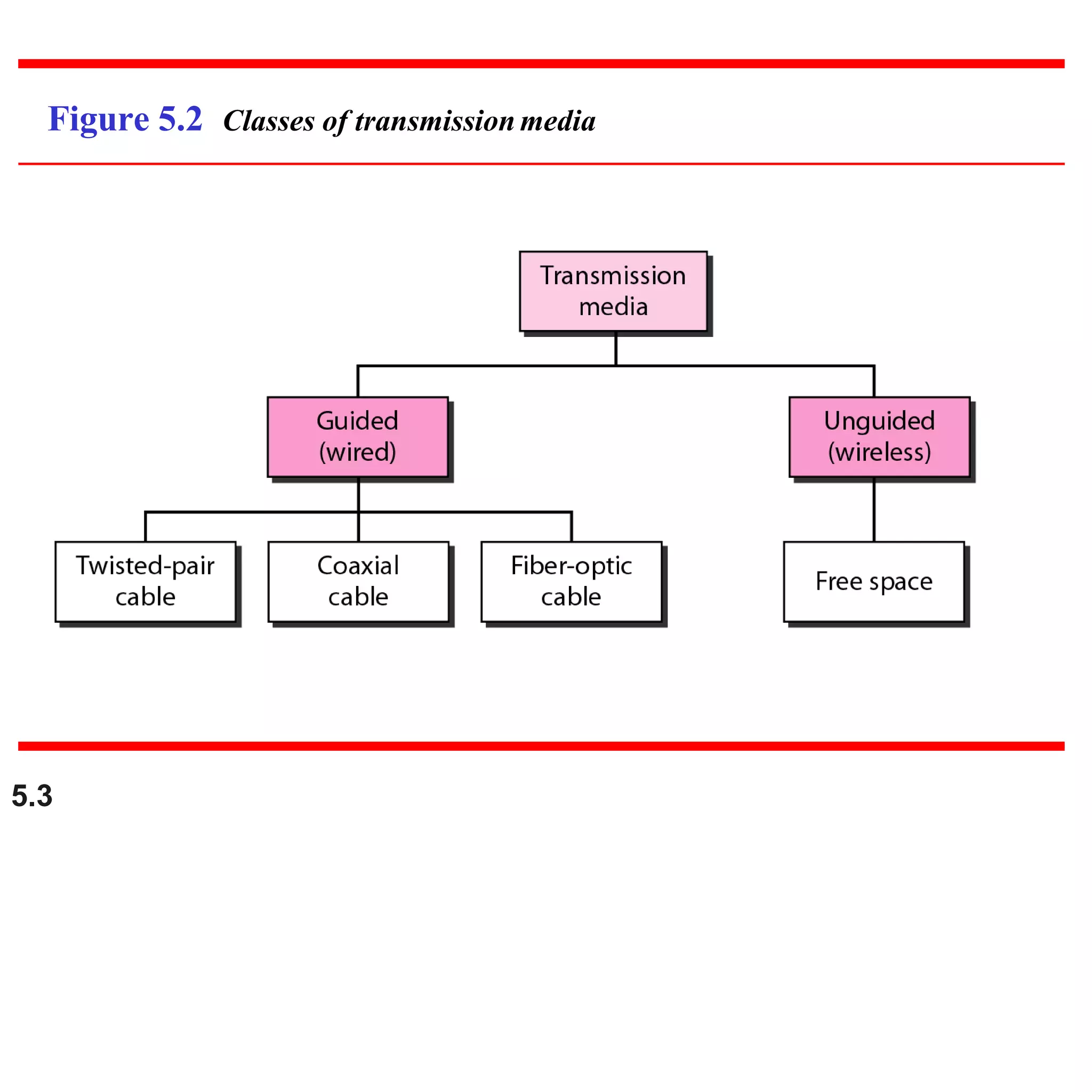
Figure 5.2 Classes of transmission media
5.3
5-1 GUIDED MEDIA
5.4
Guided media, which are those that provide a conduit
from one device to another, include twisted-pair cable,
coaxial cable, and fiber-optic cable.
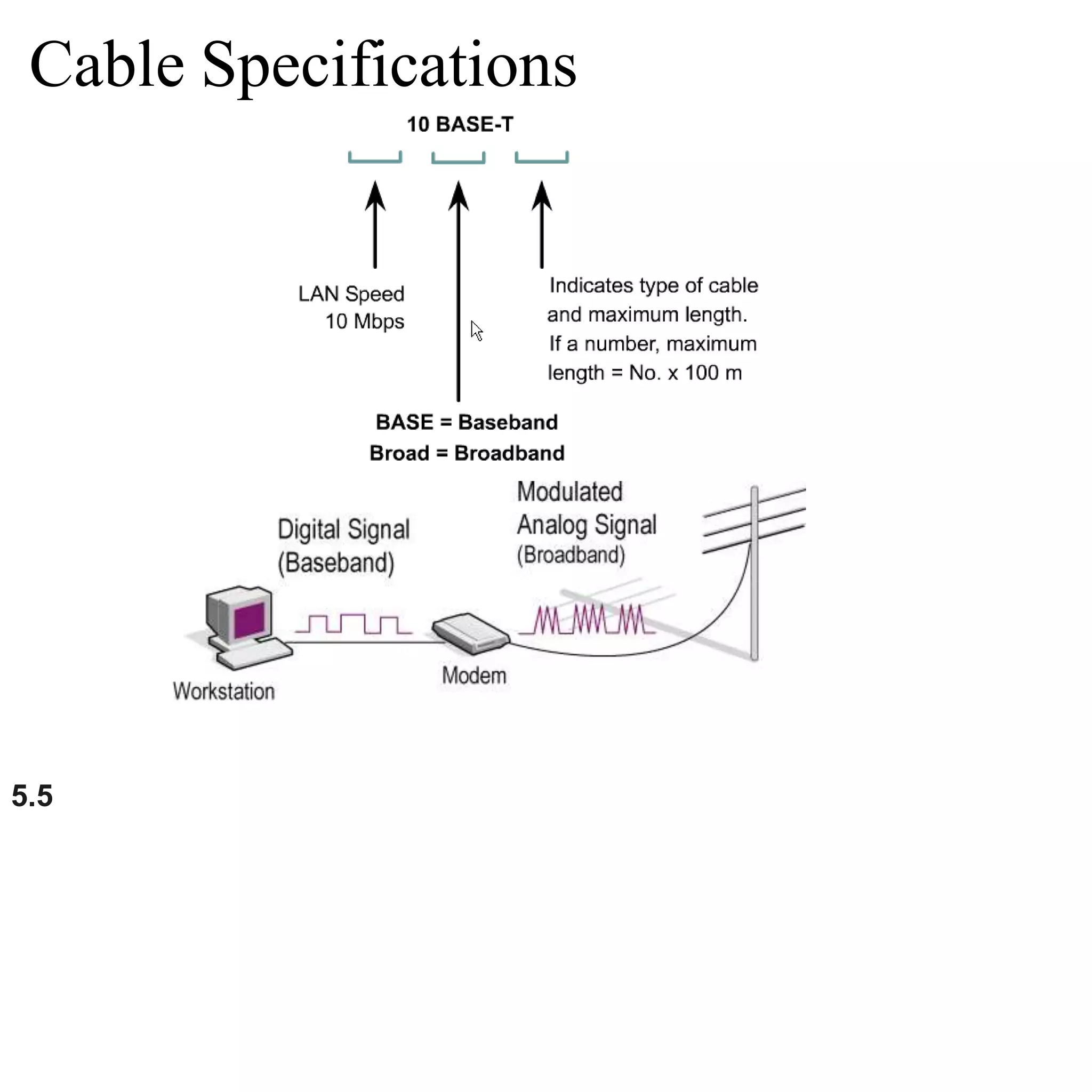
Cable Specifications
5.5
5.6
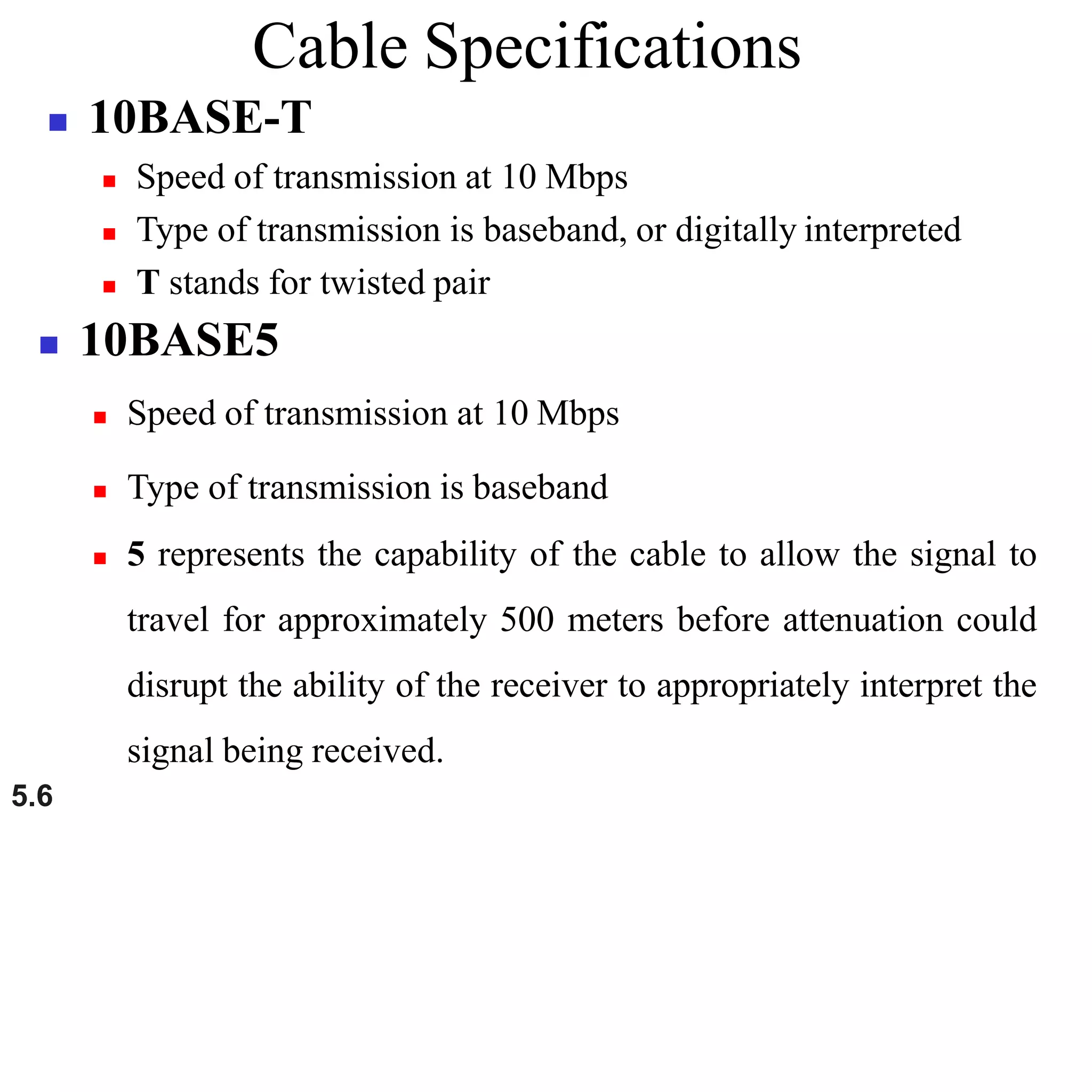
Cable Specifications
 10BASE-T
 Speed of transmission at 10 Mbps
 Type of transmission is baseband, or digitally interpreted
 T stands for twisted pair
 10BASE5
 Speed of transmission at 10 Mbps
 Type of transmission is baseband
 5 represents the capability of the cable to allow the signal to
travel for approximately 500 meters before attenuation could
disrupt the ability of the receiver to appropriately interpret the
signal being received.
5.7
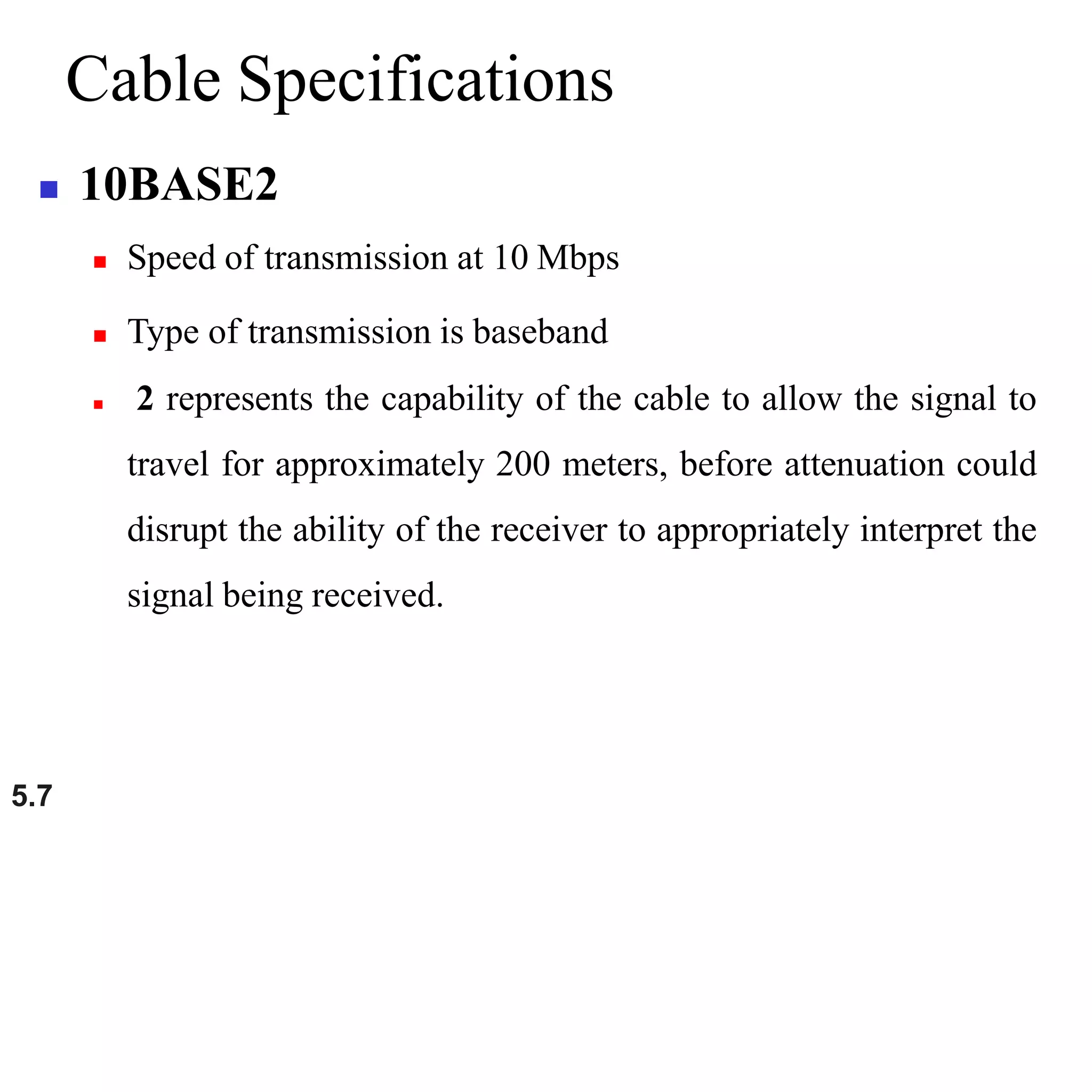
Cable Specifications
 10BASE2
 Speed of transmission at 10 Mbps
 Type of transmission is baseband
 2 represents the capability of the cable to allow the signal to
travel for approximately 200 meters, before attenuation could
disrupt the ability of the receiver to appropriately interpret the
signal being received.
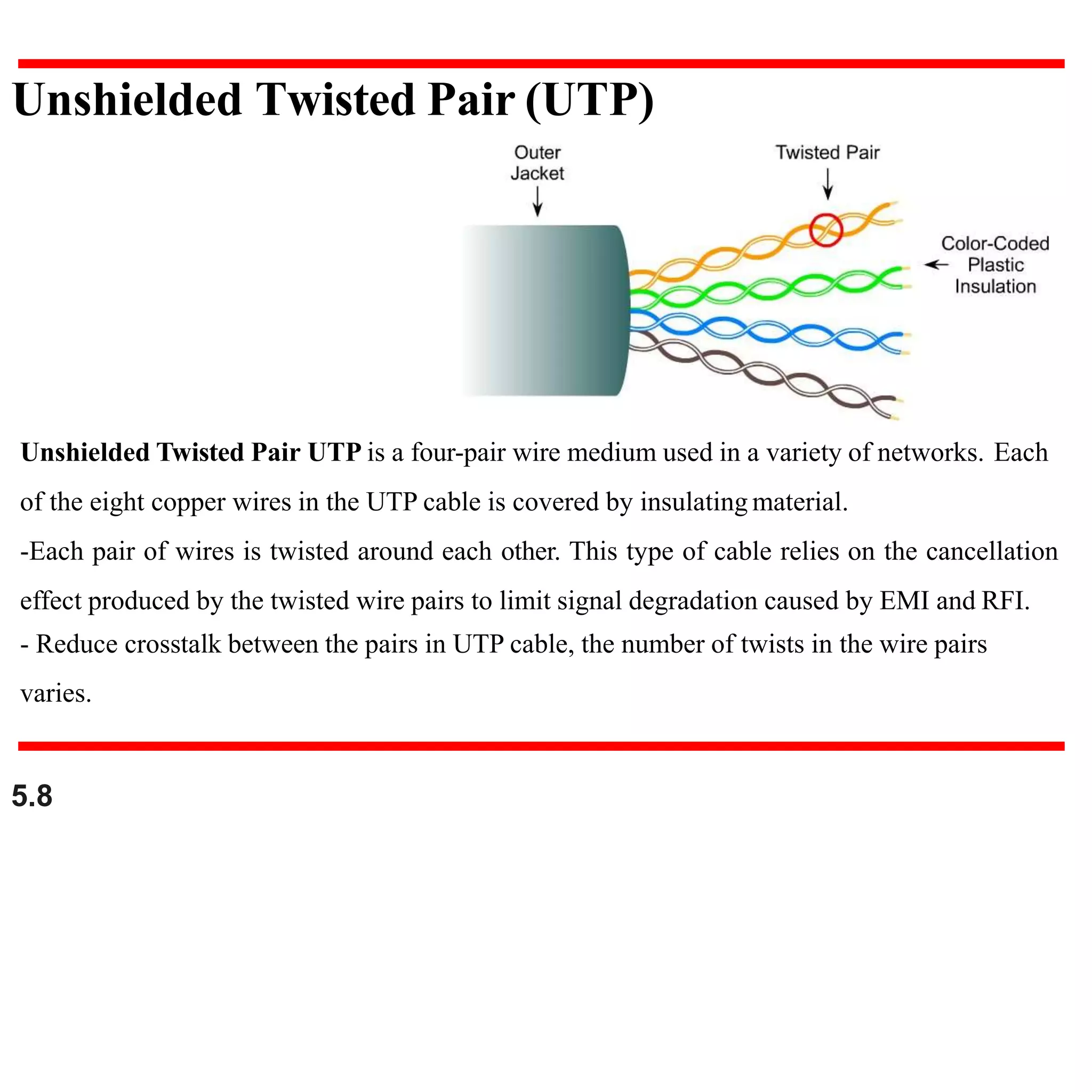
Unshielded Twisted Pair UTP is a four-pair wire medium used in a variety of networks. Each
of the eight copper wires in the UTP cable is covered by insulating material.
-Each pair of wires is twisted around each other. This type of cable relies on the cancellation
effect produced by the twisted wire pairs to limit signal degradation caused by EMI and RFI.
- Reduce crosstalk between the pairs in UTP cable, the number of twists in the wire pairs
varies.
Unshielded Twisted Pair (UTP)
5.8
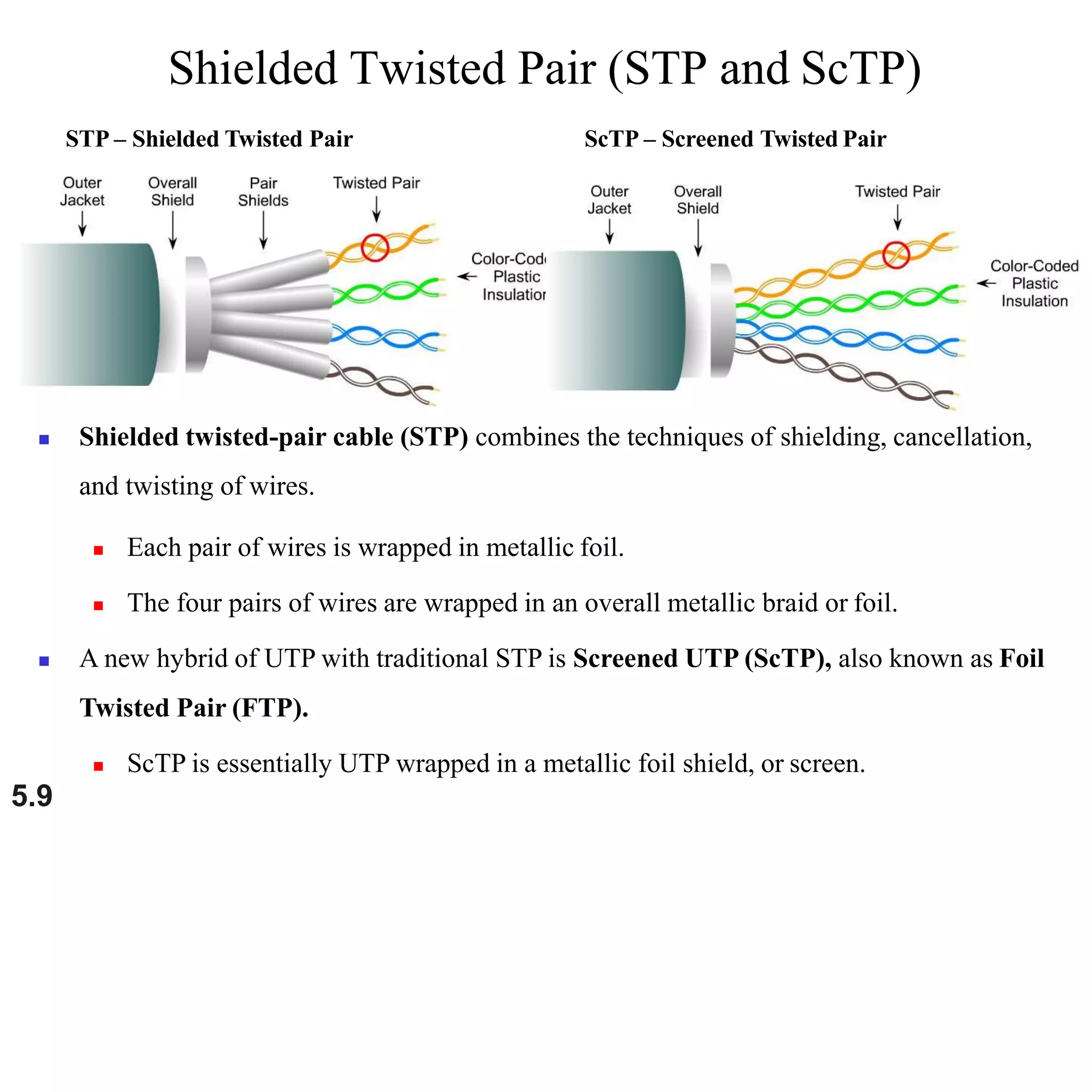
Shielded Twisted Pair (STP and ScTP)
 Shielded twisted-pair cable (STP) combines the techniques of shielding, cancellation,
and twisting of wires.
 Each pair of wires is wrapped in metallic foil.
 The four pairs of wires are wrapped in an overall metallic braid or foil.
 A new hybrid of UTP with traditional STP is Screened UTP (ScTP), also known as Foil
Twisted Pair (FTP).
 ScTP is essentially UTP wrapped in a metallic foil shield, or screen.
STP – Shielded Twisted Pair ScTP – Screened Twisted Pair
5.9
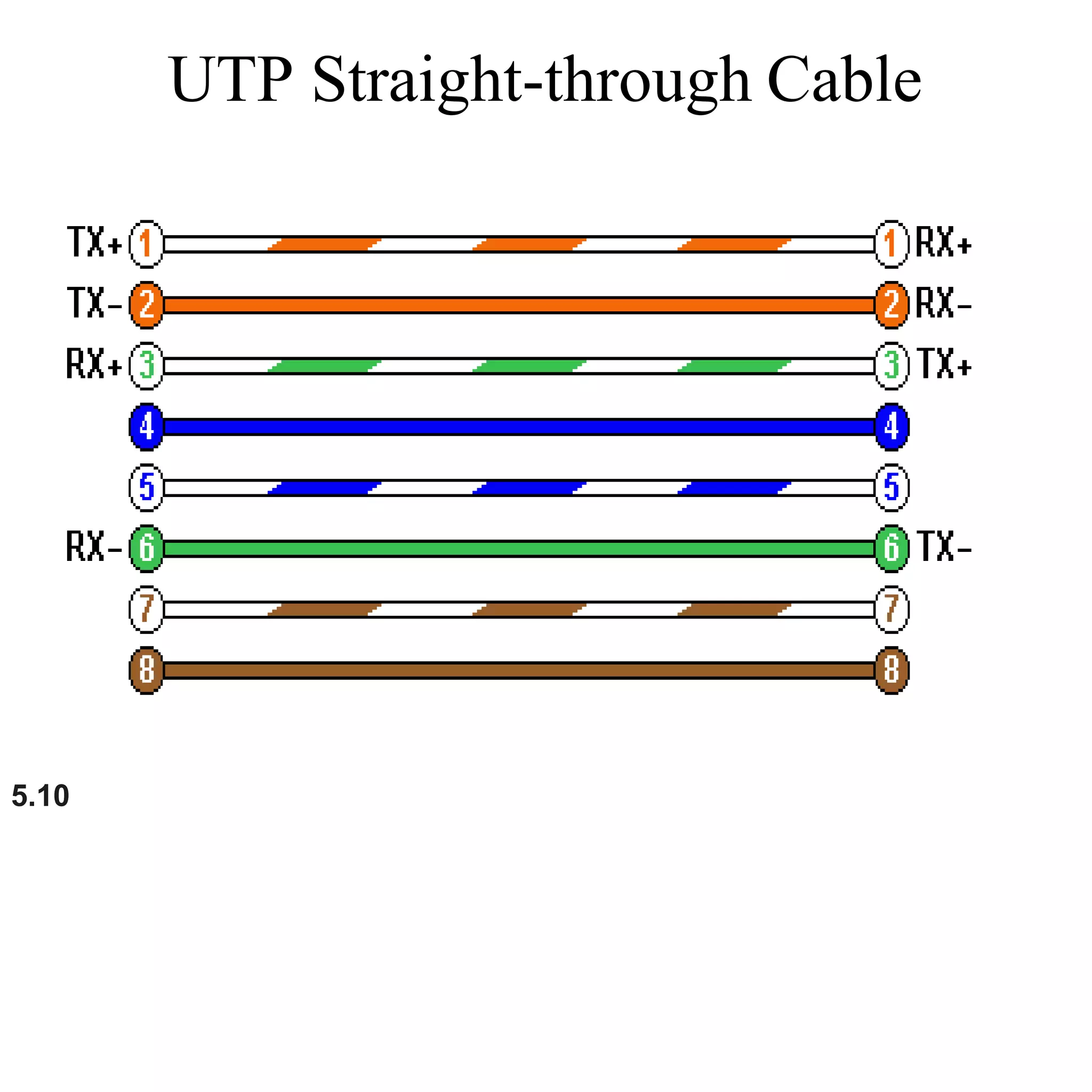
UTP Straight-through Cable
5.10
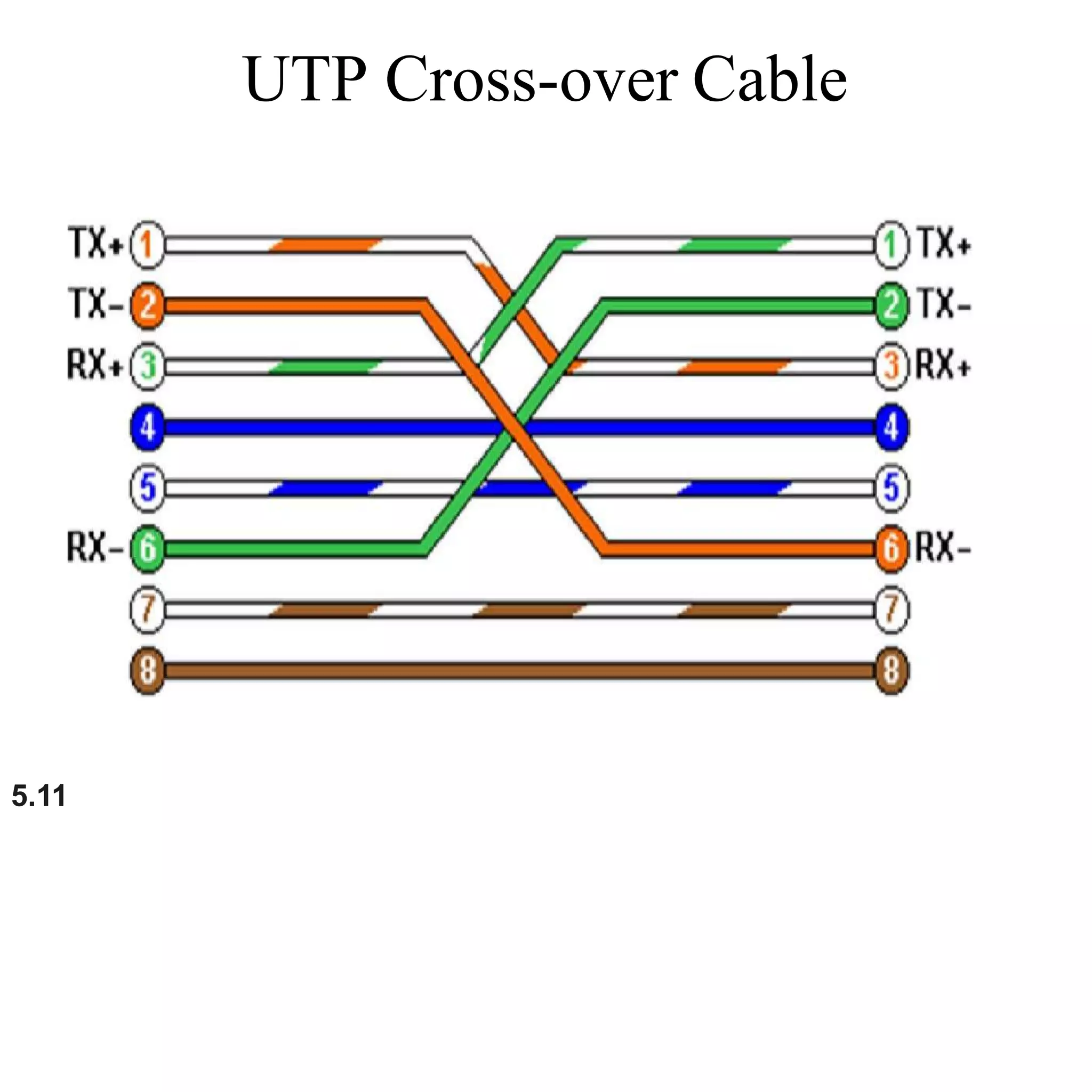
UTP Cross-over Cable
5.11
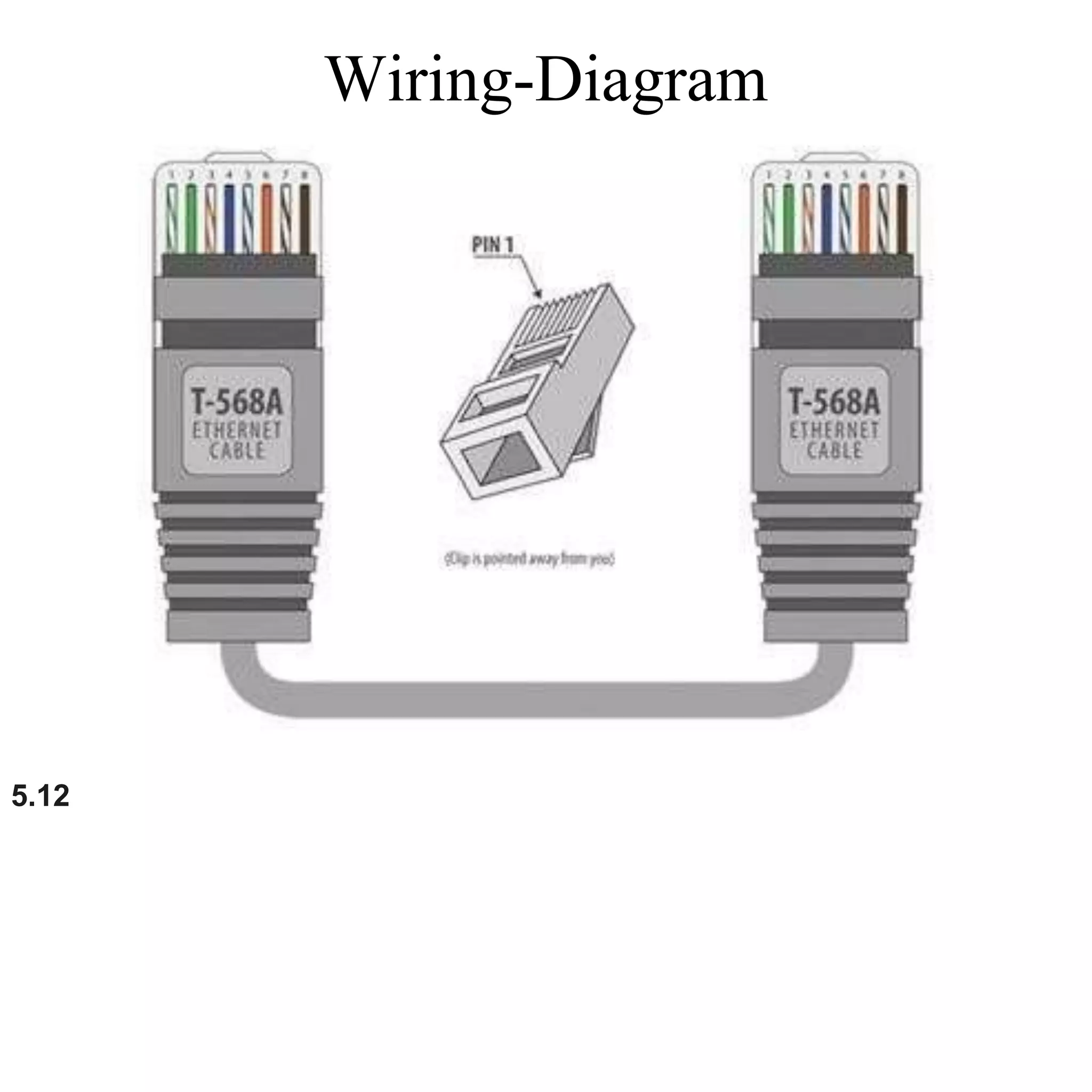
Wiring-Diagram
5.12
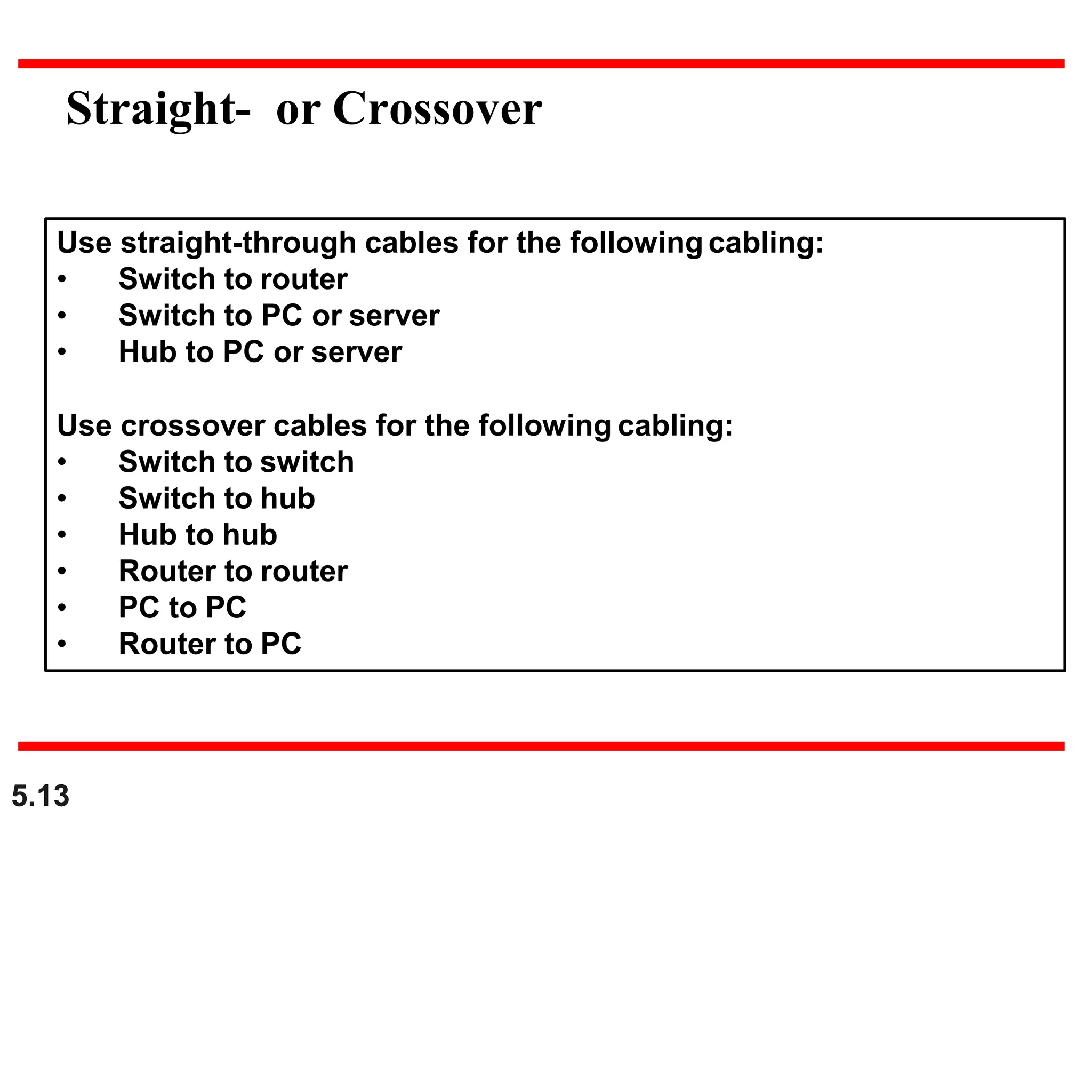
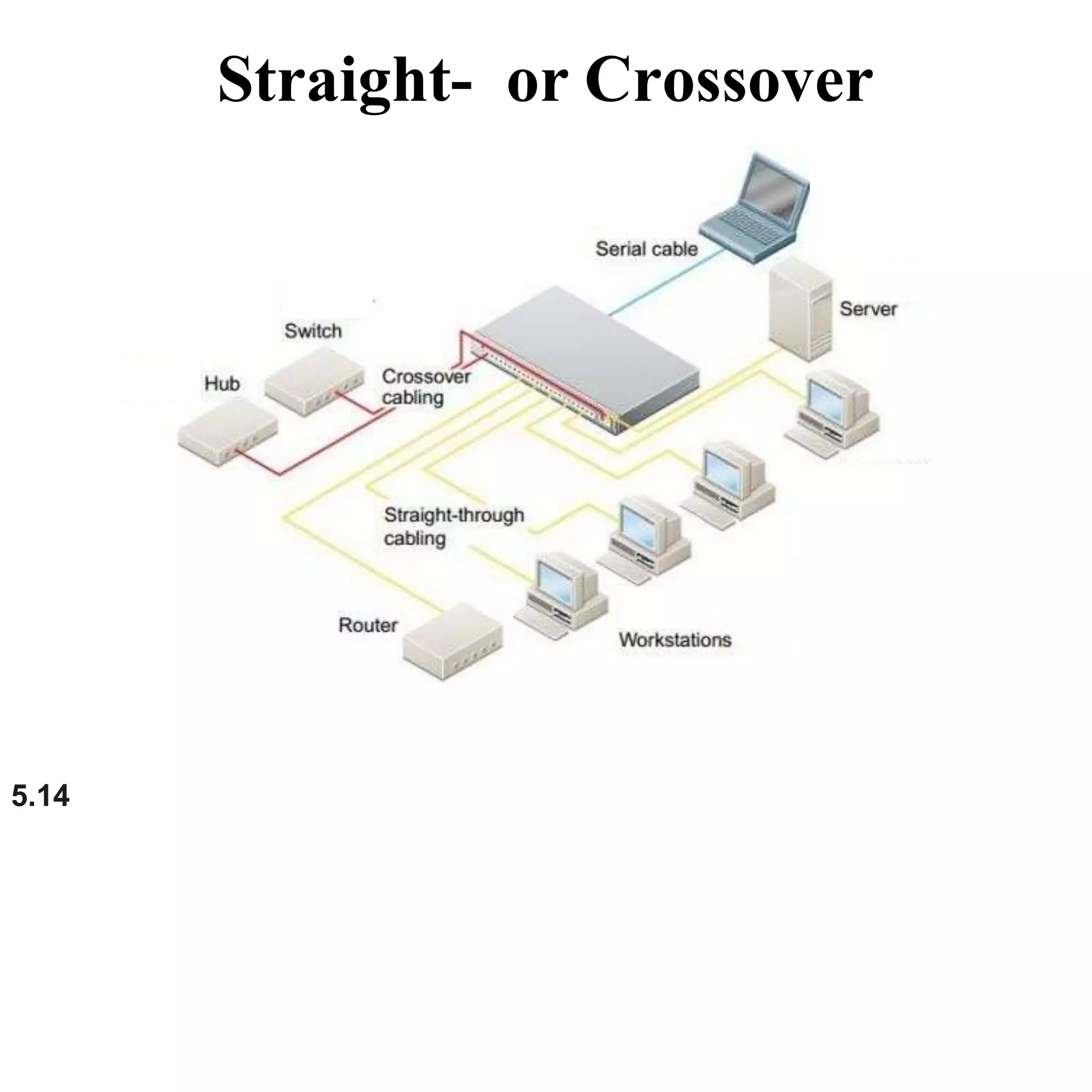
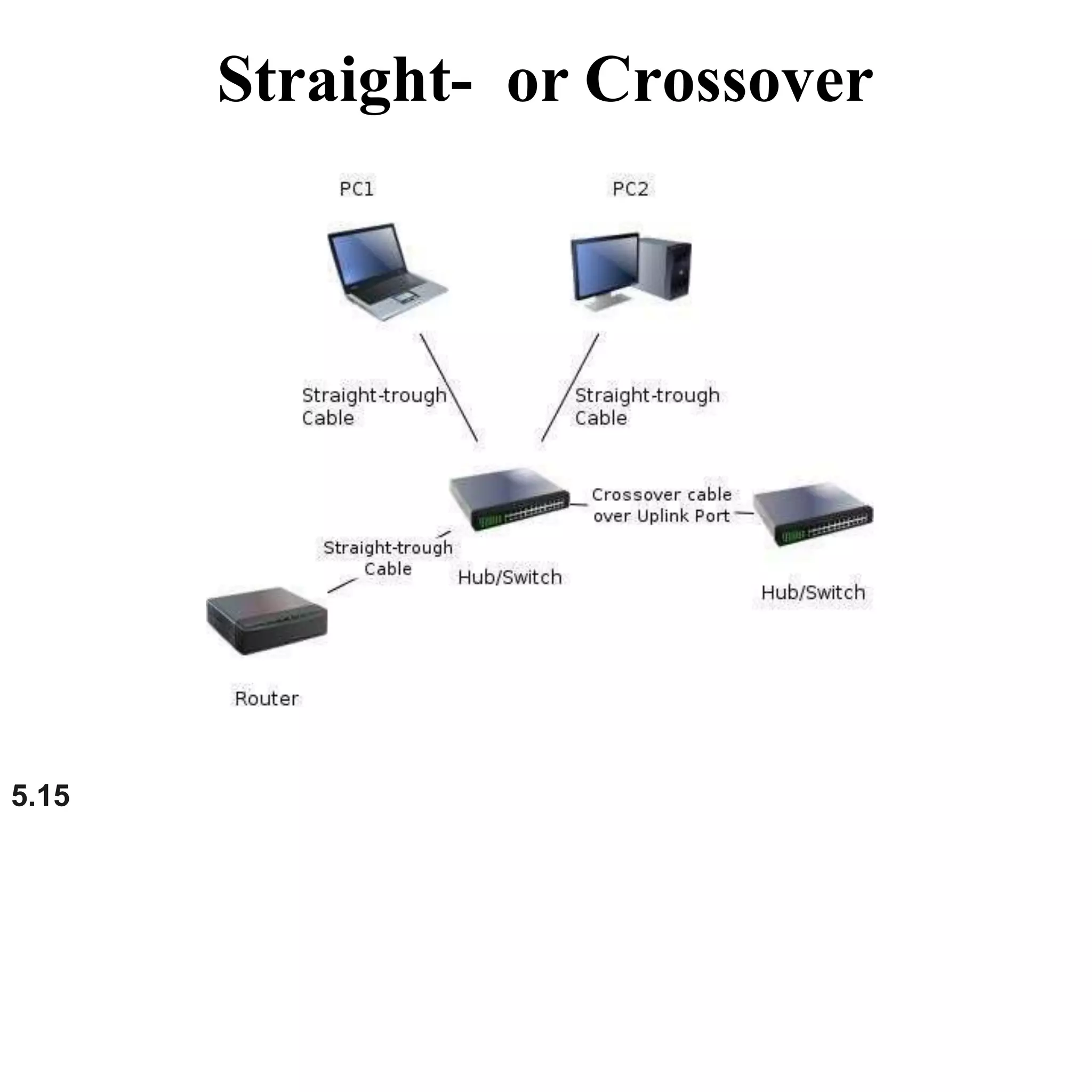
Straight- or Crossover
Use straight-through cables for the following cabling:
• Switch to router
• Switch to PC or server
• Hub to PC or server
Use crossover cables for the following cabling:
• Switch to switch
• Switch to hub
• Hub to hub
• Router to router
• PC to PC
• Router to PC
5.13
Straight- or Crossover
5.14
Straight- or Crossover
5.15
5.16
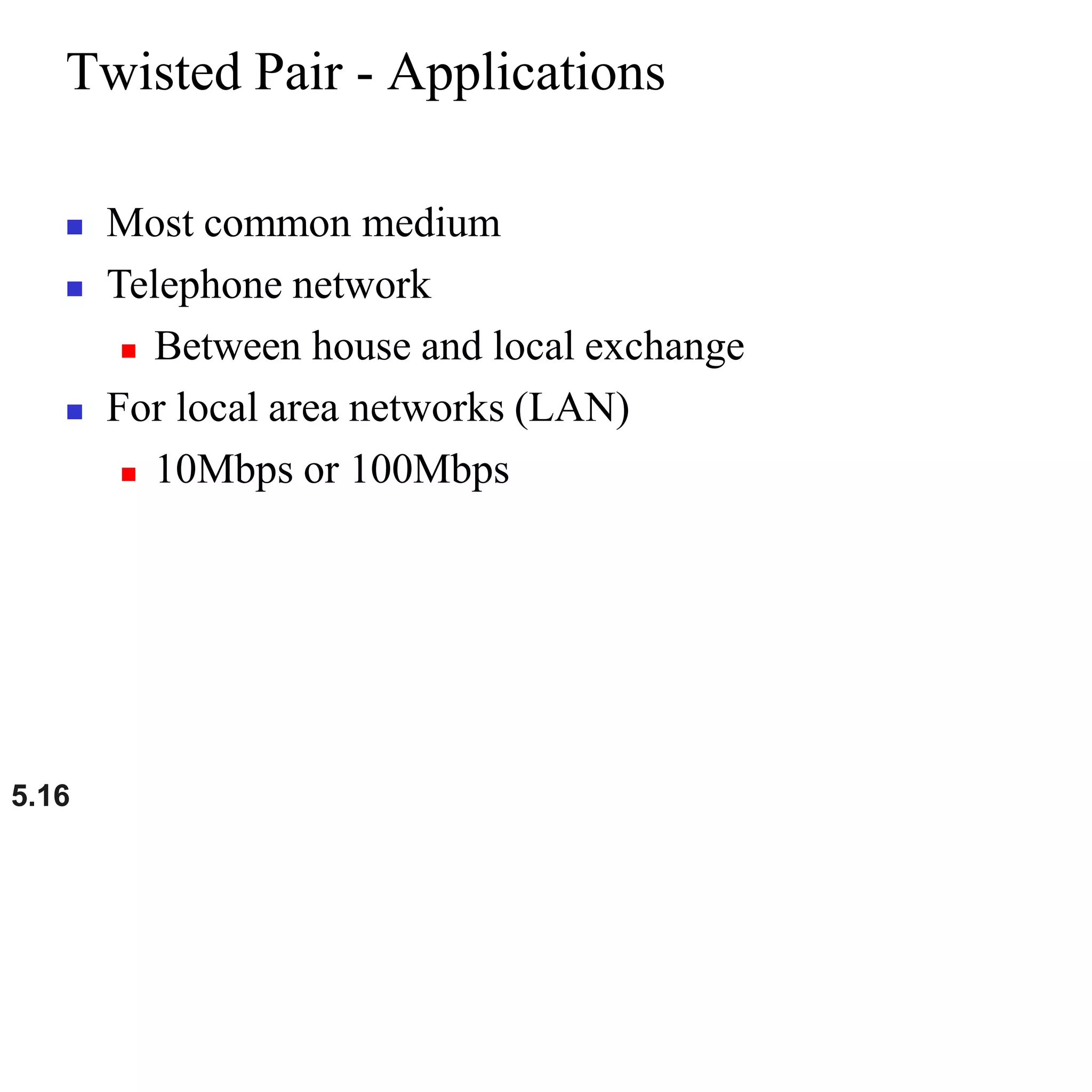
Twisted Pair - Applications
 Most common medium
 Telephone network
 Between house and local exchange
 For local area networks (LAN)
 10Mbps or 100Mbps
5.17
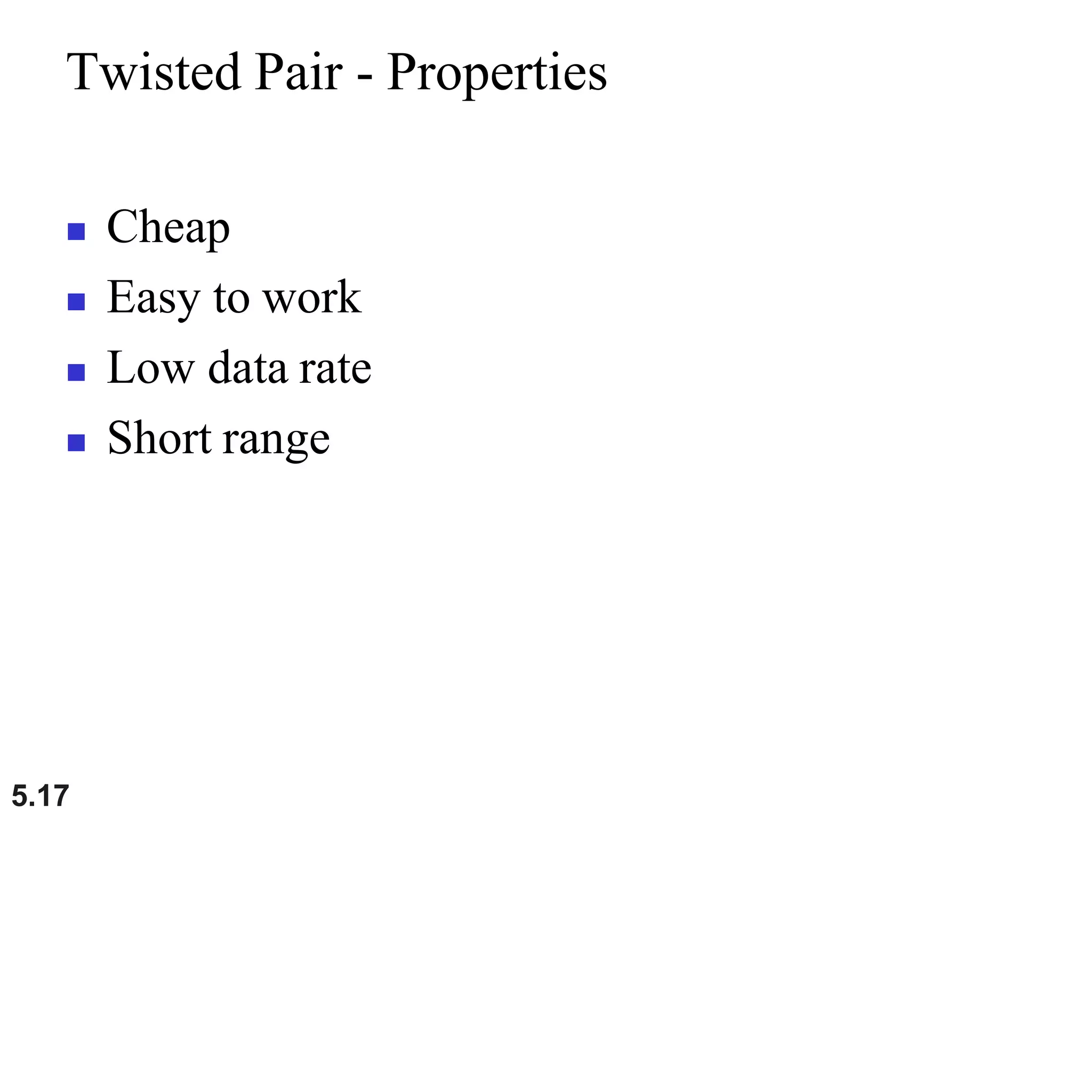
Twisted Pair - Properties
 Cheap
 Easy to work
 Low data rate
 Short range
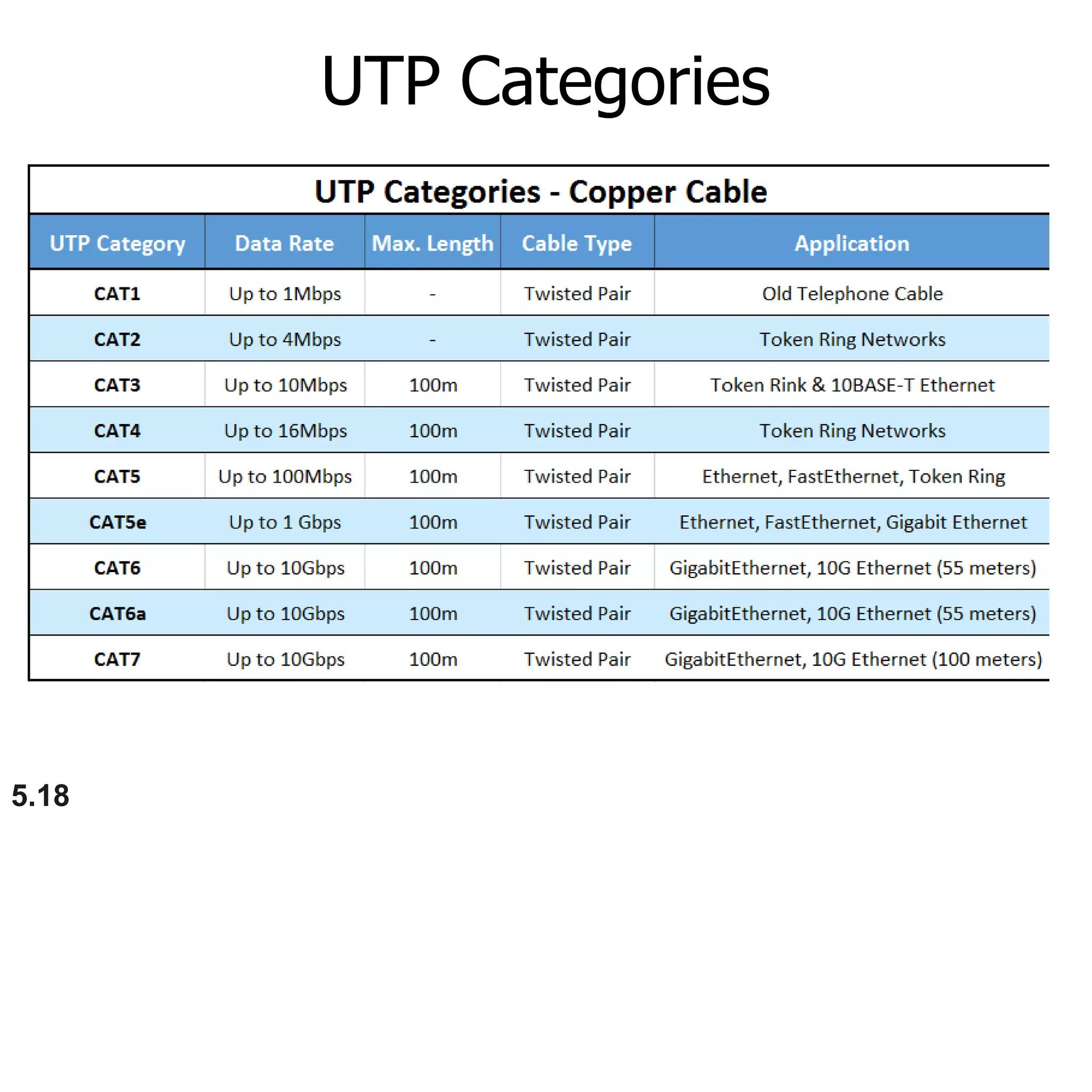
UTP Categories
5.18
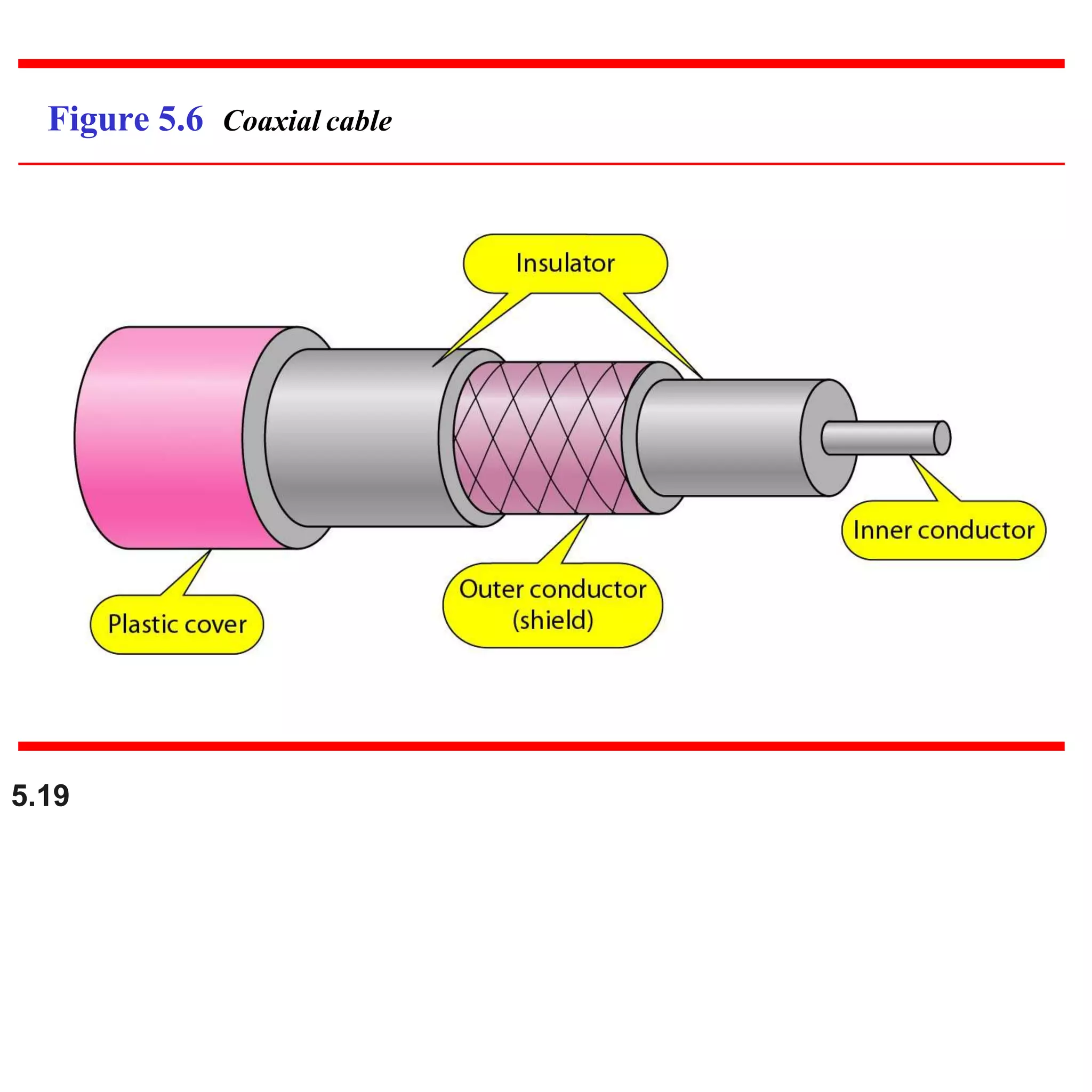
Figure 5.6 Coaxial cable
5.19
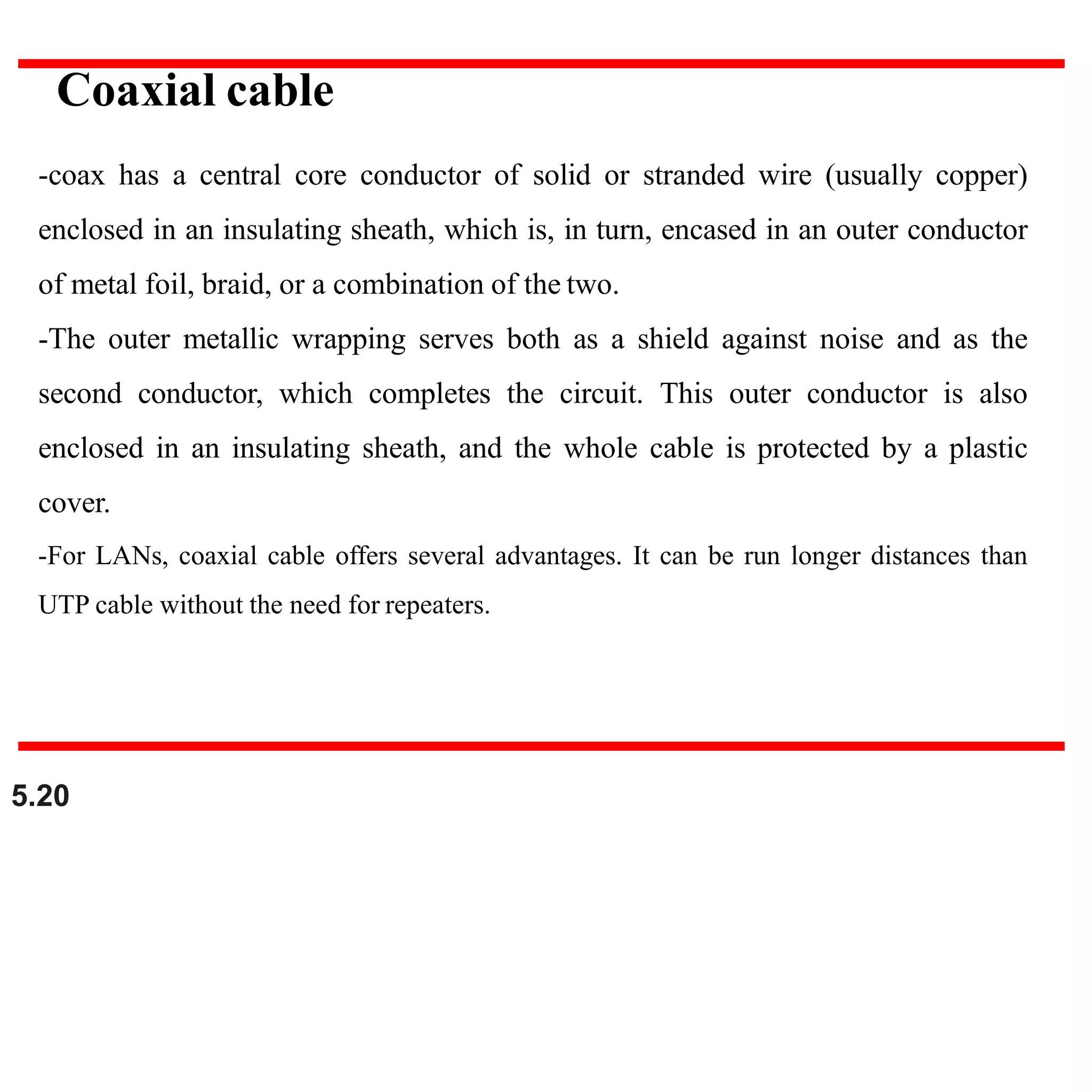
-coax has a central core conductor of solid or stranded wire (usually copper)
enclosed in an insulating sheath, which is, in turn, encased in an outer conductor
of metal foil, braid, or a combination of the two.
-The outer metallic wrapping serves both as a shield against noise and as the
second conductor, which completes the circuit. This outer conductor is also
enclosed in an insulating sheath, and the whole cable is protected by a plastic
cover.
-For LANs, coaxial cable offers several advantages. It can be run longer distances than
UTP cable without the need for repeaters.
Coaxial cable
5.20
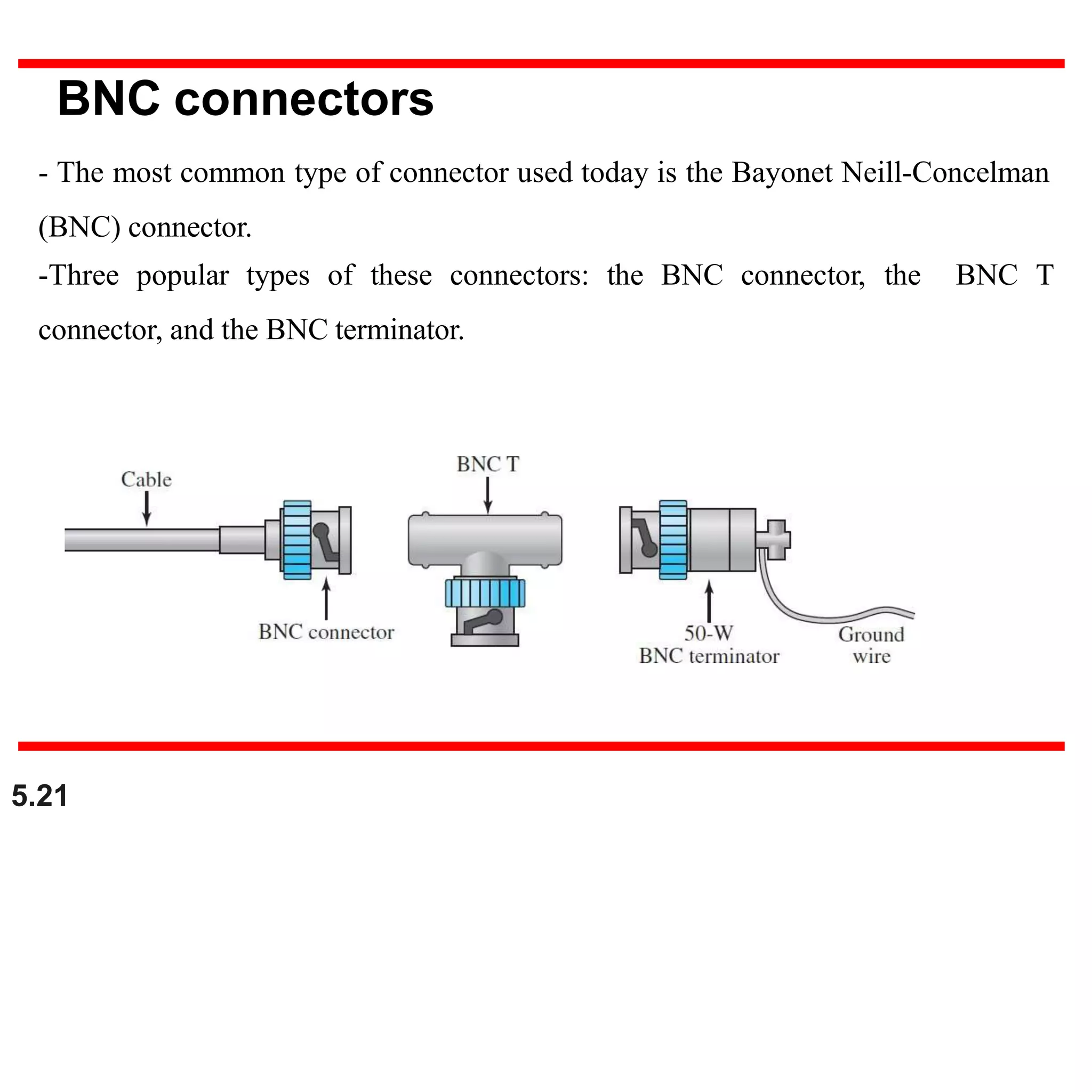
BNC connectors
- The most common type of connector used today is the Bayonet Neill-Concelman
(BNC) connector.
-Three popular types of these connectors: the BNC connector, the BNC T
connector, and the BNC terminator.
5.21
5.22
Coaxial Cable Applications
 Television distribution
 Ariel to TV
 Cable TV
 Long distance telephone transmission
 Can carry 10,000 voice calls simultaneously
 Being replaced by fiber optic
 Short distance computer systems links
 Local area networks
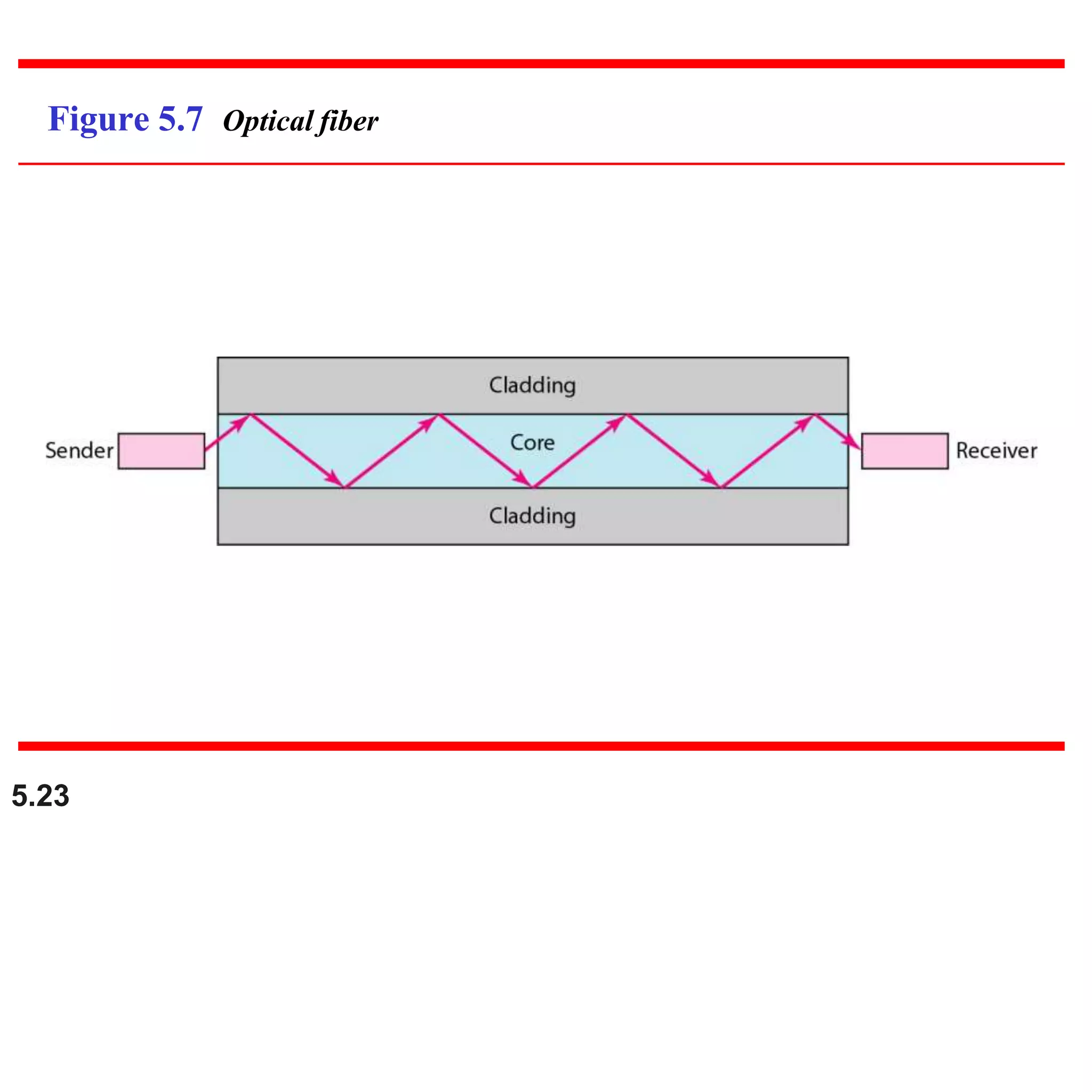
Figure 5.7 Optical fiber
5.23
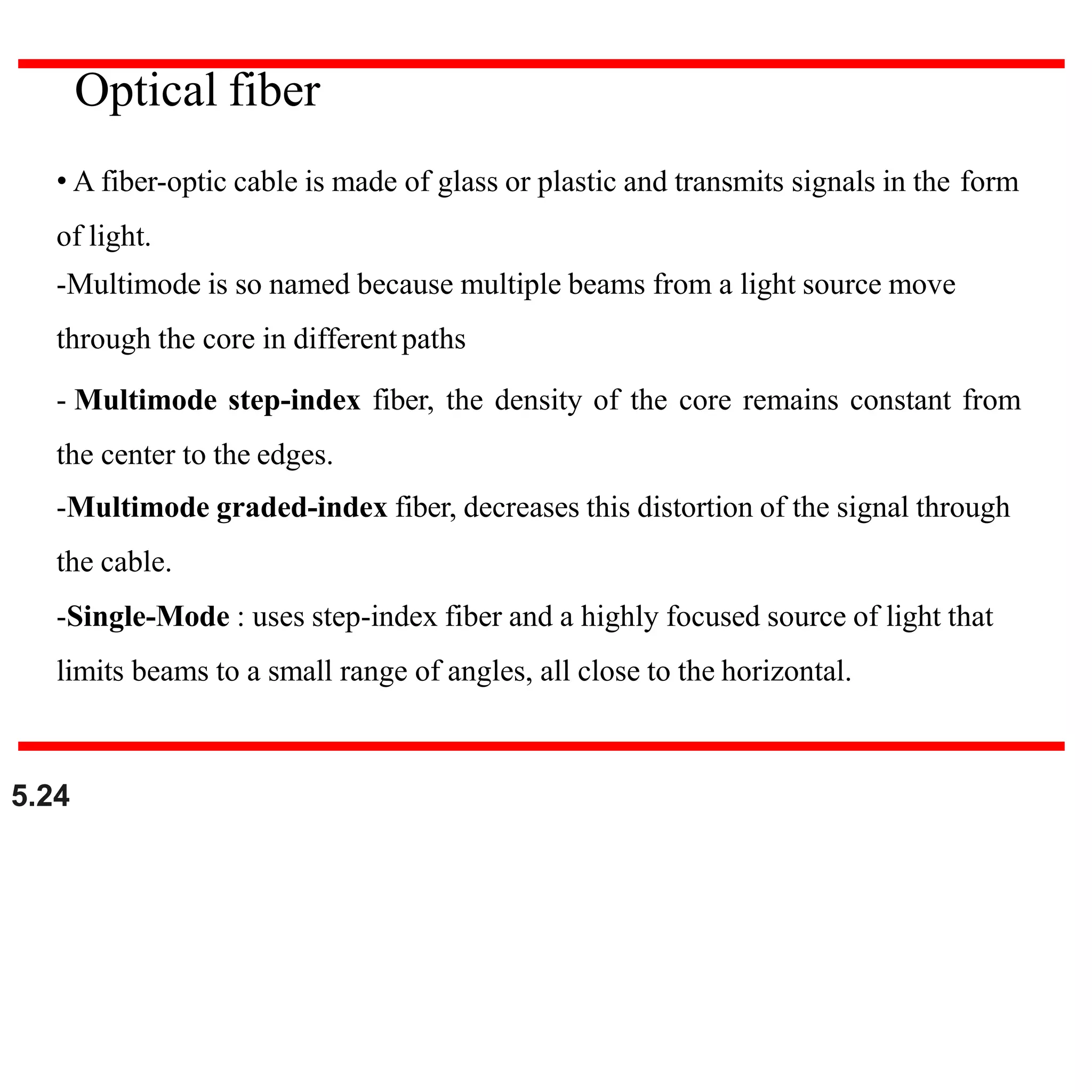
• A fiber-optic cable is made of glass or plastic and transmits signals in the form
of light.
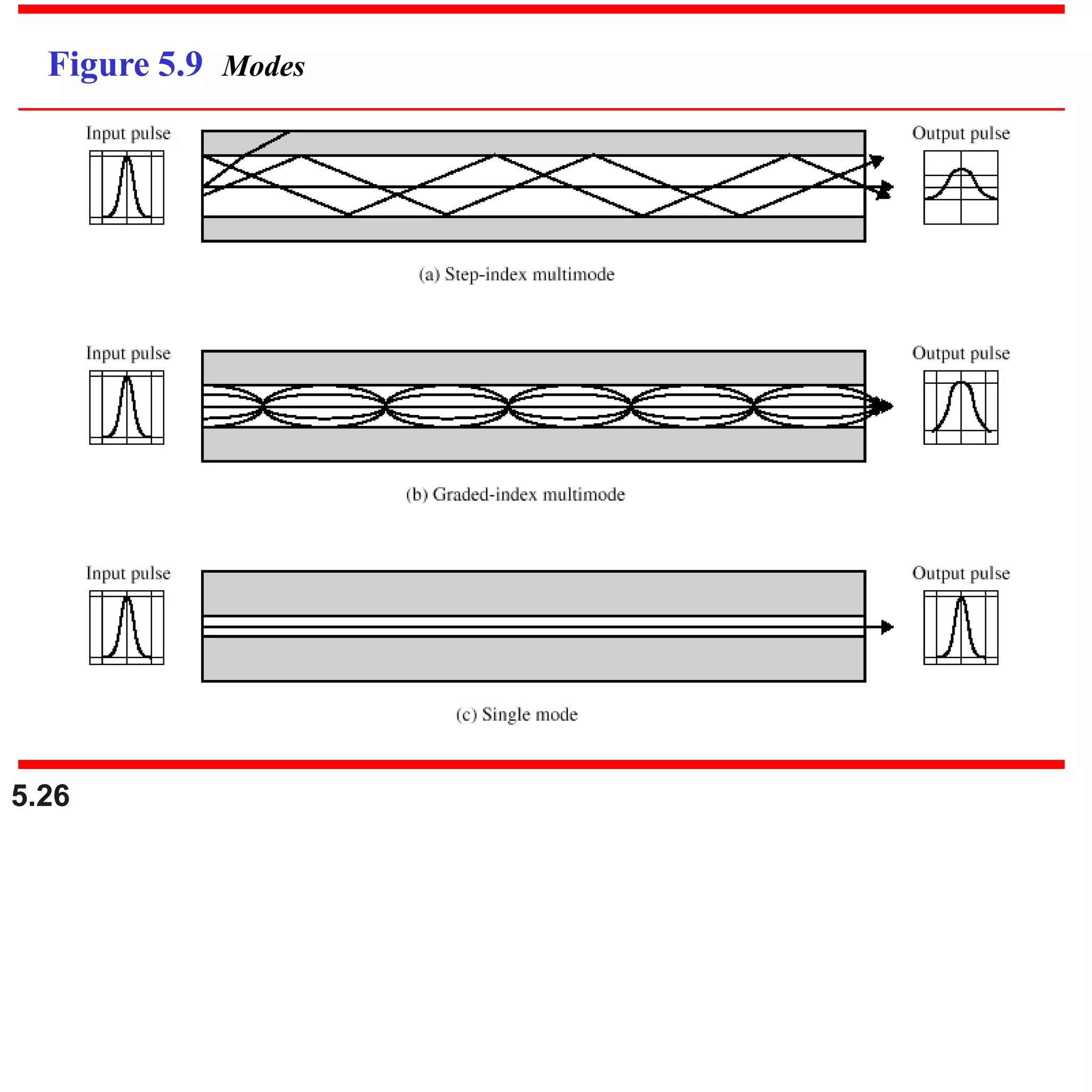
-Multimode is so named because multiple beams from a light source move
through the core in different paths
- Multimode step-index fiber, the density of the core remains constant from
the center to the edges.
-Multimode graded-index fiber, decreases this distortion of the signal through
the cable.
-Single-Mode : uses step-index fiber and a highly focused source of light that
limits beams to a small range of angles, all close to the horizontal.
Optical fiber
5.24
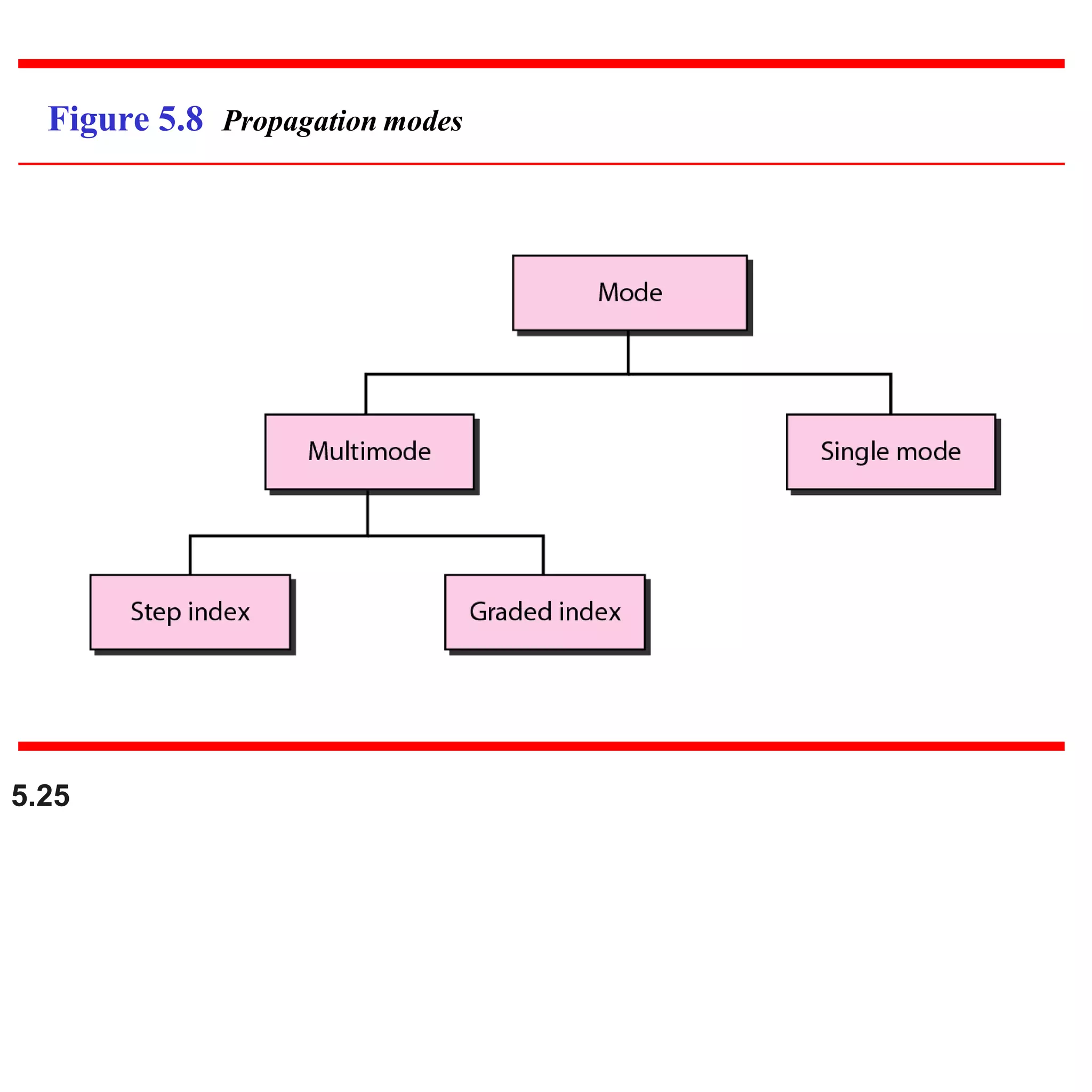
Figure 5.8 Propagation modes
5.25
Figure 5.9 Modes
5.26
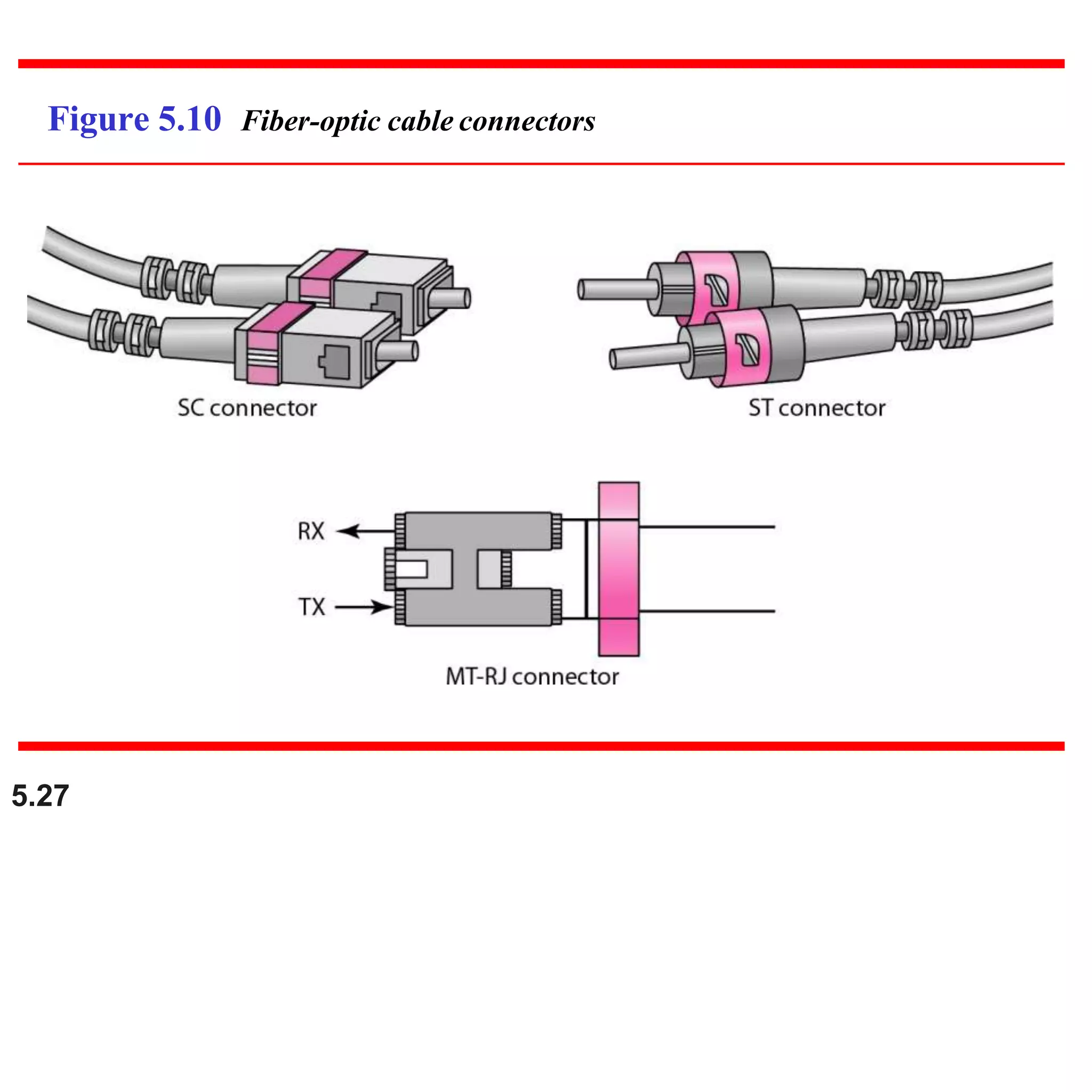
Figure 5.10 Fiber-optic cable connectors
5.27
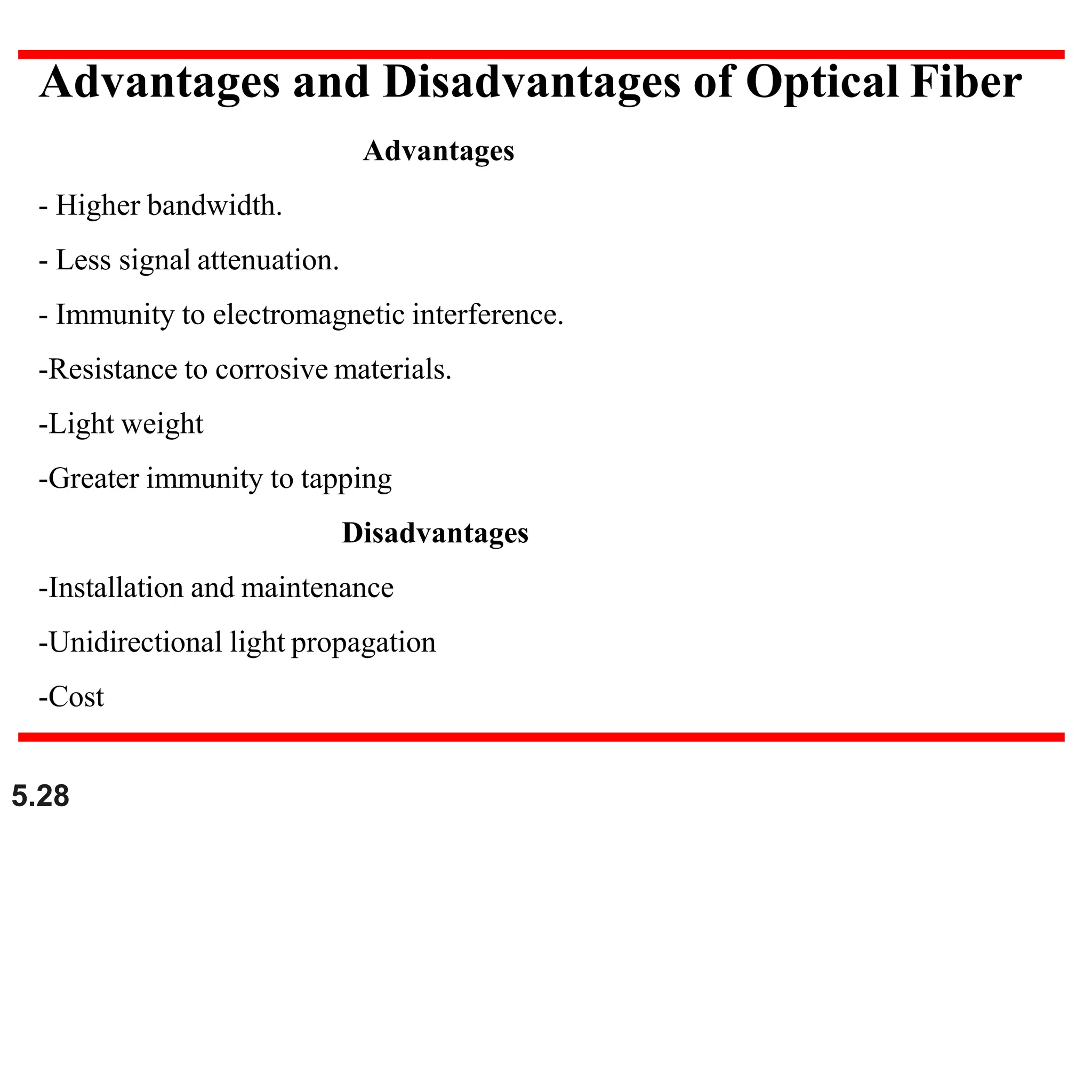
Advantages and Disadvantages of Optical Fiber
Advantages
- Higher bandwidth.
- Less signal attenuation.
- Immunity to electromagnetic interference.
-Resistance to corrosive materials.
-Light weight
-Greater immunity to tapping
Disadvantages
-Installation and maintenance
-Unidirectional light propagation
-Cost
5.28
5.29
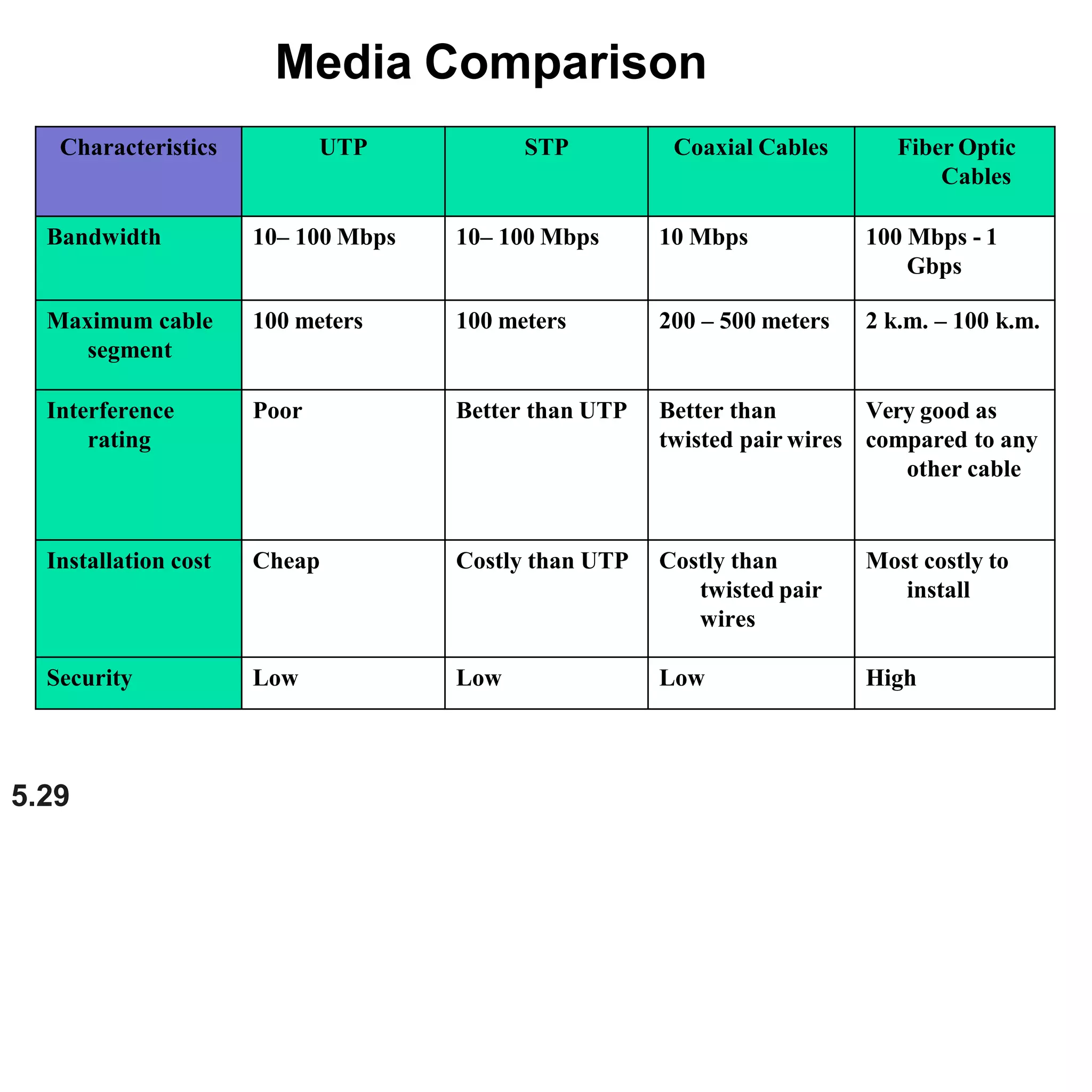
Characteristics UTP STP Coaxial Cables Fiber Optic
Cables
Bandwidth 10– 100 Mbps 10– 100 Mbps 10 Mbps 100 Mbps - 1
Gbps
Maximum cable
segment
100 meters 100 meters 200 – 500 meters 2 k.m. – 100 k.m.
Interference
rating
Poor Better than UTP Better than
twisted pair wires
Very good as
compared to any
other cable
Installation cost Cheap Costly than UTP Costly than
twisted pair
wires
Most costly to
install
Security Low Low Low High
Media Comparison
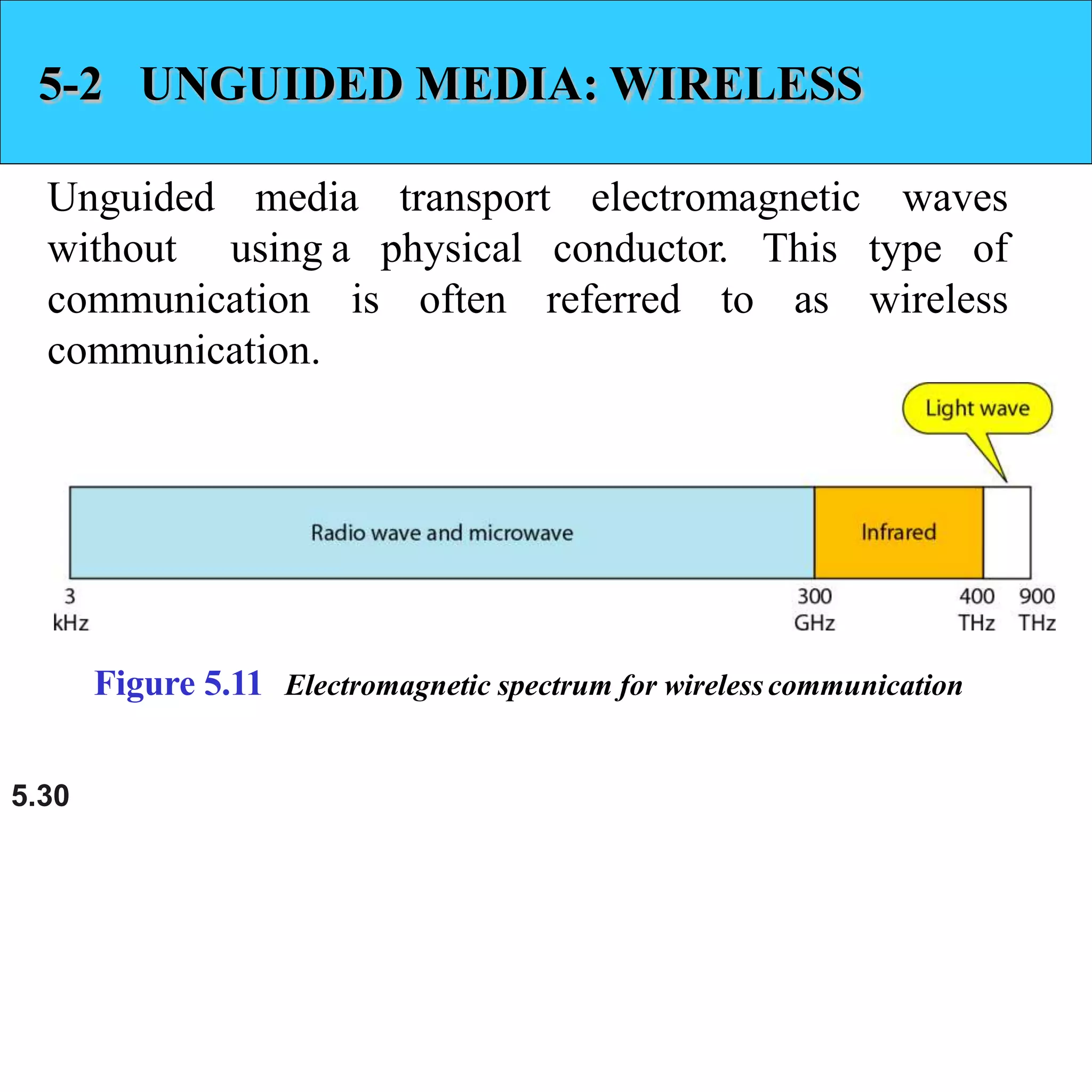
5-2 UNGUIDED MEDIA: WIRELESS
Unguided media electromagnetic waves
a
transport
physical of
is often referred to
conductor. This type
as wireless
without using
communication
communication.
Figure 5.11 Electromagnetic spectrum for wirelesscommunication
5.30
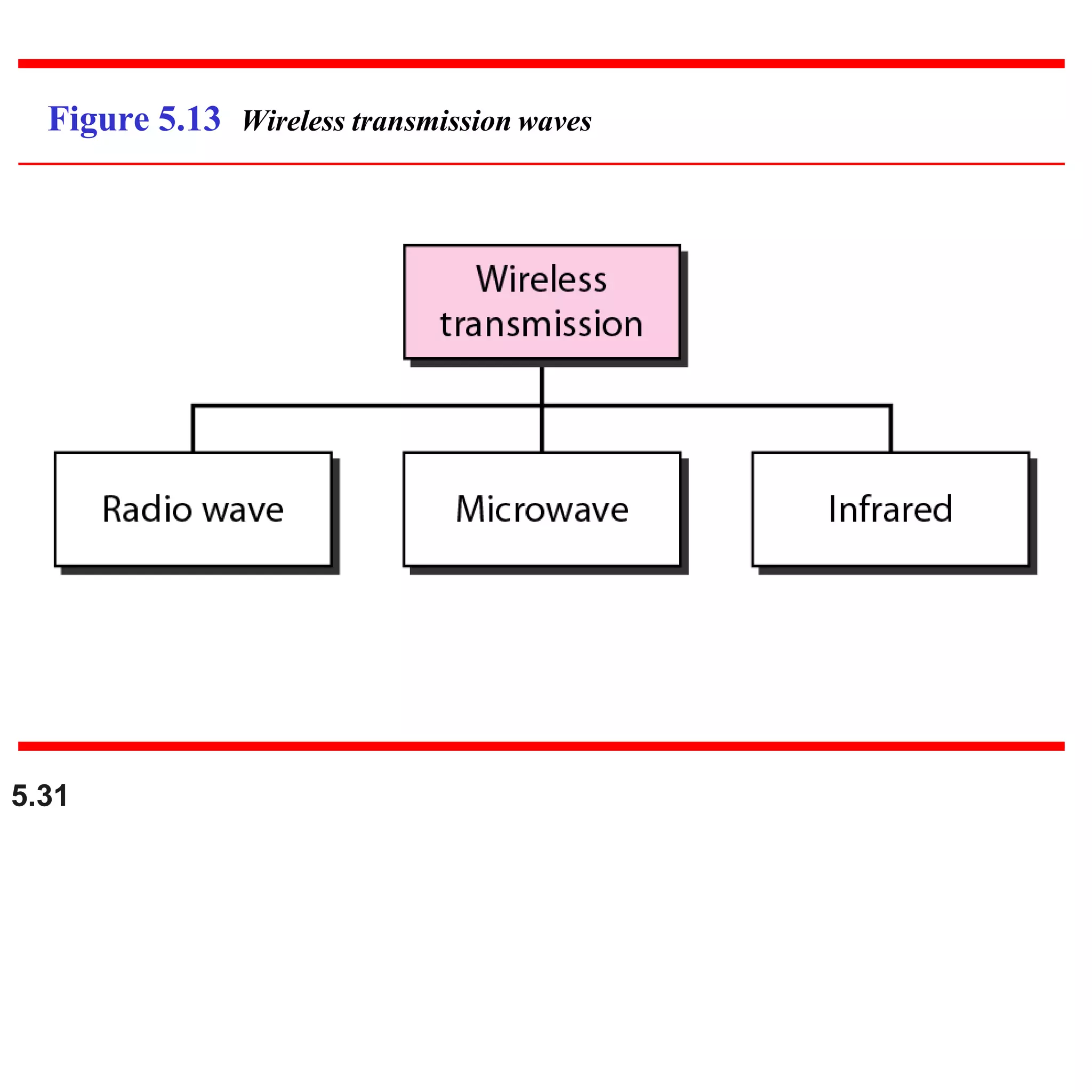
Figure 5.13 Wireless transmission waves
5.31
•Radio waves are used
5.32
for multicast
communications, such as radio and
television, and paging systems.
•They can penetrate through walls.
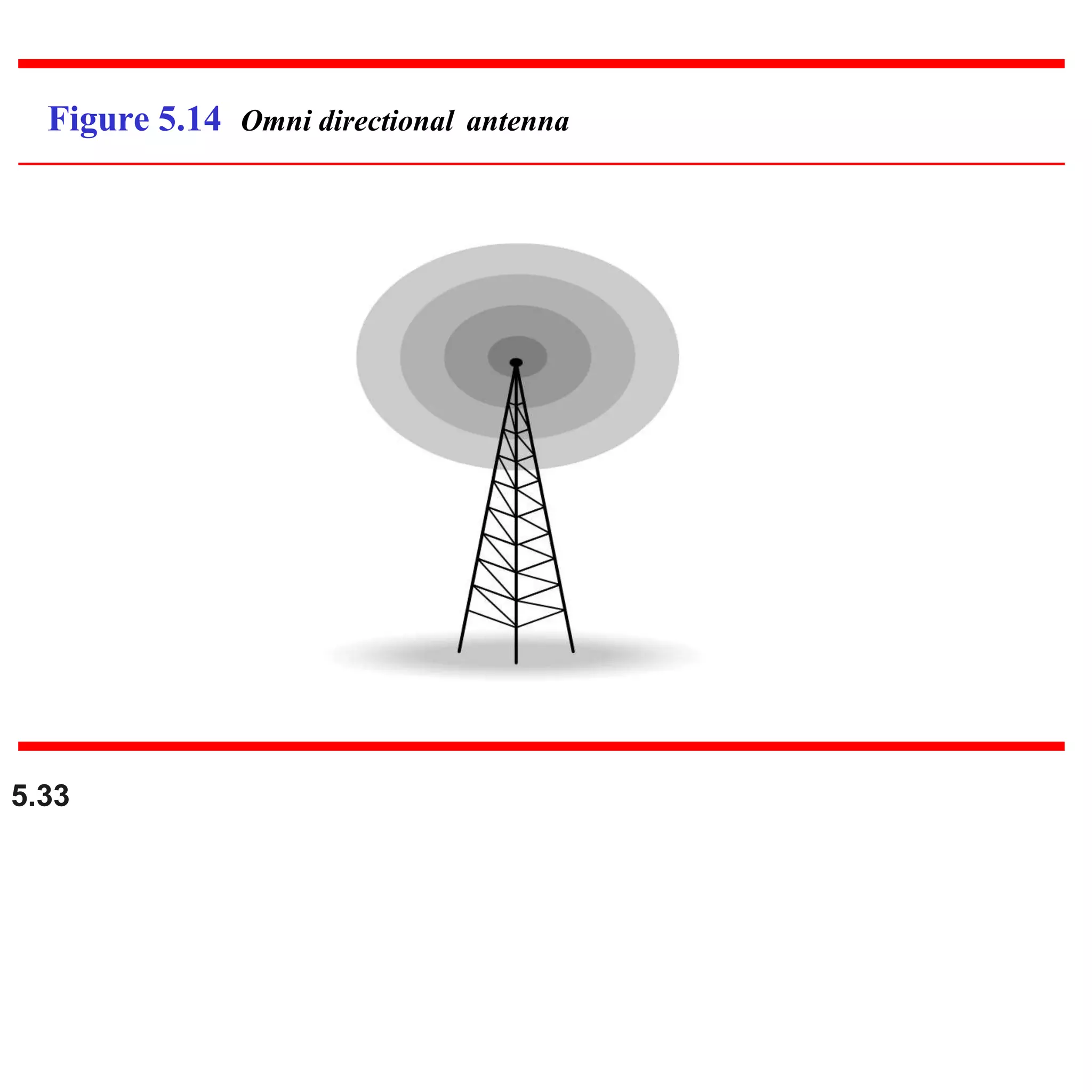
•Use omni directional antennas
Figure 5.14 Omni directional antenna
5.33
•Microwaves are
5.34
used
such
for unicast
as cellular
communication
telephones, satellite networks,
and wireless LANs.
•Higher frequency ranges cannot
penetrate walls.
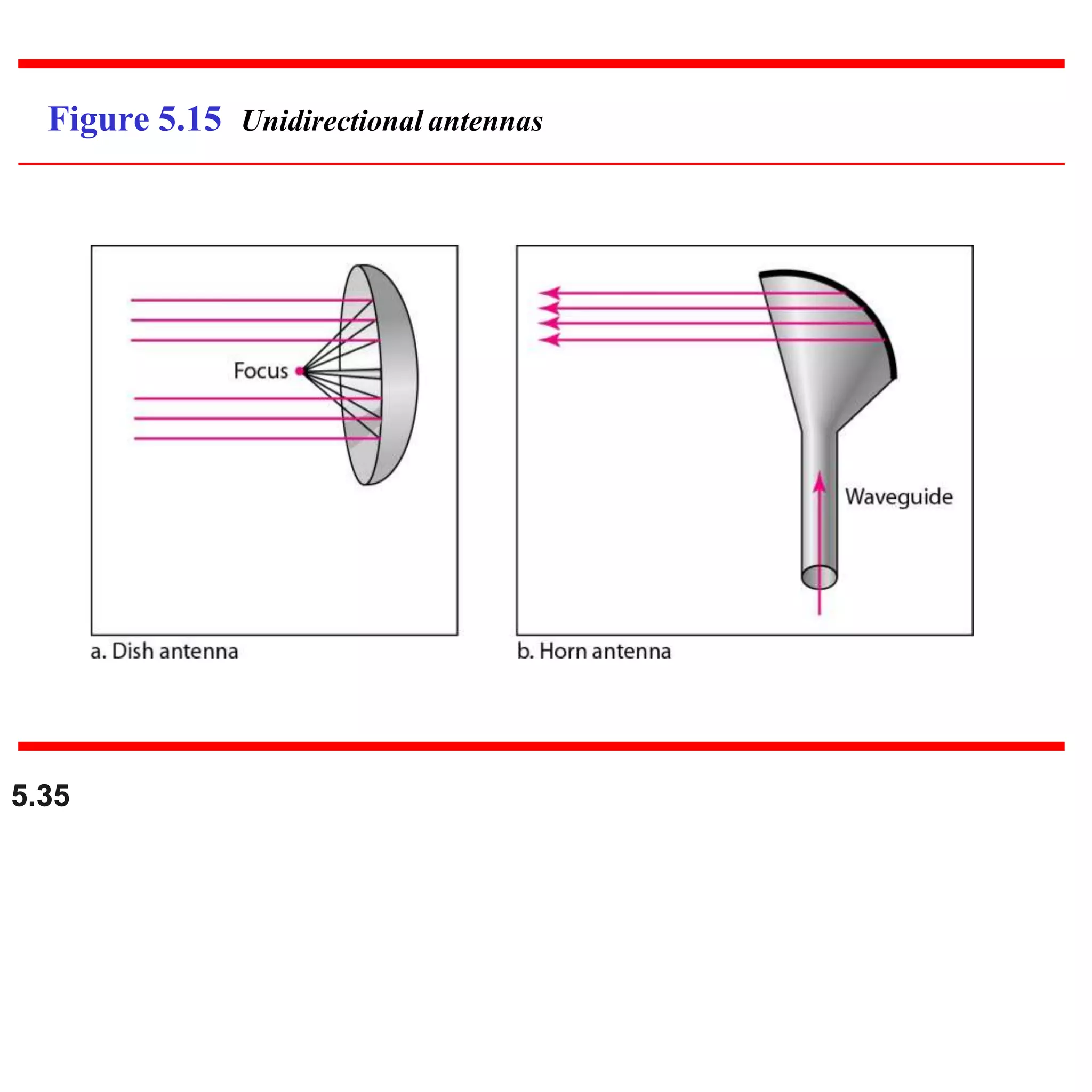
•Use directional antennas - point to point
line of sight communications.
Figure 5.15 Unidirectional antennas
5.35
•Infrared signals can be used for short-
range communication in a closed area
using line-of-sight propagation.
5.36View publication stats

transmission media in computer network

  • 1.
    See discussions, stats,and author profiles for this publication at: https://www.researchgate.net/publication/340247805 Computer Networks Chapter (5) Transmission Media Presentation · March2020 DOI:10.13140/RG.2.2.16768.99848 CITATIONS 0 READS 15,405 Some ofthe authors ofthis publication are also working on these relatedprojects: Inverse kinematics solution for robotic manipulatorsbased on fuzzy logic and PDcontrol View project control Viewproject 1author: Abbas Miry Al-Mustansiriya University 58 PUBLICATIONS102CITATIONS SEEPROFILE All content following this pagewasuploaded by Abbas Miryon 28March2020. Theuser hasrequestedenhancementof the downloaded file.
  • 2.
    5.1 Chapter 5 Transmission Media Computer Networks  Al-Mustansiryah University  Elec. Eng. Department College of Engineering Fourth Year Class
  • 3.
    Figure 5.1 Transmissionmedium and physical layer 5.2
  • 4.
    Figure 5.2 Classesof transmission media 5.3
  • 5.
    5-1 GUIDED MEDIA 5.4 Guidedmedia, which are those that provide a conduit from one device to another, include twisted-pair cable, coaxial cable, and fiber-optic cable.
  • 6.
  • 7.
    5.6 Cable Specifications  10BASE-T Speed of transmission at 10 Mbps  Type of transmission is baseband, or digitally interpreted  T stands for twisted pair  10BASE5  Speed of transmission at 10 Mbps  Type of transmission is baseband  5 represents the capability of the cable to allow the signal to travel for approximately 500 meters before attenuation could disrupt the ability of the receiver to appropriately interpret the signal being received.
  • 8.
    5.7 Cable Specifications  10BASE2 Speed of transmission at 10 Mbps  Type of transmission is baseband  2 represents the capability of the cable to allow the signal to travel for approximately 200 meters, before attenuation could disrupt the ability of the receiver to appropriately interpret the signal being received.
  • 9.
    Unshielded Twisted PairUTP is a four-pair wire medium used in a variety of networks. Each of the eight copper wires in the UTP cable is covered by insulating material. -Each pair of wires is twisted around each other. This type of cable relies on the cancellation effect produced by the twisted wire pairs to limit signal degradation caused by EMI and RFI. - Reduce crosstalk between the pairs in UTP cable, the number of twists in the wire pairs varies. Unshielded Twisted Pair (UTP) 5.8
  • 10.
    Shielded Twisted Pair(STP and ScTP)  Shielded twisted-pair cable (STP) combines the techniques of shielding, cancellation, and twisting of wires.  Each pair of wires is wrapped in metallic foil.  The four pairs of wires are wrapped in an overall metallic braid or foil.  A new hybrid of UTP with traditional STP is Screened UTP (ScTP), also known as Foil Twisted Pair (FTP).  ScTP is essentially UTP wrapped in a metallic foil shield, or screen. STP – Shielded Twisted Pair ScTP – Screened Twisted Pair 5.9
  • 11.
  • 12.
  • 13.
  • 14.
    Straight- or Crossover Usestraight-through cables for the following cabling: • Switch to router • Switch to PC or server • Hub to PC or server Use crossover cables for the following cabling: • Switch to switch • Switch to hub • Hub to hub • Router to router • PC to PC • Router to PC 5.13
  • 15.
  • 16.
  • 17.
    5.16 Twisted Pair -Applications  Most common medium  Telephone network  Between house and local exchange  For local area networks (LAN)  10Mbps or 100Mbps
  • 18.
    5.17 Twisted Pair -Properties  Cheap  Easy to work  Low data rate  Short range
  • 19.
  • 20.
  • 21.
    -coax has acentral core conductor of solid or stranded wire (usually copper) enclosed in an insulating sheath, which is, in turn, encased in an outer conductor of metal foil, braid, or a combination of the two. -The outer metallic wrapping serves both as a shield against noise and as the second conductor, which completes the circuit. This outer conductor is also enclosed in an insulating sheath, and the whole cable is protected by a plastic cover. -For LANs, coaxial cable offers several advantages. It can be run longer distances than UTP cable without the need for repeaters. Coaxial cable 5.20
  • 22.
    BNC connectors - Themost common type of connector used today is the Bayonet Neill-Concelman (BNC) connector. -Three popular types of these connectors: the BNC connector, the BNC T connector, and the BNC terminator. 5.21
  • 23.
    5.22 Coaxial Cable Applications Television distribution  Ariel to TV  Cable TV  Long distance telephone transmission  Can carry 10,000 voice calls simultaneously  Being replaced by fiber optic  Short distance computer systems links  Local area networks
  • 24.
  • 25.
    • A fiber-opticcable is made of glass or plastic and transmits signals in the form of light. -Multimode is so named because multiple beams from a light source move through the core in different paths - Multimode step-index fiber, the density of the core remains constant from the center to the edges. -Multimode graded-index fiber, decreases this distortion of the signal through the cable. -Single-Mode : uses step-index fiber and a highly focused source of light that limits beams to a small range of angles, all close to the horizontal. Optical fiber 5.24
  • 26.
  • 27.
  • 28.
    Figure 5.10 Fiber-opticcable connectors 5.27
  • 29.
    Advantages and Disadvantagesof Optical Fiber Advantages - Higher bandwidth. - Less signal attenuation. - Immunity to electromagnetic interference. -Resistance to corrosive materials. -Light weight -Greater immunity to tapping Disadvantages -Installation and maintenance -Unidirectional light propagation -Cost 5.28
  • 30.
    5.29 Characteristics UTP STPCoaxial Cables Fiber Optic Cables Bandwidth 10– 100 Mbps 10– 100 Mbps 10 Mbps 100 Mbps - 1 Gbps Maximum cable segment 100 meters 100 meters 200 – 500 meters 2 k.m. – 100 k.m. Interference rating Poor Better than UTP Better than twisted pair wires Very good as compared to any other cable Installation cost Cheap Costly than UTP Costly than twisted pair wires Most costly to install Security Low Low Low High Media Comparison
  • 31.
    5-2 UNGUIDED MEDIA:WIRELESS Unguided media electromagnetic waves a transport physical of is often referred to conductor. This type as wireless without using communication communication. Figure 5.11 Electromagnetic spectrum for wirelesscommunication 5.30
  • 32.
    Figure 5.13 Wirelesstransmission waves 5.31
  • 33.
    •Radio waves areused 5.32 for multicast communications, such as radio and television, and paging systems. •They can penetrate through walls. •Use omni directional antennas
  • 34.
    Figure 5.14 Omnidirectional antenna 5.33
  • 35.
    •Microwaves are 5.34 used such for unicast ascellular communication telephones, satellite networks, and wireless LANs. •Higher frequency ranges cannot penetrate walls. •Use directional antennas - point to point line of sight communications.
  • 36.
  • 37.
    •Infrared signals canbe used for short- range communication in a closed area using line-of-sight propagation. 5.36View publication stats