1
Transgenic Animals
SUBMITTED BY
JONAID ALI
8MARCH 2017
FACULTY OF FARMACY
M.PHARM(PHARMACOLOGY 2ND SEM)
JAMIA HAMDARD
NEW DELHI
Contents
• Introduction
• History
• Animals enginnered
• Purpose
• Benefits of transgenic animals
• Negatives of transgenic animals
• Methods of transforming genes
• Few commercial drugs
• Application of transgenic animals
• Some important advances
• Problems and prospects
• Conclusions
• References
3
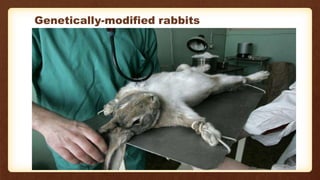
Genetically-modified rabbits
4
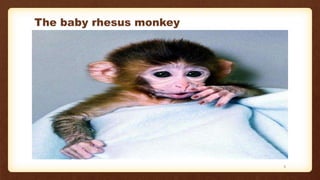
The baby rhesus monkey
5
Dolly ship
6
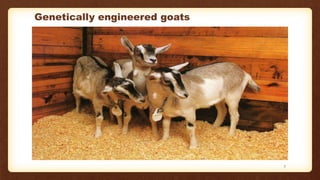
Genetically engineered goats
7
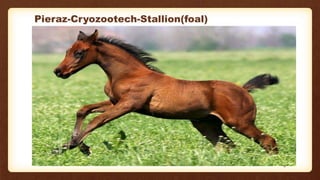
Pieraz-Cryozootech-Stallion(foal)
8
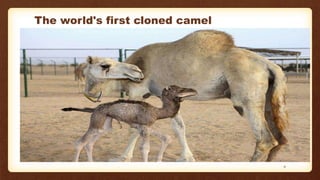
The world's first cloned camel
9
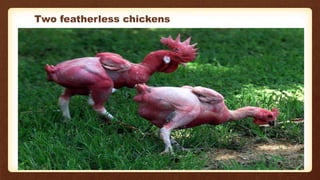
Two featherless chickens
10
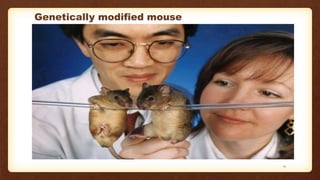
Genetically modified mouse
11
Introductions
• Transgenic animals:
An organism whose genome is modified by foreign gene
by using genetic engineering.
• A large number of organism have been created
successfully by genetic engineering such as:
Cows,pigs,mice,sheep,fish,frogs,goats etc.
• No. To date, FDA has not permitted GE animals to be
placed into the human food supply except one Atryn.
12
History
13
History
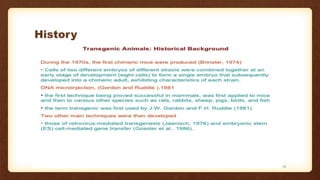
• The first transgenic animals were Rudolf Jaenisch’s
mice.
• In the 1970s he successfully introduced an outside
gene into the mice embryos.
• The first two commercially prepared products from
recombinant DNA technology were insulin and human
growth hormone, both of which were cultured in the E.
coli bacteria.
14
purpose
• These animals are useful in the production of
producing useful proteins in large animals
• Transgenic animals are animals that produce the
substance which are good for human welfare and
disease models
• Animals genetically manipulated to study the
symptoms of a disease.
for example. harvard mouse that carry genes that
promote the development of various human cancers.
15
Benefits of transgenic animals
1. Regulation of gene expression.
2. Immune system function
3. Genetic diseases
4. Viral diseases
5. Cancer research
6. Toxicological studies
7. Development of new entity
8. Beneficial for Pharmaceutical research
9. Transgenic animals as disease models
16
Negatives of transgenic animals
• Many animals die or are born horribly disfigured as
research is conducted.
• Transgenic animals can change the direction of
evolutions which can drastic consequences for human
and natures.
17
Methodes
1. Injection of DNA into the nucleus of a fertilized egg
cell and implanting it into the uterus (in vitro) of an
organism(microinjection method)
2. Injection of DNA into embryonic stem cells
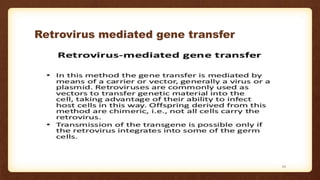
3. Using viruses to transfer gene by recombinanat DNA
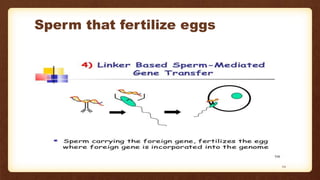
4. Introducing genetic material into sperm that fertilize
eggs
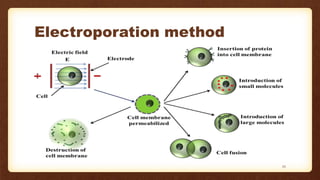
5. Electrically induced membrane fusion methode
18
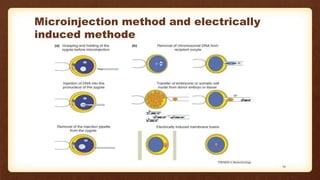
Microinjection method and electrically
induced methode
19
Microinjection methode
• transfer of a desired gene construct (of a single gene
or a combination of genes that are recombined and
then cloned) from another member of the same species
or from a different species into the pronucleus of a
reproductive cell
• in vitro culture of the manipulated cells to develop to a
specific embryonic phase; and 3) then transfer of the
embryonic cells to the recipient female
20
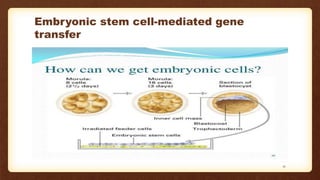
Embryonic stem cell-mediated gene
transfer
21
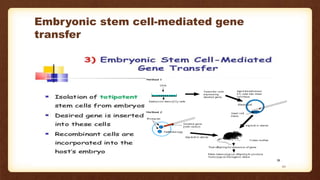
Embryonic stem cell-mediated gene
transfer
22
Retrovirus mediated gene transfer
23
Sperm that fertilize eggs
24
Electroporation method
25
Animal products that have appeared
on the market(all made in E.coli)
• Tumor necrosis factor:Treatment for certain tumor
cells.
• Interleukin-2 (IL-2):Cancer treatment, immune
deficiency, and HIV infection treatment.
• Prourokinase:Treatment for heart attacks.
• Taxol:Treatment for ovarian cancer.
• Interferon:Treatment for cancer and viral infections
26
Application of transgenic animals
In agricultural application:
1. Selective breeding applied to get desired traits i.e
high milk production and high growth rate.
2. Traditional breeding is a time-consuming, difficult
task.
3. Researchers have now used gene transfer to improve
the productivity of livestock.
4. Transgenic cows exist that produce more milk or milk
with less lactose or cholesterol. Transgenic cows
have been used to produce milk which are richer in
proteins and lower in fat.
27
Application of transgenic animals
• Quality Herman, a transgenic bull carries a human
gene for Lactoferrin (gene responsible for higher iron
content) Pigs and cattle that have more meat on them.
Sheep that grow more wool. Eggs can be made
healthier with high quality protein.
• Disease resistance Disease-resistant livestock is not a
reality just yet. But there has been improvement in
disease reduction in animals.
• Scientists are attempting to produce disease-resistant
animals, such as influenza-resistant pigs, but a very
limited number of genes are currently known to be
responsible for resistance to diseases in farm animals
28
Application of transgenic animals
Medical Applications:
1. Transplant organ may comes from transgenic animals.
2. Transgenic pigs may provide the transplant organs
needed to alleviate the shortfall.
3. Currently, xenotransplantation is hampered by a pig
protein that can cause donor rejection but research is
underway to remove the pig protein and replace it
with a human protein.
29
Application of transgenic animals
Medical applications:
1. Products such as insulin, growth hormone, and blood anti-
clotting factors may soon be or have already been obtained
from the milk of transgenic cows, sheep, or goats .
2. This transgenic milk is a more nutritionally balanced
product than natural milk and could be given to babies or
the elderly with special nutritional or digestive needs.
3. Human gene therapy involves adding a normal copy of a
gene (transgene) to the genome of a person carrying
defective copies of the gene. Finland produced a calf with
a gene that makes the substance that promotes the growth
of red cells in humans .
30
Application of transgenic animals
• Industrial Applications:
1. By extracting polymer strands from the milk and weaving them
into thread, the scientists can create a light, tough, flexible
material that could be used in such applications as military
uniforms, medical microsutures , and tennis racket strings .
2. Biosteel is an extraordinary new product that may be soon used
in bullet proof vests and in suture silk for stitching wounds.
3. Animals have been used as “Bioreactors” to produce proteins .
4. Toxicity-sensitive transgenic animals have been produced for
chemical safety testing.
5. Microorganisms have been engineered to produce a wide variety
of proteins, which in turn can produce enzymes that can speed
up industrial chemical reactions .
31
SOME IMPORTANT ADVANCES
• Few advances of transgenic animals.
1. US scientists report use of CRISPR to modify 60
genes in pig embryos in first step to creat pig organs
suitable for use in humans(HARVARD UNIVERSITY).
2. There is only one approved product in the world from
a GE animal. That product is called ATryn®, a human
pharmaceutical developed to prevent blood
clots. This drug is produced in the milk of GE goats
32
Problems and prospects
• Problems and prospects Transgenic animals have potentially
broad application for the improvement of animal production
quality, the enhancement of productivity, the studies of
human disease models and the production of
pharmaceuticals.
• Dietary and food safety concerns: Foreign gene inserted in
the chromosome locus may also result in different genetic
changes in different degrees, causing unintended effects.
• Environmental impacts: It may also lead to the loss of the
wild allele, resulting in a decline in genetic diversity
Respect for life and “unnaturalness” of genetic engineering:
it might devalue nature and commercialize life.
33
Conclusion
• Transgenic animal techniques have developed rapidly
and provided more and improved platforms for the
preparation of transgenic animals since their
emergence.
• All of these developments will provide new ideas and
bring forth important changes in fields like medicine,
health and livestock improvement. In particular, the
economic and social benefits from the production of
bioreactors, drug production, and organ culture for
human transplantation will be great.
34
References
• https://en.wikipedia.org.
• https://www.ncbi.nlm.nih.gov.
• European Journal of Pharmacology.
• http://whatisbiotechnology.org/science/transgenic.
• http://www.infoplease.com.
• http://www.fda.gov/AnimalVeterinary/DevelopmentAppro
valProcess/GeneticEn...
35
Thanks all
36

Transgenic animals (1)

  • 1.
  • 2.
    Transgenic Animals SUBMITTED BY JONAIDALI 8MARCH 2017 FACULTY OF FARMACY M.PHARM(PHARMACOLOGY 2ND SEM) JAMIA HAMDARD NEW DELHI
  • 3.
    Contents • Introduction • History •Animals enginnered • Purpose • Benefits of transgenic animals • Negatives of transgenic animals • Methods of transforming genes • Few commercial drugs • Application of transgenic animals • Some important advances • Problems and prospects • Conclusions • References 3
  • 4.
  • 5.
  • 6.
  • 7.
  • 8.
  • 9.
    The world's firstcloned camel 9
  • 10.
  • 11.
  • 12.
    Introductions • Transgenic animals: Anorganism whose genome is modified by foreign gene by using genetic engineering. • A large number of organism have been created successfully by genetic engineering such as: Cows,pigs,mice,sheep,fish,frogs,goats etc. • No. To date, FDA has not permitted GE animals to be placed into the human food supply except one Atryn. 12
  • 13.
  • 14.
    History • The firsttransgenic animals were Rudolf Jaenisch’s mice. • In the 1970s he successfully introduced an outside gene into the mice embryos. • The first two commercially prepared products from recombinant DNA technology were insulin and human growth hormone, both of which were cultured in the E. coli bacteria. 14
  • 15.
    purpose • These animalsare useful in the production of producing useful proteins in large animals • Transgenic animals are animals that produce the substance which are good for human welfare and disease models • Animals genetically manipulated to study the symptoms of a disease. for example. harvard mouse that carry genes that promote the development of various human cancers. 15
  • 16.
    Benefits of transgenicanimals 1. Regulation of gene expression. 2. Immune system function 3. Genetic diseases 4. Viral diseases 5. Cancer research 6. Toxicological studies 7. Development of new entity 8. Beneficial for Pharmaceutical research 9. Transgenic animals as disease models 16

  • 17.
    Negatives of transgenicanimals • Many animals die or are born horribly disfigured as research is conducted. • Transgenic animals can change the direction of evolutions which can drastic consequences for human and natures. 17
  • 18.
    Methodes 1. Injection ofDNA into the nucleus of a fertilized egg cell and implanting it into the uterus (in vitro) of an organism(microinjection method) 2. Injection of DNA into embryonic stem cells 3. Using viruses to transfer gene by recombinanat DNA 4. Introducing genetic material into sperm that fertilize eggs 5. Electrically induced membrane fusion methode 18
  • 19.
    Microinjection method andelectrically induced methode 19
  • 20.
    Microinjection methode • transferof a desired gene construct (of a single gene or a combination of genes that are recombined and then cloned) from another member of the same species or from a different species into the pronucleus of a reproductive cell • in vitro culture of the manipulated cells to develop to a specific embryonic phase; and 3) then transfer of the embryonic cells to the recipient female 20
  • 21.
  • 22.
  • 23.
  • 24.
  • 25.
  • 26.
    Animal products thathave appeared on the market(all made in E.coli) • Tumor necrosis factor:Treatment for certain tumor cells. • Interleukin-2 (IL-2):Cancer treatment, immune deficiency, and HIV infection treatment. • Prourokinase:Treatment for heart attacks. • Taxol:Treatment for ovarian cancer. • Interferon:Treatment for cancer and viral infections 26
  • 27.
    Application of transgenicanimals In agricultural application: 1. Selective breeding applied to get desired traits i.e high milk production and high growth rate. 2. Traditional breeding is a time-consuming, difficult task. 3. Researchers have now used gene transfer to improve the productivity of livestock. 4. Transgenic cows exist that produce more milk or milk with less lactose or cholesterol. Transgenic cows have been used to produce milk which are richer in proteins and lower in fat. 27
  • 28.
    Application of transgenicanimals • Quality Herman, a transgenic bull carries a human gene for Lactoferrin (gene responsible for higher iron content) Pigs and cattle that have more meat on them. Sheep that grow more wool. Eggs can be made healthier with high quality protein. • Disease resistance Disease-resistant livestock is not a reality just yet. But there has been improvement in disease reduction in animals. • Scientists are attempting to produce disease-resistant animals, such as influenza-resistant pigs, but a very limited number of genes are currently known to be responsible for resistance to diseases in farm animals 28
  • 29.
    Application of transgenicanimals Medical Applications: 1. Transplant organ may comes from transgenic animals. 2. Transgenic pigs may provide the transplant organs needed to alleviate the shortfall. 3. Currently, xenotransplantation is hampered by a pig protein that can cause donor rejection but research is underway to remove the pig protein and replace it with a human protein. 29
  • 30.
    Application of transgenicanimals Medical applications: 1. Products such as insulin, growth hormone, and blood anti- clotting factors may soon be or have already been obtained from the milk of transgenic cows, sheep, or goats . 2. This transgenic milk is a more nutritionally balanced product than natural milk and could be given to babies or the elderly with special nutritional or digestive needs. 3. Human gene therapy involves adding a normal copy of a gene (transgene) to the genome of a person carrying defective copies of the gene. Finland produced a calf with a gene that makes the substance that promotes the growth of red cells in humans . 30
  • 31.
    Application of transgenicanimals • Industrial Applications: 1. By extracting polymer strands from the milk and weaving them into thread, the scientists can create a light, tough, flexible material that could be used in such applications as military uniforms, medical microsutures , and tennis racket strings . 2. Biosteel is an extraordinary new product that may be soon used in bullet proof vests and in suture silk for stitching wounds. 3. Animals have been used as “Bioreactors” to produce proteins . 4. Toxicity-sensitive transgenic animals have been produced for chemical safety testing. 5. Microorganisms have been engineered to produce a wide variety of proteins, which in turn can produce enzymes that can speed up industrial chemical reactions . 31
  • 32.
    SOME IMPORTANT ADVANCES •Few advances of transgenic animals. 1. US scientists report use of CRISPR to modify 60 genes in pig embryos in first step to creat pig organs suitable for use in humans(HARVARD UNIVERSITY). 2. There is only one approved product in the world from a GE animal. That product is called ATryn®, a human pharmaceutical developed to prevent blood clots. This drug is produced in the milk of GE goats 32
  • 33.
    Problems and prospects •Problems and prospects Transgenic animals have potentially broad application for the improvement of animal production quality, the enhancement of productivity, the studies of human disease models and the production of pharmaceuticals. • Dietary and food safety concerns: Foreign gene inserted in the chromosome locus may also result in different genetic changes in different degrees, causing unintended effects. • Environmental impacts: It may also lead to the loss of the wild allele, resulting in a decline in genetic diversity Respect for life and “unnaturalness” of genetic engineering: it might devalue nature and commercialize life. 33
  • 34.
    Conclusion • Transgenic animaltechniques have developed rapidly and provided more and improved platforms for the preparation of transgenic animals since their emergence. • All of these developments will provide new ideas and bring forth important changes in fields like medicine, health and livestock improvement. In particular, the economic and social benefits from the production of bioreactors, drug production, and organ culture for human transplantation will be great. 34
  • 35.
    References • https://en.wikipedia.org. • https://www.ncbi.nlm.nih.gov. •European Journal of Pharmacology. • http://whatisbiotechnology.org/science/transgenic. • http://www.infoplease.com. • http://www.fda.gov/AnimalVeterinary/DevelopmentAppro valProcess/GeneticEn... 35
  • 36.