MBB611/607 MEDICAL
BIOTECHNOLOGY/APPLIED
BIOTECHNOLOGY
ASSIGNMENTAND SEMINARS
TOPIC2: TRANSGENIC ANIMALS
STUDENT NAME: BARAKA L NGINGO
MSC ONE HEALTH MOLECULAR BIOLOGY
REG NUMBER: MOH/D/2018/0041
INSTRUCTOR: PROF MACHANGU R
Outline
Introduction
Advantages and disadvantages
Examples of transgenic animals
Methods for production of transgenic animals
Application of transgenic animals
Issues related to transgenic animals
Conclusion
Introduction
Transgenic animals are one that carries a foreign gene that has
been purposely inserted into its genome by transgenesis.
The foreign gene is constructed using recombinant DNA
methodology
Foreign genes are inserted into the germ line not in somatic cells of
the animal.
Fishes, livestock and other animals with altered genetic profiles
which are useful to mankind have been developed.
History of transgenic animals
1970’s, first transgenic mice via viral infection, but not germline
transmission
1980’s, first transgenic mice via microinjection. The most popular
technique
1985, First transgenic rabbits, sheep, pigs and cattle
1980-1990, commercial transgenic services, via transgenic facility
1990’s, transgenic farm animal campanies as bioreactors and organ
donors
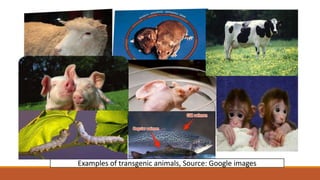
Examples of transgenic animals, Source: Google images
Advantages and disadvantages of
transgenic animals
Advantages:
•Increased growth rate.
•Improved disease resistance.
•Increased muscle mass.
•Improved nutritional quality.
•Improved wool quality.
Disadvantages:
• Inserted gene has multiple
functions.
• Breeding problems.
• Sometimes leads to
mutagenesis and functional
disorders.
• Low survival rate of transgenic
animals.
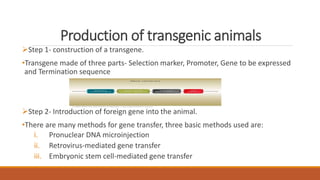
Production of transgenic animals
Step 1- construction of a transgene.
•Transgene made of three parts- Selection marker, Promoter, Gene to be expressed
and Termination sequence
Step 2- Introduction of foreign gene into the animal.
•There are many methods for gene transfer, three basic methods used are:
i. Pronuclear DNA microinjection
ii. Retrovirus-mediated gene transfer
iii. Embryonic stem cell-mediated gene transfer
Step 3 – Screening for transgenic positives.
•Transgenic progenies are screened by PCR to examine the site of
incorporation of the gene, use of selection marker and other DNA
techniques.
•Some transgenes may not be expressed if integrated into a
transcriptionally inactive site.
Step 4 – Further animal breeding is done to obtain maximal expression.
•Heterozygous offspring's homozygous strains are mated to form
homozygous offspring.
Method for gene transfer:
1. Pronuclear DNA Microinjection
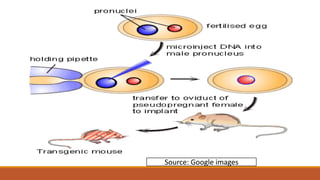
A female animal is super-ovulated, eggs are collected and fertilized
in vitro.
The transgene containing solution is injected into the male
pronucleus.
Eggs with the transgenes are kept overnight in an incubator to
develop to a specific embryonic phase.
The eggs are then implanted into the uterus of a pseudo pregnant
female.
The mouse was the first animal to undergo successful gene transfer
using DNA microinjection.
Source: Google images
Retrovirus-Mediated Gene Transfer
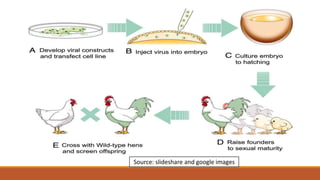
A retrovirus is a virus that carries its genetic material in the form of
RNA rather than DNA.
This involves transfer genetic material by retrovirus into the host
cell (4-16 cell stage embryos) forming chimera, an organism with
tissues or parts of diverse genetic composition.
Chimeras are inbred for many generations until homozygous
transgenic offspring are born
The method was successfully used in 1974, a simian virus was
inserted into mice embryos, resulting in mice carrying this DNA.
Source: slideshare and google images
Embryonic Stem Cell-Mediated Gene
Transfer
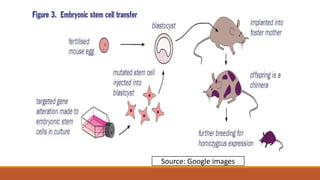
Transgenic animals can be created by manipulating embryonic
stem cells obtained from the inner cell mass of a blastocyst.
Transgene is incorporated into the ES cell by: microinjection,
retro virus and electroporation
Transgenic stem cells are grown in vitro and then inserted into a
blastocyst and implanted into a host’s uterus to grow normally.
This method allows testing for transgenes at the cell stage.
Source: Google images
Applications of transgenic animals
Are used for research and other studies such as gene
functions, disease model etc
Are used to amplify desired characteristics or products
which are beneficial to mankind.
Are used as food
Generally they are used in medicine, agriculture, and
industries as explained below
In medicine
i. Xenotransplantation
Transgenic pigs may provide the transplant organs needed to
alleviate the shortfall.
ii. Nutritional supplements and pharmaceuticals
Products such as insulin, growth hormone, and blood anti-clotting
factors can be obtained from the milk of transgenic cows, sheep, or
goats.
In medicine contd.
iii. Human gene therapy
Involves adding a normal copy of a gene (transgene) to the genome
of a person carrying defective copies of the gene. Transgenic animals
could play a role of making gene copies.
The potential for treatments for the 5,000 named genetic diseases
is huge and transgenic animals could play a role.
iv. Disease models
In agriculture
i. Increasing yields
Transgenesis made it possible to develop animals with traits like
increased milk production, high growth rate. Offering farmer an easy
way to increase yields.
ii. Quality
Transgenic cows exist that produce more milk or milk with less lactose
or cholesterol, pigs and cattle that have more meat on them, and sheep
that grow more wool.
iii. Disease resistance
iv. Biocontrol of plant diseases
In Industries
Toxicity-sensitive transgenic animals have been produced
for chemical safety testing.
Animals can be engineered to produce a wide variety of
proteins, which in turn can produce enzymes that can speed
up industrial chemical reactions.
 Manufacture Spider silk in milk of goat.
Used to test vaccines and drugs
Used as bioreactors
Issues related to transgenic animals
There may be biosafety issues or health risks associated
with transgenics.
There is ethical issues related to production of transgenic
animals
There may be long term effects on the environment when
transgenic animals are released into the field (loss of
biodiversity)
Conclusion
With proper research and careful considering bioethics
and biosafety, use the transgenic animals can go a long way
in solving several problems for which science doesn't have a
solution till now.
Example: emerging and re-emerging diseases and
antimicrobial resistance.
Transgenic animals can me used in studying pathogenesis,
diagnosis, treatment and even preventions
References
1. O. G. Maksimenko, A.V. Deykin, Yu. M. Khodarovich, and P. G.
Georgiev. Use of Transgenic Animals in Biotechnology: Prospects and
Problems. Acta Naturae. 2013 Jan-Mar; 5(1): 33–46.
2. Demain A.L., Vaishnav P.. Biotechnology Advances. 2009;27:297–
306. [PubMed] [Google Scholar]
3. Houdebine LM. Production of pharmaceutical proteins
by transgenic animals. Comp Immunol Microbiol Infect Dis. 2009
Mar;32(2):107-21. doi: 10.1016/j.cimid.2007.11.005. Epub 2008 Feb
19.

MBB611 Transgenic animals

  • 1.
    MBB611/607 MEDICAL BIOTECHNOLOGY/APPLIED BIOTECHNOLOGY ASSIGNMENTAND SEMINARS TOPIC2:TRANSGENIC ANIMALS STUDENT NAME: BARAKA L NGINGO MSC ONE HEALTH MOLECULAR BIOLOGY REG NUMBER: MOH/D/2018/0041 INSTRUCTOR: PROF MACHANGU R
  • 2.
    Outline Introduction Advantages and disadvantages Examplesof transgenic animals Methods for production of transgenic animals Application of transgenic animals Issues related to transgenic animals Conclusion
  • 3.
    Introduction Transgenic animals areone that carries a foreign gene that has been purposely inserted into its genome by transgenesis. The foreign gene is constructed using recombinant DNA methodology Foreign genes are inserted into the germ line not in somatic cells of the animal. Fishes, livestock and other animals with altered genetic profiles which are useful to mankind have been developed.
  • 4.
    History of transgenicanimals 1970’s, first transgenic mice via viral infection, but not germline transmission 1980’s, first transgenic mice via microinjection. The most popular technique 1985, First transgenic rabbits, sheep, pigs and cattle 1980-1990, commercial transgenic services, via transgenic facility 1990’s, transgenic farm animal campanies as bioreactors and organ donors
  • 5.
    Examples of transgenicanimals, Source: Google images
  • 6.
    Advantages and disadvantagesof transgenic animals Advantages: •Increased growth rate. •Improved disease resistance. •Increased muscle mass. •Improved nutritional quality. •Improved wool quality. Disadvantages: • Inserted gene has multiple functions. • Breeding problems. • Sometimes leads to mutagenesis and functional disorders. • Low survival rate of transgenic animals.
  • 7.
    Production of transgenicanimals Step 1- construction of a transgene. •Transgene made of three parts- Selection marker, Promoter, Gene to be expressed and Termination sequence Step 2- Introduction of foreign gene into the animal. •There are many methods for gene transfer, three basic methods used are: i. Pronuclear DNA microinjection ii. Retrovirus-mediated gene transfer iii. Embryonic stem cell-mediated gene transfer
  • 8.
    Step 3 –Screening for transgenic positives. •Transgenic progenies are screened by PCR to examine the site of incorporation of the gene, use of selection marker and other DNA techniques. •Some transgenes may not be expressed if integrated into a transcriptionally inactive site. Step 4 – Further animal breeding is done to obtain maximal expression. •Heterozygous offspring's homozygous strains are mated to form homozygous offspring.
  • 9.
    Method for genetransfer: 1. Pronuclear DNA Microinjection A female animal is super-ovulated, eggs are collected and fertilized in vitro. The transgene containing solution is injected into the male pronucleus. Eggs with the transgenes are kept overnight in an incubator to develop to a specific embryonic phase. The eggs are then implanted into the uterus of a pseudo pregnant female. The mouse was the first animal to undergo successful gene transfer using DNA microinjection.
  • 10.
  • 11.
    Retrovirus-Mediated Gene Transfer Aretrovirus is a virus that carries its genetic material in the form of RNA rather than DNA. This involves transfer genetic material by retrovirus into the host cell (4-16 cell stage embryos) forming chimera, an organism with tissues or parts of diverse genetic composition. Chimeras are inbred for many generations until homozygous transgenic offspring are born The method was successfully used in 1974, a simian virus was inserted into mice embryos, resulting in mice carrying this DNA.
  • 12.
  • 13.
    Embryonic Stem Cell-MediatedGene Transfer Transgenic animals can be created by manipulating embryonic stem cells obtained from the inner cell mass of a blastocyst. Transgene is incorporated into the ES cell by: microinjection, retro virus and electroporation Transgenic stem cells are grown in vitro and then inserted into a blastocyst and implanted into a host’s uterus to grow normally. This method allows testing for transgenes at the cell stage.
  • 14.
  • 15.
    Applications of transgenicanimals Are used for research and other studies such as gene functions, disease model etc Are used to amplify desired characteristics or products which are beneficial to mankind. Are used as food Generally they are used in medicine, agriculture, and industries as explained below
  • 16.
    In medicine i. Xenotransplantation Transgenicpigs may provide the transplant organs needed to alleviate the shortfall. ii. Nutritional supplements and pharmaceuticals Products such as insulin, growth hormone, and blood anti-clotting factors can be obtained from the milk of transgenic cows, sheep, or goats.
  • 17.
    In medicine contd. iii.Human gene therapy Involves adding a normal copy of a gene (transgene) to the genome of a person carrying defective copies of the gene. Transgenic animals could play a role of making gene copies. The potential for treatments for the 5,000 named genetic diseases is huge and transgenic animals could play a role. iv. Disease models
  • 18.
    In agriculture i. Increasingyields Transgenesis made it possible to develop animals with traits like increased milk production, high growth rate. Offering farmer an easy way to increase yields. ii. Quality Transgenic cows exist that produce more milk or milk with less lactose or cholesterol, pigs and cattle that have more meat on them, and sheep that grow more wool. iii. Disease resistance iv. Biocontrol of plant diseases
  • 19.
    In Industries Toxicity-sensitive transgenicanimals have been produced for chemical safety testing. Animals can be engineered to produce a wide variety of proteins, which in turn can produce enzymes that can speed up industrial chemical reactions.  Manufacture Spider silk in milk of goat. Used to test vaccines and drugs Used as bioreactors
  • 20.
    Issues related totransgenic animals There may be biosafety issues or health risks associated with transgenics. There is ethical issues related to production of transgenic animals There may be long term effects on the environment when transgenic animals are released into the field (loss of biodiversity)
  • 21.
    Conclusion With proper researchand careful considering bioethics and biosafety, use the transgenic animals can go a long way in solving several problems for which science doesn't have a solution till now. Example: emerging and re-emerging diseases and antimicrobial resistance. Transgenic animals can me used in studying pathogenesis, diagnosis, treatment and even preventions
  • 22.
    References 1. O. G.Maksimenko, A.V. Deykin, Yu. M. Khodarovich, and P. G. Georgiev. Use of Transgenic Animals in Biotechnology: Prospects and Problems. Acta Naturae. 2013 Jan-Mar; 5(1): 33–46. 2. Demain A.L., Vaishnav P.. Biotechnology Advances. 2009;27:297– 306. [PubMed] [Google Scholar] 3. Houdebine LM. Production of pharmaceutical proteins by transgenic animals. Comp Immunol Microbiol Infect Dis. 2009 Mar;32(2):107-21. doi: 10.1016/j.cimid.2007.11.005. Epub 2008 Feb 19.