NEUROSTEROIDS AND NEUROPEPTIDES
PRESENTED BY
Jonaid Ali(2ndSem)
Faculty Of Pharmacy
M.pharm(pharmacology)
Jamia Hamdard(New Delhi)
Date 6March 2017
Contents
▪ Introduction
▪ History
▪ Classifications and mechanism
▪ Biosynthesis
▪ Functions
▪ Therapeutic applications
▪ Recent
▪ References
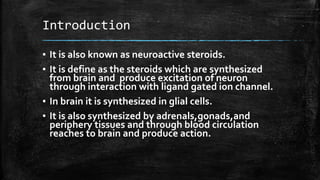
Introduction
▪ It is also known as neuroactive steroids.
▪ It is define as the steroids which are synthesized
from brain and produce excitation of neuron
through interaction with ligand gated ion channel.
▪ In brain it is synthesized in glial cells.
▪ It is also synthesized by adrenals,gonads,and
periphery tissues and through blood circulation
reaches to brain and produce action.
History
▪ Neurosteroid term was coined by French
physiologist Étienne-Émile Baulieu.
▪ physiologist Étienne-Émile Baulieu in 1981
found that brain can itself produce steroids.
▪ The term neuroactive steroid was first
coined in 1992 by Steven Paul and Robert
Purdy.
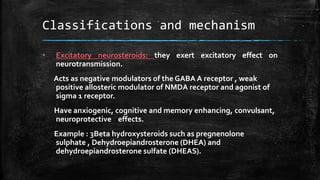
Classifications and mechanism
• Excitatory neurosteroids: they exert excitatory effect on
neurotransmission.
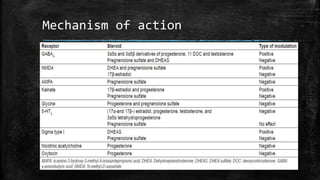
Acts as negative modulators of the GABA A receptor , weak
positive allosteric modulator of NMDA receptor and agonist of
sigma 1 receptor.
Have anxiogenic, cognitive and memory enhancing, convulsant,
neuroprotective effects.
Example : 3Beta hydroxysteroids such as pregnenolone
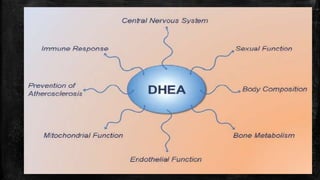
sulphate , Dehydroepiandrosterone (DHEA) and
dehydroepiandrosterone sulfate (DHEAS).
Classifications and mechanism
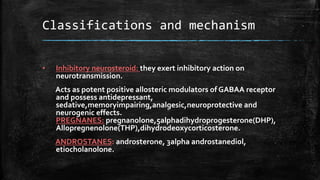
• Inhibitory neurosteroid: they exert inhibitory action on
neurotransmission.
Acts as potent positive allosteric modulators of GABAA receptor
and possess antidepressant,
sedative,memoryimpairing,analgesic,neuroprotective and
neurogenic effects.
PREGNANES: pregnanolone,5alphadihydroprogesterone(DHP),
Allopregnenolone(THP),dihydrodeoxycorticosterone.
ANDROSTANES: androsterone, 3alpha androstanediol,
etiocholanolone.
Classifications and mechanism
▪ OTHER NEUROSTEROIDS
• Endogenous steroids such as pregnenolone,
progesterone,estradiolase are also neurosteroids.
• They do not modulate GABA A or NMDA receptors instead they
affects cell surface receptors and non genomic targets.
Mechanism of action
Biosynthesis
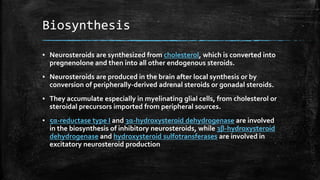
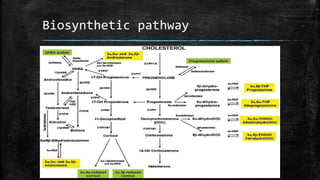
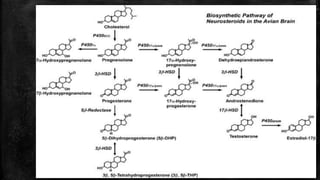
▪ Neurosteroids are synthesized from cholesterol, which is converted into
pregnenolone and then into all other endogenous steroids.
▪ Neurosteroids are produced in the brain after local synthesis or by
conversion of peripherally-derived adrenal steroids or gonadal steroids.
▪ They accumulate especially in myelinating glial cells, from cholesterol or
steroidal precursors imported from peripheral sources.
▪ 5α-reductase type I and 3α-hydroxysteroid dehydrogenase are involved
in the biosynthesis of inhibitory neurosteroids, while 3β-hydroxysteroid
dehydrogenase and hydroxysteroid sulfotransferases are involved in
excitatory neurosteroid production
Biosynthesis
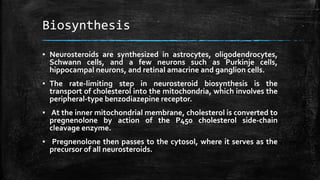
▪ Neurosteroids are synthesized in astrocytes, oligodendrocytes,
Schwann cells, and a few neurons such as Purkinje cells,
hippocampal neurons, and retinal amacrine and ganglion cells.
▪ The rate-limiting step in neurosteroid biosynthesis is the
transport of cholesterol into the mitochondria, which involves the
peripheral-type benzodiazepine receptor.
▪ At the inner mitochondrial membrane, cholesterol is converted to
pregnenolone by action of the P450 cholesterol side-chain
cleavage enzyme.
▪ Pregnenolone then passes to the cytosol, where it serves as the
precursor of all neurosteroids.
Biosynthetic pathway
Functions
▪ Modulation of neural plasticity, learning,memory
processes,behavior seizure, responses to stress,anxiety
and depression.
▪ changes in neurosteroid levels may be involved in the
changes in mood, anxiety, and sexual desire that occur
during puberty in both sexes and during menopause in
women.
▪ Elevated levels of inhibitory neurosteroids, namely
allopregnanolone, can produce paradoxical effects, such
as negative mood, anxiety, irritability, and aggression
Functions
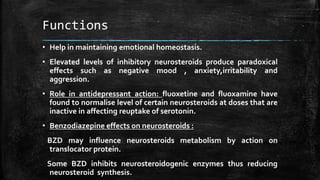
• Help in maintaining emotional homeostasis.
• Elevated levels of inhibitory neurosteroids produce paradoxical
effects such as negative mood , anxiety,irritability and
aggression.
• Role in antidepressant action: fluoxetine and fluoxamine have
found to normalise level of certain neurosteroids at doses that are
inactive in affecting reuptake of serotonin.
• Benzodiazepine effects on neurosteroids :
BZD may influence neurosteroids metabolism by action on
translocator protein.
Some BZD inhibits neurosteroidogenic enzymes thus reducing
neurosteroid synthesis.
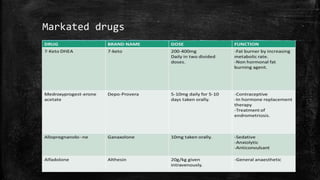
Markated drugs
Therapeutic uses
▪ Several synthetic neurosteroids have been used as sedatives for
the purpose of general anaesthesia for carrying out surgical
procedures.The best known of these are alphaxolone,
alphadolone, hydroxydione, and minaxolone.
▪ The neurosteroid ganaxolone, an analog of the progesterone
metabolite allopregnanolone, has been extensively investigated
in animal models and is currently in clinical trials for the treatment
of epilepsy.
▪ way of treating catamenial epilepsy with neuroactive steroids
such as ganaxolone during the period of the menstrual cycle when
seizure frequency increases
Recent finding
• Both glial cells and neurons participate in
neurosteroid biosynthesis and metabolism.
• Additional unexpected mechanism of neurosteroid
action is: pregnenolone binds to neural microtubule
associated protein of type 2 (MAP2) and increase the
rate and extent of tubulin polymerisation.
• This play a role in regulating microtubule formation
and thus neuronal plasticity and function.
Recent finding
▪ Extrasynaptic GABA-A receptors are emerging as
novel targets for epilepsy, pain, insomnia, and
mood disorders. Neurosteroids activate

extrasynaptic GABA-A receptor function and thus
are attractive therapeutic agents.
▪ Clinical trials are currently assessing
neurosteroids for the treatment of diverse CNS
disorders, such as epilepsy, SE, FXS,TBI, and
Alzheimer's disease.
Introduction(NEUROPEPTIDE)
▪ Neuropeptides are small protein-like molecules (peptides) used by
neurons to communicate with each other.
▪ They are neuronal signaling molecules that influence the activity of
the brain and the body in specific ways.
▪ Different neuropeptides are involved in a wide range of brain
functions, including analgesia, reward, food intake, metabolism,
reproduction, social behaviors, learning and memory.
▪ Neuropeptides are secreted from neuronal cells (primarily neurons
but also glia for some peptides) and signal to neighboring cells
(primarily neurons)
▪ The human genome contains about 90 genes that encode precursors
of neuropeptides.
Cont…
 Neurotransmitters consisting of 3-40 amino acids are known
as neuropeptides.
 Widely spread in the central nervous system and the
peripheral nervous system.
 Have both excitatory and inhibitory actions and work in a
similar way to neurotransmitters.
 Many neuropeptides also work as hormones in other parts of
the body.
Endorphins: discovered in 1975 by Dr.John Hughes and Dr.
Kosterlitz.
 Have a role in memory and learning; sexual activity, and
control of body temperature.
Classifications
▪ Hypthalamic releasing factors.
1. CRH:corticosteroid releasing harmone.
2. GHRH:growth harmone releasing harmone.
3. GNRH:gonadotropin releasing harmone.
4. SOMATOSTATIN
5. TRH:thyroid releasing harmone.
Cont…
▪ Pituitary hormones.
1. ACTH: adrenocorticotropic hormone.
2. αMSH: α-melanocyte stimulating hormone.
3. β-endorphin.
4. GH: growth hormone.
5. PRL: prolactin.
6. FSH: follicle stimulating hormone.
7. LH: luteinizing hormone.
8. TSH: thyrotropin .
Cont…
▪ Opiate peptidase.
1. β-endorphin
2. Dynorphin
3. Leu-encephalin
4. Met-encephalin
Cont…
▪ Neurohypophyseal peptides
1. Oxitocin
2. Vassopressin
▪ Neuronal and endocrine peptides
1. ANF: atrial natriuretic peptide
2. CGRP: calcitonin gene-related peptide
3. VIP: vasoactive intestinal peptide
Cont…
▪ Circulating peptides
1. Angiotensin
2. Bradykinin
▪ GI and brain peptides
1. CCK: cholecystokinin
2. Gastrin
3. GRP:gastrin releasing factor
4. Motilin
5. Neurotensin
6. Substance k and substance p
Cont…
▪ GI and pancreas peptides
1. Glucagon
2. PP: pancreatic polypeptide
▪ Neurons only peptides
1. Galanin
2. Neuromedin K
3. NeuropeptideY
4. PYY: peptideYY
Cont…
▪ Endocrine only peptides
1. Calcitonin
2. Insulin
3. Secretin
4. Parathyroid hormone
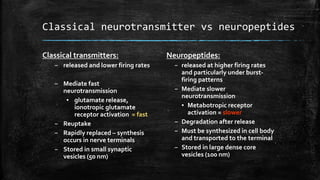
Classical neurotransmitter vs neuropeptides
Classical transmitters:
– released and lower firing rates
– Mediate fast
neurotransmission
▪ glutamate release,
ionotropic glutamate
receptor activation = fast
– Reuptake
– Rapidly replaced – synthesis
occurs in nerve terminals
– Stored in small synaptic
vesicles (50 nm)
Neuropeptides:
– released at higher firing rates
and particularly under burst-
firing patterns
– Mediate slower
neurotransmission
▪ Metabotropic receptor
activation = slower
– Degradation after release
– Must be synthesized in cell body
and transported to the terminal
– Stored in large dense core
vesicles (100 nm)
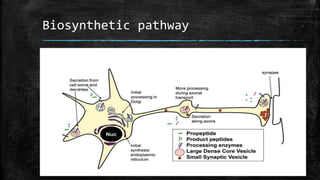
Biosynthetic pathway
Functions
▪ Control our mood, energy levels, pain and
pleasure reception, body weight, and ability
to solve problems
▪ they also form memories and regulate our
immune system.
Clinical application
Recent developments
Transgenic Mice Overexpressing NeuropeptideY in Noradrenergic Neurons: A Novel Model of
Increased Adiposity and Impaired GlucoseTolerance
SuviT. Ruohonen, MS1,,4, Ullamari Pesonen, PhD1, Niko Moritz, PhD2, Katja Kaipio, MS1,,4,
Matias Röyttä, MD, PhD3, Markku Koulu, MD, PhD1, and Eriika Savontaus, MD, PhD1,,5
1Department of Pharmacology, Drug Development andTherapeutics
2Department of Orthopedics andTraumatology
From 3Department of Pathology and
4Drug Discovery Graduate School, University ofTurku and
5Clinical Pharmacology,TYKSLAB, Health Care District of Southwest Finland,
Finland significantly increased in comparison with wildtype mice.
Conclusions:The present study shows that even a moderate increase in NPY levels in
noradrenergic neurons leads to disturbances in glucose and lipid metabolism.The OE-
NPYDβH mouse is an interesting new model to investigate the pathophysiology of some key
components of the cluster of abnormalities characterizing the metabolic syndrome.
References
▪ www.wikipedia.org/wiki/Neuroactivesteroid
▪ Paul SM, Purdy RH (Mar 1992). "Neuroactive steroids" (abstract).
FASEB Journal. 6 (6): 2311–22.
▪ Patte-Mensah C, Meyer L,Taleb O, Mensah-Nyagan AG (Feb 2014).
"Potential role of allopregnanolone for a safe and effective therapy
of neuropathic pain". Progress in Neurobiology. 113: 70–8.
▪ www.ncbi.nlm.nih.gov/pubmed/21094889.
▪ Frye CA (December 2009). "Neurosteroids effects and mechanisms
for social, cognitive, emotional,
andphysicalfunctions”Psychoneuroendocrinology.
References
▪ http://www.biosyn.com/TEW/Neuropeptides-and-their-
classification.
▪ Neuropeptides and Other Bioactive Peptides: From Discovery to
Function, L.D.Fricker, Morgan & Claypool Publishers, 2012
▪ database of all neuropetides.
▪ Rang & dale pharmacology 7th ed
▪ Basic & Clinical Pharmacology 12th edition by Bertram G.
Katzung,Susan B. Masters & Anthony J.Trevor
▪ Goodman & Gilman’s Pharmacological basis of therapeutics 12th
edition

Neurosteroids and neuropeptides

  • 1.
    NEUROSTEROIDS AND NEUROPEPTIDES PRESENTEDBY Jonaid Ali(2ndSem) Faculty Of Pharmacy M.pharm(pharmacology) Jamia Hamdard(New Delhi) Date 6March 2017
  • 2.
    Contents ▪ Introduction ▪ History ▪Classifications and mechanism ▪ Biosynthesis ▪ Functions ▪ Therapeutic applications ▪ Recent ▪ References
  • 3.
    Introduction ▪ It isalso known as neuroactive steroids. ▪ It is define as the steroids which are synthesized from brain and produce excitation of neuron through interaction with ligand gated ion channel. ▪ In brain it is synthesized in glial cells. ▪ It is also synthesized by adrenals,gonads,and periphery tissues and through blood circulation reaches to brain and produce action.
  • 4.
    History ▪ Neurosteroid termwas coined by French physiologist Étienne-Émile Baulieu. ▪ physiologist Étienne-Émile Baulieu in 1981 found that brain can itself produce steroids. ▪ The term neuroactive steroid was first coined in 1992 by Steven Paul and Robert Purdy.
  • 5.
    Classifications and mechanism •Excitatory neurosteroids: they exert excitatory effect on neurotransmission. Acts as negative modulators of the GABA A receptor , weak positive allosteric modulator of NMDA receptor and agonist of sigma 1 receptor. Have anxiogenic, cognitive and memory enhancing, convulsant, neuroprotective effects. Example : 3Beta hydroxysteroids such as pregnenolone sulphate , Dehydroepiandrosterone (DHEA) and dehydroepiandrosterone sulfate (DHEAS).
  • 6.
    Classifications and mechanism •Inhibitory neurosteroid: they exert inhibitory action on neurotransmission. Acts as potent positive allosteric modulators of GABAA receptor and possess antidepressant, sedative,memoryimpairing,analgesic,neuroprotective and neurogenic effects. PREGNANES: pregnanolone,5alphadihydroprogesterone(DHP), Allopregnenolone(THP),dihydrodeoxycorticosterone. ANDROSTANES: androsterone, 3alpha androstanediol, etiocholanolone.
  • 7.
    Classifications and mechanism ▪OTHER NEUROSTEROIDS • Endogenous steroids such as pregnenolone, progesterone,estradiolase are also neurosteroids. • They do not modulate GABA A or NMDA receptors instead they affects cell surface receptors and non genomic targets.
  • 8.
  • 9.
    Biosynthesis ▪ Neurosteroids aresynthesized from cholesterol, which is converted into pregnenolone and then into all other endogenous steroids. ▪ Neurosteroids are produced in the brain after local synthesis or by conversion of peripherally-derived adrenal steroids or gonadal steroids. ▪ They accumulate especially in myelinating glial cells, from cholesterol or steroidal precursors imported from peripheral sources. ▪ 5α-reductase type I and 3α-hydroxysteroid dehydrogenase are involved in the biosynthesis of inhibitory neurosteroids, while 3β-hydroxysteroid dehydrogenase and hydroxysteroid sulfotransferases are involved in excitatory neurosteroid production
  • 10.
    Biosynthesis ▪ Neurosteroids aresynthesized in astrocytes, oligodendrocytes, Schwann cells, and a few neurons such as Purkinje cells, hippocampal neurons, and retinal amacrine and ganglion cells. ▪ The rate-limiting step in neurosteroid biosynthesis is the transport of cholesterol into the mitochondria, which involves the peripheral-type benzodiazepine receptor. ▪ At the inner mitochondrial membrane, cholesterol is converted to pregnenolone by action of the P450 cholesterol side-chain cleavage enzyme. ▪ Pregnenolone then passes to the cytosol, where it serves as the precursor of all neurosteroids.
  • 11.
  • 13.
    Functions ▪ Modulation ofneural plasticity, learning,memory processes,behavior seizure, responses to stress,anxiety and depression. ▪ changes in neurosteroid levels may be involved in the changes in mood, anxiety, and sexual desire that occur during puberty in both sexes and during menopause in women. ▪ Elevated levels of inhibitory neurosteroids, namely allopregnanolone, can produce paradoxical effects, such as negative mood, anxiety, irritability, and aggression
  • 14.
    Functions • Help inmaintaining emotional homeostasis. • Elevated levels of inhibitory neurosteroids produce paradoxical effects such as negative mood , anxiety,irritability and aggression. • Role in antidepressant action: fluoxetine and fluoxamine have found to normalise level of certain neurosteroids at doses that are inactive in affecting reuptake of serotonin. • Benzodiazepine effects on neurosteroids : BZD may influence neurosteroids metabolism by action on translocator protein. Some BZD inhibits neurosteroidogenic enzymes thus reducing neurosteroid synthesis.
  • 16.
  • 17.
    Therapeutic uses ▪ Severalsynthetic neurosteroids have been used as sedatives for the purpose of general anaesthesia for carrying out surgical procedures.The best known of these are alphaxolone, alphadolone, hydroxydione, and minaxolone. ▪ The neurosteroid ganaxolone, an analog of the progesterone metabolite allopregnanolone, has been extensively investigated in animal models and is currently in clinical trials for the treatment of epilepsy. ▪ way of treating catamenial epilepsy with neuroactive steroids such as ganaxolone during the period of the menstrual cycle when seizure frequency increases
  • 18.
    Recent finding • Bothglial cells and neurons participate in neurosteroid biosynthesis and metabolism. • Additional unexpected mechanism of neurosteroid action is: pregnenolone binds to neural microtubule associated protein of type 2 (MAP2) and increase the rate and extent of tubulin polymerisation. • This play a role in regulating microtubule formation and thus neuronal plasticity and function.
  • 19.
    Recent finding ▪ ExtrasynapticGABA-A receptors are emerging as novel targets for epilepsy, pain, insomnia, and mood disorders. Neurosteroids activate extrasynaptic GABA-A receptor function and thus are attractive therapeutic agents. ▪ Clinical trials are currently assessing neurosteroids for the treatment of diverse CNS disorders, such as epilepsy, SE, FXS,TBI, and Alzheimer's disease.
  • 20.
    Introduction(NEUROPEPTIDE) ▪ Neuropeptides aresmall protein-like molecules (peptides) used by neurons to communicate with each other. ▪ They are neuronal signaling molecules that influence the activity of the brain and the body in specific ways. ▪ Different neuropeptides are involved in a wide range of brain functions, including analgesia, reward, food intake, metabolism, reproduction, social behaviors, learning and memory. ▪ Neuropeptides are secreted from neuronal cells (primarily neurons but also glia for some peptides) and signal to neighboring cells (primarily neurons) ▪ The human genome contains about 90 genes that encode precursors of neuropeptides.
  • 21.
    Cont…  Neurotransmitters consistingof 3-40 amino acids are known as neuropeptides.  Widely spread in the central nervous system and the peripheral nervous system.  Have both excitatory and inhibitory actions and work in a similar way to neurotransmitters.  Many neuropeptides also work as hormones in other parts of the body. Endorphins: discovered in 1975 by Dr.John Hughes and Dr. Kosterlitz.  Have a role in memory and learning; sexual activity, and control of body temperature.
  • 22.
    Classifications ▪ Hypthalamic releasingfactors. 1. CRH:corticosteroid releasing harmone. 2. GHRH:growth harmone releasing harmone. 3. GNRH:gonadotropin releasing harmone. 4. SOMATOSTATIN 5. TRH:thyroid releasing harmone.
  • 23.
    Cont… ▪ Pituitary hormones. 1.ACTH: adrenocorticotropic hormone. 2. αMSH: α-melanocyte stimulating hormone. 3. β-endorphin. 4. GH: growth hormone. 5. PRL: prolactin. 6. FSH: follicle stimulating hormone. 7. LH: luteinizing hormone. 8. TSH: thyrotropin .
  • 24.
    Cont… ▪ Opiate peptidase. 1.β-endorphin 2. Dynorphin 3. Leu-encephalin 4. Met-encephalin
  • 25.
    Cont… ▪ Neurohypophyseal peptides 1.Oxitocin 2. Vassopressin ▪ Neuronal and endocrine peptides 1. ANF: atrial natriuretic peptide 2. CGRP: calcitonin gene-related peptide 3. VIP: vasoactive intestinal peptide
  • 26.
    Cont… ▪ Circulating peptides 1.Angiotensin 2. Bradykinin ▪ GI and brain peptides 1. CCK: cholecystokinin 2. Gastrin 3. GRP:gastrin releasing factor 4. Motilin 5. Neurotensin 6. Substance k and substance p
  • 27.
    Cont… ▪ GI andpancreas peptides 1. Glucagon 2. PP: pancreatic polypeptide ▪ Neurons only peptides 1. Galanin 2. Neuromedin K 3. NeuropeptideY 4. PYY: peptideYY
  • 28.
    Cont… ▪ Endocrine onlypeptides 1. Calcitonin 2. Insulin 3. Secretin 4. Parathyroid hormone
  • 29.
    Classical neurotransmitter vsneuropeptides Classical transmitters: – released and lower firing rates – Mediate fast neurotransmission ▪ glutamate release, ionotropic glutamate receptor activation = fast – Reuptake – Rapidly replaced – synthesis occurs in nerve terminals – Stored in small synaptic vesicles (50 nm) Neuropeptides: – released at higher firing rates and particularly under burst- firing patterns – Mediate slower neurotransmission ▪ Metabotropic receptor activation = slower – Degradation after release – Must be synthesized in cell body and transported to the terminal – Stored in large dense core vesicles (100 nm)
  • 30.
  • 31.
    Functions ▪ Control ourmood, energy levels, pain and pleasure reception, body weight, and ability to solve problems ▪ they also form memories and regulate our immune system.
  • 32.
  • 33.
    Recent developments Transgenic MiceOverexpressing NeuropeptideY in Noradrenergic Neurons: A Novel Model of Increased Adiposity and Impaired GlucoseTolerance SuviT. Ruohonen, MS1,,4, Ullamari Pesonen, PhD1, Niko Moritz, PhD2, Katja Kaipio, MS1,,4, Matias Röyttä, MD, PhD3, Markku Koulu, MD, PhD1, and Eriika Savontaus, MD, PhD1,,5 1Department of Pharmacology, Drug Development andTherapeutics 2Department of Orthopedics andTraumatology From 3Department of Pathology and 4Drug Discovery Graduate School, University ofTurku and 5Clinical Pharmacology,TYKSLAB, Health Care District of Southwest Finland, Finland significantly increased in comparison with wildtype mice. Conclusions:The present study shows that even a moderate increase in NPY levels in noradrenergic neurons leads to disturbances in glucose and lipid metabolism.The OE- NPYDβH mouse is an interesting new model to investigate the pathophysiology of some key components of the cluster of abnormalities characterizing the metabolic syndrome.
  • 34.
    References ▪ www.wikipedia.org/wiki/Neuroactivesteroid ▪ PaulSM, Purdy RH (Mar 1992). "Neuroactive steroids" (abstract). FASEB Journal. 6 (6): 2311–22. ▪ Patte-Mensah C, Meyer L,Taleb O, Mensah-Nyagan AG (Feb 2014). "Potential role of allopregnanolone for a safe and effective therapy of neuropathic pain". Progress in Neurobiology. 113: 70–8. ▪ www.ncbi.nlm.nih.gov/pubmed/21094889. ▪ Frye CA (December 2009). "Neurosteroids effects and mechanisms for social, cognitive, emotional, andphysicalfunctions”Psychoneuroendocrinology.
  • 35.
    References ▪ http://www.biosyn.com/TEW/Neuropeptides-and-their- classification. ▪ Neuropeptidesand Other Bioactive Peptides: From Discovery to Function, L.D.Fricker, Morgan & Claypool Publishers, 2012 ▪ database of all neuropetides. ▪ Rang & dale pharmacology 7th ed ▪ Basic & Clinical Pharmacology 12th edition by Bertram G. Katzung,Susan B. Masters & Anthony J.Trevor ▪ Goodman & Gilman’s Pharmacological basis of therapeutics 12th edition