CELL CULTURE AND ITS
MAINTENANCE:
MADE BY:
VIPIN KUMAR SHUKLA
DEPARTMENT OF BIOTECHNOLOGY.
HIMT GROUP OF INSTITUTIONS , GREATER NOIDA UTTAR PRADESH
CONTENTS:
• CELL LINES
• TYPES OF TISSUE CULTURES
• PRIMARY TISSUE CULTURES
• CONTINOUS CELL LINES
• CELL TYPES
• HUMAN CELL LINES
• ANIMAL CELL LINES
• APPLICATIONS
CELL LINES:
• It is defined as permanently established cell culture
that will proliferated indefinitely given appropriate
fresh medium and space.
• Cell line defined as the culture developed from single
cell and therefore it consisting of cell with a uniform
genetic make up.
• Cell lines shows a presence of cell linkage either
similar or distinct.
• In this culture stem cells are generally used.
CONTD…..
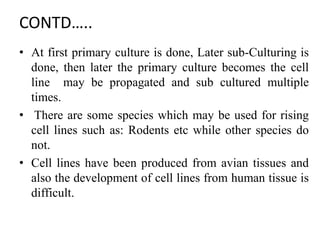
• At first primary culture is done, Later sub-Culturing is
done, then later the primary culture becomes the cell
line may be propagated and sub cultured multiple
times.
• There are some species which may be used for rising
cell lines such as: Rodents etc while other species do
not.
• Cell lines have been produced from avian tissues and
also the development of cell lines from human tissue is
difficult.
TYPES OF TISSUE CULTURE:
PRIMARY CONTINOUS
FINITE CELL
LINES
IN-DEFINATE
Normal cells
cultured without any
change in their
division rate.
Single type roughly, thirty times
of division enhanced by growth.
It is near the same as
finite but the cells here
can divide indefinitely
by transformation into
tumor cells, called Cell
Lines.
PRIMARY CONTINOUS
CELL LINE:
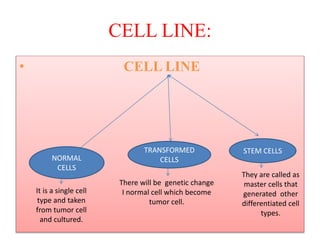
• CELL LINE
NORMAL
TRANSFORMED
STEM CELLS
It is a single cell
type and taken
from tumor cell
and cultured.
There will be genetic change
I normal cell which become
tumor cell.
They are called as
master cells that
generated other
differentiated cell
types.
NORMAL
CELLS
TRANSFORMED
CELLS
STEM CELLS
PRIMARY CULTURE:
• Primary culture is defined as a culture were cells are
removed enzymatically and surgically from an organism
and later placed into a suitable culture medium that will
attach and grow are called as primary culture.
• These primary culture have a finite life span.
• These cultures contain a heterogeneous population of
cells.
Contd…..
• Sub culturing of primary cells leads to the generation
of cell lines.
• Cell lines have limited life span, they passage several
times before they become senescent.
• Cells such as Macrophages and neurons do not divide
in-vitro can be used as primary cultures.
CONTINOUS CELL LINES:
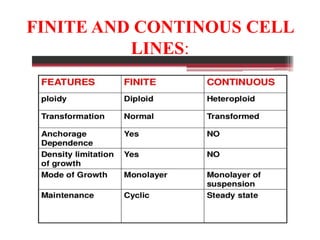
• Most cell lines grow for a limited number of
generations after which they cease.
• Cell lines which either occur spontaneously or
induced virally are chemically transformed into
continuous cell lines.
CHARACTERSTICS OF
CONTINOUS CELL LINES:
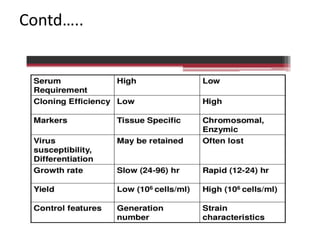
• These are more rounded, les adherent, with a higher
nucleus/ cytoplasmic ratio.
• Fast growth.
• Grow in more in suspension conditions.
• Ability to grow up to higher cell density.
• Stop expressing tissue specific genes.
CELL TYPES:
• On the basis of morphology ( Appearance and Shape) or
on their functional characteristics. They are divided into
three.
• Epithelial like: Attached to a substrate and appears
flattened and polygonal in shape.
• Lymphoblast like: Cells do not attach, remain in
suspension with a spherical shape.
• Fibroblast like: Cells attached to a substrates, appear
elongated and bipolar.
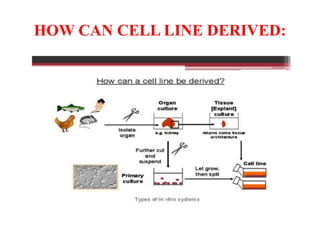
HOW CAN CELL LINE DERIVED:
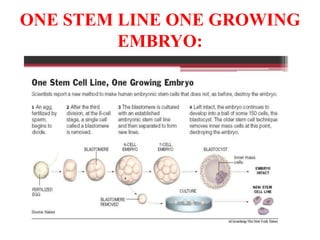
ONE STEM LINE ONE GROWING
EMBRYO:
FINITE AND CONTINOUS CELL
LINES:
Contd…..
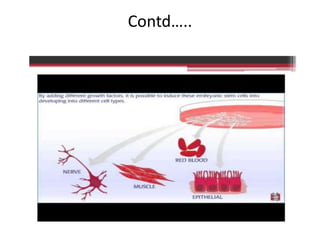
Contd…..
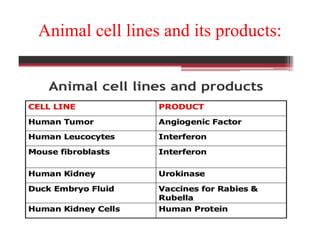
Animal cell lines and its products:
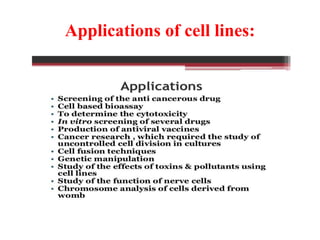
Applications of cell lines:
Cell culture and its maintenance

Cell culture and its maintenance

  • 1.
    CELL CULTURE ANDITS MAINTENANCE: MADE BY: VIPIN KUMAR SHUKLA DEPARTMENT OF BIOTECHNOLOGY. HIMT GROUP OF INSTITUTIONS , GREATER NOIDA UTTAR PRADESH
  • 2.
    CONTENTS: • CELL LINES •TYPES OF TISSUE CULTURES • PRIMARY TISSUE CULTURES • CONTINOUS CELL LINES • CELL TYPES • HUMAN CELL LINES • ANIMAL CELL LINES • APPLICATIONS
  • 3.
    CELL LINES: • Itis defined as permanently established cell culture that will proliferated indefinitely given appropriate fresh medium and space. • Cell line defined as the culture developed from single cell and therefore it consisting of cell with a uniform genetic make up. • Cell lines shows a presence of cell linkage either similar or distinct. • In this culture stem cells are generally used.
  • 4.
    CONTD….. • At firstprimary culture is done, Later sub-Culturing is done, then later the primary culture becomes the cell line may be propagated and sub cultured multiple times. • There are some species which may be used for rising cell lines such as: Rodents etc while other species do not. • Cell lines have been produced from avian tissues and also the development of cell lines from human tissue is difficult.
  • 5.
    TYPES OF TISSUECULTURE: PRIMARY CONTINOUS FINITE CELL LINES IN-DEFINATE Normal cells cultured without any change in their division rate. Single type roughly, thirty times of division enhanced by growth. It is near the same as finite but the cells here can divide indefinitely by transformation into tumor cells, called Cell Lines. PRIMARY CONTINOUS
  • 6.
    CELL LINE: • CELLLINE NORMAL TRANSFORMED STEM CELLS It is a single cell type and taken from tumor cell and cultured. There will be genetic change I normal cell which become tumor cell. They are called as master cells that generated other differentiated cell types. NORMAL CELLS TRANSFORMED CELLS STEM CELLS
  • 7.
    PRIMARY CULTURE: • Primaryculture is defined as a culture were cells are removed enzymatically and surgically from an organism and later placed into a suitable culture medium that will attach and grow are called as primary culture. • These primary culture have a finite life span. • These cultures contain a heterogeneous population of cells.
  • 8.
    Contd….. • Sub culturingof primary cells leads to the generation of cell lines. • Cell lines have limited life span, they passage several times before they become senescent. • Cells such as Macrophages and neurons do not divide in-vitro can be used as primary cultures.
  • 9.
    CONTINOUS CELL LINES: •Most cell lines grow for a limited number of generations after which they cease. • Cell lines which either occur spontaneously or induced virally are chemically transformed into continuous cell lines.
  • 10.
    CHARACTERSTICS OF CONTINOUS CELLLINES: • These are more rounded, les adherent, with a higher nucleus/ cytoplasmic ratio. • Fast growth. • Grow in more in suspension conditions. • Ability to grow up to higher cell density. • Stop expressing tissue specific genes.
  • 11.
    CELL TYPES: • Onthe basis of morphology ( Appearance and Shape) or on their functional characteristics. They are divided into three. • Epithelial like: Attached to a substrate and appears flattened and polygonal in shape. • Lymphoblast like: Cells do not attach, remain in suspension with a spherical shape. • Fibroblast like: Cells attached to a substrates, appear elongated and bipolar.
  • 12.
    HOW CAN CELLLINE DERIVED:
  • 13.
    ONE STEM LINEONE GROWING EMBRYO:
  • 14.
  • 15.
  • 16.
  • 17.
    Animal cell linesand its products:
  • 18.